
An open relationship, in romance and erotica, is a committed couple who have agreed that sex or romance with other people is allowed. The couple stays a couple. The exclusivity gets renegotiated. The love doesn't.
That single adjustment changes everything about how a story breathes. Every scene carries an extra layer of permission, negotiation, and risk, and the heat comes as much from what the partners say to each other beforehand as from what happens in the room. Readers who chase open relationship stories are usually chasing that dual charge: security and adventure running on the same circuit.
This guide covers what the term actually means on the page, where the trope came from in publishing, how authors build scenes around it, and how it differs from the non-monogamy labels readers most often mix it up with.
What Open Relationship Actually Means
The plain definition: a primary partnership in which both people consent to outside sexual or romantic contact, governed by rules they set together. The rules are the story.
Who do you tell, and when? Is it one night or a recurring arrangement?
Does the outside partner come to the house? Is kissing allowed, or only sex? Do you text during, after, never?
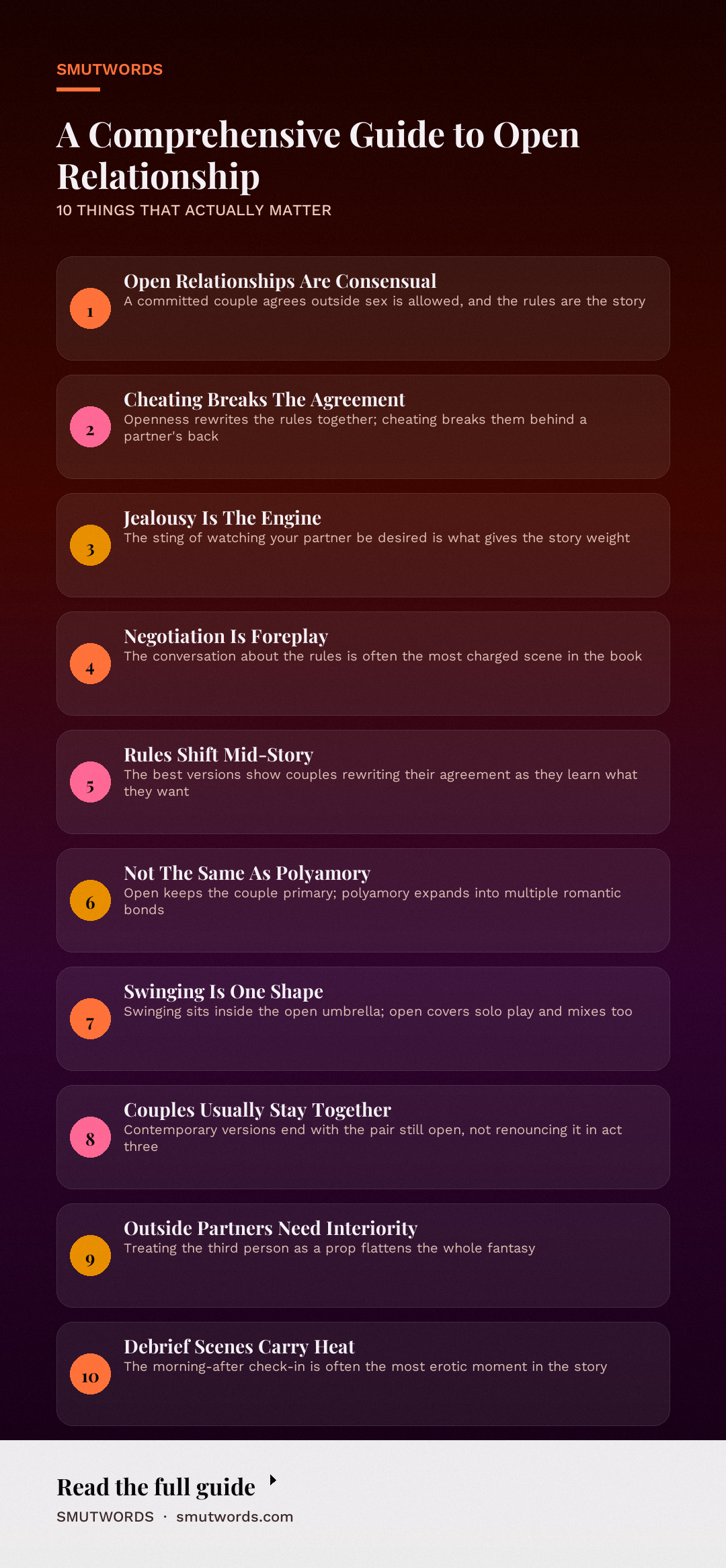
An open relationship is not the same as cheating, and erotica is very deliberate about that distinction. Cheating breaks the agreement. An open relationship rewrites it.
The betrayal in these stories, when it comes, is almost never the outside sex. It's a broken rule, a withheld detail, a lie about something small that turns out to matter enormously.
Nor is it automatically polyamory. Open relationship as a term covers a wide range: couples who only play together (see swinging), couples where one partner goes out solo with the other's blessing, couples who allow sex but not romance, couples who allow romance but keep one primary household. The term is the umbrella, not the specifics.
What doesn't count, for genre purposes: a couple where one person pressures or coerces the other into it. That's a different story, usually a dark one, and readers know the difference immediately. The defining feature of an open relationship in this genre is that both people chose it, even when choosing it is hard.
Common misconceptions worth clearing up:
- It means the couple is struggling. Often the opposite in fiction. Open relationships in erotica frequently appear in couples who are secure, communicative, and a little bored in a way that has nothing to do with love.
- Nobody gets jealous. Jealousy is the engine. Good open relationship stories are practically built on it, and some authors lean straight into a jealousy kink where the sting itself becomes erotic fuel.
- The rules are permanent. They rarely are. Most of the best written versions show the rules shifting mid-story as the couple learns what they actually want.
- It's the same as polyamory. Polyamory usually implies multiple romantic relationships with emotional weight. Open relationships can be purely sexual, or romantic-but-casual in a way the couple would never call poly.
Where Open Relationship Stories Come From
Non-monogamy is not new, but its life as a recognizable romance and erotica category is recent enough to trace. Through most of the twentieth century, published erotica treated any outside sex as transgression, and the genre's job was to punish or titillate. The married couple who swung appeared in mid-century pulp as scandal, not as a negotiated arrangement. The drama was discovery, not consent.
The shift happened gradually, in three waves. First, from the 1970s onward, a strain of literary and genre fiction started taking the couple's own agreement seriously, treating non-monogamy as a choice adults made rather than a moral collapse.
Second, the explosion of online erotica in the 2000s created a space where the negotiation itself, the conversation about the rules, became a scene people sought out. That conversation is now a fetish in its own right for a lot of readers.
The third wave is the one currently shaping the genre: self-published romance and erotica authors who write openly non-monogamous couples as the central love story, not the complication. Books where the couple ends the story still together, still married, and still open, with no third-act renunciation. That ending would have read as impossible thirty years ago. Now it's a recognizable subgenre with its own reader expectations.
It's worth naming that the genre's realism has improved alongside its popularity. Contemporary authors writing this trope tend to build in the check-ins, the safe words, the debrief conversations. A strong open relationship story almost always shows the couple talking about it before, during, and after, because that ongoing communication is what makes the fantasy hold together. The fantasy only works if the trust is real.
How Open Relationship Dynamics Show Up in Erotica
On the page, this trope is a structure for generating heat from a specific emotion: the thrill of watching your partner be desired. That emotion is the engine. Authors who understand it write very different scenes than authors who treat outside sex as pure titillation.
There's a big overlap here with the voyeur husband trope, where a partner deliberately watches their spouse with someone else and the watching is the point. The best versions of that trope are open relationship stories with the negotiation done off-page. The husband knows, the wife knows, and the story lives in the charged space between them during and after.
Authors commonly use one of a handful of structural variations:
Enjoyed this? Get a free book.
Join the list and we will send a complete free story straight to your inbox, plus new releases every week after that. No credit card, no catch.
- The first-time nervousness arc. A couple opens up for the first time. Most of the book is anticipation, rule-setting, and the moment one of them actually walks out the door. The payoff scene is often the return home.
- The established-players story. The couple has done this for years. The heat comes from precision, the shorthand they've built, the way they read each other's signals across a room.
- The one-partner-reluctant story. One is eager, one is doing it for the other, and the arc is the reluctant partner discovering something they didn't expect about themselves. This is where the genre gets its richest jealousy and trust material.
- The rules-break story. Everything is fine until someone crosses a line. The repair, not the break, is the erotic core. This version pairs beautifully with power-exchange dynamics when one partner takes control of the aftermath, or with makeup sex as the reunion scene.
- The two-couples crossover. Two open couples connect, and the negotiation moves to group level. This is where the story can tip into orgy territory without the couples losing their primary bonds.
What separates a strong open relationship story from a flat one comes down to specific craft choices. The strongest versions do three things well.
They show the negotiation as its own kind of foreplay, not as exposition. They let jealousy exist without resolving it too quickly, because jealousy is the texture readers came for. And they write the aftercare and the debrief with as much heat as the main event. A couple talking in bed the morning after, still tangled up and quietly checking in, is often the most erotic scene in the book.
Weak versions make one of two mistakes. They skip the negotiation entirely, so the openness reads as an excuse for the author to write a threesome. Or they treat the outside partner as a prop who has no interiority, which flattens the whole fantasy.
The genre's best authors give the outside partner a personality, a sense of humor, and a reason to be there, because the primary couple looks more secure, not less, when the person they've invited in is actually a person.
Communication is the trope's structural spine, and it's also where writers who care about realism spend their effort. Ongoing honest talk about limits, jealousy, consent, and regular check-ins is what makes the fantasy safe enough to enjoy. On the page, that shows up as text threads, whispered conversations in the kitchen, codes, rules with names. The rules themselves are a kind of erotic architecture.
Some authors layer in dom/sub frameworks, where the primary partner holds control over what's permitted. That overlaps naturally with a keyholding dynamic where permission itself becomes the turn-on. Others strip the kink layer and play it purely emotional, and both work.
Open Relationship vs Polyamory
These two get conflated more than any other pair in the non-monogamy space, and the difference matters for readers picking books. Polyamory typically means multiple relationships with romantic and emotional weight, often with everyone aware of each other and sometimes with everyone involved with each other. Open relationship usually means the primary couple stays primary, and outside connections are either sexual, casual, or explicitly secondary.
On the page, polyamory books tend to have sprawling casts and complex emotional geometry, with the arc about how everyone fits together. Open relationship books tend to have a tight two-person emotional core with outside partners coming and going around it.
A reader who wants the couple to stay the center of gravity should look for open relationship. A reader who wants the couple to expand into a group should look for polyamory. Some books do both, and the genre increasingly blends the labels. For an even broader look at how non-monogamous structures get dramatized, a related angle lives in mate bond and marking stories, where exclusivity works completely differently and serves a different emotional appetite.
Frequently Asked Questions
Is an open relationship the same as cheating in erotica?
No. Cheating breaks the agreement. An open relationship is built on an explicit agreement the couple made together, and the genre treats lying about the arrangement as the real betrayal. Readers who want the transgression of cheating and the permission of openness in one story will find it in the subgenre where a couple has rules and one partner breaks them.
Why is jealousy such a big part of these stories?
Jealousy is the emotional furnace. Without it, the outside sex has no weight. The genre uses jealousy as a way to keep the primary bond visible and charged, and many readers specifically seek out stories where the sting is eroticized rather than avoided. Some authors push this into a full jealousy kink, where the partner's discomfort is the central turn-on for everyone involved.
What rules do couples usually set in these stories?
Common rules in open relationship fiction include who gets told, whether the outside partner can stay overnight, whether it happens in the shared home, what counts as a kiss versus a full encounter, and whether either partner can veto. The rules exist to give the story friction, so authors pick the ones that will create the most tension without breaking the couple's trust.
Do these stories always end with the couple still together?
In contemporary romance and erotica with an open relationship at the center, the couple almost always stays together and usually stays open. The romantic arc is about deepening trust, not closing the relationship. Stories that end with the couple going back to monogamy exist, but they're a minority, and many readers actively avoid them.
How does an open relationship show up in writing while keeping everyone safe?
The genre builds in ongoing honest communication about limits, consent, and jealousy, plus regular check-ins that keep the fantasy grounded. A strong open relationship story shows the couple talking before, during, and after, because the negotiation is half the heat. On the page, this is often written as a soft ritual, a text thread, or a quiet conversation the morning after.
Is an open relationship the same as swinging?
Not quite. Swinging is a specific practice within the broader open relationship umbrella, usually involving couples playing together or swapping with other couples. An open relationship can include swinging, solo play, or a mix. The label describes the agreement, and swinging describes one shape that agreement can take.
Final Thoughts
Open relationship stories are the genre at its most emotionally precise. They ask the author to hold two opposite charges at once, security and risk, and the best ones do it without flinching.
If you're new to the trope, start with a story that takes the negotiation as seriously as the sex, because that's where the actual heat lives.
If you already read in this space, look for the version where the couple is still talking in the final chapter. Still checking in. Still choosing each other. That ending is the whole point.








Loading comments…