
The bite lands on the side of the throat. Sometimes it's the juncture where neck meets shoulder. Sometimes the inside of the wrist.
Location matters less than what it does. In a mate bond marking romance, that single act of teeth-breaking-skin is the genre's way of writing a permanent commitment into a body. Readers who seek out these books are rarely there for the ceremony. They're there for the moment the mark sinks in and everything changes.
Shifters have the cleanest version of the mechanic because they come with built-in biology. A wolf shifter doesn't need a wedding officiant when he can clamp his jaw around his mate's neck and let the bond snap into place, visible to every other wolf in the pack and irreversible even if one of them wanted to walk away. It's a wedding ring that can't be pawned. The fantasy runs on that finality.
But marking shows up well outside the shifter shelf. Alien romances use it too, sometimes as a claiming ritual, sometimes as a biological necessity the human heroine didn't agree to. The mechanism changes. The emotional payload doesn't.
What follows is a breakdown of how the mechanic actually works across the subgenres, where authors get it right, and where they fumble it into something that reads more like a plot device than a fantasy.
What the Mark Actually Means In-World
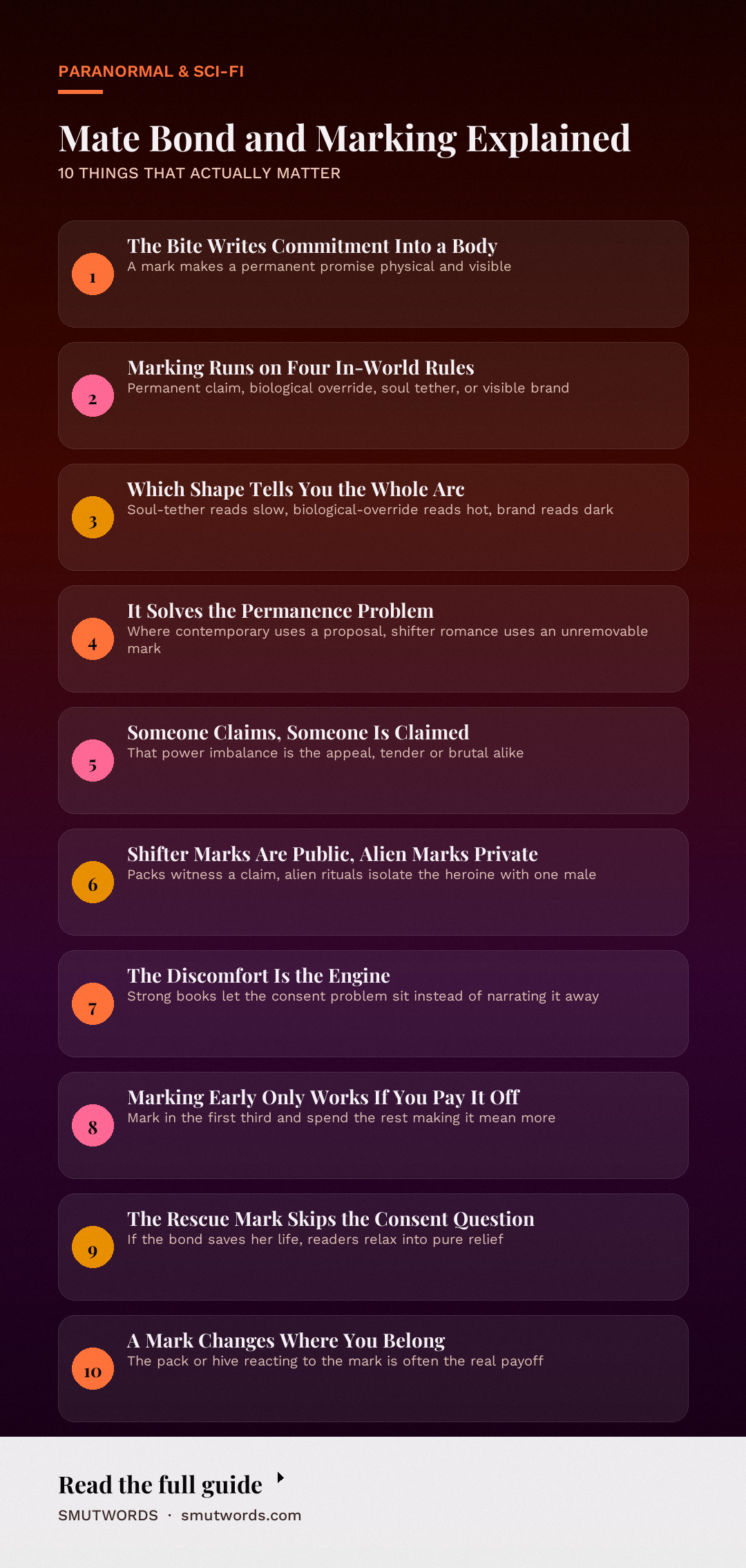
Authors rarely invent a marking system from scratch. They borrow from a small set of established rules, and once you notice the pattern, you can usually predict the whole book's emotional arc from the first chapter.
- The permanent claim. The mark can't be broken, undone, or hidden. Other shifters or aliens can smell it, see it, sense it. It broadcasts "taken" to the entire world without the heroine having to say a word.
- The biological override. The bond triggers something involuntary: heat cycles syncing, scent recognition, an inability to be physically comfortable more than a few feet from the other person. The body decides before the mind catches up.
- The soul-level tether. Some authors skip biology entirely and go metaphysical, writing the mark as a visible thread or warmth under the skin that both parties can feel at a distance. Useful for keeping tension alive during forced separations.
- The visible scar or brand. Less about magic, more about ownership made public. Common in darker alien or dystopian settings where the marking is closer to a slave brand than a romantic gesture.
The choice between these four shapes tells you what kind of book you're holding. A soul-tether story is usually slower and more emotional. A biological-override story leans hard into the heat and the loss of control. A visible-brand story is doing something darker, and the author knows it.
Why Authors Reach For It As A Permanence Marker
Every romance subgenre has to solve the same problem: how do you convince a reader, in 300 pages, that this couple is genuinely and permanently bound, when real relationships end all the time?
Contemporary romance solves it with an epilogue and a proposal. Historical romance solves it with a marriage contract. Shifter and alien romance solve it with a mark that literally cannot be removed. That's a much more efficient tool, because it skips the part where the reader has to believe a promise and just shows them a fact.
It's the same instinct that drives knotting in the genre. Both mechanics take an emotional commitment and make it physical, unavoidable, and visible to anyone watching. The difference is that knotting is temporary, a few minutes or hours, while the mark is meant to last a lifetime. Authors who understand the genre stack them: the bite happens, the bond locks in, and the knot is the physical proof that plays out in the same scene.
There's also a power-exchange layer most readers clock immediately, even if they don't name it. The one doing the marking is claiming. The one being marked is being claimed. That imbalance is the whole appeal for a big chunk of the audience, and it works whether the dynamic is tender or brutal, consensual from the start or negotiated under duress.
Shifters Versus Aliens: Two Different Marks
Shifter marking and alien marking look similar on the surface and operate on completely different logic underneath. Getting the distinction right matters if you're trying to figure out which flavor of mate bond marking romance actually does it for you.
In shifter books, the mark is communal. It happens in front of a pack, it changes the heroine's social standing, and other characters react to it. The shifter romance shelf runs on pack politics as much as on the couple, so a mark is often a public event with witnesses, rivals, and consequences.
Alien marking tends to be private or ritualistic instead. A human heroine abducted or transplanted to another world gets marked by a single alien male, often as part of a bonding ceremony that her own species has no equivalent for. There's no pack watching. The isolation is part of the appeal, and so is the cultural gap, since the heroine usually has to have the ritual explained to her before it happens or while it's happening.
Zorgon's Pet runs the alien-claiming version of this well, using the mark as a signal of possession that the heroine spends the rest of the book negotiating the terms of. That negotiation is often the actual plot in these books. The mark happens early, and the remaining chapters are about what it means, whether it can be softened, and how two people who didn't choose each other build something real out of a bond neither of them can undo.
Where The Mechanic Shows Up Outside Romance Proper
Science fiction erotica borrows the marking device constantly, sometimes without calling it a mate bond at all. A brand, a chip, a biological tether, a shared neural link: functionally the same permanence marker wearing a different costume.
Enjoyed this? Get a free book.
Join the list and we will send a complete free story straight to your inbox, plus new releases every week after that. No credit card, no catch.
Planet Of Orgasms leans into the ritual side of this, treating the marking as part of a larger cultural practice rather than a one-off romantic gesture, which lets the author build an entire world around what the mark means to the society that invented it.
The same logic scales down to something as specific as a feeding or bonding ritual. Milked in the Moonpit: A Sci-Fi Cult Lactation And Breastmilk Ritual Erotica uses ritual as the mechanism for binding a person to a group rather than a single mate. That's a useful reminder that "marking" doesn't have to mean monogamous partnership. Sometimes the mark claims you for a cult, a hive, or a collective, and the permanence is just as binding and considerably creepier.
The Consent Question, Handled Well And Badly
This is where a lot of these books either earn their tension or lose the reader entirely. The marking scene sits right on top of a consent problem by design: the whole point is often that the heroine didn't fully agree, or couldn't have understood what she was agreeing to, or agreed under pressure she couldn't refuse. Authors who write this well know that's the engine, and they don't pretend otherwise.
Authors who write it badly tend to paper over the problem with a paragraph of narration insisting she wanted it the whole time. That paragraph is almost never convincing, and it flattens the exact dynamic that made the scene interesting in the first place. The books that land let the discomfort sit there, then let the characters reckon with it afterward.
Breeding-heavy alien romance runs into this constantly, since the mark is usually tied to a reproductive imperative rather than a purely romantic one. Alien Heatwave: An Alien Breeding First Contact Erotica works the claiming and the breeding instinct into the same scene, so the mark functions as both an emotional bond and a biological trigger.
That doubling is common in the subgenre, and it's why so many of these stories link the marking scene to a heat cycle or a fertility window. The permanence marker and the reproduction plot are doing the same job at once. For the version of this mechanic that plays the same beat for straight physical consequence, check impregnation kink written for biology rather than romance.
If you want the mechanic stripped of the romance framing entirely and played for consequence, Bred Beneath the Bio Domes is a good place to see how far the claiming logic can be pushed before it stops feeling like romance. For some readers, that's the upgrade.
Where The Marking Scene Usually Sits In The Structure
Timing matters more than most readers consciously notice. A marking scene placed in the first third is a promise the rest of the book has to pay off emotionally, and if the author doesn't do that work, the back half sags. A marking scene placed near the end functions as the climax of the romantic arc, which is more conventional but can feel predictable if nothing else in the book has raised the stakes.
The books that do it best tend to mark early and spend the rest of the story making the mark mean more than it did when it happened. That's a harder structure to pull off, and it's why the subgenre has so many near-misses: authors nail the heat of the marking scene itself and then run out of ideas for what the bond is supposed to do to two people who are now stuck with each other.
Common Marking Scenes Readers Search For
If you're hunting for a specific flavor of this trope, these are the beats that come up most often, roughly in order of how frequently they appear across the subgenre:
- Marked without warning during a fight, a rut, or a heat the character didn't expect to trigger
- Marked in front of a pack, clan, or rival as a public claim and a warning
- Marked during a ritual the heroine only half understands, with a witness or officiant present
- Marked as an accident, where the bond snaps into place before either character intended it
- Marked as an act of rescue, where the bond is the only thing that can save one character's life
The rescue version is worth flagging specifically, because it solves the consent problem in a way that lets the reader relax into the scene. If the mark is the only thing standing between the heroine and death, the "did she really agree" question gets set aside for a chapter or two, and the author gets to write the marking as pure relief instead of a violation.
There's a real appetite for the variation where the mark triggers a secret baby plot down the line, since the permanence of the bond and the permanence of a pregnancy are doing the same narrative work. Both devices exist to make it impossible for the couple to quietly separate, and stacking them is a reliable way to raise the stakes in a sequel or a later act.
And for readers who like their bonding mechanics with a bit of found family built around them, the pack or hive reacting to the new mark is often more emotionally satisfying than the marking scene itself. The found family angle in monster romance runs on exactly this: a mark doesn't just bind two people, it changes where both of them belong in a larger group.
Final Thoughts
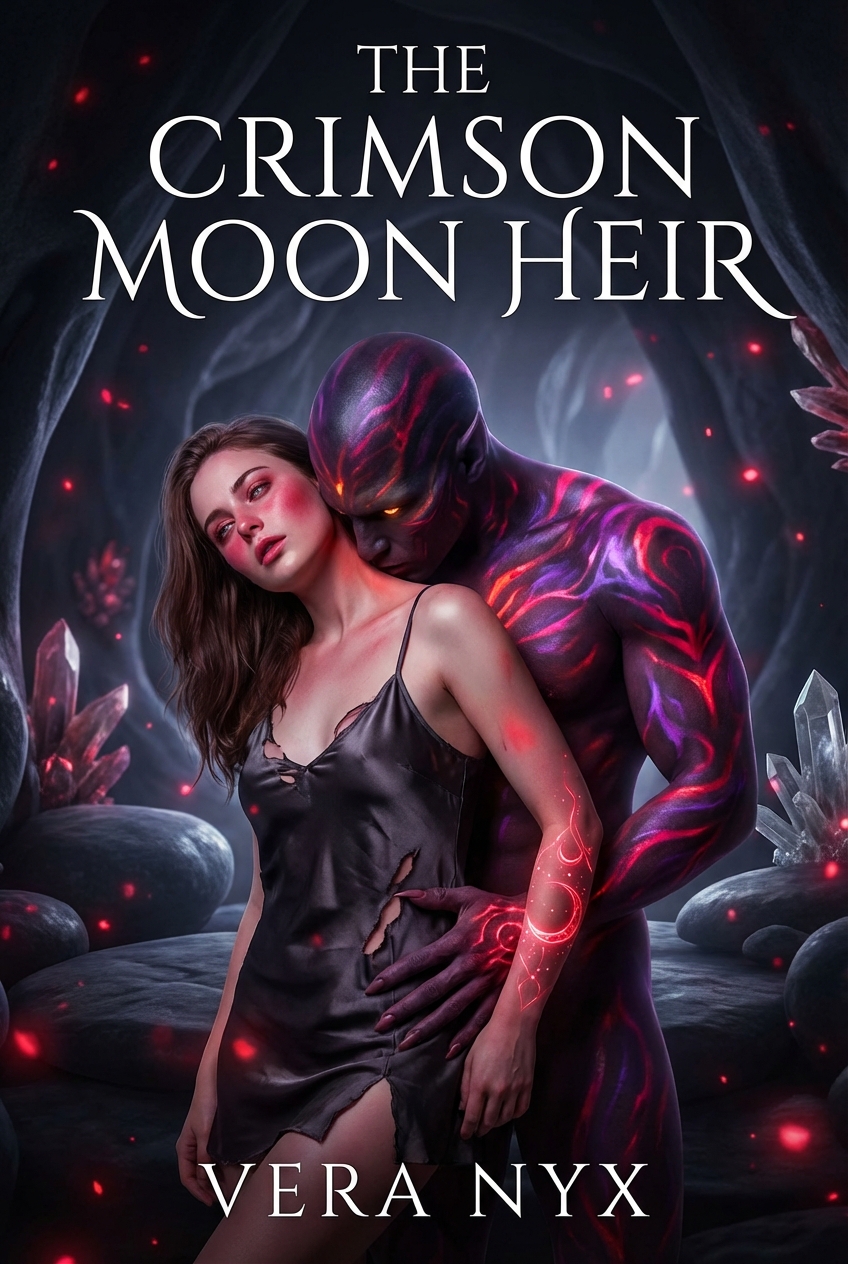
Start with The Heir of Two Worlds: An Alien Hybrid Breeding Erotica if you want the marking mechanic doing double duty with a breeding arc. Bond established, permanence sealed, a pregnancy that makes the claim impossible to walk back. Read it for the marking scene. Stay for what the bond does to both characters once they realize there's no undoing it.






Loading comments…