
A big city romance is a love story built on the premise that the metropolis itself is doing half the work. Put two people in a city with eight million other people in it, give them a skyline, a late-night subway, a doorman who knows too much, and the odds that they keep colliding start to feel like fate.
The backdrop supplies proximity, friction, and stakes the suburbs can't. That's the basic machine, and once you see how it runs, you can spot a good one and a lazy one from the first chapter.
What Big City Romance Actually Means
The short definition gets you the setting. The full one gets you the mechanism. Big city romance is a trope class in which the urban environment functions as an active force in the plot, shoving the leads together, tearing them apart, and giving the reader a constant sense of scale. The city is never just wallpaper.
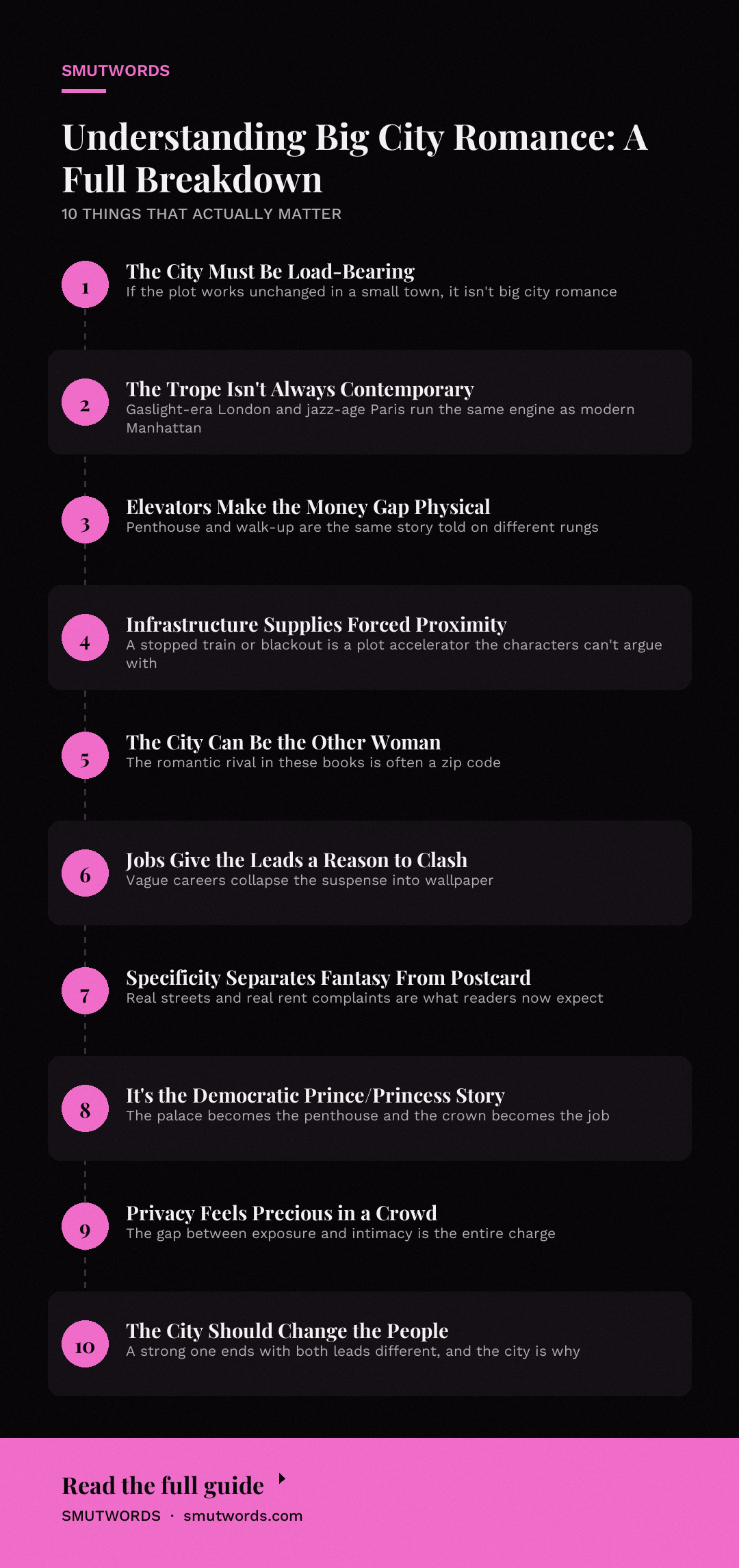
If you could lift the story and drop it in a small town with no changes to any scene, it wasn't big city romance. It was a romance that happened to be in a city.
The name is a marketing convenience more than a literary category. Publishers and retailers have used "big city romance" and "urban romance" as shelf labels for decades to signal a specific reader promise: glamour, density, nightlife, ambition, and the particular loneliness of being surrounded by millions of people and still wanting one person.
"Metropolitan romance" and "city lights love story" are the softer rebrands. "NYC romance" is the most common specific flavor, though Chicago, London, Tokyo, and Seoul all run the same engine.
What counts is narrower than people assume. A billionaire romance set in Manhattan counts if the city shapes the obstacles. A story about two people in a Manhattan apartment who never leave it does not, no matter what the cover art promises.
The test is whether the city generates conflict, coincidence, or texture the plot depends on. If the answer is no, you're reading something else wearing a skyline.
What doesn't count, despite common confusion: anything merely labeled urban to signal grit, danger, or a specific subculture. "Urban fiction" as a bookstore category is a different animal with its own conventions and audience. Big city romance is about the metropolis as a romantic pressure system. It can be gritty or glossy, blue-collar or penthouse, but the city has to be load-bearing.
The other misconception is that big city romance is inherently contemporary. It isn't. Historical big city romance is a massive, established tradition, and the tropes translate cleanly to gaslight-era London, jazz-age Paris, or 1980s Tokyo. The city just changes which obstacles it can throw.
Where Big City Romance Comes From
The trope has roots in the nineteenth-century city novel, where the metropolis was already cast as a machine for producing chance encounters, moral danger, and social climbing. Dickens built plots out of coincidental meetings in crowded streets. Balzac did the same in Paris.
The romance genre inherited that machinery wholesale. When the modern mass-market romance industry took shape in the twentieth century, the big city was one of its most reliable settings, because it let authors do in three scenes what would take a small town thirty.
The real publishing history, though, is a story of cycles. Mid-century category romance leaned heavily on the city as a marker of sophistication and career ambition, and the woman-with-a-job-in-the-city plot became a staple.
The 1980s and 1990s brought the glitzy city romance to its commercial peak, with Manhattan as the default stage and finance, publishing, and fashion as the industries that gave the leads a reason to be there and a reason to clash. These books sold the city as an aspiration: the skyline as a promise of a bigger life.
The 2000s shifted the tone toward the workplace and the roommate, and the 2010s onward split the trope into two broad tracks. One is the glossy aspirational version, richer and more self-aware, often centering wealth and real estate. The other is darker and more textured, borrowing the sensory density of the city and using it for tension, proximity, and sometimes outright menace.
The cyberpunk romance runs the big city engine in a near-future key, stacking neon, surveillance, and vertical class stratification on top of the same collision logic.
The internet era changed the trope again, and the change is mostly about specificity. Readers now expect the city to be this city, with correct subway lines, correct neighborhoods, correct rent complaints. Generic "the city" reads as lazy in a way it didn't thirty years ago. The trope has gotten more documentary as its audience has gotten more demanding.
How It Shows Up in Erotica
This is where the trope earns its keep, because the city is a machine for producing exactly the kinds of scenes the genre wants: too close, too late, too public, too good to stop.
The vertical geography of class. Big city romance loves floors and views and elevators. The penthouse and the walk-up are the same story told on different rungs.
Elevators are a whole subgenre of their own because they force two people into a small metal box with a long, accelerating climb. The best authors use the city's physical layers to make the money gap physical too. You can feel the altitude change.
Forced proximity through infrastructure. A stopped train, a blackout, a hurricane warning, a shared cab, a broken lock on a rooftop. The city supplies interruptions the characters can't argue with. A skilled writer treats transit and building failures as free plot accelerators and never lets the couple sit still long enough to be sensible.
Enjoyed this? Get a free book.
Join the list and we will send a complete free story straight to your inbox, plus new releases every week after that. No credit card, no catch.
Public and semi-public pressure. The metropolis is never empty, and that's the point. Sex scenes that use the city's near-constant audience, the alley, the balcony, the lit window across the street, the dinner party upstairs, run on the gap between how exposed the characters are and how private the moment feels to them.
If you want the craft side of that, the guide to semi-public sex lays out the exposure rules cleanly, and the complete guide to public sex covers the fantasy-versus-reality distinction readers keep asking about.
Professional collision. Finance, fashion, publishing, hospitality, politics, medicine, tech. Big city romance needs a reason for two ambitious people to be in the same building at midnight.
The job is the spine of the plot in the strongest versions. When authors skip the job and give the leads vague "careers," the suspense collapses into wallpaper.
The city as a rival. This is the trope's secret weapon. The metropolis can be the other woman or the other man: the thing your partner loves more than you, the place that's always offering a better offer.
A well-built big city romance lets the reader feel the pull of the city competing directly with the pull of the love interest. The best version resolves that tension without making either party choose to shrink. The romantic rival in these books is often a zip code.
Four common variations you'll see on the shelf:
- Stranger-collision romance: repeated chance meetings in a city too dense to be coincidence. Runs on serendipity and the reader's sense that the metropolis is conspiring.
- Roommate and neighbors: proximity by lease. Thin walls, shared laundry, and the slow burn of hearing someone every night before you ever understand them.
- Corporate rivals: two people who want the same account, the same promotion, the same building. This flavor pairs naturally with enemies to lovers and borrows its pacing.
- Socialite and outsider: one lead owns the city, one just arrived. The plot turns on access, invitations, and who gets to belong.
What makes a strong one work on the page, from someone who has read too many of them:
- The city is specific. Real streets, real foods, real complaints. Specificity is what separates a fantasy from a postcard.
- The obstacles are urban. Rent, commute, schedules, competition, class, visibility. The conflict has to come from density, not from a misunderstanding a text message would solve.
- The characters have jobs with stakes. The metropolis rewards ambition; the plot should too.
- The intimacy is private inside a public world. The reader should feel the crowd pressing in even when the door is locked.
- The city changes the people. A great big city romance ends with both leads different from who they were on page one, and the city is the reason.
What makes a flat one: a generic skyline, a love interest with no visible life outside the couple, a third act that hinges on a lie instead of a city-shaped problem, and a setting that could be anywhere. If the story would survive unchanged with the city swapped for a suburb and a bigger house, you're reading the trope in name only.
Readers who love the "the world is bigger than us" feeling of the trope often also love the class and family pressure of a prince/princess romance, or the slow burn of childhood friends to lovers when the city is the thing that separated them and the thing that brings them back. And if your city romance turns adversarial and one lead comes home for payback, the revenge romance playbook maps onto it cleanly.
Big City Romance vs Prince/Princess Romance
These two get confused because they share a core fantasy: the lead is swept into a bigger, brighter world with rules they don't fully know. In a prince/princess romance, the world is a court, and the obstacle is protocol, family, and duty. In a big city romance, the world is a skyline, and the obstacle is money, schedule, and competition.
The big city romance is effectively the democratic version of the same story: the palace becomes the penthouse, the court becomes the industry, the crown becomes the job nobody can announce you for.
That's why so many of these books blur the line. A novel about a woman who falls for the heir to a media empire in Manhattan is both a big city romance and a prince/princess romance, and the strongest versions lean into both. If you want the court-and-protocol version, the prince/princess romance glossary entry is the right place to start. If you want the version where the city itself is the throne, keep reading this one.
Frequently Asked Questions
What is a big city romance?
It's a romance where the love story unfolds inside a major metropolis and the city drives the plot through proximity, class, and chance. The setting has to matter. If the story would work identically in a small town, it's not really a big city romance.
What's the difference between big city romance and urban romance?
In practice, publishers use the two interchangeably, but "urban romance" is also a bookstore category with its own gritty, street-level conventions and audience. When you're searching a catalog, check the blurb and the sample. The fancier term usually signals a glossier version of the same trope.
Is big city romance always contemporary?
No. Historical big city romance is a large and established tradition. The trope works in gaslight-era London, jazz-age Paris, 1980s Tokyo, or a near-future neon sprawl. What has to be contemporary for the story to work is the city's ability to generate obstacles, not the setting itself.
Why do readers love cities as settings for sex scenes?
Because the metropolis is loud, crowded, and full of neighbors, which makes privacy feel precious and perverse at the same time. The gap between how exposed the characters are and how private the moment feels is the entire charge. If you want the anatomy of that specific dynamic, the guide to semi-public sex meaning is a good next read.
What makes a big city romance fail?
Generic settings and generic obstacles. If the conflict could be resolved by a five-minute conversation, or if the love interest has no life outside the couple, the city is doing no work. The strongest versions put rent, jobs, class, and the city's competing pull directly on the page.
Do I need to have been to the city to write one?
You need to have paid attention to some city. The trope rewards specificity: the smell of a particular subway platform, the way the light hits at a specific hour. A writer with real knowledge of a secondary city will beat a writer faking Manhattan every time.
Final Thoughts
The big city romance is one of the most reliable engines in the genre because it manufactures what every good romance needs: reasons two people cannot avoid each other, and reasons they cannot quite have each other either. When the city is doing both jobs at once, the book reads like it couldn't have happened anywhere else. The next time you pick one up, check the skyline early. If it's real, the rest of the book will hold.







Loading comments…