
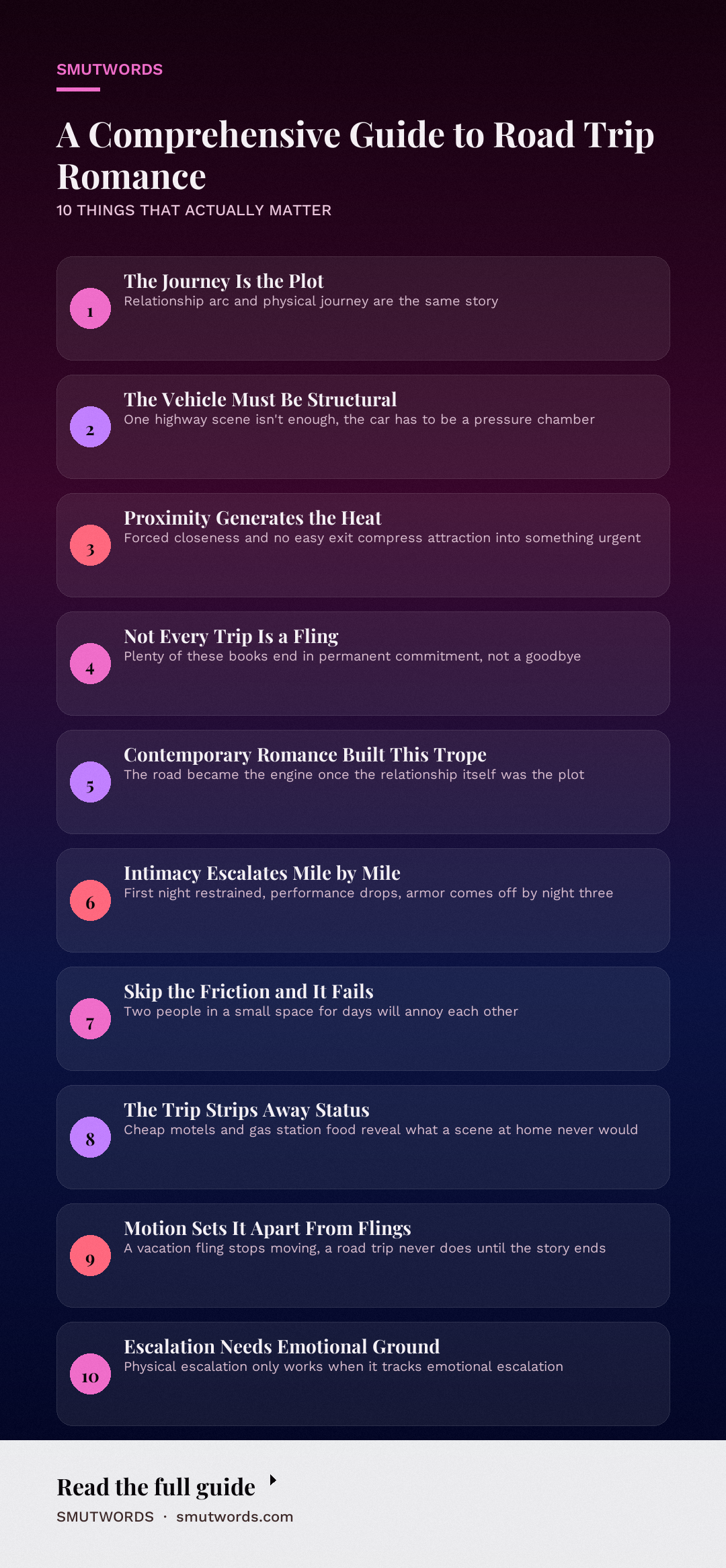
Road trip romance is the subgenre where a couple’s relationship arc and their physical journey are the same story. They meet, share a car, van, bike, or camper for days or weeks, and the miles do the work a dating montage would do in any other book.
Forced proximity, changing scenery, cheap motels, and the fact that neither of them can storm off without stranding themselves somewhere in Kansas: all of it compresses attraction into something urgent. The destination matters, but the highway is where the sex, the confessions, and the damage happen.
What Road Trip Romance Actually Means
The term describes a romance where travel by road is structural, not decorative. A book with one highway scene is not a road trip romance. A book where the couple spends the middle third of the story in a moving vehicle, sleeping in the same space, making decisions about where to stop next, absolutely is.
The name comes from the American road trip as a cultural form: the cross-country drive, the Route 66 mythology, the idea that leaving home is how you find out who you are. Romance picked that up and added a second engine. The journey reveals character, and the proximity generates heat. Both have to be true for the trope to land.
What counts:
- The couple travels together by car, van, RV, motorcycle, or truck for a sustained stretch of the book
- They share sleeping space, whether that’s a motel room with one bed, a camper, a tent, or a backseat
- The trip has a destination or a reason, even a flimsy one, so the reader feels forward motion
- Physical and emotional intimacy escalate in step with the mileage
What doesn’t count: a couple who flies somewhere and has a fling, a couple who takes one scenic drive to a wedding, a road trip that happens entirely in flashback. The vehicle has to be a pressure chamber the characters can’t easily leave.
Common misconceptions are worth naming. Readers sometimes assume road trip romance is automatically a vacation fling, meaning the couple parts at the end. Plenty of these books end in a permanent commitment, and the trip is the courtship rather than an escape from one.
Others assume the trope requires a cross-country scale. A three-day drive up the coast with a broken transmission can carry just as much weight as four thousand miles.
Where Road Trip Romance Comes From
The road trip as a narrative device has deep roots in American fiction. Its life as a romance trope is much more specific, and much more recent.
Through the 1980s and 1990s, category romance used travel as a backdrop for other plots. A heroine fled a bad marriage and met someone on the way. A hero drove a woman to a family funeral. The road was a device for getting two people into a car, not the emotional engine of the book.
The shift happened alongside the rise of contemporary romance as a dominant commercial category in the 2000s and 2010s. Once authors started writing books where the relationship itself was the plot, the road trip became one of the most efficient containers available. It supplies forced proximity, a ticking clock, escalating stakes, and a natural reason for two people to be alone together without anyone asking why.
Two publishing developments pushed it further. First, self-publishing let authors write longer, hornier contemporary books without a category line’s page limits, and road trip stories benefit from length. The reader wants the diner, the motel, the fight at the gas station, the make-up at the next exit.
Second, audiobooks made the trope commercially stronger, because a drive is a seamless listen and road trip romances have a rhythmic, episodic structure that suits the format.
More recently, the trope has absorbed influences from adjacent genres. Motorcycle club romance brought its own version of the ride, where the road is brotherhood and danger rather than freedom. Contemporary authors have blurred the line between the two deliberately, putting an MC-adjacent love interest on a bike and sending the couple out of state.
Where the older version of road trip romance was often a woman discovering herself, the current version is frequently two people discovering each other in a confined space with nowhere to hide.
How It Shows Up in Erotica
The trope works because the car does the plotting. An author who understands road trip romance builds scenes around the logistics of travel. Who drives. Where they stop for the night. Whether there’s one bed. What happens when the air conditioning dies outside Barstow.
None of this feels like filler when it’s written with intent, because every logistical decision is also a relationship decision.
Strong versions handle the escalation curve carefully. The first night on the road is charged but restrained. The couple is still performing versions of themselves. By the second or third night, the performance drops.
By the time they’re sharing a tent or a motel bed, they’ve already told each other things they wouldn’t tell anyone at home, and the sex lands harder because the reader has watched the armor come off mile by mile.
Weak versions make two mistakes. The first is a road trip that functions as a slideshow. The author writes a series of scenic stops with no relational change between them, and the reader gets tourism instead of tension.
The second is skipping the friction. Two people in a small space for days will annoy each other. Books that ignore that reality lose the credibility that makes the eventual sex feel earned.
Common variations authors use:
Enjoyed this? Get a free book.
Join the list and we will send a complete free story straight to your inbox, plus new releases every week after that. No credit card, no catch.
- Cross-country: the full coast-to-coast drive, usually with a family emergency, a job, or a funeral at the end
- RV or camper: a smaller, more domestic space, often involving a borrowed vehicle and someone else’s family
- Motorcycle: less cargo, more danger, and a natural overlap with MC stories
- One-night stand extended: the couple hooks up first and then discovers they’re driving to the same city
- Vacation fling that turns serious: a trip with a clear end date that neither of them wants to reach
- Reluctant escort: one character needs to get somewhere and the other is the only ride available
The one-night-stand-turned-week-long-ride variant is especially effective in erotica because it front-loads the physical relationship and then lets the emotional one chase it. The reader already knows the chemistry works. The tension shifts to whether anything survives the return home.
Authors also use the trip to strip away status. A wealthy character sleeping in a cheap motel and eating gas station food reveals something a scene at home never would. A character who’s always in control has to hand over the wheel when they’re too tired to drive. That kind of small surrender builds the case for the larger one later.
Secondary settings matter more than authors sometimes realize. Diners, truck stops, roadside attractions, and motels are all clichés for a reason: they’re liminal, cheap, and honest.
A couple eating pie at 2 a.m. in a diner booth says more than a formal dinner ever could. Writers who lean into the texture of these places get a lot of emotional work for free.
There’s also a quiet overlap with the kind of relationship repair arcs you see in marriage in trouble stories, or in a second marriage romance where the couple is starting over rather than patching something up.
A couple whose marriage is failing can get in a car and drive, and the enforced proximity does what a therapist’s office couldn’t. The trip becomes a container for everything they haven’t said to each other, and the sex that follows usually isn’t about passion so much as it’s about reacquaintance.
If you want to know how far to push the physical side, the same principles that govern any other trope apply. Physical escalation only works when it tracks emotional escalation. If the sex is good on page five, the author needs a different engine for the remaining two hundred pages. If it’s good on page one hundred, the drive there has already done the heavy lifting.
This is roughly the same logic behind roleplay kinks in erotica: the setup is what makes the payoff land.
Road Trip Romance vs Vacation Fling
The two tropes get grouped together constantly, and the difference is worth understanding because it changes what a reader is signing up for. A vacation fling is defined by impermanence. The couple meets somewhere away from home, has a defined window, and the central question is whether anything survives the trip. The setting is usually a resort, a destination city, or an island.
Road trip romance is defined by motion. The couple isn’t stationary anywhere for long. The relationship develops in transit, so it develops in a state of ongoing transition.
The question isn’t usually whether they’ll stay together but whether they’ll admit what’s happening before they run out of highway. Plenty of road trip romances end with the destination reached and the couple deciding to keep driving.
The overlap exists because both rely on the idea that leaving home changes people. But a vacation fling stops moving. A road trip never does until the story is over.
Frequently Asked Questions
What is road trip romance in simple terms?
A romance where the couple’s relationship develops while they’re traveling together by car, van, motorcycle, or camper. The journey creates forced proximity, and the physical and emotional intimacy build as the miles accumulate. The destination usually matters less than what happens getting there.
Why is forced proximity so common in these books?
Because it solves the central problem of romance plotting. Two people have to be near each other long enough for the relationship to develop, and a shared vehicle provides that without anyone needing to contrive reasons to meet. It also removes the option to walk away, which raises the stakes on every conversation.
Do road trip romances always end happily?
In the romance genre, almost always, because the genre’s contract requires an emotionally satisfying ending. The variation is in how. Some end with the couple reaching the destination and staying together. Some end with a decision to keep driving.
A smaller number use the trip to close out a relationship, though those are usually shelved as women’s fiction rather than romance.
Is a motorcycle road trip romance the same as an MC romance?
Related but distinct. Motorcycle club romance centers on a club, its hierarchy, and often criminal or violent stakes. A motorcycle road trip romance just uses a bike as the vehicle. Some books blend the two deliberately, but the focus is different.
Can road trip romance work as a short story or novella?
It works better at length, because the escalation depends on accumulated days and nights. A novella can pull it off if the author starts in transit and keeps the timeline tight, usually covering three to five days. Anything shorter starts to feel like a scene rather than a journey.
What kinds of conflict work best in this trope?
Mechanical failures, money problems, missed turns, family obligations waiting at the destination, and mismatched expectations about what happens when the trip ends. The strongest versions use conflict that arises from the trip itself rather than importing external drama that could happen anywhere.
Final Thoughts
The vehicle is doing two jobs at once. It’s moving the couple forward and holding them still. Readers who love road trip romance are usually readers who love watching two people get stripped down to something honest, one stop at a time, with no easy way to leave.
If that sounds like the kind of book you want next, the road trip catalog on SmutWords has options across every variant covered here, from cross-country epics to one-bed motel stories that never leave the state.






Loading comments…