Safeword use is the pre-agreed verbal or non-verbal signal that pauses, slows, or stops a BDSM scene the moment either partner needs it. It is the contract that makes intense power exchange possible, because everyone involved knows there is a literal off-switch they can reach for at any second.
In erotica, safeword use is where the fiction proves that the submission is chosen, the dominance is earned, and the desire running through a scene is fierce precisely because it is safe.
What Safeword Use Actually Means
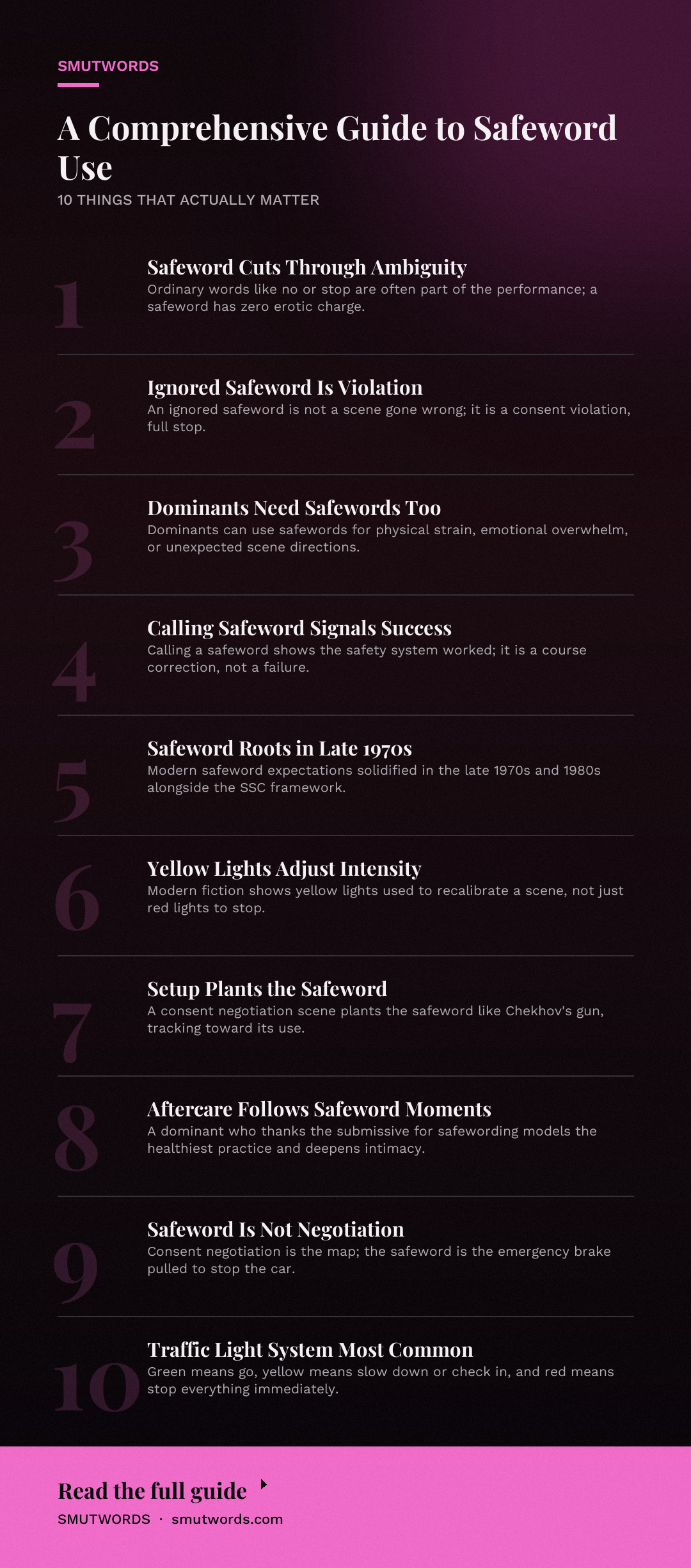
A safeword is a word, phrase, or physical signal chosen before a scene begins, understood by every participant to mean "slow down," "check in with me," or "stop everything right now." It exists because ordinary words like "no," "stop," "don't," and "please" are often part of the performance in BDSM play.
A struggling submissive moaning "no, please stop" during a punishment scene may be having the time of their life. A safeword cuts through that ambiguity with a signal that has zero erotic charge attached to it.
The key feature that defines safeword use is the deliberate separation between in-scene protest and out-of-scene communication. When someone says their safeword, it is not a negotiation. It is not a playful plea. It carries the full weight of real-world communication breaking into the fiction of the scene.
That clarity is what lets a dominant push harder, tie tighter, or deliver a sharper impact, because they know the instant those limits get crossed, they will hear about it without any guesswork.
What does not count as safeword use: picking a word and then not honoring it. A safeword is only functional when both partners agree to treat it as absolute. It works when the dominant stops immediately, checks in, and adjusts. It fails when someone argues, negotiates, or keeps going.
An ignored safeword is not a scene gone wrong; it is a consent violation, full stop.
Common misconceptions swirl around safewords. Some newcomers assume only submissives use them. Dominants can need them too, whether from physical strain, emotional overwhelm, or a scene that veers somewhere they did not expect. Another myth: using a safeword means the scene failed.
In healthy BDSM practice, calling a safeword is a sign that the safety system functioned exactly as designed. It is not an admission of weakness or a ruined evening. It is a course correction.
Where Safeword Use Comes From
The concept of a specific word to halt play has roots in early 20th century BDSM communities. But the modern expectation of an agreed-upon safeword solidified in the late 1970s and 1980s alongside the rise of the Safe, Sane, and Consensual or SSC framework.
As leather communities and later online BDSM culture began formalizing how scenes should run, the safeword became a practical tool to address a real problem: the word "no" does not reliably mean no once roleplay and power exchange are in motion.
Erotica and romance fiction adopted the safeword more slowly. For decades, the genre's dominant figures simply halted when a captive or submissive partner cried out, and the narrative treated that cry as honest communication.
As kink-positive publishing grew through the 1990s and exploded in the 2010s, authors began incorporating safeword use as a marker of competent, caring dominance. A hero who checked for safeword use before a heavy scene read as trustworthy. A heroine who used hers and was immediately respected became a proof point for the safety of the dynamic itself.
A notable shift in fiction has been the movement away from the safeword as a scene-killing emergency brake and toward it as a fluid tool. Modern stories show yellow lights used to adjust intensity, not just red lights to stop. They show safewords spoken mid-scene, followed by a pause, recalibration, and a resumption of play.
This reflects a real cultural evolution where the off-switch became part of the erotic texture rather than something that only appears in a crisis.
The rise of digital BDSM communities in the 2000s spread safeword literacy widely. Fan fiction, in particular, normalized the traffic light system in stories long before mainstream romance caught up. By the time kink-aware editors were standard in publishing, readers already expected safeword use as a given in any credible power exchange scene.
How Safeword Use Shows Up in Erotica
Strong safeword use in a book has a recognizable rhythm. First comes the setup, often during a consent negotiation scene where the characters establish what they want, what they fear, and what word will stop everything. That moment plants the safeword like Chekhov's gun. A savvy reader tracks it, waiting for the moment it gets fired.
Then comes the scene itself. The dominant pushes toward an edge, the tension builds, and the submissive hovers at their limit.
The best authors make the reader feel the internal debate: "Should I call it? Can I take more?" When the safeword finally surfaces, the writing shifts register. The word itself lands with a particular weight, often rendered in a different rhythm or as a single stark line of dialogue.
What follows matters as much as the word itself. A dominant who stops instantly, checks the submissive's face, eases restraints, and moves into reassurance demonstrates competency that makes the character attractive. The pause becomes an emotional beat where the trust underlying the whole dynamic becomes visible.
Then the scene either resumes at a gentler level or transitions into aftercare, depending on what the moment called for.
Common variants authors use:
Enjoyed this? Get a free book.
Join the list and we will send a complete free story straight to your inbox, plus new releases every week after that. No credit card, no catch.
- The traffic light system, where green means "keep going," yellow means "slow down or check in," and red means "stop now." This gets used in serial fiction because it allows multiple checkpoints within a longer scene.
- A non-verbal safe signal, like tapping twice or dropping a held object, used when the submissive is gagged, bound, or otherwise unable to speak.
- A safeword repurposed as dirty talk, where the dominant whispers "you remember your word" as a reminder of the control the submissive holds, or where a submissive breathing out their safeword during orgasm becomes a specific kind of surrender.
- The broken safeword plot, where one character ignores the word and the other must decide whether trust can be rebuilt. This appears most often in dark romance and psychological erotica.
- Safeword as relationship milestone, where a new partner learns the word for the first time, or a long-term couple retires an old word because it has picked up too much charge and needs a fresh one.
The craft difference between a flat scene and a powerful one often comes down to the stakes around the safeword. In weak versions, the safeword exists as a single line of dialogue with no setup: a character shouts "red," the dominant stops, and everyone moves on as though nothing happened. The emotional beat vanishes because the reader never learned what the safeword cost the speaker to use.
In strong versions, the characters treat the safeword with deliberate gravity. The submissive knows using it will interrupt a moment they desperately want, so hesitation reads as real. The dominant knows honoring it instantly is non-negotiable regardless of how close to climax either of them is. The friction between desire and safety is what makes safeword use emotionally gripping.
The author shows the submissive's voice shaking as they say the word. They show the dominant's body going still, the raw effort of stopping mid-motion. That effort is its own form of love, and the best erotica makes it sing.
Safeword use in CNC-style stories carries particular weight. When the fiction's premise is that one partner resists and the other overwhelms, the safeword becomes the single thread of actual consent running through the entire scenario. It is what separates roleplayed non-consent from an actual violation.
Authors who write credible CNC understand that the safeword is not a side detail; it is the structural element that makes the whole premise legible to a consent-aware reader. If you want to see how that works in practice, our article on CNC erotica explains the precise mechanics of how consensual non-consent maintains its safety rails.
For domination-focused stories, safeword use often functions as a grounding point when the dominant is deep in what we call Domspace. The rush of control and power can blur judgment, and a scene that includes the dominant asking for the safeword or responding to one with visible effort shows the character managing that headspace responsibly. It adds a dimension of care to what could otherwise read as pure aggression.
Free use and workplace fantasy stories present an interesting challenge for safeword integration. When the dynamic implies constant availability, authors must decide when safeword use fits without breaking the continuous-consent premise. The common solution is a standing agreement established before the dynamic begins, with a safeword reserved for true emergencies rather than routine check-ins.
That framing keeps the fantasy of endless access while preserving a credible emergency brake. If you're writing this kind of dynamic, our guide to free use workplace romance walks through how other authors handle this tension on the page.
The aftercare scene that follows a safeword moment carries its own weight. After someone calls the word, they often feel vulnerable or embarrassed, worried they disappointed their partner. A dominant who responds with warmth and reassurance, who thanks the submissive for using the word, who confirms the pause was the right call, models the healthiest version of the practice. Those scenes often carry more emotional intimacy than the action that preceded them.
Safeword Use vs. Consent Negotiation
The line between safeword use and the broader process of consent negotiation confuses many new readers. Consent negotiation is the entire conversation that happens before any play begins: what activities are on the table, what limits exist, what health considerations matter, whether there are emotional triggers to avoid. Safeword use is one specific tool that emerges from that conversation, the emergency communication system agreed upon during negotiation.
Think of negotiation as the map and the safeword as the emergency brake. Negotiation defines the route and the destinations. The safeword is what you pull when you suddenly need to stop the car.
A scene can run without explicit safeword discussion if the partners know each other well and operate on a shared understanding, but every scene needs negotiation. In fiction, authors often show characters discussing safeword use as the final beat of a longer negotiation, the capstone that signals each partner understands the stakes.
A related confusion exists around safeword use and fluid bonding discussion. The latter is specifically about conversations around sexual health, STI status, and barrier use. Some couples combine these into one big negotiation session, but they address different needs.
Safeword use governs immediate in-scene safety; fluid bonding discussion governs what physical risks each partner accepts. Both belong in the pre-scene conversation, but neither substitutes for the other.
Frequently Asked Questions
What are the most common safewords?
The traffic light system is the most widespread: green for good, yellow for slow down or check in, red for stop immediately. Many couples choose an unrelated word like "pineapple" or "banana" instead, precisely because it would never naturally occur during sex. Non-verbal signals like tapping twice or dropping a held object cover situations where speech is impossible.
Do safewords only apply to submissives?
No. Either partner can use a safeword, and smart couples agree on that before starting. A dominant might safeword if a position causes physical strain, if they feel emotionally overwhelmed, or if they sense something is wrong with their partner. In fiction, a dominant using a safeword can be a powerful beat that shows the character's own limits.
How do you show safeword use in writing without breaking the mood?
Make the safeword a beat you set up before the scene starts, then treat its use as an emotional pivot rather than a narrative failure. The pause where the dominant stops and checks in can be the most intimate moment of the chapter. Write the submissive's hesitation before saying the word and the dominant's visible effort to halt, and the mood deepens instead of breaking.
What does the traffic light system yellow light mean?
Yellow means slow down, ease up, or check in, but do not stop entirely. It signals that something needs adjusting before play continues. Red means stop everything immediately and move into aftercare or discussion. Using yellow effectively lets a scene keep momentum while respecting that a limit is approaching.
Is it realistic for characters to safeword in casual encounters?
It should be. Any scene involving power exchange, bondage, or impact play requires a working safeword regardless of relationship length. Realistic fiction shows characters establishing one even in a one-night stand, often as part of a quick but explicit negotiation about limits and comfort levels.
What happens when a safeword is ignored in a story?
That is a consent violation, and a well-written story treats it with appropriate weight. The scene stops being play and becomes an assault. Whether the narrative handles this as a dark romance betrayal, a thriller element, or a recovery arc, the aftermath matters as much as the violation itself.
Final Thoughts
Safeword use is the quiet machinery that makes intense fictional scenes possible, the structural honesty beneath the fiction of control. Whether you are writing the first nervous agreement before a scene or the gut-punch of a safeword called at exactly the wrong moment, the practice rewards attention.
For a masterclass in how a safeword can anchor an entire dynamic, look at how Kara claims her word, uses it, and then watches her dominant honor it in the middle of the night. That single beat tells you everything about why their bond holds.






Loading comments…