
The office is the real frontier for free use fiction, and it's strange that it took the genre so long to get there. Household free use hinges on domestic intimacy, the idea that the people who share your breakfast table also share your body on demand.
The workplace version runs on something sharper: a power imbalance that everyone pretends isn't there, an audience of colleagues who are either oblivious or complicit, and a clock that turns desire into a scheduled part of the business day.
The free use workplace romance trope takes everything compelling about the fantasy and strips away the cozy parts. No one is coming home to a warm kitchen in these stories. They're coming to a desk with a locked door, a quarterly review hanging over their head, and a boss who has redefined "open door policy" in ways HR never anticipated.
Why the Office Changes Everything
The household version of free use erotica is fundamentally about closeness. In our guide to free use household fiction, the dynamic works because the people involved already share everything: meals, rent, a bathroom counter covered in someone else's products. Adding sex to that mix feels like an extension of existing intimacy rather than a break from it.
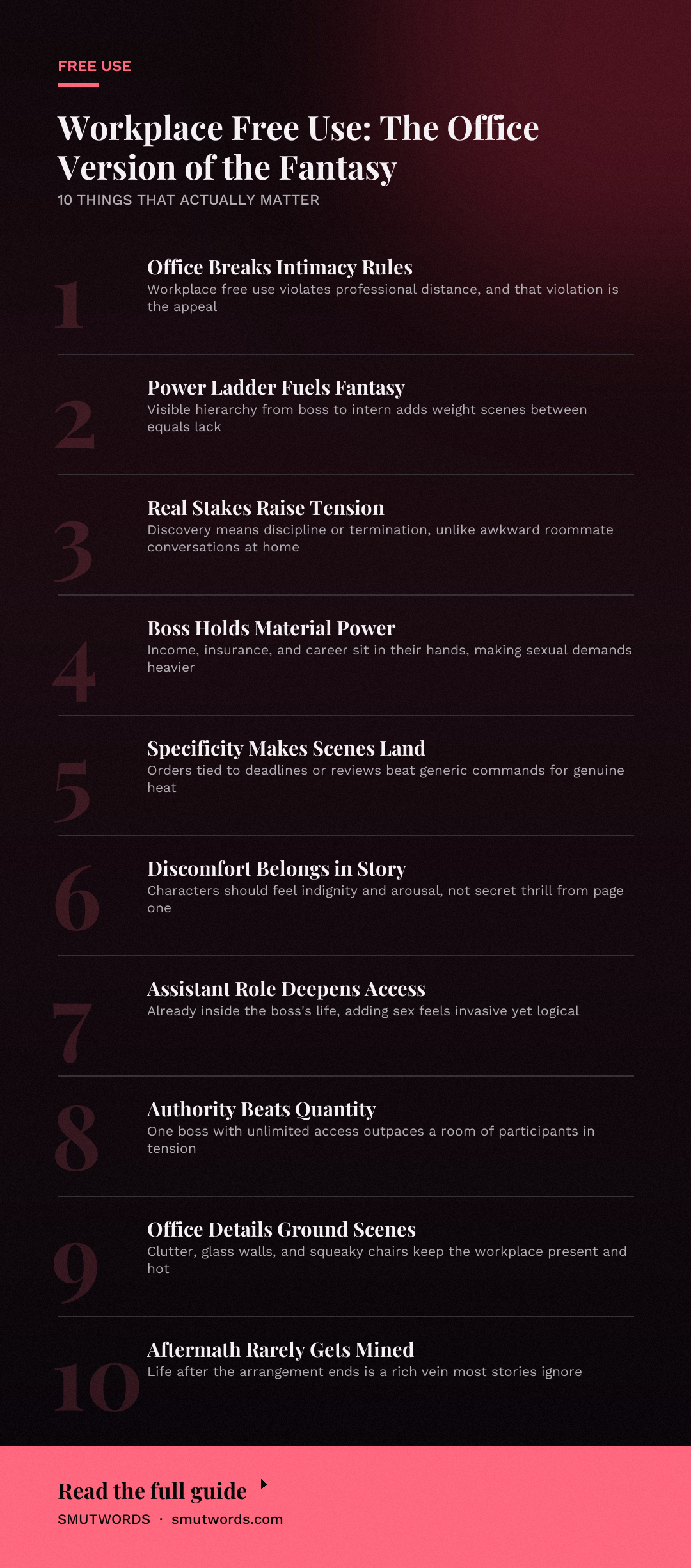
The office is the opposite. Workplaces are built on hierarchy, performance, and the careful maintenance of professional distance. When free use gets inserted into that environment, it doesn't extend intimacy. It violates the unspoken rules of the space, and that violation is the entire appeal.
Consider what the office brings to the fantasy that the living room never could:
- A clear power ladder. The boss, the senior partner, the department head, the intern three weeks into their first real job. The ranking is visible on every org chart and in every meeting room seating arrangement.
- An audience. Even when no one is watching, colleagues are one thin wall or one forgotten badge swipe away. The risk of being caught is structural, not incidental.
- Real consequences. Being discovered could mean discipline, termination, or a lawsuit. The stakes give the fantasy weight that a household scene, where the worst outcome is an awkward conversation with a roommate, can't match.
- The daily grind itself. Meetings, deadlines, performance reviews, the drone of fluorescent lighting. Putting free use inside that context makes the ordinary workday the setting for transgression, not a separate fantasy space.
The public use fantasy genre already understands that open settings amplify the trope's power. An office sits at an interesting midpoint: it's a private enough space for plausible deniability, but public enough that discovery feels genuinely possible.
The glass-walled conference room is the perfect symbol of this. Everyone can see what's happening if they bother to look, but the meeting is technically private, so no one does.
The Boss-Subordinate Dynamic
The most common shape for a free use workplace romance is the boss-employee configuration, and it's easy to see why. The fantasy leans directly into the hierarchy that real workplaces spend so much energy pretending they don't have.
The boss character in these stories isn't just someone who makes decisions about quarterly budgets. They hold the subordinate's employment in their hands, which means they hold their income, their health insurance, their career trajectory, their ability to pay rent. When that kind of material power gets expressed sexually, the scene carries a weight that a scene between equals simply can't generate.
What makes the best versions of this work is specificity about the power. The boss doesn't just say "on your knees" because it's hot. They do it because they just rejected the subordinate's project proposal, or because the subordinate is already late on a deadline, or because the performance review is scheduled for the afternoon and the subordinate knows exactly what will be discussed if they don't comply.
There's a dark mirror here of real workplace dynamics. The unpaid overtime, the expectation of availability after hours, the way junior staff are expected to absorb the emotional labor of managing their superiors. Free use workplace fiction takes that existing structure and makes it literal. The subordinate's body becomes another deliverable, another thing the company expects on demand.
This is why the fantasy works best when the author commits to the discomfort instead of softening it. A free use office story where the subordinate is secretly thrilled from page one misses the point.
The better stories let the character feel the full range: the indignity, the arousal, the confusion about whether wanting it makes the power imbalance okay, and the slow realization that the wanting was there all along, buried under professional decorum.
The Executive Assistant Setup
One specific configuration deserves its own mention because it appears so often in the strongest free use workplace romance stories: the executive assistant whose job responsibilities have expanded to include sexual availability.
The assistant dynamic works on multiple levels. On the surface, there's the proximity. The assistant is always there, always in the outer office, always reachable by intercom.
When the boss wants something, the assistant is the person who provides it. That's the job. Extending the provision from coffee and calendar management to sexual access feels almost logical, which makes it deeply unsettling and deeply arousing in equal measure.
Beneath that surface sits the intimacy of the role. The executive assistant knows everything: the boss's schedule, their travel patterns, their dietary restrictions, the names of their exes, the medications they take. An assistant is already inside the boss's life in ways that a spouse might not be. The free use dynamic adds a physical layer to an already invasive professional relationship.
The best assistant-based stories also play with the assistant's agency in interesting ways. Some versions have them discover the arrangement exists because they're the fifth assistant in three years and the previous four all left under mysterious circumstances.
Others have them walk into the job knowing exactly what it entails and deciding the salary and benefits make it worth it. The negotiation angle, where the free use policy is written into the employment contract in explicit terms, appears in several strong books and lets the author explore consent issues head on.
How Workplace Free Use Differs From a Gangbang
Readers who come to the workplace variant from other free use stories sometimes expect the same dynamics. It's worth being precise about the difference, because it changes what you're looking for.
A free use vs gangbang comparison shows that gangbang stories are primarily about numbers, about multiple partners and the physical sensation of being passed between bodies. The free use workplace romance is about access and authority rather than quantity.
The office fantasy doesn't require multiple partners to land. A single boss with unlimited access to an employee's body generates more tension than a conference room full of participants, because the power relationship gives every encounter a charge that pure physical multiplication can't replicate.
The reader isn't wondering how many people will show up. They're wondering what the boss will request next, and whether the employee will say no, and what happens if they do.
The Executive's Office as Setting
Setting matters enormously in these stories, and the executive office is its own character. The corner office with floor-to-ceiling windows that look out over the city. The desk you've seen in a thousand movies, the one where deals get closed and careers get made. The leather chair that squeaks at exactly the wrong moment. The door that locks with a quiet click that sounds much louder than it should.
The best free use workplace stories use the physical details of the office to heighten the tension. The glass windows that can't be obscured, forcing a choice between exposure and the blinds that everyone on the floor will notice being closed. The conference table that runs meetings during the day and serves other purposes after hours. The supply closet that's technically large enough for two people but doesn't have a lock.
One underused detail in weaker versions of the trope is the clutter of professional life.
The binders and printed reports that get knocked off the desk. The laptop that has to be carefully moved aside. The coffee cup that leaves a ring on the mahogany while its owner is otherwise occupied.
Enjoyed this? Get a free book.
Join the list and we will send a complete free story straight to your inbox, plus new releases every week after that. No credit card, no catch.
These small physical details ground the scene in the workplace and keep the reader from forgetting where they are, which is exactly what makes the fantasy work.
The Professional Consequences
A free use workplace romance story has to address what happens when the arrangement collides with the actual business of working. The strongest versions of the trope build entire plot arcs around this collision.
Consider the promotion that goes to someone else. The subordinate in a free use arrangement has already accepted that their body is available, but did they accept that their career would stall regardless? When the boss's favoritism becomes obvious, do other colleagues start angling for their own access? Does the subordinate weaponize the arrangement, using their position to secure advantages they never could have earned on merit?
And then there's the question of what happens when the arrangement ends. The boss gets transferred, or the company restructures, or the subordinate finally works up the nerve to quit.
The aftermath of free use, the process of learning to exist in a workplace where your body is no longer part of the job description, is a rich vein that surprisingly few stories mine. The ones that do tend to be the most memorable.
The anti-hero romance tradition has a lot to offer this trope. A boss who is genuinely terrible in compelling ways, who isn't secretly a softie underneath, who fully embraces the monstrousness of the arrangement without a redemption arc getting in the way, makes for a more satisfying read than yet another CEO who turns out to have a heart of gold.
Some readers want the redemption arc romance version where the boss eventually sees the error of their ways and fights to earn genuine consent. But the stories that refuse that arc, that let the boss stay unrepentant and force the subordinate to find power elsewhere, deserve equal attention.
Questions Readers Ask About Workplace Free Use
Plot fantasy aside, several practical questions come up repeatedly among readers of this trope.
Is this just sexual harassment fiction? The label doesn't bother the genre as much as you'd think. The fantasy is about wanting the thing that real-world rules forbid, finding arousal in the exact scenario that every workplace training video warns against.
Readers who want comfortable, uncomplicated, socially approved dynamics have a million other romance subgenres available. Readers of this trope are here for the transgression.
Does the subordinate ever have genuine power in these stories? The best ones find ways to give it to them. The threat of exposure is a weapon. The recorded conversation is a weapon. The ability to withhold access, to suddenly become unavailable when the boss needs them most, is a weapon.
The power imbalance at the start of the story doesn't have to be the power imbalance at the end.
Can the arrangement ever become loving? Some stories transition from pure power dynamic into genuine attachment.
The boss's possessiveness becomes protectiveness. The subordinate's compliance becomes willingness. The free use arrangement becomes the framework for a real relationship, just with a permanently unusual structure.
What happens if another employee finds out? This is where the logistics get interesting. The coworker who discovers the arrangement can become a blackmailer, a facilitator, an additional participant, or a witness who stays silent for reasons of their own. Each choice reshapes the story in meaningful ways.
Where to Find the Strongest Versions
The free use genre has expanded well beyond its domestic origins, and some of the most inventive settings are worth visiting for comparison. The free use casino moves the dynamic into a space where risk and chance already dominate, making every encounter feel like a bet. The free use airport lounge is a masterclass in transience, where the free use arrangement is tied to the traveler's layover and ends when their flight boards.
For readers who want the power imbalance without the professional setting, the free use doctor takes the dynamic into a medical context where vulnerability is literal, while the free use nurse version remixes the same territory from a different angle of the hierarchy.
The free use county fair explores what happens when free use goes fully public, and the free use vampire coven transplants the dynamic into a supernatural power structure where the authority isn't just professional but existential.
Reading across these settings clarifies what makes the workplace version distinct. The office brings a realism that the other settings don't have to contend with. No vampire coven needs to worry about quarterly earnings, and no casino has to maintain a professional relationship with its free use participants once they leave the floor.
The workplace story has to keep functioning as a workplace story even as it descends into total perversity, and that constraint is exactly what makes it work.
The Appeal of the Forbidden Professional
At the end of the day, the free use workplace romance lands because it makes the familiar strange. Everyone who has worked in an office has felt the undercurrent of attraction and power that runs beneath the professional surface.
The boss who lingers a moment too long. The coworker whose hand brushes yours when they pass the remote. The meeting that runs long and leaves you alone together.
The trope takes that ambient tension and makes it explicit. The boss stops lingering and starts demanding. The coworker stops with the hand brushes and takes what they want. The meeting that runs long becomes the meeting where the door locks and the presentation gets abandoned entirely.
If you're new to the workplace variant, look for stories that respect the setting. The ones that remember the quarterly projections, the office gossip, the badge access levels, the nine-to-five rhythm.
Those details are what transform the story from generic power fantasy into something that feels like it could actually happen, which is exactly what makes it thrilling.
Final Thoughts
Start with a story that commits fully to the hierarchy rather than apologizing for it. The free use casino is a fine entry point if you want the dynamic in a glamorous, risk-soaked setting, but for the pure office experience, seek out something where the boss doesn't flinch and the subordinate doesn't magically escape the structural reality of the arrangement.
The best workplace free use stories stare straight at the ugliness of the power imbalance and find the heat in it, which is exactly what the best free use erotica has always done.








Loading comments…