
The alien breeding trope is a science fiction romance plot built around reproduction as the central engine of the story: a human and a nonhuman partner, a biological or political reason they have to conceive, and a pregnancy (or the urgent attempt at one) that drives every emotional beat from first contact to final chapter.
The alien hero might be the last fertile male of his species. The heroine might be a surrogate chosen by treaty, a captive bride, or a scientist who volunteered for an experiment she did not fully understand. Whatever the setup, the alien breeding trope treats conception as high-stakes plot, not epilogue.
It is one of the most reliably popular dynamics in sci-fi romance, and it has almost nothing to do with the soft-focus pregnancy epilogues you find at the end of contemporary romances. Here the breeding is the conflict. The book opens with it, escalates through it, and resolves because of it.
What the Alien Breeding Trope Actually Means
The name is descriptive rather than literary. "Alien" covers the nonhuman partner: a spacefaring humanoid, a tentacled diplomat, a scaled warrior from a dying colony, a being whose biology runs on entirely different rules than ours.
"Breeding" is the plot mechanism and the erotic charge at once. The pairing is not incidental to the story. It is the reason the story exists.
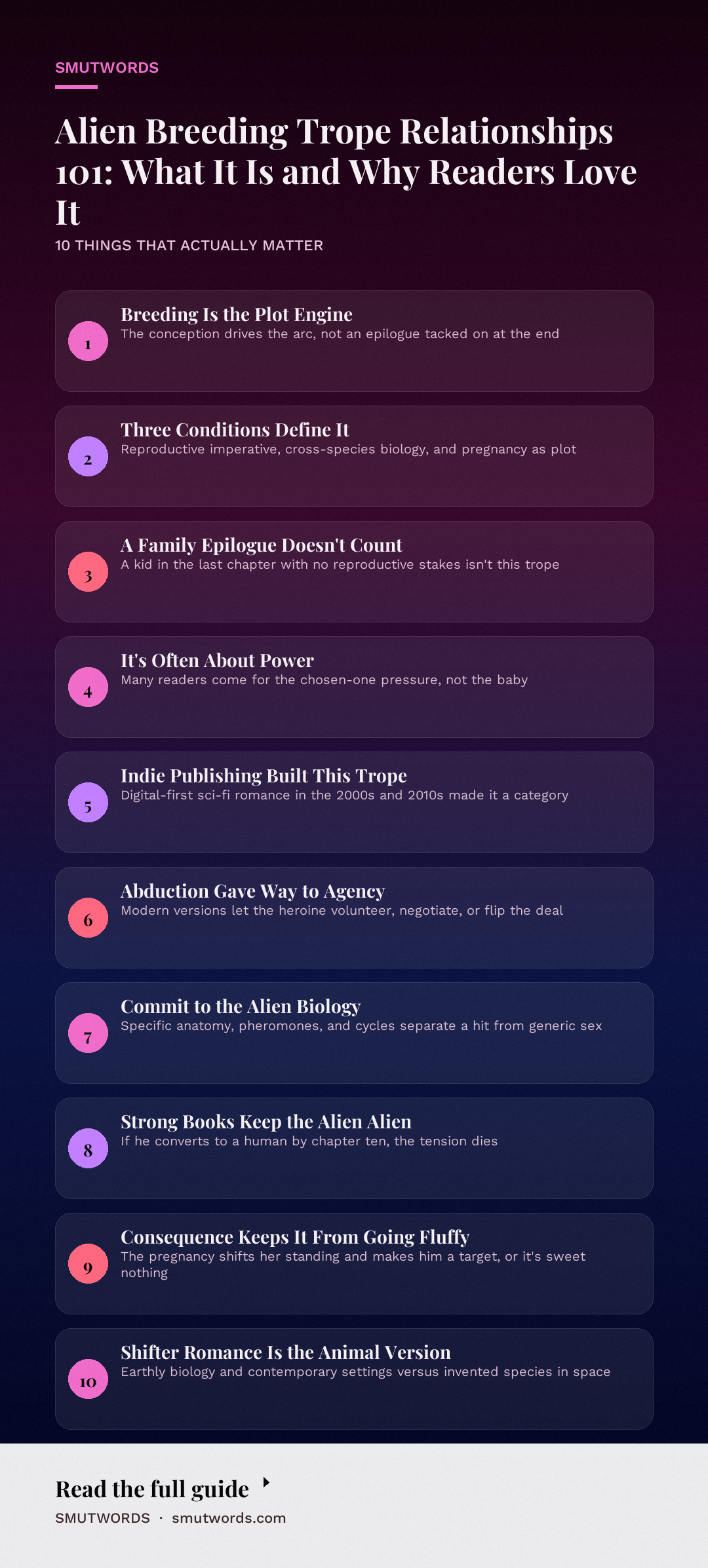
Three conditions usually need to be present for a book to count as part of this trope rather than just sci-fi romance with a pregnancy in it.
- A reproductive imperative. Something external makes conception necessary: species collapse, a prophecy, a treaty clause, a heat cycle that will kill the alien if unmatched, a queen who needs an heir.
- Cross-species biology as a feature. The mechanics of how a human and an alien actually make a baby get page time. Compatibility questions, medical intervention, pheromones, breeding cycles, unusual anatomy. The weirdness is part of the appeal.
- The pregnancy or hybrid child as plot, not coda. The conception, gestation, or offspring shapes the arc. Cut it and the book collapses.
What does not count: a human-alien couple who happen to have a kid in the epilogue with no reproductive stakes driving the story. That is a family epilogue, not this trope. Also excluded are stories where the alien is functionally a human with pointed ears and no biological difference matters at all. The breeding element has to cost something, physically or politically, or the trope is just decoration.
A common misconception is that this is only a pregnancy kink for readers who want baby content. Plenty of readers come for the power dynamic instead: the chosen-one pressure, the captive who becomes essential, the enormous alien who needs something only a fragile human body can give him. The pregnancy is often the excuse for the intimacy, not the payoff.
Where the Alien Breeding Trope Comes From
The trope's publishing history is shorter and more specific than most readers assume. It grew out of the pulp science fiction era, where human-alien hybrids appeared as horror or curiosity, and then migrated into romance as the genre's boundaries loosened.
The real turning point was the explosion of indie and digital-first sci-fi romance in the 2000s and 2010s. Authors publishing directly to e-readers found an audience hungry for exactly this: fast, explicit, high-stakes books that mainstream publishers were not buying.
Series with fated alien warriors, human brides mailed off-world, and mate-bond pregnancies sold in enormous numbers. The trope went from a niche curiosity to a recognizable category with its own cover conventions: abs, galaxies, and a woman looking over her shoulder.
Two shifts are worth noting. First, the move from abduction-only plots to consensual or semi-consensual setups. Early versions leaned hard on the alien abduction romance framework, with the heroine taken and the breeding happening whether she agreed or not. Modern versions still use abduction as a starting point, but they increasingly give the heroine agency: she volunteers, negotiates, or turns the arrangement to her advantage.
Second, the arrival of male pregnancy and mpreg variants. What started as a heroine-centered fantasy expanded to include fated-mates mpreg and alien surrogacy plots, which broadened the trope's audience considerably. The mechanics changed; the imperative did not.
If you want the deeper genre context, our breakdown of space opera romance covers how these books sit inside the larger sci-fi romance shelf.
How the Alien Breeding Trope Shows Up in Erotica
The craft question is what a scene actually does with the premise on the page. Here is where the trope lives or dies, and it is where a lot of weak versions fall apart.
Strong versions commit to the biology. A good breeding scene makes the alien's difference felt physically, not just described in a paragraph of exposition.
Maybe his anatomy requires a specific position. Maybe the pheromones are so strong the heroine cannot think. Maybe the heat cycle runs on a clock and the whole scene is a race.
Specificity is what separates a scene that lands from one that reads like generic sex with a color change applied.
Enjoyed this? Get a free book.
Join the list and we will send a complete free story straight to your inbox, plus new releases every week after that. No credit card, no catch.
Weak versions treat the alien as a human in a costume. If the breeding could happen between two humans with no changes to the scene, the trope is not doing any work. Readers who came for the alien part will notice immediately.
Common variations authors use:
- The treaty bride. A human woman is given to an alien leader as part of a peace agreement, and an heir is part of the contract. Political stakes, forced proximity, slow thaw.
- The last fertile pair. Both species are dying. The hero and heroine are the only compatible match left, and they both know it. Every scene is freighted with the weight of a civilization.
- The heat or rut cycle. The alien's biology flares on a schedule, and the heroine gets caught in it. Often paired with a soulbond that makes the bond permanent once the cycle completes.
- The surrogacy arrangement. The heroine signs up for a paid or diplomatic surrogacy and develops feelings she did not contract for.
- Fated mates mpreg. A male human or male alien carries the pregnancy, usually because the bond or the species biology requires it.
- The captive bride pregnancy. Taken, held, claimed, and bred. This variant sits closest to the non-consent end of the spectrum and often borrows from power exchange dynamics in how it structures the control.
What makes a strong version work is tension between the alien's otherness and the intimacy the breeding forces. The best books do not resolve that tension early. They let the heroine stay unnerved by what her partner is while also wanting him, and they let the alien stay alien rather than converting into a human with better shoulders by chapter ten.
The other craft lever is consequence. In a strong alien breeding trope book, the pregnancy changes the character's standing in the world. She becomes a political asset. He becomes vulnerable to a rival who wants the heir.
The baby is a person with a future and a faction, not just a sweet ending. Books that skip the consequence tend to read as fluffy even when the sex is explicit.
If you want to see how far the "biology overrides reason" angle can be pushed, our guide to primal play deals with the same instinct-driven wiring in a real-world context, and the overlap in reader appetite is real.
Alien Breeding Trope vs Similar Dynamics
The most common point of confusion is between this trope and hybrid shifter romance. Both involve nonhuman partners, both involve mates, and both frequently feature pregnancy.
The difference is the source of the otherness. Shifter romance draws its biology from animals (wolves, bears, big cats) and its settings from the contemporary world. Alien breeding draws its biology from invented species and its settings from space, colonies, or off-world politics.
If the hero turns into an animal, it is shifter romance. If he is a warrior from a dying planet with a breeding cycle, it is this trope.
A second overlap exists with merman romance and cryptid romance, which both use nonhuman biology and reproductive curiosity as part of the appeal. The dividing line is origin and scale. Merfolk and cryptids are earthly, and their stories usually stay local. Alien breeding is cosmic, and the stakes are usually species-wide.
Frequently Asked Questions
Is the alien breeding trope only about pregnancy?
No. Many books in the trope end before a pregnancy is confirmed, and the tension comes from the attempt, the risk, or the negotiation. The reproductive stakes drive the plot even when the baby never appears on the page.
Does the trope always involve non-consent or captivity?
Not anymore. Early versions leaned heavily on abduction, and the captive bride pregnancy variant still does. But a large share of modern books use treaty arrangements, voluntary surrogacy, or a heat cycle the heroine chooses to enter. The spectrum is wide.
What is fated mates mpreg in this context?
It is a variant where a male character, human or alien, carries the pregnancy because the bond or species biology requires it. It usually combines a soulbond-style connection with a reproductive imperative, and the pregnancy follows the same plot function as in heroine-centered versions.
Can an alien breeding book also be a soulbond book?
Frequently. The two dynamics pair well because both rely on a bond that cannot be undone. The soulbond supplies the permanence, and the breeding supplies the stakes. Many series use both in the same book.
Why do readers gravitate to this trope over a standard pregnancy romance?
The alien element removes the mundane. There is no shared culture, no familiar biology, no social script to fall back on, so every step of the relationship has to be negotiated from scratch. That friction is the appeal.
Is there an AI romance version?
It exists but is rare and structurally different, since an artificial partner cannot contribute biology. Where AI romance does use reproductive plots, it usually involves a physical body the AI controls rather than a genuine cross-species pairing. See our AI romance glossary entry for how those stories handle embodiment.
Final Thoughts
The alien breeding trope earns its shelf space because it does something no other dynamic can do quite as well: it makes intimacy enormous. Every kiss carries a species. Every choice about a body carries a future. If you want to see the trope executed with real discipline, start with a book that does not rush the alien into humanity, and notice how much more the breeding scenes hit when the difference stays alive on the page.








Loading comments…