
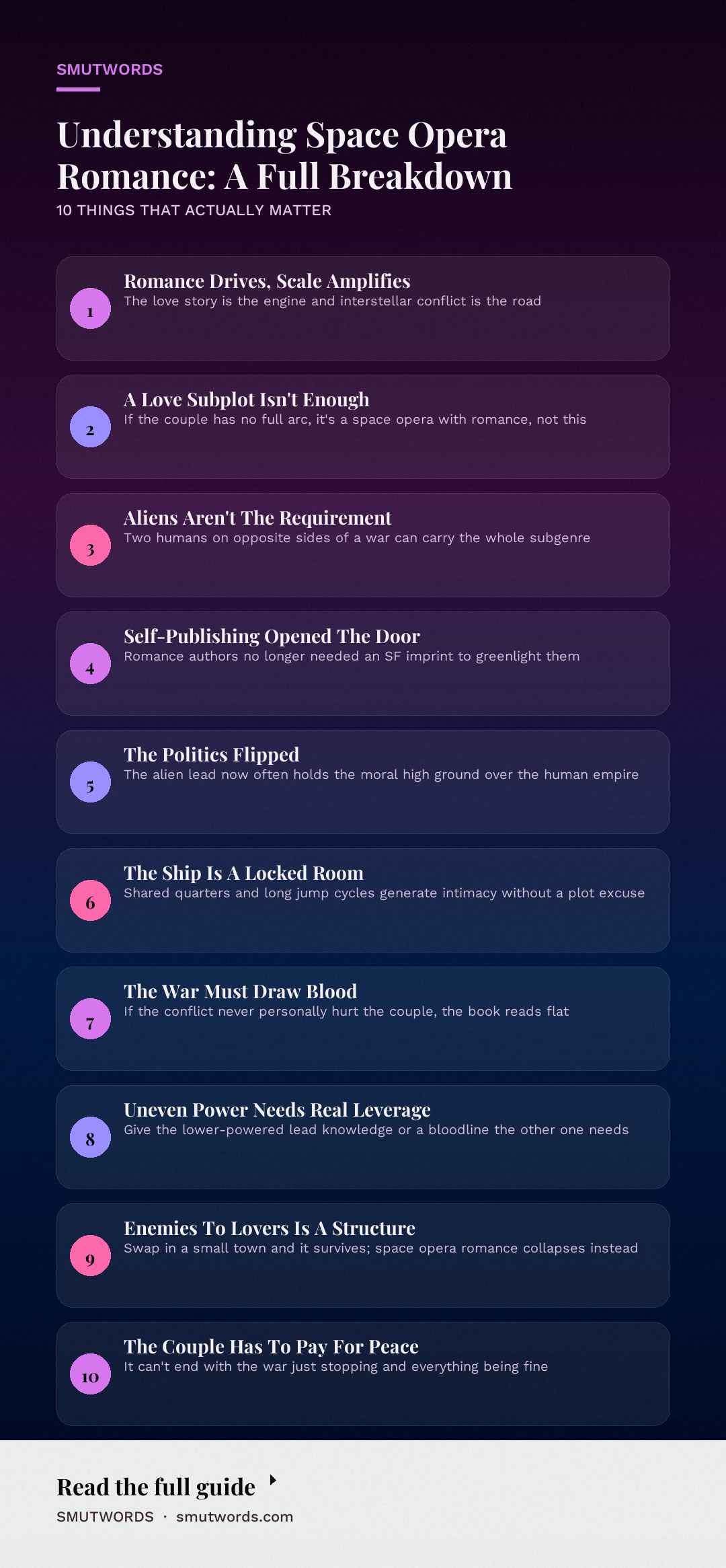
Space opera romance is the subgenre where a love story plays out at the scale of a galaxy. Two people fall for each other while empires collapse, fleets burn, and the political fate of a dozen worlds hangs on whether they can trust each other.
The term covers everything from a smuggler captain seducing an enemy agent mid-jump to a royal heir bonding with the alien warlord sent to conquer her planet. If the romance is the engine and interstellar conflict is the road, you're reading space opera romance. It's one of the biggest, fastest-growing corners of the genre, and one of the most misunderstood, so this guide covers the definition, the history, the craft, and the answers to the questions readers actually ask.
What Space Opera Romance Actually Means
The name is a mashup of two older categories. "Space opera" started as a slightly dismissive label for the grand, melodramatic, planet-hopping adventure fiction of the early pulp era, the stuff where heroes dueled across star systems and the science was more mood than math. "Romance" carries its own contract: a central love story and an emotionally satisfying ending in which the two leads end up together.
Put them in the same book and you get a specific set of promises. The scope is interstellar, the stakes are civilizational, and the emotional throughline is the relationship rather than the war. A space opera with a love subplot is not the same thing as a space opera romance. Readers feel that distinction immediately, even when they couldn't articulate it.
What counts:
- A romance plot that drives the book, with the sci-fi setting amplifying it rather than replacing it.
- Large-scale conflict (war, empire, rebellion, first contact, galactic politics) that the couple is personally caught inside.
- At least one lead who is embedded in that conflict by role: captain, soldier, smuggler, diplomat, monarch, assassin, pilot, refugee.
- Worldbuilding rich enough that the setting feels like a character. Ships, stations, alien species, tech, customs.
What doesn't count, or only partially:
- A contemporary romance where one character happens to be an alien or owns a spaceship. The scale has to be there.
- Hard science fiction with a romantic subplot that stays subplot. If the couple doesn't get a full arc and a satisfying resolution, it's not this.
- Military SF where the romance is a single chapter of downtime between battles.
- Straight erotica set in space with no emotional architecture under the sex.
The most common misconception is that space opera romance means "romance with aliens." Alien romance is a sibling category and the two overlap heavily, but they're not synonyms. You can write a space opera romance with two humans on opposite sides of a war and no non-human love interest at all.
Second misconception: that "space opera" means low-quality science. It doesn't. It means the science serves the drama. This genre has always cared more about how a hyperdrive changes a marriage than about how the hyperdrive works.
Where Space Opera Romance Comes From
Space opera itself dates to the 1920s and 1930s pulps, when writers like E.E. "Doc" Smith were churning out galaxy-spanning serials with romances folded into the adventure. Those early love stories were typically chaste, secondary, and resolved in a paragraph. The girl got the hero, the hero got the throne, roll credits.
For most of the twentieth century, romance and space opera lived in the same books without ever fully committing to each other. The pulp era gave us adventure with a kiss. The New Wave of the 1960s and 70s got literary and often bleak.
Then the 1980s and 90s produced some genuinely romantic space opera (C.J. Cherryh's Alliance-Union books, Lois McMaster Bujold's Vorkosigan Saga). Those were published as science fiction first, shelved in the SF aisle, marketed to SF readers. The romance was there, but the industry kept it in the back seat.
The real shift happened in publishing in the 2000s and 2010s. Two things converged.
First, digital self-publishing gave romance authors a direct route to readers without needing a science fiction imprint to greenlight them. Writers who wanted to set a full romance contract against an interstellar backdrop no longer had to convince an SF editor that the romance was the point.
Second, the alien romance boom that started in earnest around 2010 proved there was a massive, hungry audience for love stories with non-human leads and speculative settings. Once that audience existed at scale, space opera romance had a shelf to sit on.
By the mid-2010s, the subgenre had its own recognizable conventions, its own cover language (a lone figure against a nebula, a ship silhouetted on a planet's curve, a shirtless alien with visible ridges), and its own bestseller ecosystem. The rise of Kindle Unlimited accelerated everything. Readers who finished one series could mainline twelve more in the same month.
The most interesting shift over that period is the politics. Early space opera romance often reproduced a colonial fantasy: a human woman "civilizes" or softens a barbarian alien.
Contemporary space opera romance has swung hard the other way. The alien love interest is now more often the one with the moral high ground, and the human empire is the one committing atrocities. The genre has gotten considerably more interested in who gets to be the villain.
How It Shows Up in Erotica
On the page, space opera romance does something specific that other subgenres can't easily replicate: it makes the physical world hostile and the emotional world necessary. A couple stranded in deep space with a failing oxygen scrubber has a reason to be in each other's space that no contemporary setting can quite match. The craft problem is making that pressure feel real instead of decorative.
Here's what a strong space opera romance scene actually does.
It uses the ship as a pressure cooker
A ship is a locked room. There's no walking out. That's forced proximity at its most literal, and the best authors lean all the way into it: shared quarters, one bunk, a jump cycle that takes eleven days, a repair that requires two bodies in a cramped crawlspace. The setting generates the intimacy instead of the plot having to justify it.
It gives the conflict a body count
In a strong version, the war between the leads' factions has already hurt someone they love. A sibling killed in a raid. A homeworld glassed. That grievance is the wall between them, and the romance is the work of dismantling it in real time.
Weak versions gesture at a war and never let it touch the couple personally. That's why they read flat.
It handles the physical logistics with confidence
Non-human anatomy, pheromones, mating cycles, psychic bonds, incompatible biology that turns out to be extremely compatible. This is genre furniture, and readers want it handled directly. The mate bond and marking tradition runs through a lot of this subgenre, and it works best when the author commits to the biology as a system rather than tossing in a glowing bond mark for flavor.
If you're writing a species with a heat cycle, decide what it does to consent, negotiation, and aftermath. Then write that.
Enjoyed this? Get a free book.
Join the list and we will send a complete free story straight to your inbox, plus new releases every week after that. No credit card, no catch.
It lets the power dynamic be genuinely uneven
A captain and a stowaway. A general and a prisoner of war. An empress and the mercenary she hired to kill her. Space opera romance thrives on unequal footing, and the skilled version lets the lower-powered character hold real leverage: knowledge, a bloodline, a hidden weapon, the one thing the other person needs.
That's how you keep a possessive hero from becoming a caricature. Give the object of his obsession something he can't take.
It pays the emotional debt of the war
If one lead has done terrible things for their side, the romance has to reckon with it, and that's where the redemption arc romance machinery kicks in. Space opera gives that arc higher stakes than a contemporary can. A man who ordered a planetary blockade has more to answer for than a man who yelled at his ex-girlfriend.
Common variations authors reach for:
- Enemies on opposite sides of a war. Human pilot and alien ace. Rebel and imperial enforcer. The hate to love structure, scaled up to fleets.
- Captor and captive. Prisoner of war, abductee, political hostage. Needs real negotiation and a clear exit to work.
- Arranged political marriage between species. A treaty sealed with a wedding. Great for slow-build and cultural friction.
- Smuggler and aristocrat. Class conflict in a cockpit. Often comedic, often very hot.
- Bodyguard and royal. Overlaps with prince/princess romance and lets you keep the couple in constant proximity without needing a plot excuse.
- Second chance between former crewmates. Years apart, one betrayal, a forced reunion on the same ship. That's marriage in trouble wearing a flight suit.
- Soldier and civilian. A medic and the pilot she pulled out of a crash. Cousin to the entire soldier romance tradition.
What separates a book that works from one that doesn't usually comes down to a single decision: does the sci-fi setting matter to the romance, or is it wallpaper?
If you could swap the space station for a Manhattan apartment and the story still functioned, the worldbuilding is decorative. If the alien biology, the language barrier, the treaty law, the jump lag, the lack of a shared homeworld all specifically shape how these two people can love each other, the book is doing the real work.
The flat version also tends to underwrite the ending. Space opera romance can end with a throne, a fleet, a truce, or a quiet cabin on a forgotten moon. What it can't do is end with "and then they stopped fighting the war and everything was fine." The couple has to pay for the peace.
The other craft lever is restraint. Because the canvas is enormous, a lot of weaker books try to show everything: five POVs, three subplots, a galaxy map in the front matter. Strong ones pick one corner of the conflict and go deep. Two people, one ship, one war they personally broke.
If you're writing a heat-heavy version, the sex scenes benefit from the same logic. Zero-g mechanics, temperature differences between species, a mating bond that makes orgasm control and denial a biological rather than purely psychological game. These are moves the genre lets you make that a contemporary can't. The scene should feel like it could only happen in this universe.
Space Opera Romance vs Enemies to Lovers
These get confused constantly because space opera romance so often runs on a war between the leads' factions. The difference is what's generating the conflict.
Enemies to lovers is a relationship structure. The opposition comes from who these two people are to each other, and it can play out in a boardroom, a bakery, or a throne room. A setting isn't required at all.
Space opera romance is a setting-plus-scale category. The couple can be enemies, allies, strangers, or already in love when the book opens. What defines the subgenre is the interstellar scope and the fact that the romance is structurally load-bearing. You can absolutely have a space opera romance where the leads are on the same side from page one and the conflict is external.
Practical test: if the two leads were plucked out of the galaxy and dropped into a small town, would the story survive? If yes, you're reading enemies to lovers with a space backdrop. If the story collapses because the whole plot depended on the war, the species gap, or the empire, it's space opera romance.
Frequently Asked Questions
Is space opera romance the same as alien romance?
They overlap but aren't identical. Alien romance is defined by a non-human love interest. Space opera romance is defined by scale and by the romance being the main plot.
Plenty of alien romances are set on one planet with no galactic politics, and plenty of space opera romances pair two humans. Books that do both are common and get shelved under either label.
Do I need to read space opera romance in order?
Series in this subgenre usually work as standalones even when they share a universe, especially series that pair a different couple per book. Where you need to check is ongoing-plot series with a single couple across multiple volumes and a cliffhanger ending. Those you read in order or you'll spoil yourself.
Why are the heroes so often possessive in these books?
Because the setting justifies it in a way contemporaries can't. A mating bond, a species-wide instinct, a wartime claim on a person, a biological certainty that this is the only one: all of these let the author write obsessive devotion without having to sell it as a normal relationship dynamic. The heat comes from the stakes being real, not from a personality flaw.
How explicit does space opera romance get?
Across the full range. You'll find closed-door versions shelved as science fiction, mid-level heat with one or two open-door scenes, and fully explicit books where the sex is the point and the worldbuilding is the delivery mechanism. The subgenre has no single heat standard, so check the tags before you buy.
What's the difference between space opera romance and sci-fi romance?
Sci-fi romance is the umbrella. Space opera romance is the branch that specifically requires a large-scale, galaxy-spanning setting. A quiet romance between two engineers on a Mars colony is sci-fi romance. A romance between a rebel commander and the imperial admiral hunting her across three star systems is space opera romance.
Can the couple be from the same species?
Yes, routinely. The defining feature of the subgenre is the scope and the structural role of the romance, not the biology of the leads. Human-on-human war romances are a substantial slice of the category, and so are romances between two members of the same alien species from rival clans or planets.
What's the appeal of a story where the whole galaxy is at stake?
It makes the love feel proportionate to the feeling. A first kiss that could end a war hits harder than a first kiss at a coffee shop. The genre is selling emotional immensity, and the scale is the delivery system. That's why readers who want to feel wrecked by a romance gravitate to it.
Final Thoughts
Space opera romance is the subgenre for readers who want the love story to feel as enormous as it feels inside their own chest. It's a big canvas with real rules: the war has to touch them personally, the biology has to be committed to, the ending has to be earned, and the setting has to matter. Get those right and the stakes do the heavy lifting for you.
Want a starting point that nails every one of those rules? Pick up a book with a rebel pilot and an imperial officer locked into a single ship for a jump cycle neither of them can cut short. The genre's best entries all share that trick: two people, one impossible situation, a galaxy outside the hull that neither of them can afford to lose.





Loading comments…