Angry sex is the genre's answer to a question erotica rarely asks out loud: what happens when two characters want each other so badly they can barely stand to be in the same room, and they solve that problem by fucking instead of talking?
It is a high-emotion, high-physics encounter where fury does the work foreplay usually does, and every thrust lands like an accusation. The argument itself becomes the foreplay, the fight spilling directly into physicality without softness or preamble. This is not a misunderstanding solved with a hug. It is a war that ends in a truce signed with teeth and hips.
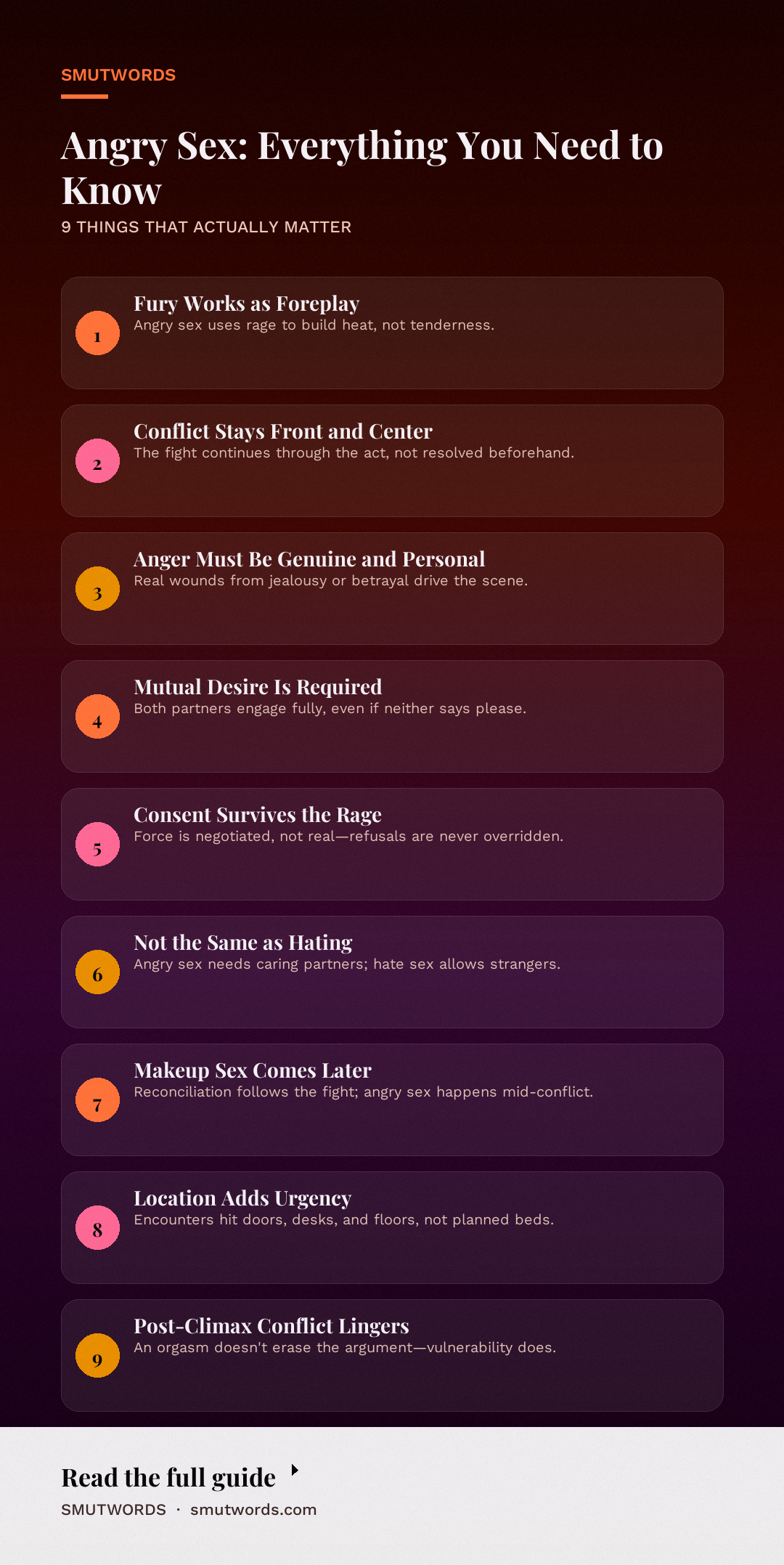
Angry sex is a specific emotional state rendered physical, not merely rough play with a grumpy attitude. The anger is the engine: the characters are genuinely furious with each other, and the friction of that fury becomes arousal.
This occupies a distinct lane from other high-intensity encounters. Rough sex, for instance, prioritizes physical sensation and power exchange over emotional conflict. Angry sex puts the conflict front and center. The physicality is the argument continuing by other means.
What does and doesn't count as angry sex:
- It requires active, unresolved anger between partners. Bickering that dissolves into giggles is not this. A cold, silent standoff that breaks into sudden need is adjacent but closer to a one night stand dynamic if the partners are strangers.
- It is mutual, or at least reciprocated. One partner raging while the other cowers is a different power dynamic entirely.
- The anger is personal. It comes from jealousy, betrayal, frustration, pride, or a genuine clash of wills, not from generic stress or a bad day at work.
- The sex is a direct expression of that anger. Slamming, biting, harsh words during the act, a refusal to slow down, all count. So does the flip side: the sudden collapse into tenderness after climax.
A common misconception is that angry sex and makeup sex are interchangeable. They are sequential, not synonymous. Makeup sex happens after the conflict has been resolved or at least acknowledged, the relief of reconciliation turned physical.
Angry sex happens during the conflict, unresolved and raw. A scene can travel from one to the other mid-encounter, but the starting line determines which trope you are reading.
Another misconception: angry sex requires physical violence or abuse. Consent and safety remain intact in a well-written scene. The rage is expressed through intensity, verbal sparring, and forceful but negotiated contact, not through genuinely harmful acts. The line between fiction and consensual non-consent (CNC) territory is crossed only when a character overrides an explicit refusal. Classic angry sex has both partners fully consenting to the fight, even if neither is saying please.
Where Angry Sex Comes From
Angry sex has a pedigree as old as romance itself. The trope maps neatly onto the enemies-to-lovers arc, which has been a pillar of Western romance since Pride and Prejudice, though Austen kept the passion off the page.
The sensation-driven version, where rage curdles into lust mid-sentence, became a staple of bodice-ripper romances in the 1970s and 1980s, an era when heroines were allowed to slap heroes and heroes were allowed to kiss them breathless in retaliation.
The term as a recognizable kink classification is younger, tracking with the internet's habit of naming every sexual dynamic. Forums and fanfiction communities in the late 1990s and 2000s codified "hate sex" as a tag, then "angry sex" as its close cousin, to flag scenes where the conflict is the point.
The rise of dark romance as a mainstream category in the 2010s gave the trope a publishing home, with authors leaning into the raw, possessive energy of characters who fight and fuck with equal abandon.
The portrayal has shifted in one significant way over the decades. Older versions often blurred the line between angry sex and coercion, with the "angry" partner forcing the encounter. Modern erotica has largely cleaned this up, emphasizing mutual intensity and reciprocal rage.
The current iteration is more likely to show two equal opponents snarling at each other than a pursuer and a resister. The term itself has evolved alongside the genre's collective conversation about consent. Readers now expect the anger to stay on the surface while the negotiation stays underneath, a convention that has made the trope more sustainable and more popular than ever.
How It Shows Up in Erotica
Angry sex scenes are a masterclass in escalation. The strongest versions follow a recognizable arc: a verbal or emotional provocation, a building physical tension that neither character can ignore, the moment one of them snaps and closes the distance, and then the act itself, rendered with language that keeps the fight alive.
The language of an angry sex scene is its defining feature. Authors use verbs that belong to combat as much as coupling: wrestle, grab, shove, pin, bite, slam. Dialogue during the act stays sharp, sometimes cruel.
Characters say unforgivable things mid-thrust that they will have to walk back afterward, and that tension is part of the appeal. The internal monologue of the point-of-view character often shows the whiplash between "I hate them" and "I need them," sometimes within the same sentence.
Common variants authors use:
- The jealousy spike: Character A sees Character B flirting with someone else, and the resulting row ends with A claiming B roughly, almost punishingly.
- The betrayal aftermath: One character discovers a lie or omission, and the confrontation dissolves into a desperate, angry physical reclamation.
- The rivalry finally snapping: Two characters who have been competitive for years, in work or sport or family, cross a line in a heated argument and end up against the nearest wall.
- The bitter exes dynamic: Former partners who still carry a torch collide at a wedding or a bar, trade insults, and then fuck each other senseless to prove they feel nothing. This variant often carries an undercurrent of feral play, as the veneer of civility strips away entirely.
- The adrenaline letdown: Characters in a high-stakes situation, fresh from danger, snap at each other from pent-up fear and then burn it off in an aggressive coupling.
What makes a strong version work versus a flat one comes down to stakes and aftermath. A flat angry sex scene has characters who are angry on page but whose conflict is trivial or manufactured. Readers need to believe the rage matters.
The argument should touch on something real in the relationship, a fault line that the sex either exposes or temporarily papers over.
The aftermath is equally crucial. Angry sex that ends with a pillow and a smirk and no one addressing the original problem can read as cheap. The best versions carry the conflict through the orgasm and slightly past it.
The characters may soften, but they do not instantly forget why they were furious. The moment of vulnerability after climax, when one character hates themselves for wanting the other, is often the emotional core of the entire scene.
Enjoyed this? Get a free book.
Join the list and we will send a complete free story straight to your inbox, plus new releases every week after that. No credit card, no catch.
A word on the physical staging. Angry sex rarely starts in a bed. It happens against doors, on desks, on the floor of a hallway, in a car, anywhere the space was not prepared for tenderness.
The improvisation of the location reinforces the lack of preamble. The characters were not planning this. They were fighting, and their bodies took over.
For writers tackling this trope, the rule of thumb is to keep the anger specific. Every insult should land on a real wound. Every grab should reference a moment from the argument.
When the characters are mid-act and one of them growls a callback to what the other said an hour ago, the scene earns its intensity. The rough sex mechanics matter less than the emotional throughline, and readers feel the difference when the author remembers that this is a conversation, not just a collision.
Angry Sex vs Hate Sex vs Makeup Sex
The distinction between angry sex and its two closest relatives is one readers actually search for, and the three terms do overlap in ways that merit untangling.
Hate sex is the extreme wing of angry sex. It implies a more pronounced animosity, often between characters who are enemies in a larger sense: rivals, antagonists, people on opposite sides of a conflict who should not want each other at all.
Angry sex can occur between lovers mid-fight; hate sex is more likely between people who are not otherwise lovers. The hate sex variant often carries a quality of disbelief, the sense that both parties are shocked by their own attraction.
Makeup sex is the reconciliation counterpart. It follows a resolution. The couple has talked, or at least one party has capitulated, and the sex is celebratory, relieved, tender even when it is physically intense. Makeup sex has softness baked in, a quality that angry sex deliberately lacks.
Angry sex sits between the two. The partners care about each other, which is why the anger carries such a charge, but the conflict is live at the moment of contact.
A useful test for labeling a scene: if the characters stop talking about the fight the second their clothes come off, it is angry sex. If the fight was resolved over dinner and they are celebrating, it is makeup sex. If they are virtual strangers who despise each other and can barely admit they are attracted, it is hate sex.
The terms can blend within a single encounter, but the starting conditions determine the tag. For a deeper exploration of how animosity curdles into desire in a different context, the forbidden beast tamer romance guide covers a dynamic where the conflict is baked into the very nature of the pairing.
Frequently Asked Questions
Is angry sex the same as hate sex?
Not exactly. Hate sex describes encounters between characters with deep mutual animosity, often enemies or rivals, while angry sex more often involves people who care about each other and are fighting about something real. Hate sex is the more extreme version, with the anger baked into the relationship itself rather than a single situation.
Can angry sex be consensual?
Yes. In a well-written scene, both partners are consenting to the intensity even if neither is verbally checking in mid-act. For real-world practice, angry sex demands clear safewords and a check-in afterward to separate fictional heat from genuine hostility, ensuring both partners feel safe and consensual throughout.
Why do people enjoy reading about characters who are furious at each other having sex?
The appeal is the raw charge of unresolved tension turning physical. Anger strips away pretense and politeness, and readers get to watch characters who are usually composed lose control. The emotional chaos ends in a dizzying release that proves even rage can be a form of intimacy.
Does angry sex require rough physical treatment?
No, although rough elements are common. The defining trait is the emotional state, not the specific physical acts. Two characters can have angry sex that is almost gentle in technique while their words remain sharp, the contradiction between their bodies and their tongues creating the tension.
What is the difference between angry sex and a rape fantasy or CNC scene?
Angry sex involves mutual desire and engagement, even when the characters are hostile. CNC scenes involve a negotiated dynamic where one partner resists or simulates non-consent within pre-agreed bounds. In angry sex, both characters actively want each other and express that desire through the encounter, not through playing unwilling.
Do characters usually stay angry after the sex is over?
Sometimes. The most memorable scenes preserve a thread of the conflict into the afterglow, because an orgasm does not magically resolve a betrayal or a deep disagreement. The best versions use the physical surrender as a starting point for real communication, rather than a replacement for it.
Final Thoughts
Angry sex endures because it dramatizes the oldest truth in romance: that the people who infuriate you most are often the ones you cannot live without. The trope gives readers a way to see affection wearing its meanest clothes, and it rewards authors who trust their characters to fight honestly before they fuck honestly.
The dynamic works best when the anger is rooted in something real, something the characters actually have to work through. That is why the trope pairs so naturally with stories about relationships that are already complicated, where love and frustration are two sides of the same coin. For a look at how that tension plays out when the conflict is built into the very structure of the relationship, the forbidden beast tamer romance guide examines couples whose anger and desire are inseparable from their circumstances.
For a closer look at how fury can curdle into devotion when the stakes are supernatural, the Beauty and the Beast style dynamics guide shows how anger softens into something else when the beast finally gets what he wants. And for readers who like their emotional extremes with a bit more physical texture, the scar fetish guide explores how the marks of past conflict become objects of desire in their own right.






Loading comments…