
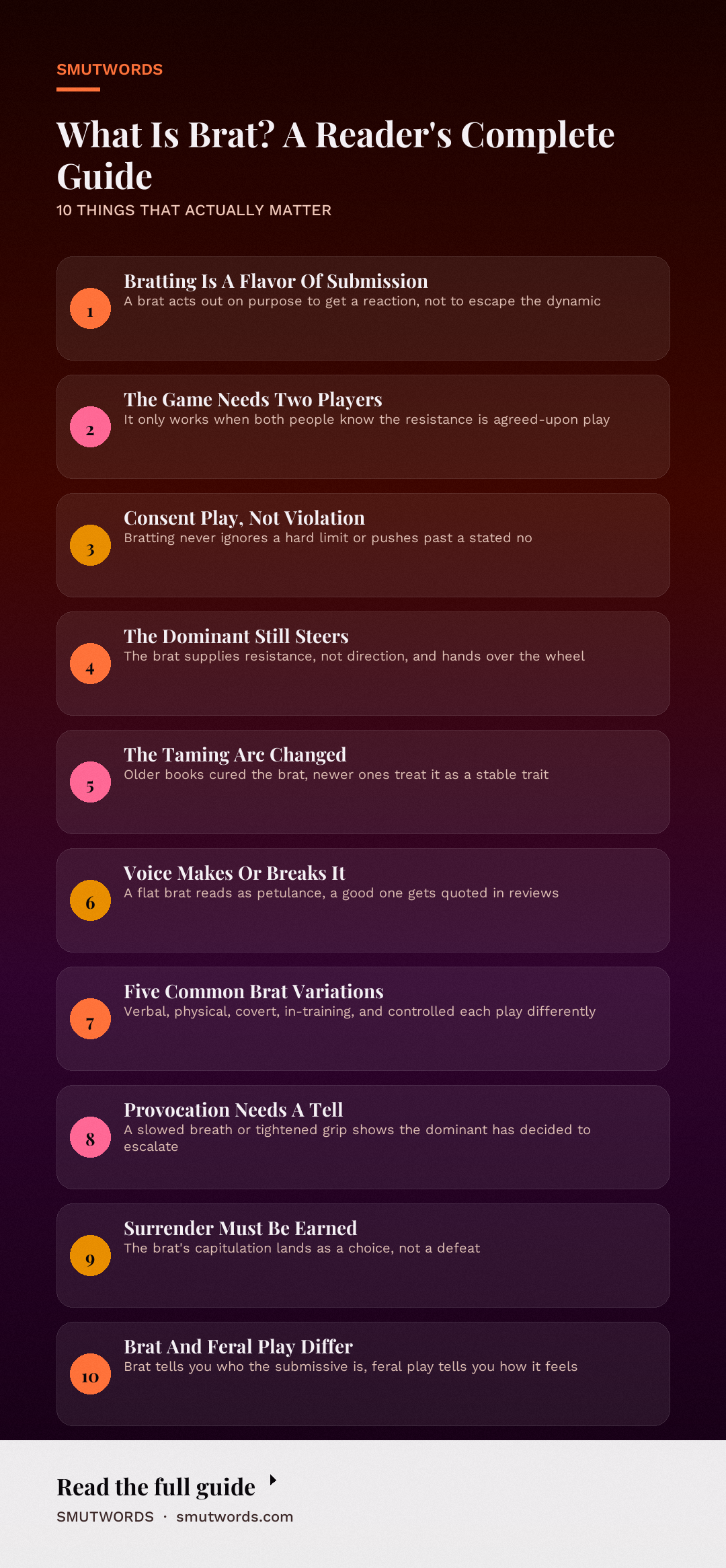
Being a brat is a specific flavor of submission: a submissive who talks back, teases, stalls, and pokes at their dominant on purpose. Not because they want out of the dynamic. Because they want the reaction.
The brat wants to be caught, corrected, chased, and eventually tamed, and the whole game only works when both people know it's a game. In erotica, this is one of the most reliable engines for sexual tension because it puts two characters in direct opposition and lets the resolution do the work of a dozen overwrought longing glances.
If you've ever read a scene where the heroine calls the hero "sir" with a smirk and immediately regrets it, you've read a brat. If you've watched a hero's jaw tighten because the woman across from him just refused an order with a slow smile, same thing, roles flipped. It's a dynamic built on friction, and friction is what makes a scene burn.
What Brat Actually Means
The term comes out of real-world kink communities, where "brat" describes a submissive whose submission is delivered with attitude. The distinction matters: a brat isn't a submissive who has stopped consenting, and they aren't a dominant who's lost control. They're a submissive who chooses to make submission harder on purpose, as play.
The word itself is borrowed from the everyday insult, and the borrowing is deliberate. A brat in the general sense is a kid who argues, negotiates, and pushes. A brat in the kink sense is an adult who does the same thing inside a negotiated scene, with a safe word in hand and a partner who signed up for exactly this.
What counts as bratting is broader than most readers assume. Nine times out of ten it's verbal: sarcasm, backtalk, calling the dominant by the wrong title, asking "make me." The other ten percent is physical or behavioral. A brat might walk away mid-instruction, hide a toy, spill something on purpose, or simply refuse to move.
What doesn't count is the important part. Bratting isn't ignoring a hard limit, and it isn't pushing past a "no" that was already stated plainly. The moment the behavior stops being playful and starts being a real attempt to override the dominant's limits, the label no longer fits. It's consent play, not a violation of consent.
Another common misconception: the brat is secretly topping from the bottom. In a well-written scene, the dominant is still the one steering. The brat is providing resistance, not direction. The submissive has handed over the wheel and is now kicking the back of the seat.
The relationship also isn't inherently heterosexual or gendered. Male brats and female brat tamers exist in published erotica, though the more common configuration on the page is a female brat and a male tamer, partly because the reverse dynamic has its own market category and partly because of what publishers believe sells in the heavy-hitting section of the shelves.
Where Brat Comes From
The term has lived in real-world BDSM communities since at least the 1990s, when online forums and chat rooms gave subcultures a vocabulary they could share across geography. "Brat" and "brat tamer" were already established as role labels in that period, used to describe a specific negotiation style rather than a specific act.
Its arrival in commercial erotica lags that history by roughly a decade. The 2000s saw the rise of the "sassy sub" in mainstream romance, but those heroines were sassy without the label. The words "brat" and "brat tamer" started showing up in book blurbs in a serious way in the 2010s, alongside the broader visibility of fanfiction-turned-published romance and the growing comfort of independent publishers with explicit kink terminology on covers.
What changed most in that transition was tone. Early published versions often treated bratting as something to be broken out of the submissive as a character flaw. The arc went: brat acts out, dominant punishes, brat learns to submit properly, everyone is healed. That arc still exists, but it's less dominant now.
Contemporary erotica increasingly treats bratting as a stable trait rather than a problem. The brat doesn't get cured. The brat gets understood, and the dominant's arc becomes learning to enjoy the resistance instead of trying to eliminate it. That's a meaningful shift, because it reframes the dynamic as a partnership built around a specific taste, not a correction of a flaw.
The publishing side of the history matters too. Once brat became a searchable keyword, authors who wrote it well built loyal readerships around it, and the glossary around it expanded.
Brat tamer, playful brat, bratty sub, back-talk, and sassy sub are all now used as signposts, each pointing to a slightly different flavor, and each helping readers find the exact friction they're looking for. Similar keyword maturation happened with authors building careers around specific names and niches, where a recognizable signature does most of the marketing work.
How It Shows Up in Erotica
On the page, a brat scene has a recognizable shape. There's a provocation, an escalation, a moment where the dominant decides to stop asking and start acting, and a resolution in which the brat gets exactly what they were angling for. The word "tamed" shows up in a lot of blurbs because it names the resolution, not the whole dynamic.
Strong brat writing lives and dies on voice. The brat's dialogue has to be genuinely funny or genuinely bold, or the whole scene reads as petulance. A flat brat is just annoying. A good brat is the character readers quote in reviews.
The dominant's interiority is the other half. If the tamer reads as a rage machine who happens to be sexually rewarded for temper, the scene collapses into unpleasantness. The strong version shows a dominant who is amused, challenged, and increasingly deliberate, someone who is choosing to engage rather than simply reacting.
Here's a short list of the variations that show up most often, and what each one does differently on the page:
- Verbal brat: Sarcasm, backtalk, deliberate misuse of titles. The most common version, and the easiest to write in dialogue-heavy scenes.
- Physical brat: Resisting position changes, wriggling out of restraints, walking away mid-instruction. Requires more choreography but reads as more visceral.
- Covert brat: Off-page or in-public bratting where the dominant is the only one who knows. Adds jeopardy and often pairs well with darker settings.
- Brat-in-training: A submissive new to the dynamic who brats badly, and whose arc is learning the shape of the game rather than its intensity.
- Controlled brat: A submissive who brats deliberately to elicit a specific response they want. The scene is a negotiation wearing a costume.
Bratting often sits alongside other textures rather than carrying a scene alone. A brat scene might tip into degradation kink when the correction involves humiliating language, or into feral play when the resolution is more animal than ceremonial. It can also sit inside a longer arc about ownership, where the vocabulary of keyholding gives the dynamic a physical symbol the brat can push against.
What makes a strong brat scene work versus a flat one comes down to a few specific choices.
Enjoyed this? Get a free book.
Join the list and we will send a complete free story straight to your inbox, plus new releases every week after that. No credit card, no catch.
- The provocation has to be motivated. The reader needs to believe the brat wants the reaction, not just wants to be difficult.
- The dominant has to have a tell. A slowed breath, a tightened grip, a specific phrase they only use when they've decided to escalate.
- The consequence has to answer the provocation. If the brat mocks a title, the response should reassert that title or replace it. Otherwise the scene loses logic.
- The surrender has to be earned and visible. The brat's capitulation is the payoff, and it needs to land as a choice, not as a defeat.
- Aftercare, or at least the shape of it, needs to register. Not every scene needs a full ritual, but the reader should feel that both people are safe.
The strongest published versions also make room for the real-world scaffolding. Bratting relies on clear boundaries and a safe word so the playfully rude behavior never spills into real disrespect or ignores the dominant's limits. Scenes that show this negotiation, even briefly, feel more honest than scenes that pretend it isn't happening.
Common flat versions of the trope look the same across subgenres. The brat is a collection of eye-rolls with no interior life. The tamer is silently furious for most of the book and softens on page two hundred. The correction is generic.
The surrender is instant. When all four happen at once, the dynamic reads as a costume change rather than a relationship.
Cross-genre bratting is one of the more interesting recent developments. Brat dynamics now show up in alien romance, where the "taming" vocabulary gets mapped onto cross-species power imbalance, and in contemporary series where the power exchange is contained inside a single relationship, and in the kind of universe-building some authors do at scale, like an eighty-five-book alien romance universe, where specific dynamics get reused as architecture for entire serials.
Reader taste inside the trope runs deeper than the label suggests. Some readers want the brat to win small battles throughout and only lose the war once. Others want the brat flattened quickly and repeatedly. Both are brat books, and both sit under the same keyword, which is why the category feels bigger than it is.
Word choice does a lot of the work. The best brat scenes use terms like "game," "chase," "spar," "flinch," and "finally" to signal the shape of what's happening. The weakest use "defiance" and "rebellion" without any sense of proportion, and the scene reads like a courtroom drama.
Pacing matters too. A brat scene that starts at maximum intensity in chapter one has nowhere to go. The dynamic usually needs a slow build, where the brat tests a smaller boundary first and discovers that the dominant is willing to play. Once trust is on the table, the escalation can go wherever the author wants.
Brat vs Feral Play
Readers often mix these up because both involve resistance, but they describe different things. Bratting is a role within a submission dynamic, defined by playfully acting out. Feral play describes a scene style where the physical register is more animal, less negotiated, and less verbal.
A brat can be wearing a collar and quoting a rule back with a smirk. Feral play is about snarls, grip, and the disappearance of language.
The two overlap more than most categories do, and a scene can be both, but they answer different questions. Brat tells you who the submissive is being.
Feral play tells you what the scene feels like. If you want the friction of a personality, brat is the term. If you want the friction of bodies without words, feral play is closer.
Frequently Asked Questions
Is being a brat the same as being disobedient?
No. Bratting happens inside an agreed dynamic where both people know the resistance is part of the play and neither is trying to actually override the other's limits. Real disobedience, where one person ignores a hard boundary, is a different thing entirely and sits outside the label.
What is a brat tamer, and do they have to be dominant?
A brat tamer is the partner who engages with the brat's provocations and responds to them. In published erotica the tamer is almost always the dominant in the scene, but the role is really about willingness to play, not about title. A switch or service-oriented dominant can fill it just as easily.
Do brats always get "tamed" by the end of the book?
Not anymore. Older books in the trope tended to end with the brat permanently subdued, but contemporary versions treat bratting as a stable trait. The arc is more likely to end with both characters understanding and enjoying the dynamic than with the brat quietly dropping it.
Is bratting a male or female thing?
It goes both ways, though the more common publishing configuration is a female brat and a male tamer. Male brats and female tamers are a smaller but real category, and same-sex versions of the dynamic are well represented in indie erotica and fanfiction-adjacent publishing. If you want a closer look at how power exchange gets structured across those configurations, a piece like the guide to the multiple mates dynamic covers similar ground from a different angle.
How does bratting differ from degradation kink?
Bratting is about the submissive's behavior, and degradation kink is about the content of the dominant's response. A brat scene can use degradation to answer the provocation, but a scene can also have one without the other. Bratting without degradation is common and often reads as more playful.
What if the dominant in the scene is the one who gets pushed past a real limit?
That's where the safe word comes in, and it's the single most important piece of the dynamic in real life. A brat who has been given clear boundaries can go right up to them, and the dominant can call the stop just as easily as the submissive can. Both directions of consent need to be visible on the page for the scene to feel honest.
Can bratting coexist with other kinks?
Constantly. It sits easily with ownership structures, with voyeuristic setups, and with the kind of public-facing power games where the dominant's control is partly for an audience. That last combination often overlaps with the voyeur husband trope, where the brat's performance is meant to be seen.
Final Thoughts
Brat writing works when the author takes the game seriously. The provocation has to mean something, the dominant has to be a person instead of a reaction, and the surrender has to land as a decision. When all three are on the page, the dynamic is one of the most satisfying shapes in the genre, because it turns the whole book into a long negotiation with a clear payoff.
If you want to see it done with a slow, deliberate hand, start with the books in the brat list below. Read the first scene twice. Notice where the tamer's tell shows up, notice what the brat actually wanted from the very first line, and you'll start recognizing the shape of the dynamic in every brat book you pick up afterward.







Loading comments…