Your first JOI game will probably start with you lying on your bed with your phone propped on a pillow, already half-hard and a little embarrassed, skimming a page that says "press start." That embarrassment fades about ninety seconds in. What replaces it is a slightly weird, very focused feeling, like a voice in your ear is paying attention to something you usually do alone in the dark with the door locked.
The JOI game is a scripted, often interactive sequence of jerk off instructions you follow in real time, and for a lot of readers it turns out to be the most absorbing form of solo play they've tried. Here's what the first session actually looks like, how to set yourself up so it doesn't fizzle, and how to walk away if it isn't your thing.
What Is a JOI Game, Actually?
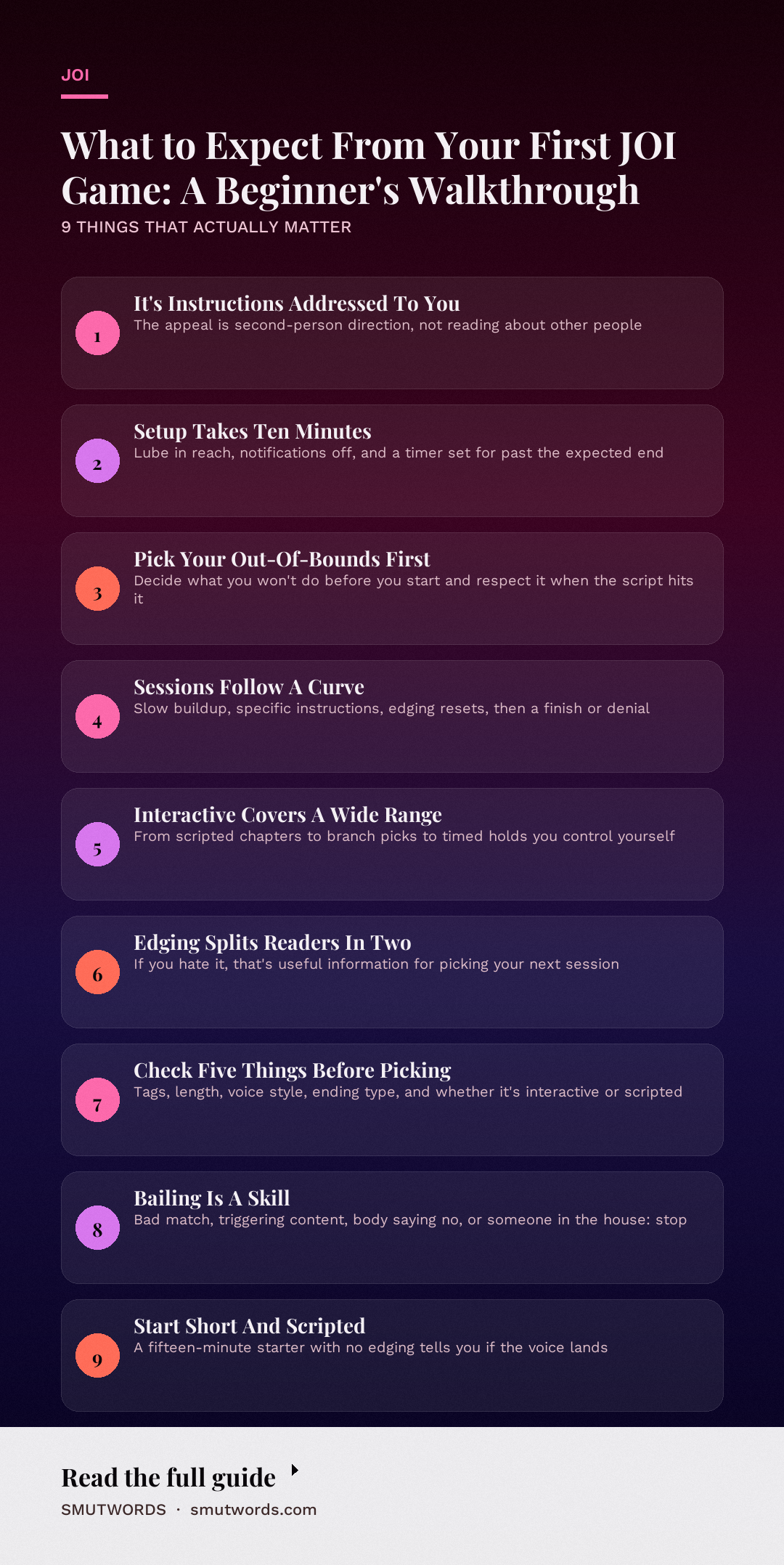
At its core, a JOI game is a set of instructions you follow as you go. Some versions are pure text, delivered in chapters you read at your own pace. Others are interactive: you pick options, the scene branches, and the pacing changes depending on what you click. Some are audio-only, a voice guiding you through strokes, holds, edges, and pauses over twenty or forty minutes.
The unifying thing is that you're not reading a scene about other people doing it. You're following directions addressed to you. That shift in address is most of the appeal. The best versions know exactly how to keep a reader on the edge without letting them finish until the script says so.
The interactive JOI game format is the one that surprises newcomers most, because the branching means your choices actually change the pacing. If you pick the slower option, you get more teasing. Pick the harsher one and you might get an edges-only stretch with a countdown. If you want the fuller picture of how these are structured, the complete guide to interactive JOI games walks through the formats in detail.
How to Prepare Before You Press Start
Almost nobody does this the first time and almost everybody regrets it. Ten minutes of setup makes the whole thing run smoother.
- Read the setup block first. Most JOI entries open with a warning label or a content list. Read it. It'll tell you if there are restraints, blindfolds, denial, or a hard finish.
- Have lube within arm's reach. Not in the bathroom, not in a drawer across the room. The moment the game asks you to slow down, you don't want to be walking to a cabinet.
- Kill your notifications. A text from your boss mid-edge is the least sexy thing on earth.
- Set a timer for ten minutes past the expected length. Some sessions run long, and it's easier to relax when you know you've got a soft end time.
- Decide your out-of-bounds list in advance. What won't you do, even in a fantasy, even scripted? Write it on a sticky note if that helps. Then respect it when the script hits that thing.
The out-of-bounds question is the one most first-timers skip and later wish they hadn't. A JOI game moves faster than a novel because it's directing you in the second person. If a specific kink shows up that you're not ready for, it helps to have already decided you'll skip that chapter or close the tab.
What the Session Actually Looks Like
Here's a realistic shape of a first JOI game, start to finish, so you know what's coming.
Minutes One to Five: The Buildup
You'll usually get an opening frame: a persona, a setting, sometimes a backstory. The voice might be a demanding boss, a cocky stranger, a partner who's been waiting for you.
Most JOI stories start slow. You'll be instructed to get comfortable, get undressed, take yourself in hand, and not move yet. The tease is intentional. The first few minutes exist to slow you down, which is not what you'd normally do.
Minutes Five to Fifteen: The Instructions Get Specific
This is where the JOI game does its real work. You'll get numbered strokes, timed holds, hand-position changes, sometimes a specific count. A good version varies the rhythm: fast strokes, then a hold, then a slow count of ten with your hand still.
A bad version just repeats "stroke" for forty pages. If it feels mechanical here, that's a signal for later.
Minutes Fifteen to Twenty-Five: Edging and Denial
A lot of JOI games include edging. You'll be told to stop right before you finish, breathe, reset, and start again. Sometimes this repeats three or four times.
This is the part most readers either love or hate. If you love it, welcome. If you hate it, that's useful information for choosing your next session.
Minutes Twenty-Five to End: The Finish (Or Not)
Some games let you finish. Some don't. Some have a choice at the end: finish, or extend the denial another round. Always check the tags before you start if the ending matters to you.
What "Interactive" Actually Means in Practice
The interactive label gets applied loosely. Here's the range you'll see:
- Scripted chapters with no choice. You read and follow along. Easiest entry point.
- Branch picks. At certain points you choose an option and the scene goes one of two or three ways.
- Timed challenges. The text tells you to hold at a certain point and then come back. You control the pace by how long you actually hold.
- Persona mashups. A game might route you through a scenario like the ghostwriter romance setup, where the instruction voice is a client or a rival, or something closer to a blind date romance, where the persona is someone who doesn't yet know you. Different skins, same mechanics.
The pick-your-path version is the one that reads like an actual game. That's where options open up and the session feels less like a script and more like a conversation.
Who Actually Enjoys a JOI Game (and Who Doesn't)
The readers who get the most out of it tend to share a few things:
- They like following instructions. If a demanding voice telling you what to do and when to stop is a turn-on, this format is built for you.
- They're okay with edging. If finishing quickly is the point of solo play for you, JOI may frustrate more than excite.
- They read in longer sessions. A JOI game is usually a two-thousand-word minimum, often much longer. Ten-minute attention spans struggle.
- They're curious about second-person POV. The format lives or dies on whether "you" feels good to read.
Readers who bounce off it are just as predictable: they want a story with characters, or they don't want to be told what to do, or they find the second-person voice distractingly odd. None of those are wrong. It means the JOI game isn't the right fit, and there's no reason to force it.
Five Things to Check Before You Pick a JOI Game
Not all JOI offerings are built equal. Here's a working checklist.
Enjoyed this? Get a free book.
Join the list and we will send a complete free story straight to your inbox, plus new releases every week after that. No credit card, no catch.
- Tags. Look for kink tags at the top of the page: edging, denial, restraints, breathplay. If a breathplay tag shows up and you want to know what that actually involves before you opt in, the guide to breath play JOI covers the safety specifics.
- Length. Short entry-level runs in the ten-to-fifteen-minute range. Serious stuff pushes forty-plus.
- Style of the voice. Bossy, teasing, clinical, affectionate. Read the first paragraph to see which one you're getting.
- Ending type. Finish allowed, denial, or player choice. Never start one you don't want to end.
- Interactive or not. If you don't want to pick options mid-session, look for the scripted version.
Doing those five checks takes ten minutes. Skipping them takes twenty minutes and a ruined evening.
When It's Going Wrong: How to Bail
Halfway through your first JOI game and it's not clicking. What do you do?
The simple answer is stop.
The longer answer is that a JOI game where the pacing is off, or the persona is grating, or the edging goes on too long, is not a failure on your part. It's a bad match. Close the tab. Get up. Drink water. Reset.
If the discomfort is more specific, though, there are a few distinct off-ramps to know:
- It's just not hitting. Skip to the end or close out. Come back another day or not at all.
- It's triggering something. Stop immediately. A JOI game can hit a nerve fast because it's addressing you directly. Step away from the screen, get grounded, and don't go back to that specific entry.
- Your body says no. Cramps, numbness, an uncooperative wrist. Nothing about this genre requires you to push past physical discomfort to "finish." Stop.
- Someone else is in the house. Stop. The embarrassment of getting caught is genuinely not part of the fantasy for most people.
Half the skill of enjoying JOI is knowing when to bail. The other half is knowing which entry to pick next.
Where JOI Sits in the Broader Kink Lexicon
JOI games split into recognizable subgenres, and knowing the labels helps you find the version you actually want.
Exhibitionism-flavored JOI puts you in the position of being watched or observed. The comprehensive guide to exhibitionism explains what readers find in that setup and how a JOI game builds the same feeling of being seen. Breathplay JOI is a different beast and requires actual safety awareness; don't skip the prerequisite reading if you're curious. The JOI game for women angle is worth reading regardless of your gender, because the trope patterns are informative about why the format works.
Persona-wise, romance subgenres graft onto JOI surprisingly well. You'll find JOI scripts built around marriage in trouble dynamics where the instruction voice is a partner trying to rebuild something, and revenge romance setups where the instruction has a sharp edge. Chef and restaurant romance fans occasionally get a kitchen-set JOI with a demanding expo voice; if that vibe appeals, the chef/restaurant romance guide is the place to trace the pattern back to its source.
Five Mistakes First-Timers Make
- Skipping the tags. Then getting twenty minutes in and hitting a hard limit.
- Skipping prep. No lube, phone in the other room, notifications screaming.
- Starting with a forty-minute denial piece. Beginner sessions exist. Start there.
- Treating the JOI game like a novel. You can't read it in bed with a partner asleep beside you if the instructions require movement. It's active, not passive.
- Feeling like you failed if you stop. You didn't. You learned something about what you want.
Each of those mistakes has an obvious fix. The bigger point is that a first JOI session is a learning experience. You're not going to nail the perfect run on your first try. You're going to figure out which pacing, which voice, and which level of interactivity you actually want, and then you'll go hunt the version that hits those boxes.
What "Good" Looks Like vs. What "Bad" Looks Like
A good JOI game paces the instructions in a curve. Slow buildup, escalating intensity, at least one reset, and a finish that feels earned. It varies the instruction vocabulary so you're not just reading "stroke, stroke, stroke" for pages. It gives you something to follow in your head (a count, a position change, a breathing cue) so you're doing the work and not just reading.
A bad JOI game is repetitive, mechanical, and reads like it was written by someone who has never actually tried to follow their own script for twenty minutes. The instructions come too fast to actually obey. The pacing is flat. The persona is flat. You feel like you're reading a checklist instead of being spoken to.
The tell on a bad one shows up in the first five minutes. If the rhythm already feels off two pages in, close it and try a different entry. There's no shortage of these. Do a little filtering.
Things You Should Know Before Your Second Session
The first session is reconnaissance. By the second, you should be running with more information.
Know your ideal length. Know whether you want scripted or interactive. Know which personas work for you and which feel stupid. Know whether edging is a turn-on or a frustration.
Know how much prep actually matters, because the second time you'll have the lube there, the notifications off, the ten-minute buffer set, and the sticky note of out-of-bounds items done.
Second-time advice that almost nobody gives: don't try to recreate the first session's best moment. Chase what felt right, not what the exact script said. Every JOI session is going to feel different because you'll be in a different mood, in a different room, with a different day behind you. The variability is part of the appeal.
Final Thoughts
If you're going to try one specific entry as your first real JOI game, pick something short and scripted with a clear tag list and a finish that's actually allowed. A fifteen-minute starter with no edging on the first run, just to see if the second-person voice lands for you.
If it does, the complete guide to interactive JOI games is the natural next read, since it'll walk you through what to look for in the longer, branchier versions. If it doesn't, you learned something useful about your taste, and that's the whole point of a beginner's walkthrough.




Loading comments…