
Bondage furniture use is the practice of building a scene around a dedicated piece of apparatus (a bench, a rack, a pillory, a cage, a spanking horse, a spreader frame) so that a character is secured to or inside the equipment rather than simply tied up on a bed.
The furniture becomes the scene's architecture: it fixes the body in one position, decides what the dominant can reach and what the submissive cannot, and turns stillness into its own kind of pressure.
Readers come to bondage furniture use for the geometry of it, the way a bench or a cross reorganizes a body into something the dominant can walk around and study at leisure. The short version: the furniture does the holding, and the held character does the waiting.
What Bondage Furniture Use Actually Means
The term describes a category of restraint play in which the hardware is a structure, not a hand. Rope and cuffs can go anywhere a partner wants. Furniture only works one way, and that one way is the point.
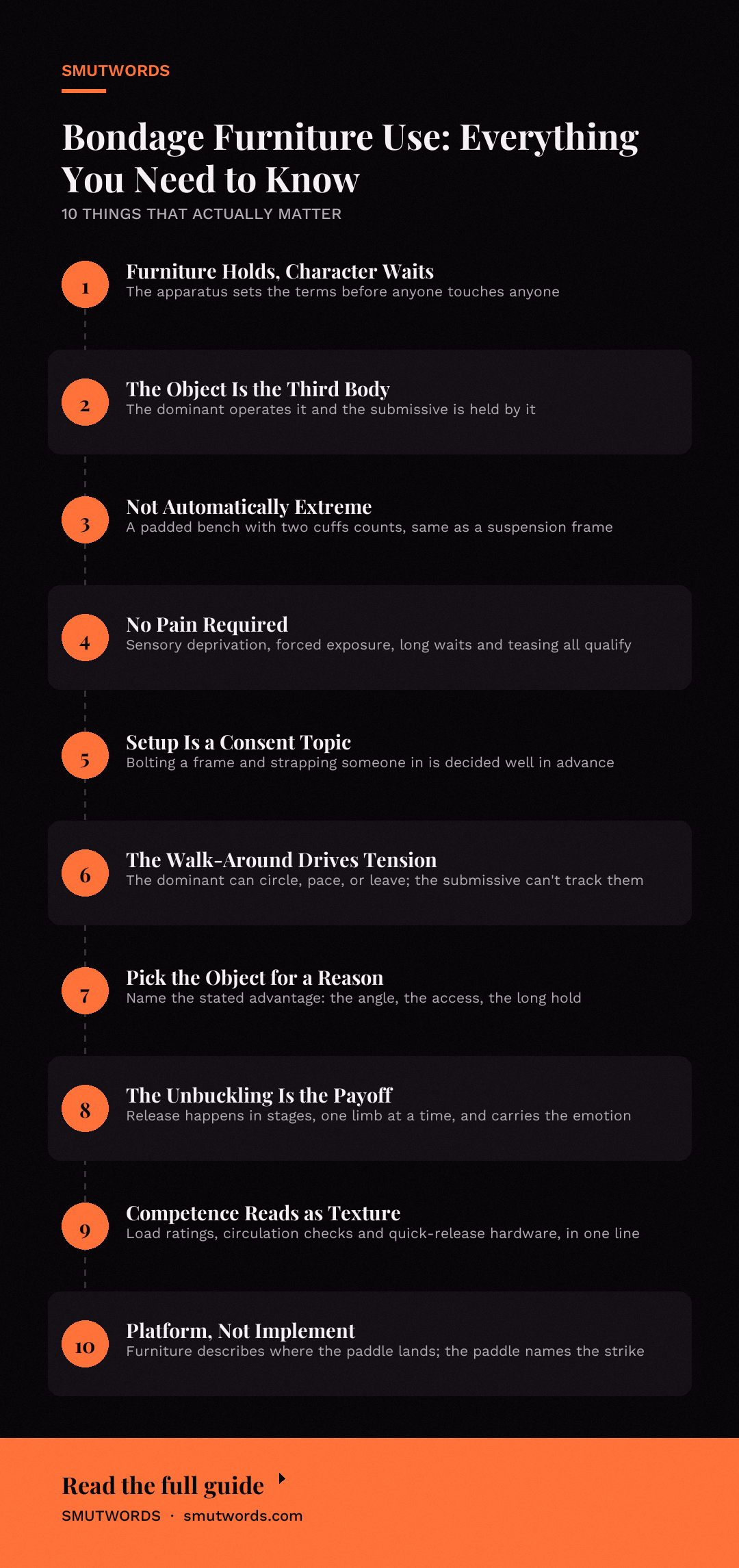
A spanking bench folds a body forward and presents a specific view. A pillory takes the hands and head out of play. A cage decides which direction the occupant faces and how much floor they get. The apparatus sets the terms before anyone touches anyone.
What counts as bondage furniture use is broader than purpose-built sex furniture, though purpose-built sex furniture is the core of it. A repurposed church pew, a heavy coffee table with anchor points bolted under it, a wall-mounted bracket set, a suspension frame over a garage floor: all of it fits the term if the body is secured to the object and the object is doing structural work.
What doesn't count is a scarf looped around a headboard for thirty seconds. That's a restraint aid. The furniture category implies mass, intention, and a setup that took planning.
Three misconceptions come up constantly in reader questions and in the fiction itself.
- That it's automatically extreme. A padded bench at hip height with two leather cuffs is bondage furniture, and so is a full suspension frame. The category spans everything from gentle to severe, and most published scenes sit much closer to the gentle end than the internet suggests.
- That the dominant is the main character of the scene. The apparatus is. The dominant operates it; the submissive is held by it. The object is the third body in the room.
- That furniture play is a masochism thing. Plenty of furniture scenes involve no pain at all: sensory deprivation, forced exposure, long waits, teasing. The apparatus delivers position and helplessness, which appeal to readers who skip every flogging scene in the book.
One more distinction worth stating plainly: furniture use in fiction is often the first thing negotiated and the last thing described. A well-built scene treats the apparatus itself as a consent negotiation topic, because bolting a steel frame to a floor and strapping someone into it is a decision made well in advance of the encounter, by people who talked about it first.
Where Bondage Furniture Use Comes From
The honest history here is thin in the way most kink histories are thin: the practice predates its archival record, and the published fiction has always run a step ahead of the etiquette manuals. Purpose-built restraint furniture existed for centuries in institutional contexts (stocks, pillories, cages) long before anyone wrote it into erotica. The erotic interest in those objects arrived through a different door. Nineteenth-century gothic and flagellant literature loved the dungeon-adjacent prop.
Restraint-and-discipline erotica of the early twentieth century, circulated privately and sold under plain covers, leaned heavily on benches, racks, and wall brackets because the apparatus solved a narrative problem: it kept a character in place for a chapter that a rope alone couldn't justify.
The real evolution is a publishing story. Bondage furniture use as a recognizable trope in commercial romance and erotica tracks the rise of the specialty publisher. From the mid-twentieth century onward, the books that sold on explicit restraint scenes built those scenes around equipment because equipment is photogenic in the reader's mind, easy to describe, and endlessly variable. The dungeon-as-location became a subgenre staple, and the furniture catalogued the room.
Three shifts changed how it's written now.
- From institutional to interior. Early scenes borrowed the dungeon and the prison. Contemporary scenes borrow the well-appointed private home: a converted basement, a locked spare room. The furniture stopped meaning punishment and started meaning investment.
- From exotic to domestic. Modern romance heroes and heroines buy furniture, have it delivered, install it discreetly. The apparatus became a sign of a partner who plans. That's a romantic gesture now.
- From set dressing to centerpiece. Older books used a rack in the background of a party scene. Current books put the bench in the middle of the page and give it chapters of its own.
Interest in scene play generally has grown alongside it, and so has the subgenre of highly technical, apparatus-forward kink written for readers who want the equipment named and used well. The headspace map of a furniture scene reads differently from a freestyle one, and the best authors know it.
How It Shows Up in Erotica
A furniture scene on the page lives or dies on a single craft question: does the object have a shape the reader can feel? The strong versions describe the apparatus in physical terms. The height of the bench relative to the dominant's hip. The cold of the cross against a bare back. The way a pillory forces the chin up.
The weak versions skip straight from "strapped to the bench" to the sex and let the furniture collapse into a prop noun.
The most reliable tension engine in the category is the walk-around. In freestyle restraint, the dominant is physically entangled with the submissive. In furniture scenes the dominant can leave. They can circle, pace, step out of the room, stand behind a head that can't turn. The submissive hears footsteps and can't triangulate.
Readers respond to that gap because it converts anticipation into an actual physical condition: held still, exposed, unable to check what's coming. This is also where domspace gets written well, since a character with a scale of options and a walking perimeter has room to enjoy their own planning.
The main variations, and what each one is good for
- Spanking bench. The workhorse. Padded, angled, presents the rear. Great for impact scenes and for wooden paddle territory, also useful for teasing and denial. The angle controls access, so the writer gets to choose what's reachable.
- St Andrew's cross. A vertical X, wrists and ankles at the four points. Face-out, fully visible, arms spread. Ideal for exposure and for a dominant who wants to look. The occupant sees everything, which changes the tension from anticipation-by-blindness to anticipation-by-watching.
- Pillory and stockade. Head and hands held. Blind by default because the neck can't crane. Best for scenes where the point is that the submissive can't see or move at all, and for rear-access setups.
- Cage play. Floor, bars, confinement over time. The chair of the category, because the scene is waiting rather than contact. The occupant sits, the dominant goes about their evening, comes back. Excellent for drawn-out tension across a long chapter.
- Suspension frame. An overhead structure rather than a support. Full-body restraint, feet possibly off the ground. Requires the technical detail to read right: anchor points, sling, load distribution. The most demanding to write, the most spectacular when done well.
- Spreader bar setup. A bar between the ankles or wrists, usually combined with something else. The word "spreader" does most of its own work; strong versions name the bar's length and what it permits.
- Fucking machine rig. Apparatus that does the moving. A logical extreme of the category: the furniture isn't just holding the character, it's acting. Best when the dominant controls the settings and the submissive has no say in pace.
- Breeding bench. A bench form with a specific posture: hips raised, face down or forward, body arranged for one purpose. Common in the breeding tropes that branch off cuckold breeding fiction.
- Wall-mounted restraints. Brackets bolted to a wall, arms overhead. The room itself becomes the frame. Works exceptionally well in domestic settings because the evidence is installed in the house.
What separates a strong scene from a flat one
A strong furniture scene does three jobs. First, it establishes why this object and not a rope. There's a stated advantage: the angle, the access, the long hold, the exposure. Second, it lets the submissive's body do work the writer doesn't have to describe. Position becomes posture, posture becomes feeling. Third, it gives the dominant something to operate, which means the dominant has decisions to make on the page.
A flat scene treats the furniture as a fetish object with no logistics. Nobody discusses setup, nobody has a bolt or a cushion or a safeword within reach, and the object might as well be a hotel bed. Editors notice this instantly, and so do readers.
Enjoyed this? Get a free book.
Join the list and we will send a complete free story straight to your inbox, plus new releases every week after that. No credit card, no catch.
There's also a craft point about sequencing. Furniture scenes want a beginning, a middle, and an unbolting. The setup, the holding, the release. The release matters most: how the apparatus is left, who has to be untied, what the body feels like coming out of a position it's held for twenty minutes.
This is where the scene hands off to aftercare, and the best authors give the unbuckling its own beats. The frame comes down or the cuffs come off, one limb at a time, and the character's newly returned range of motion is the emotional payoff.
Real-world details that improve fiction
Readers who know apparatus find sloppy details jarring, so a writer working this category should know the practical basics. Equipment has load ratings, and anchors need to be secured to structure, studs, or a proper floor plate, not plaster. A fixed position means circulation and joint strain are live concerns for anyone held for any length of time; strong fiction acknowledges both with a check-in or a reassessment.
Quick-release hardware and safety shears should be within reach during any scene with real binding, and the characters who read as competent are the ones who mention it, even in one line. None of this belongs in an erotic scene as a disclaimer. All of it belongs as texture, because competence is attractive and readers notice when a dominant has it.
The impact play aftercare that follows a bench scene tends to look different from the aftercare after a rope scene, mostly because the body is stiff, not the skin. Care in a furniture scene means decompressing joints, restoring warmth, and easing someone out of a posture they couldn't choose to leave on their own.
Romantic fiction gets real mileage from a dominant who's already got a blanket and a hot water bottle waiting, or who has to learn to be that person.
Bondage Furniture Use vs Wooden Paddle Scene
These two get confused because they co-occur so often: a bench scene where the paddle comes out reads to a newcomer as one thing, when really the apparatus is holding and the paddle is acting. The distinction is useful for anyone searching. Wooden paddle scene names the implement and the impact; the furniture describes the platform the implement is used on.
A paddle scene can happen over a knee, against a wall, or on no furniture at all. A furniture scene can involve no impact whatsoever.
The other reason the distinction matters is search intent. Readers looking for paddle content want the strike, the weight, the sound. Readers looking for furniture content want access, exposure, and the held position. Books that deliver both are the ones that sell hardest in this corner of the market, because the apparatus gives the paddle somewhere to land.
Readers interested in the more specialized edges of the category (apparatus paired with high-intensity play like blood play, or with breathplay choreography) generally want the equipment written to real-world spec, since the intensity doesn't leave room for hand-waving.
Frequently Asked Questions
What is bondage furniture use?
It's scene play built around dedicated apparatus: benches, crosses, pillories, cages, and frames, where a character is secured to or inside the equipment rather than simply tied in place. The furniture determines posture, access, and duration, and the dominant moves around it. The apparatus functions as the third presence in the scene.
Is bondage furniture use safe?
Purpose-built equipment used with proper anchors, load-rated hardware, and quick-release hardware within reach is reasonable, and the practice has well-established safety standards in the real-world scene community. The main concerns for anyone held in a fixed position are circulation and joint strain, which need periodic repositioning or release. Check-ins at regular intervals are standard.
What's the difference between a spanking bench and a St Andrew's cross?
A bench supports the body forward and angled, so the rear is presented and the front is often hidden. A cross fixes the body upright and face-out with arms and legs spread. Bench scenes tend toward impact and hidden anticipation; cross scenes tend toward full exposure and the submissive watching everything.
Why is the furniture often described in such detail?
Because the object's dimensions shape the scene. Bench height, bar length, cage size, and anchor height all determine what the dominant can do and what the submissive can see. Detailed description is how the writer communicates the geometry without a diagram.
Can a furniture scene have no impact play at all?
Yes, and plenty do. Sensory deprivation, forced exposure, teasing, denial, and long cage scenes are common forms that involve no striking. The category is defined by how the body is held, not by what's done to it.
How does a furniture scene end?
The equipment is opened, the character is released in stages, and the body gets time to return to its own posture. That release phase is where most of the emotional weight lands, and it's usually followed by aftercare: warmth, rest, food, and conversation. Writers who rush the unbuckling leave the scene feeling unfinished.
Final Thoughts
The category rewards writers who take the equipment seriously as an object with dimensions, weight, and consequences, and it rewards readers who like their tension spatial.
If you want to see bondage furniture use at its most confident, with a bench doing real structural work and a dominant who clearly measured the room first, start with a book that puts the apparatus on the page in the first chapter and keeps returning to it. The ranked list below has the ones where the furniture earns its place.





Loading comments…