
Shibari and rope bondage get used interchangeably in a lot of blurbs, and most of the time the swap does no real damage. But read enough of both and you start noticing something: a scene tagged shibari vs rope bondage reads differently on the page even when the physical setup is identical. Same woman, same wrists crossed behind her back. Different book.
The difference isn't in whether there's rope. It's in where the rope comes from, who's holding it, and what the writing cares about once the first wrap goes on.
This matters because the label tells you what kind of experience you're signing up for. A shibari piece and a generic rope bondage piece can share an identical setup and still feel like two entirely different books. Knowing which one you're holding saves you the small disappointment of expecting one and getting the other.
What shibari actually is
Shibari, sometimes called kinbaku, is a Japanese rope tradition with its own visual vocabulary and its own rooted history. It grew out of hojojutsu, the restraint methods used on prisoners by samurai-era authorities, and evolved through the 20th century into an erotic art form in Japanese publications and clubs before crossing into Western kink spaces in the 1990s and 2000s.
When a book uses the word correctly, it's naming a specific aesthetic. The rope is usually natural jute or hemp, often that bleached tan or dark brown rather than neon nylon, and the ties are built in patterned geometric shapes with names.
That naming is part of the texture. A writer who knows what they're doing will throw around terms like takate kote, the diamond-shaped chest harness, or karada, the full-body tie, and each one has a known look. The catalog photo in your head gets specific. You can almost smell the jute.
The other half of the tradition is the suspension. Shibari scenes often lift the body off the floor with a few well-placed anchors. How a body hangs, how the weight settles into the rope, how the tied person looks to the person holding the frame: that's as much the point as control is. This aesthetic emphasis is the core difference between shibari and the wider rope world.
The broader rope bondage umbrella
Rope bondage is the whole category. If people are using rope to restrain, decorate, or control each other, that's rope bondage, and the range inside the term is enormous. Haramaki-style work, harnesses borrowed from Western kink with no Japanese lineage, simple wrist and ankle ties, decorative corsets, and a hundred harnesses that exist because someone thought they looked good.
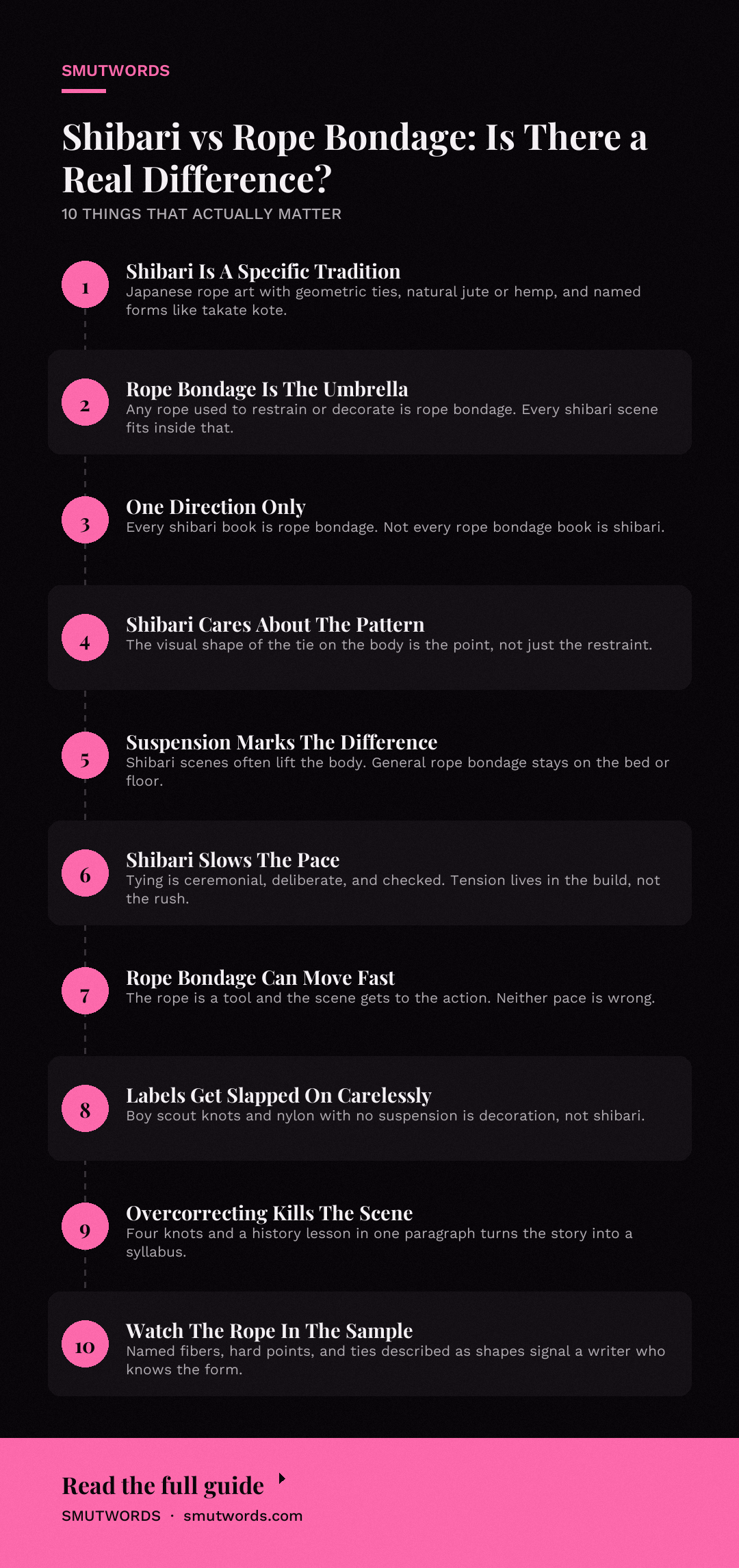
Shibari sits inside that umbrella as one specific tradition. Every shibari scene is rope bondage. Not every rope bondage scene is shibari, and a lot of books slap the label on anything with knots.
A hotwife story with her wrists tied to a headboard by a silk necktie is rope bondage. A story where a quiet man arranges her in a suspension frame on the patio, building the tie in stages while the whole scene holds its breath, is doing something closer to shibari.
The key differences you'll notice when the two labels are handled well:
- Origin: shibari comes from a specific Japanese lineage. Rope bondage in the broad sense includes Western-style restraint with no Japanese influence at all.
- Aesthetic center: shibari cares about the visual pattern of the rope on the body. General rope bondage may care only about the restraint.
- Rope material: shibari scenes tend to specify natural fiber (jute, hemp). Rope bondage scenes often don't specify at all, or use whatever's on hand.
- Suspension: shibari frequently involves lifting the body. Rope bondage often stays on the bed or floor.
- Craft: shibari treats tying as a practiced skill with a learning curve. Rope bondage can be spontaneous and crude.
How the two labels read on the page
Here's where it gets interesting for a reader. The two labels set up different expectations about pacing, and the successful books of each kind lean into them. Shibari slows things down. A good shibari scene is a slow build, because the rope has to be placed deliberately, checked for circulation, adjusted, and then built upon.
The tension lives in the ceremony of the tying. The book spends time on the sound of jute sliding against itself, the exact color the skin goes when a rope crosses it, the conversation between tyer and tied about whether the line is too tight.
Rope bondage can be much faster and rougher. It can be a quick, breathless scene where the rope is incidental and the real action is whatever happens once the wrists are secured. The rope is a tool. In shibari, it's closer to a collaborator.
That difference in focus changes what the writer describes. A shibari scene will stop to describe the geometry of the chest harness and how the cross lines up with the sternum. A general rope bondage scene might mention rope once and then get on with the plot. Neither approach is wrong, but they ask different things of you as a reader.
If you want to be inside the craft of the tie, look for the shibari label. If you want the rope to be the excuse rather than the main event, the umbrella term is usually more honest.
There's also a character dimension. Shibari scenes tend to feature a tyer with real skill and a certain quiet authority, someone who's spent years with a rope bag. Books that actually know the form write this person with patience and specificity.
A physical detail like the way a practiced tyer keeps the ends tidy, or takes a full minute to inspect a wrap before moving to the next one, does more character work than a paragraph of dialogue about trust ever could.
Where most books get the distinction wrong
A fair number of authors use "shibari" because it sounds more exotic than "tied up," then write a scene with zero of the tradition's markers: boy scout knots, nylon rope, no suspension, no Japanese terminology, and a rush to the sex within two paragraphs. The label is decoration.
When a reader who knows the form catches it, the illusion pops. It reads like a costume worn by someone who's never actually put one on.
The reverse mistake is a book that piles on the terminology so heavily it stops being a scene and starts being a syllabus. Four kinds of knot named in one paragraph, a paragraph of history about hojojutsu, and then the actual erotic content arrives fifteen pages in. The tradition becomes a footnote the story can't climb out of.
Enjoyed this? Get a free book.
Join the list and we will send a complete free story straight to your inbox, plus new releases every week after that. No credit card, no catch.
The best versions of this reach for maybe two specific, well-chosen details, the jute and the shape of the chest tie, and then get out of their own way.
If you're reading for the rope, look for one specific tie described in detail rather than a list of terms. That single tie is usually where the writer actually did the work.
Why the rope tradition pairs with certain character dynamics
Shibari's built-in ceremony gives a book a natural structure for a D/s dynamic that runs on patience and precision. A tyer who takes their time, tests every wrap, and asks a question before the next one reads as a person who takes the role seriously. Put that against a submissive character who needs to trust someone completely and you've got the engine of a lot of power-exchange fiction.
If you want a fuller picture of how those roles move around and switch, our piece on what a switch is in BDSM covers the territory where a confident tyer and a confident submissive aren't fixed labels.
The slowed-down pace of shibari also pairs naturally with denial-based plotting. When the rope is the event, a writer can stretch a scene to the edge of endurance without ever resolving it, and that's the same engine that drives orgasm denial. The rope holds the tension in place while the rest of the scene is made to wait.
General rope bondage fits the fast, crowded, rough-edged scenes where a lot of bodies and a lot of action don't need a single ceremonial tie. The no-frills approach lets the book spend its word count elsewhere.
If your taste runs toward the bigger, messier kind of setting, our guide to the orgy covers scenes where rope is one element among many. The foursome breakdown is worth a look too if the rope in your scene is holding more than one person in place.
What to look for before you open a book
The fastest way to tell which you're getting is to watch how the book handles the rope in the opening pages. A few specific tells:
- The author names a suspension frame, a hard point, or a carabiner. Shibari-aware writer.
- The rope has a fiber and a texture. Jute, hemp, worn cotton. Shibari territory.
- The tie is described as a shape on the body rather than a function of restraint. Shibari.
- The rope is a necktie, a bathrobe belt, or "whatever was in the drawer." General rope bondage, and the story isn't pretending otherwise.
- The scene moves from tied to sex in under a page with no mention of placement or tension. General rope bondage, no apology made.
None of these are quality signals on their own. A crude, quick rope scene can be excellent, and a meticulously described chest harness can sit inside a boring book. The tells just save you from expecting the wrong experience. If the blurb promises "shibari" and the scene is a scarf and a panic, you've caught the label doing work the writing doesn't back up.
The label also tells you something about intended mood, and mood is easier to shop for than technique. If you've ever skimmed the sample pages of Permission Slip: A Cuckold Erotic Short Story waiting for the moment the rope appears, you already know what it feels like when the tag misleads you. The scene that follows is worth it, but it's a different experience than a quiet tying ceremony.
Books whose titles telegraph the dynamic up front save you that surprise. He Paid Him to Fuck Me tells you exactly what kind of power exchange you're walking into before the first page.
The physical reality both labels share
Whatever the aesthetic, rope does the same things to a body, and the better books respect the basics. Jute leaves marks. A tight tie on a wrist creates a specific kind of welt that lingers into the next day, and smart writers use that as a callback scene.
A suspension requires a certain amount of physical fitness and a partner who knows what they're doing. Stories that acknowledge this read as more grounded for it. Real rope safety is its own skill, with whole schools of thought about nerve compression and nerve damage, and the writers worth reading don't skate past that part.
That's true whether the book calls it shibari or just "rope." The difference between a scene that lands and one that reads like a laundry list of kink vocabulary is almost always whether the writer understood what the rope is doing to the person underneath it.
The shibari label is a promise of a certain kind of attention. The rope bondage umbrella just means there's rope. Read the sample before you trust the tag, the same way you'd read the sample before trusting The AI Wants to Watch to be about the specific voyeuristic dynamic its cover implies.
Shibari vs rope bondage: the practical answer
If you're building a shelf and want a clean rule: shibari is the specific Japanese tradition with its geometric patterns, natural rope, and suspension work. Rope bondage is the whole category it belongs to. Every shibari book is a rope bondage book. The reverse isn't true, and the mislabeling usually runs in one direction, from the generic up to the specific.
For the reader, the practical question is what you want the rope to do in the story. If you want the ceremony, the slowness, the craft, and a tyer whose patience is its own kind of authority, look for shibari. If the rope should be a means to an end and you care more about what happens once the wrists are bound, the broader label is your friend.
Both live comfortably in the SmutWords catalog, and the difference between them is one of the more useful tags to know how to read, because it tells you what the book is actually paying attention to. A scene built on the tension of waiting is closer to orgasm denial in spirit than to the rougher tie-and-go end of the rope spectrum. That's a cross-reference worth keeping in your head.
Final Thoughts
Start with a book that gets the specific tie right, because that's the fastest way to learn the difference by feel. Shared Without Shame: A Hotwife Exhibition & Sharing Fantasy is a good place to begin, with its slow, deliberate choreography of a scene that takes its time with what's placed on the body and who gets to watch. Want the rougher rope-bondage end of the aisle after that? You'll know exactly what you're trading away.






Loading comments…