
Possessive sex is the specific subgenre of erotic writing where a character’s claim on another person stops being subtext and starts being the entire plot engine. You know the dynamic even if you’ve never called it by name: he tells her she’s his before he’s even gotten her clothes off, and she believes him.
The existing possessive hero guide covers the archetype: the growly billionaire, the mafia don, the fated mate who won’t take no for an answer. This post is about the part that guide skips. What possessive sex actually looks like on the page, which scenes work, which ones fumble the fantasy, and why “mine” keeps showing up in books that sell.
What Counts as Possessive Sex?
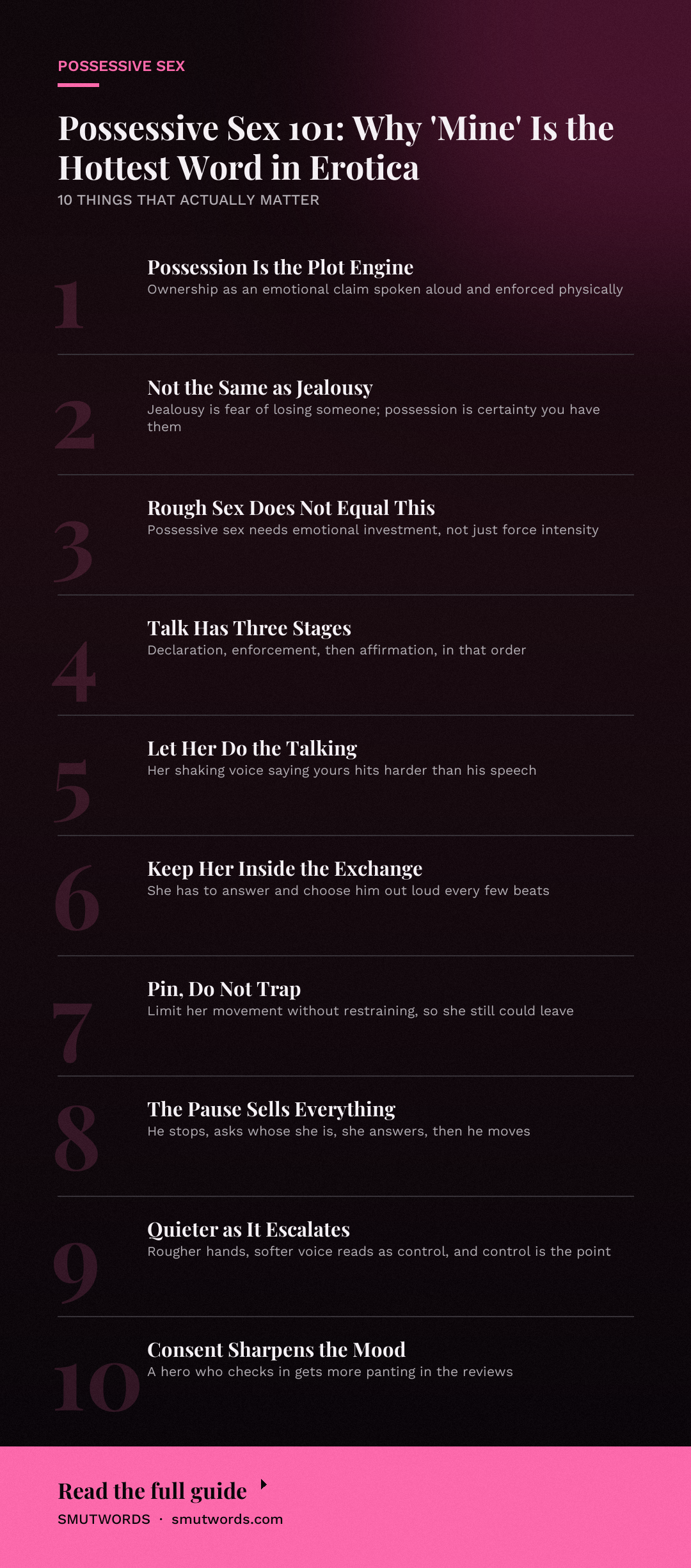
Possessive sex is sex where ownership is the point. Not ownership in a legal or property sense. Ownership as an emotional claim that gets spoken aloud, enforced physically, and reaffirmed every time the characters touch.
The dirty talk runs on possession. So does the choreography. A hand at the back of the neck. A thigh pinned down. A whispered you’re not going anywhere that lands because both people already know it’s true.
It’s adjacent to the jealousy kink (someone watching, someone wanting) but it isn’t the same thing. The confusion trips up readers all the time, so it’s worth untangling: Possessive Sex vs Jealousy Kink: What’s the Real Difference? covers where the two tropes split.
Short version: jealousy is about the threat of losing someone. Possession is about the certainty of already having them.
How It Differs From Rough Sex Generally
Rough sex can happen between two people who don’t care about each other at all. Possessive sex requires investment.
The intensity isn’t coming from the force of the act. It’s coming from the fact that both people are emotionally locked in, and the sex is how they confirm it. Take the possessiveness out and half these scenes read like standard dom/sub. Put it back in and the same dialogue gains a different charge entirely.
That’s also why possessive sex overlaps so heavily with darker tropes. Stalker romance runs on it. So does most hate to love, where the claim gets asserted after a hundred pages of denial.
Same with enemies to lovers, where the possessive turn is the moment the rivalry curdles into something else. None of those tropes require possessive sex. Almost all of them eventually deliver it.
The Dirty Talk That Actually Works
Here’s where most writers fumble. Possessive dirty talk isn’t just the word “mine” repeated every third sentence. It’s a specific rhythm, a claim, a demand, a confirmation loop, and the words shift depending on which stage the scene is in.
Early in the scene, the talk is about declaring. You’re mine. Say it. Tell me whose you are.
Mid-scene, it turns into enforcement. Nobody else gets to see you like this. You don’t get to come until you say my name.
By the end, it snaps into affirmation. Show me. Prove it. That’s right. Again.
The instinct with a possessive hero is to make him talk the entire time. Bad idea. The strongest scenes let the possessor go mostly silent and let the possessee do the talking, because the fantasy here is being claimed, not being lectured. Her shaking voice saying yours hits harder than his slick speech about what he’s going to do to her.
Lines That Land and Lines That Don’t
- Lands: “Say my name like it’s the only one you’ve ever had.” Because it asks for a specific action, not a vague vow.
- Fumbles: “You belong to me, body and soul, forever and always.” Too much, too fast, no room for her to respond.
- Lands: “Who else has touched you like this?” Because it invites her to say no one, which is the actual answer he wants.
- Fumbles: “Mine, mine, mine, mine.” Repeating a word four times isn’t dirty talk. It’s a placeholder the author didn’t finish.
- Lands: “Tell me you want this.” Because possessiveness without consent reads like a stalker monologue, not a sex scene.
- Fumbles: any variation of “You’ll never escape me.” Threatens the reader, not the love interest, and torpedoes the fantasy.
The pattern’s obvious once you name it. Good possessive dirty talk keeps the possessee inside the exchange. She has to answer. She has to choose him again, out loud, every few beats.
The Physical Beats That Sell the Trope
Possession lives in the body blocking, not the verbosity. A hand wrapped around a wrist. A forearm braced across a chest. A knee wedged between thighs to keep them apart.
Any gesture that limits her movement without actually restraining her. That last clause matters. The fantasy is “he’s not letting me leave,” not “I can’t leave.”
The single most reliable beat in the entire trope: he stops right before the main event, cups her jaw, and makes her say whose she is. Then, and only then, does he move.
That pause is where the whole fantasy lives. Skip it and the scene reads like generic dominance. Include it and the reader gets the thing she opened the book for.
Another beat that lands more often than writers realize: the possessive hero gets quieter as the scene escalates. Not louder. Rougher hands, softer voice. It reads as control, and control is the entire promise of the archetype. Yelling breaks the spell.
Why Silence Beats Speech in Possessive Sex Scenes
(That extra “s” up there is on purpose, in case you were about to call it out. Possessive sex scenes are also the ones where the hero can’t spell “possessive” without checking.)
Enjoyed this? Get a free book.
Join the list and we will send a complete free story straight to your inbox, plus new releases every week after that. No credit card, no catch.
The reason silence beats speech: the possessee’s body language does the heavy lifting. Grip tightening. Her nails on his back. The way she arches into the press of his hand instead of pulling away.
His silence gives her room to be the loud one, and readers want her reaction, not his. His job is to hold the frame. Hers is to break inside it.
This is also why the trope does so well in stories with established stakes. Soldier romance and mafia both lean on it, because a man who’s been to war or runs a criminal empire reads as someone who already understands command. So does soulbond fiction, where the magical claim does half the possessiveness for the author. Same energy, different scaffolding.
Consent Is What Makes It Work
Possessive sex without consent is just a scene where someone gets hurt. The trope runs on the possessor asking and the possessee giving. Or it runs on a pre-existing agreement, a safeword, a relationship where both people have already negotiated what’s on the table.
If you’re writing this and you’re not sure where the line is, the BDSM four letters breakdown is a decent short refresher on what consent looks like when it’s actually built into the scene and not tacked on. Possession isn’t the same as domination, but they live in the same neighborhood, and the same rules apply.
Readers can tell the difference instantly. A possessive hero who checks in (still okay?) right before he pushes harder gets more panting in the review section than one who barrels through.
The check-in doesn’t kill the mood. It sharpens it. Because it means he’s paying enough attention to know what she needs, which is the whole fantasy spelled out.
Where Possessive Sex Goes Wrong
The failure modes show up in three places, and they’re predictable enough to spot from the back cover:
- The possessive hero never softens. He growls through every scene, including the ones where the heroine is crying. No arc, no give. Readers check out around chapter six.
- The heroine has nothing to do except submit. If her only dialogue is yes and please and more, she isn’t a character. She’s furniture. The fantasy needs her to want him back, not just take him.
- The claim gets made but never reaffirmed. Possessive sex without possessive aftercare is just a rough scene. The reader needs one more moment (his hand on her back in the hallway, his jacket on her shoulders, his voice on the phone) to lock the claim in place after the sex ends.
Which is also why the trope pairs so well with redemption arc romance. The possessive hero usually needs to earn his way from “menacing” to “worth keeping.”
Most of the genre’s best versions of this arc spend as much page time on the moment he stops trying to own her and starts trying to keep her. Two different projects. Both read as possessive on the surface. Only one works.
The Different Flavors of Possessive Sex
Not all possession reads the same. The tone shifts depending on the subgenre, and readers have strong preferences about which one they want before they’ve cracked the spine.
Billionaire and CEO
Runs on control-as-resource. He owns buildings. He owns companies. He’s decided to own her too, and the sex is where he loses the composure he uses to run everything else.
Dressing rooms, private elevators, the meeting table after everyone else has left. The claim usually arrives as a shock to him, which is half the appeal.
Mafia and Dark Romance
Runs on external threat. He has to claim her because if he doesn’t, someone else will. The possessiveness is protective at the surface and territorial underneath, and the sex almost always includes some version of you’re safer with me than without me.
Handled well, the stakes are real. Handled badly, it reads like a man explaining why he’s doing her a favor.
Paranormal and Fated Mates
Runs on biology or magic. The claim isn’t chosen, it’s happened. The sex is often the moment the bond locks. This is where the soulbond framework shows up, and where authors can lean hardest into possessiveness without it feeling like a red flag, because the universe has already signed off on it.
Arranged Marriage and Royal
Runs on outside obligation. The claim is legal before it’s romantic. The possessiveness arrives as a surprise to both people (wait, I actually want this) and the sex is usually where they stop performing the role and start meaning it.
Both arranged marriage and royal romance use this exact beat, and neither works if the sex scene doesn’t shift the dynamic between them.
How to Write It: A Short Checklist
- Decide what’s being claimed (a person, a future, a promise, an identity) before you write a single word of dialogue.
- Give the possessee an active role. She has lines that aren’t yes, and at least one moment where she pushes back rather than melts.
- Build the physical blocking around restraint without cruelty. Pin, don’t trap.
- Use the pause. He stops, he asks, she answers, he continues. That beat is the trope in miniature.
- Write a scene after the scene. Possessive sex ends with an aftercare moment that reasserts the claim in a quiet register.
- Let the possessor soften at least once. A hero who never wavers isn’t possessive, he’s uninteresting.
If you’re still working out the adjacent tropes before you sit down to draft, there’s more material to read on site. Ghostwriter romance covers the version where the possession is professional, and cyberpunk romance the version where the claim gets made inside a fake identity and then has to survive the reveal.
Final Thoughts
The trope works because “mine” answers a question readers are already asking about every character in every sex scene: does this person actually want me, or are they just here? Possessive sex answers it loudly and often.
If you want to see the beat pulled off with the whole formula intact (the declaration, the pause, the answer, the aftercare), start with any of the fated mate books that get the bond-locking scene right. Skip the ones where the hero growls through the entire last act without ever asking a single question. You’ll know within two chapters which kind you’ve picked up.





Loading comments…