
The first time trope is the erotic and romantic convention built around a character's first sexual experience, whether that means literal virginity or a first with a new partner after years of abstinence, repression, or simply a life that never made room for touch. The scene or arc hinges on discovery: one person learning what their body does, the other guiding without condescending.
The trope earns its enormous popularity because it packages vulnerability, consent, and emotional stakes into a single encounter. Readers come back to it for the raw honesty of someone becoming sexual in real time.
What the First Time Trope Actually Means
The name describes a narrative event, not a specific act. A first time is any encounter that functions as an initiation for at least one participant, and the trope is the set of storytelling habits writers use to make that initiation feel meaningful: nerves, fumbling, a steadying hand, a pause to ask, a moment of wonder. The label covers a lot of ground that readers sometimes assume is narrower than it is.
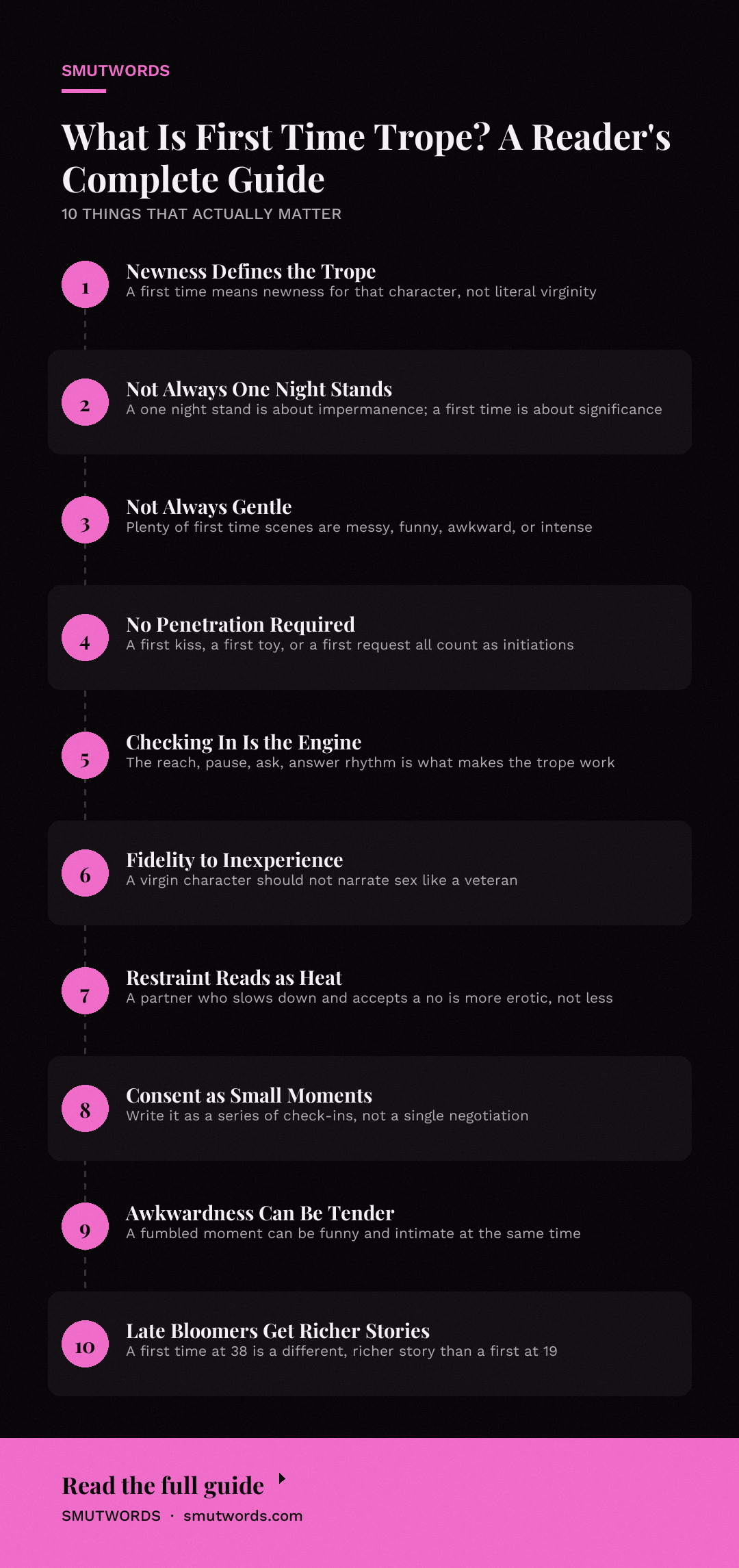
The trope does not require virginity. A divorced heroine in her forties having her first orgasm with a partner counts. So does a widower's first night with someone new, a repressed character's first time asking for what they want, or a man's first experience with another man. The defining feature is newness for that character, which is why the term "first time trope" shows up on books where nobody is technically a virgin.
Several common misconceptions are worth clearing out. Readers and writers often conflate the first time trope with the one night stand, but a one night stand is about impermanence and a first time is about significance; they can overlap, though they usually pull in different directions. The trope is also often assumed to be soft and gentle by default. Plenty of first time scenes are messy, funny, awkward, or intense.
And people assume the trope requires penetration. A first time can be a first kiss that changes everything, a first time using a toy, a first time being tied up in shibari, or a first time asking a partner to watch. The initiation is the story; the specific act is a delivery mechanism.
Where the First Time Trope Comes From
In romance publishing specifically, the first time trope has been a recognizable fixture since at least the mid-twentieth century, when mass-market paperbacks codified the genre's interest in a heroine's sexual awakening. Those mid-century novels were coy about the mechanics but intense about the emotion, and the structure they established (nerves, an experienced partner, a moment of surrender) survived long after the censorship that shaped it faded.
The 1970s and 1980s brought more explicit historical romance, and the first time scene became a set piece readers expected and skipped ahead to. The trope's reputation for emotional stakes rather than just physical description hardened during this period. The virgin heroine became a genre staple, and with her came the virgin hero as a smaller but persistent counterweight, usually in historicals and later in contemporary fiction that wanted to show a man learning too.
The bigger shift came in the 2000s and 2010s. New Adult fiction made college-age first times a publishing category of their own, and internet erotica communities expanded the trope well past the heterosexual, virgin-heroine template. Gay romance exploded with the "first gay experience" variant, and the trope became a reliable structure for coming-out stories.
Meanwhile, the rise of self-publishing let writers put out first time books aimed at readers who wanted the nerves, the discovery, and the consent negotiation without the coyness.
Recent years have also brought the "late bloomer" and "first after celibacy" variants into plain view. Writers increasingly use the first time trope to explore characters who choose not to have sex for years, whether because of faith, trauma, career, or simple preference, then decide they want to. The genre has slowly acknowledged that a first time at 38 is a different, richer story than a first time at 19.
The trope's history is partly a publishing history. Erotic romance has cycled through waves of enthusiasm for virgin heroines, virgin heroes, and coming-out first times, and each wave left its imprint on the readers who bought those books and asked for more.
How the First Time Trope Shows Up in Erotica
On the page, a strong first time scene does four things at once: it establishes nerves, it builds a ramp of trust, it delivers physical description that matches the character's inexperience, and it lands an emotional beat afterward. Editors read hundreds of these arcs, and the ones that stick out tend to get the order right. Skip the nerves and the scene reads like a manual. Skip the trust and the sex reads like a violation.
The most common structural choice is the "checking in" rhythm: a character reaches for something, pauses, asks, and gets an answer. That rhythm is the engine of the trope. Writers vary the proportion of fumbling to confidence, but the checking in is what lets readers trust that the encounter is wanted and wanted well.
Common variations writers use
- Virgin heroine: the classic, and still the most published. Readers expect a steady, confident partner and a heroine who is nervous but clear about wanting it.
- Virgin hero: less common, increasingly popular. The emotional beat is often his fear of being laughed at, and the payoff is a heroine who makes the fumbling feel welcome.
- First gay experience: a first with a same-sex partner, often as a coming-out or self-discovery arc. The trope overlaps with the broader first time brand but has its own conventions around identity rather than just mechanics.
- First after celibacy: a character re-entering physical intimacy after years of no sex, whether by choice or circumstance. This variant tends to emphasize the shock of sensation and the strange newness of a familiar body.
- Late bloomer: a character whose first time comes at an older age. These stories often do the most work to dismantle the assumption that inexperience is a flaw.
- Awkward first time: a variant that deliberately leans into the fumbling, the misplaced elbow, the absurdity of two people learning at once. Readers seek this out when they want warmth and humor rather than grand romance.
- First time with a kink element: a first spanking, a first rope scene, a first request for degradation kink play. The initiation is now double-layered: new to sex and new to the kink.
What makes a first time scene strong on the page is fidelity to the character's limited knowledge. A virgin character should not narrate sex like a veteran. The description should catch on strange details: the texture of a palm, the weirdness of a sound, the surprise of a body doing something they didn't expect. The strongest versions let readers experience the novelty through the character's senses rather than through a director's overhead shot.
Strong versions also make the partner's restraint visible. The experienced character who slows down, asks, and accepts a no on the first attempt reads as far more erotic than the one who barrels ahead. Restraint is a form of care, and care is a form of heat. The best writers know that a partner who asks is doing something intensely appealing, and they write it that way.
Enjoyed this? Get a free book.
Join the list and we will send a complete free story straight to your inbox, plus new releases every week after that. No credit card, no catch.
Flat versions share a few failure modes. The first is a character who is inexperienced on page one and a sex expert by page three with no learning curve. The second is a partner who is experienced but never checks in, which makes the consent angle hollow.
The third is a scene where the awkwardness exists only as a comedic beat and never becomes part of the intimacy. A fumbled moment can be funny and tender at the same time; a writer who only mines it for laughs wastes it.
Writers who handle the trope well often borrow texture from adjacent subgenres. A first time in a boss/employee romance carries the power dynamic into the bedroom, and a first time in a chef/restaurant romance often trades on the sensory details of a kitchen. A first time in a brother's best friend story leans on the forbidden-friend conflict. The trope is flexible enough to absorb whatever the setting provides.
Consent on the page
Readers who love the first time trope often cite consent as the thing that makes it work. The scene has to show two people actively agreeing, and it has to show a partner reading signals in real time. A line as simple as "tell me if it's too much" does enormous work. Writers who skip it or treat it as a box to check end up with scenes that feel either clinical or uneasy.
The stronger convention is to write consent as a series of small moments rather than a single negotiation. A character says "not yet" and the partner waits. A character reaches for something new and asks first. The trope rewards slow escalation, because slow escalation is itself the erotics of a first time.
First time scenes and adjacent kinks
The trope often introduces other kinks through the door of a first. A first time with primal play, for instance, has to establish consent twice: once for the sex and once for the chase. A first time with sensory play can borrow the texture language from our guide to sensory play for couples, because a blindfolded character is learning through touch and temperature rather than sight.
The trope also pairs well with the guided-masturbation structure of a JOI scene, and our beginner's walkthrough of the JOI game is a useful point of reference for writers who want a first time that is verbal, instructional, and hands-off. The trope can accommodate the character being talked through their first orgasm, and that variation is one of the most requested.
Frequently Asked Questions
Is the first time trope only about virgins?
No. The trope covers any initiation: a first with a new partner, a first after years of celibacy, a first kink experience, or a first orgasm with someone else. Virginity is one common version, not the definition.
Why do readers love first time stories so much?
The appeal is the combination of vulnerability and trust. Readers get to watch a character become sexual in real time, and the partner's care during that process is itself intensely appealing. The emotional payoff is larger than the physical description alone would provide.
What's the difference between the first time trope and a one night stand?
A one night stand is defined by impermanence; a first time is defined by significance for the character. A first time can happen between strangers, but the story it tells is about the character's initiation, not about the encounter's brevity.
Do first time stories always have to be gentle?
No. Some of the strongest versions are funny, awkward, messy, or physically intense. What they can't skip is the trust negotiation, because a first time that ignores consent reads as a different (and much worse) trope entirely.
What's the "late bloomer" variant?
A late bloomer story centers a character having a first time at an older age, usually in their thirties, forties, or later. These books often emphasize how much more the character knows about themselves and how much more they've decided to want.
Is the virgin hero variant as popular as the virgin heroine?
It's less published but steadily growing. Readers who seek it out tend to want the hero's vulnerability treated as appealing rather than shameful, and the strongest virgin hero books make his inexperience part of the romance's warmth.
Final Thoughts
The first time trope endures because it does something very few conventions can: it makes the reader feel present at a genuine beginning. Pick up a strong example the next time you want a book that takes its time, and notice how often the best scenes are the ones where the character asks a question before doing anything at all.





Loading comments…