
Dragon shifter romance is the subgenre where one half of the couple can turn into a dragon, and the other half has to decide whether that's a dealbreaker or the best news they've ever gotten.
The hero is usually ancient, wealthy, territorial, and running on a mating instinct he didn't choose. The human (or witch, or elf) who trips it becomes the center of a hoard that includes gold, land, and an alarming amount of possessive attention. If you've ever wanted a love interest who could burn down a city and chooses instead to build you a house, this is your aisle.
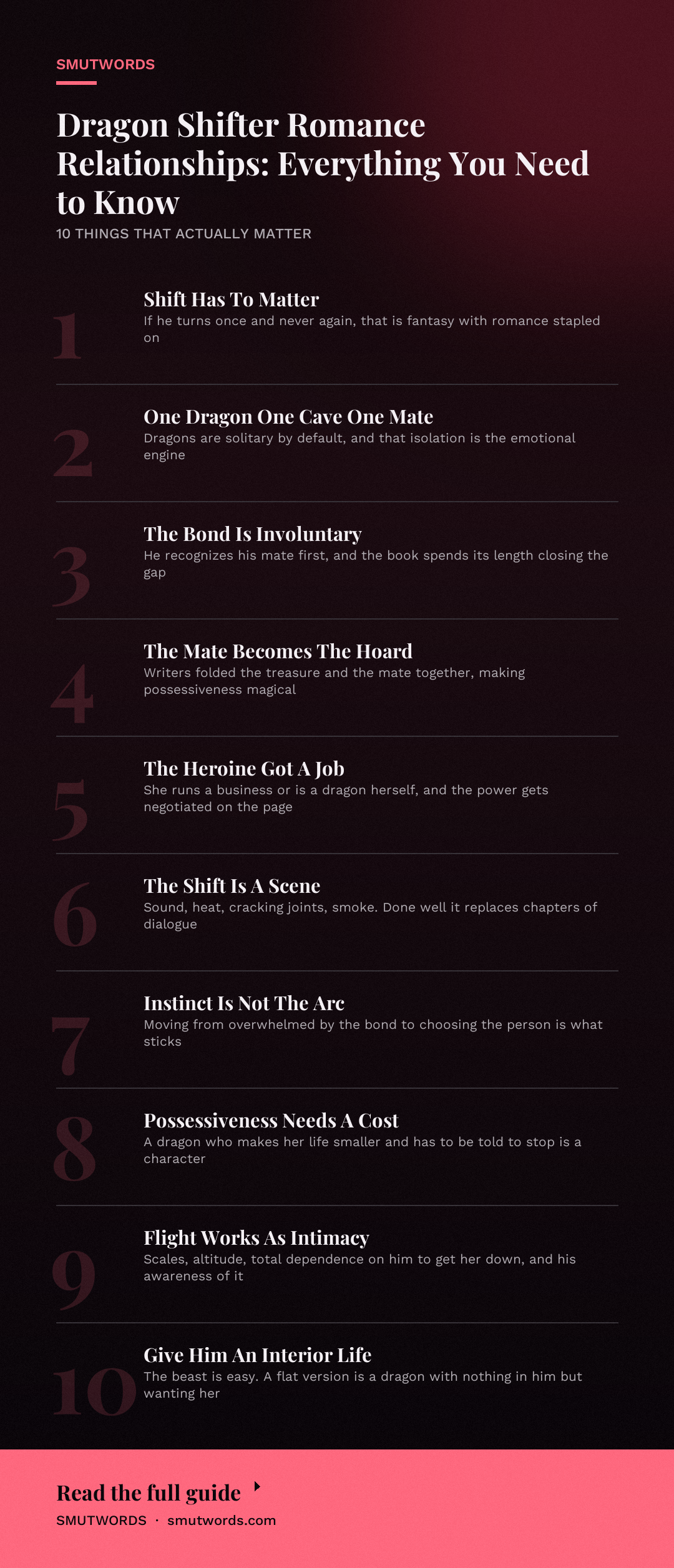
What separates a real dragon shifter romance from a book that just happens to have a lizard in it comes down to the bond, the beast, and the pile of treasure. The transformation has to matter. It has to change how the characters touch, fight, and commit to each other, or you're reading fantasy with a romance subplot stapled on.
What Dragon Shifter Romance Actually Means
The name does double duty. "Shifter" tells you the hero moves between two bodies, human and animal, and that the animal half is not a costume. "Dragon" tells you which animal, and that choice carries a specific set of expectations: fire, flight, longevity, hoards, and a temperament that runs hot even by shifter standards.
A dragon shifter romance sits inside the wider shifter genre, but it behaves differently from wolf or big cat books. Wolves come in packs, so those stories are about community, hierarchy, and shared territory (see Pack Mates Romance for how that structure works).
Dragons are solitary by default. One dragon, one cave, one mate. That isolation is the emotional engine of the whole subgenre, and it's why dragon books can carry a loneliness that pack stories never touch.
The mating bond is where the romance lives. In most versions it is involuntary, permanent, and physically undeniable. The dragon recognizes his mate before she recognizes anything, and the book spends its length closing that gap. Some authors handle this with a formal soulbond that snaps into place; others keep it biological and messy, a scent and a heartbeat instead of magic.
What does not count matters just as much. A book where the dragon shifts once in chapter three and never again is not doing the work. Neither is a story where the mate bond gets mentioned but never complicates anything, where the heroine could be swapped for a human love interest with no changes to the plot. The shift has to cost something and give something.
Common misconceptions, quickly:
- It's not a genre of its own. Dragon shifter romance is a subgenre that lives inside paranormal romance, fantasy romance, and sometimes sci-fi romance, and it borrows freely from all three.
- It's not always dark. Plenty of these books are cozy, funny, and low-conflict. A dragon who hoards teacups and panics about a dinner date is as legitimate as a warlord who burns a rival kingdom.
- The dragon is not always the man. Heroine dragons exist, and dragon-dragon pairings are a growing slice of the category.
- It's not just about sex. The heat level ranges from closed-door to genuinely filthy, and the subgenre's core appeal (being chosen, protected, kept) works at every temperature.
Where Dragon Shifter Romance Comes From
Dragons are older than romance publishing, but the specific shape readers know today has a traceable lineage. The modern dragon shifter hero grew out of the paranormal romance boom of the 1990s and 2000s, when authors started taking the alpha male archetype that had been running through category romance and giving him an animal form.
Wolves got there first, largely because pack dynamics mapped neatly onto family sagas. Dragons took longer, mostly because they are expensive to write. A wolf pack lives in a small town. A dragon needs a mountain.
The 2000s and early 2010s turned that expense into an asset. Self-publishing and digital-first imprints made it possible to sell a hundred-thousand-word dragon saga directly to readers, and demand exploded. Series became the default format, because a dragon's long lifespan practically begs for a family tree. You get brothers, cousins, an entire clan of fire-breathers, one book each.
Two shifts happened in that period worth naming.
First, the hoard changed meaning. Early dragon books played the treasure straight: gold, gems, a cave the heroine wanders into. Later writers started making the mate part of the hoard, which turns possessiveness from a character flaw into a literal magical fact of the dragon's nature. That single move generated most of the subgenre's current kink appeal.
Second, the heroine got a job. Twenty years ago she was usually a researcher who stumbled onto a secret. Now she runs a business, flies her own plane, or is a dragon herself. The power imbalance that used to be the whole point is now something authors negotiate on the page instead of assuming.
The category also cross-pollinated hard. Dragon shifters show up alongside the cold, aristocratic immortals of Fae Romance and the long-lived, half-wild figures of Elf Romance, and increasingly in hybrid books where the love interest is more than one species at once, which is its own established lane now (see Hybrid Shifter Romance).
How It Shows Up in Erotica
On the page, a dragon shifter romance is a machine for generating tension between two speeds. The dragon operates at full throttle: instinct, appetite, fury, immediate ownership. The human half has to live in a world with landlords and siblings and a job. The best books in this subgenre get their heat from that mismatch, not from the fire.
Here is what the strongest versions do consistently.
The shift is a scene, not a footnote
Transformation is where the subgenre gets to show off. Authors write it as a physical event with sound, heat, cracking joints, the smell of smoke, the ground shaking. The first time the heroine watches him shift is almost always a load-bearing scene, and it usually ends with her seeing him in a way she cannot unsee. Done well, that scene replaces three chapters of dialogue about trust.
The bond escalates the physical relationship
A mate bond gives authors permission to write insta-lust without it feeling cheap, because the characters are not choosing to want each other; they are surviving it. The arc then moves from being overwhelmed by the bond to actually choosing the person. That second step is what separates a good book from a forgettable one. If the couple is still just riding the mating instinct at the ninety percent mark, the ending lands flat.
This is the same reason claiming kink shows up so often here. A dragon marking his mate is claiming, ownership, and scent-marking in one gesture, and the scene usually arrives at exactly the moment the heroine stops running from what she wants. Authors who want the physical side to land should read how that kink is built before attempting a marking scene, because the mechanics carry the meaning.
Enjoyed this? Get a free book.
Join the list and we will send a complete free story straight to your inbox, plus new releases every week after that. No credit card, no catch.
Possessiveness needs a cost
A dragon who growls at anyone who looks at her is scenery. A dragon whose possessiveness makes her life smaller, and who has to be told to stop, is a character.
Readers tolerate a lot of alpha behavior when the book is honest about what it costs the heroine and lets her push back. The heat in a possessive scene comes from the negotiation underneath it, even when that negotiation is nonverbal. For a related dynamic built on the same push and pull, see the Territorial Shifter Trope.
Flight is erotic when it's written physically
Riding a dragon gets used as pure spectacle far too often. The version that works treats it as intimacy: her body pressed against scales, the altitude, the total dependence on him to get her down, his awareness of exactly how much trust that requires.
Some authors go further and make flight the foreplay. That thread runs through a lot of the mating-bond material in the subgenre, and it is one of the few tropes here where the dragon's non-human body is the main event rather than a reveal.
Aftercare matters more with extremes
Dragon books run hot: claiming, breath play adjacent scenes, restraint, territorial displays. When a scene pushes that hard, the landing has to be as carefully written as the climb, and the better authors treat it that way. If you want to see how that beat is constructed across both fiction and real practice, this guide to aftercare is worth the read.
The same applies to the deep, floaty headspace a submissive character drops into after an intense scene, which dragon romances often write without naming: the complete guide to subspace covers what that state actually looks like.
Common variants, by flavor
- Fire-breathing alpha: the classic. Huge, hot-tempered, runs a clan, owns the mountain.
- Ice dragon: cold, controlled, often centuries lonely. The thaw is the whole plot.
- Royal dragon: political intrigue, courts, succession drama, a throne he does not want.
- Lost dragon lord: the last of his line, or one who has been asleep, imprisoned, or hiding in plain sight.
- Dragon-bearer: the human mate carries something of the dragon inside her, which changes the power balance completely.
- Alfhedran mate: a bond-specific term used in some series for a fated, soul-deep pairing.
What makes a flat version is usually one thing: the dragon has no interior life apart from wanting her. The strong versions give him centuries of grief, a hoard he is embarrassed by, a relationship with his own species he has failed at. The beast is the easy part. The man who has to live inside it is where the writing is.
Dragon Shifter Romance vs Kraken, Merman, and Angel Romance
Readers cross-shop these constantly, and the differences are real enough to matter when you're deciding what to read tonight.
Kraken and merman romance trade in water, isolation, and depth rather than fire and flight. The settings feel entirely different, and the power fantasy runs cooler and stranger. Kraken Romance in particular leans harder into body horror and tentacle mechanics than dragon books generally do, and the isolation is oceanic rather than mountainous. If what you love about dragon shifter romance is the flight and the heat, water books will feel like a different sport.
Angel romance swaps the beast for a divine enforcer. The tension is duty versus desire, with a heavy dose of forbidden, and the love interest usually has an institution to answer to. Dragons answer to nobody. That absence of external authority is a big part of why the subgenre feels so unrestrained.
Where dragon shifter romance genuinely overlaps is with other shifter books, and that comparison is worth knowing because the dynamics run close. The difference is scale and solitude: dragons are singular, ancient, and rich, and the mate bond tends to be more permanent and less negotiable than anything in a wolf book.
Frequently Asked Questions
What is dragon shifter romance?
It is a romance subgenre where one or both love interests can transform into a dragon, usually with a fated mate bond, a hoard, and a possessive-protective dynamic driving the plot. The books range from cozy small-town stories to dark, high-heat fantasy epics.
Is dragon shifter romance the same as paranormal romance?
No. Paranormal romance is the umbrella; dragon shifter romance is one subgenre under it, alongside wolf shifters, vampires, and witches. A dragon shifter book is almost always paranormal or fantasy romance, but not all paranormal romance involves dragons.
Do I need to read dragon shifter romance series in order?
Usually not strictly, but it helps. Most series are written so each book follows one couple to a happy ending, with characters from earlier books appearing in supporting roles. Starting mid-series works, though you will spoil earlier pairings.
Why is the dragon always so possessive?
Possessiveness comes from the hoard instinct. In most worldbuilding, the dragon's mate is treated as part of the hoard, which makes the instinct involuntary rather than a personality trait. The strongest books make that possessiveness something the couple negotiates rather than a fixed fact.
Are there dragon shifter romances with a female dragon?
Yes, and they are a growing share of the category. Heroine dragons often invert the usual power balance: she is the ancient, wealthy, territorial one, and the human love interest has to adjust to being kept.
How explicit is dragon shifter romance?
Heat levels vary widely. Some titles are closed-door, many are explicit, and a subset goes quite far into claiming, restraint, and marking territory on the body. Check the content notes before starting if you have preferences.
Final Thoughts
Dragon shifter romance works because it takes the largest possible power and aims it at one person. Everything else, the hoard, the mountain, the centuries of solitude, exists to make that aim feel like a choice rather than an accident. When you find a book that gets the shift, the bond, and the cost of possessiveness all correct in the same hundred pages, you will understand why readers stay in this subgenre for years.
If you want a starting point, pick a series opener with a lost dragon lord and a heroine who already has a life worth protecting. That combination forces the author to earn the ending instead of handing it over.





Loading comments…