
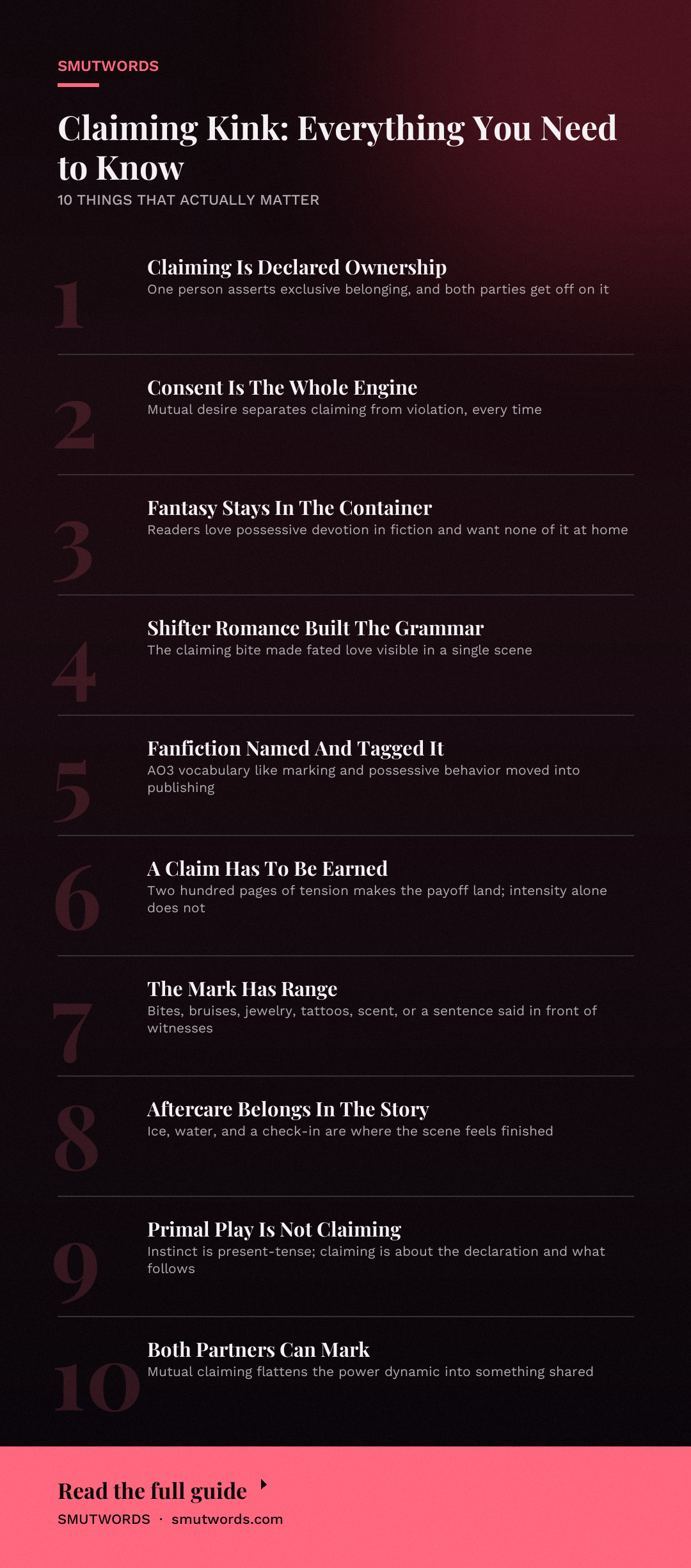
Claiming kink is the erotic charge that comes from being marked, declared, and treated as someone's exclusive property. The mark can be a bite on the shoulder, a bruise on the hip, a ring, a collar, or a sentence growled against your ear. It runs on possession, the fantasy of being so wanted that your partner needs the world to know you belong to them.
The trope shows up everywhere from dark romance to paranormal shifter books, and it works because the stakes are emotional as much as physical. Someone is not just sleeping with you. Someone is staking a claim.
If you have ever finished a scene, a chapter, or an entire novel and felt that specific ache in your chest, the one that has nothing to do with orgasms and everything to do with being chosen, you already understand the appeal. This guide covers what the term means, where the trope came from, how authors write it, and where the real-world version needs care.
What Claiming Kink Actually Means
The short definition above gets you in the door. Here is the fuller version.
Claiming kink describes any consensual erotic practice or fantasy in which one person asserts exclusive ownership or belonging over another, and both parties get off on that assertion. The assertion can be physical, verbal, symbolic, or all three at once. What unites every version is the declaration: you are mine, and this proves it.
The name maps onto the language people already use in and out of bed. "Claiming" carries legal and romantic weight. To claim someone is to say they are yours in front of witnesses.
Kink communities borrowed the word because it captures something the alternatives miss. "Marking" describes the physical act. "Possession" describes the state. "Claiming" describes the moment of declaration, the active verb, the thing that happens between two people when one of them decides to stop being polite about wanting.
Common alt names you will see in blurbs, tags, and community spaces include:
- Possessive marking: emphasis on the physical evidence left behind
- Ownership play: emphasis on the ongoing dynamic rather than a single act
- Marking or claiming bite: emphasis on teeth, usually neck, shoulder, or thigh
- Branding: the most intense version, sometimes literal, often symbolic
- Possessive possession: redundant in a way that signals exactly how feral the book is going to be
What does not count is anything non-consensual dressed up as romance. The entire engine of claiming kink is mutual desire. One person wants to claim, the other wants to be claimed, and the negotiation, spoken or understood, is what makes the whole thing hot rather than alarming.
A partner who ignores a hard limit is not claiming anyone. They are violating them, and no amount of growling fixes that.
A second misconception: claiming kink is not the same as jealousy or control in everyday life. Fiction readers often enjoy the fantasy of a partner so devoted they get possessive, while having zero interest in a real relationship with those rules.
The gap between fantasy and practice is normal and healthy, which is why the trope thrives in dark romance, paranormal, and monster genres specifically. The setting gives readers a safe container for something they would never want at the grocery store.
Third: claiming is not always permanent. Some couplings claim each other for a night. Some claim for a scene and then make pancakes. The intensity of the act does not require a lifetime commitment, though plenty of books use it as the emotional turning point that leads there.
Where Claiming Kink Comes From
The honest answer is that claiming is older than erotica as a category. Bites, scars, and marks have signaled belonging across human history, and the erotic charge of those marks is visible in literature long before anyone used the word kink. What matters for readers is how the trope became a recognizable fixture in romance and erotica publishing, and that history is more recent and more traceable.
Three streams fed into it.
The first is the shifter and paranormal boom of the 2000s and 2010s. Werewolf romance in particular built an entire grammar around the claiming bite. The bite was biological, irreversible, and mutual.
It solved a plotting problem (how do you show fated love to a skeptical reader?) and delivered a fantasy in the same gesture. Once readers learned what a claiming bite meant, authors could deploy it in a single scene and get an entire emotional arc out of it.
The second stream is dark romance, which took the possessiveness and stripped out the magic. Here the claim is a verbal declaration, a piece of jewelry, a tattoo, or a hand wrapped around a throat in front of the wrong audience. Dark romance's version is often messier, more morally gray, and more explicitly about power. It is also where the trope picked up its reputation for being intense enough that authors now routinely tag it.
The third stream is the fanfiction ecosystem, which did what it always does: named the thing, tagged the thing, and then wrote three hundred thousand words of it. AO3 tags like "possessive behavior" and "marking" taught readers to seek out the dynamic by name, and that vocabulary migrated into original publishing. If you noticed the term "claiming" getting more precise on book blurbs over the past decade, this is why.
The genuine shift over time is consent. Earlier iterations of the trope sometimes framed possessive behavior as romantic by default, with one partner deciding and the other eventually agreeing. Contemporary erotica has largely moved toward explicit reciprocity, where the person being claimed gets to want it out loud.
That shift has made the trope stronger, not tamer. A claim that is enthusiastically welcomed hits harder than one that is merely tolerated.
How It Shows Up in Erotica
This is the part that separates a good claiming scene from a flat one, and it comes down to craft, not intensity. Writers who understand the trope treat the claim as a climax in the structural sense, the moment a book has been building toward, whether or not anyone takes their clothes off during it.
Here is what strong versions do on the page.
They earn it before they land it
A claim that arrives out of nowhere reads as a plot device. A claim that arrives after two hundred pages of near-misses, interruptions, and mutual stubbornness reads as a release. Rough sex and intensity are not substitutes for build-up. The best claiming scenes are usually the payoff of a book's central tension, the point where "will they" becomes "they did, and everyone knows it now."
They vary the mark
Biting is the default, but authors have a much wider palette, and the choice of mark communicates something about the couple.
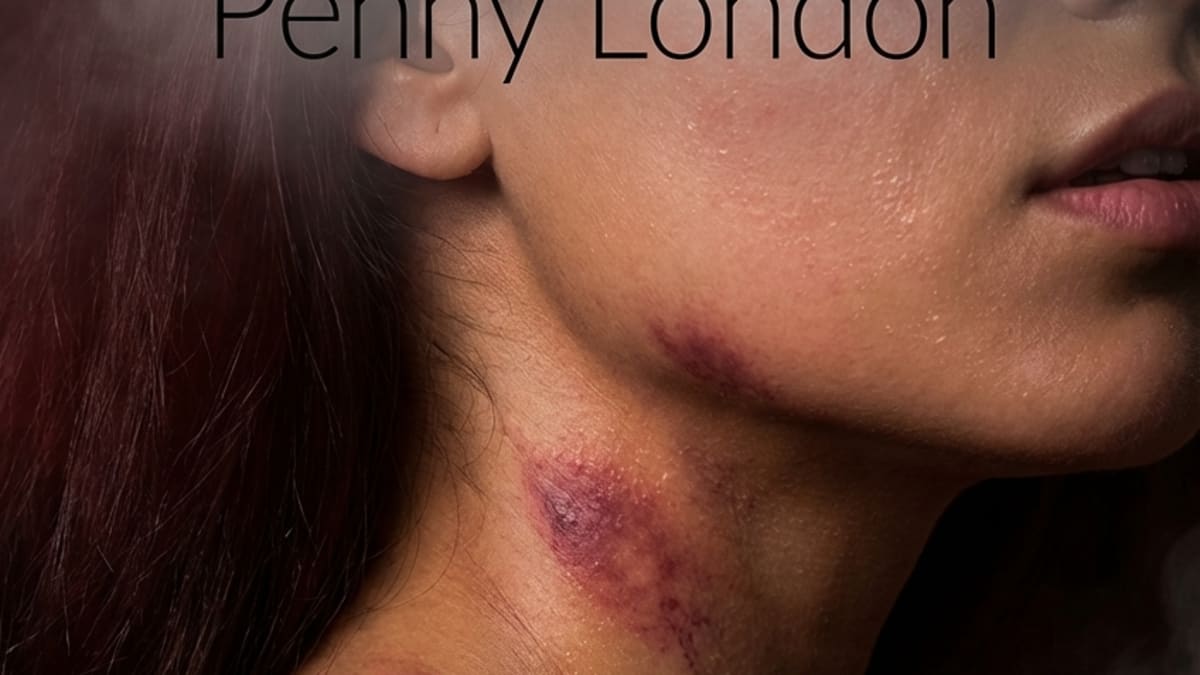
- A bite: primal, irreversable-feeling, often the neck or the inside of the thigh
- Fingertip bruises: evidence that shows up the next morning, which lets the character catalog it
- A verbal declaration: said in front of a rival, a pack, or a family member, which converts private desire into public fact
- Jewelry or an accessory: a collar, a ring, a jacket that smells wrong on anyone else
- A tattoo or brand: the most permanent option, and the one that most demands in-world consent conversation
- Scent marking: common in shifter and primal play contexts, where the claim is invisible to everyone except the people who can smell it
Notice that several of these overlap with use kink, and the two frequently get paired. The difference is aim. Use kink is about being taken for someone's pleasure. Claiming is about being taken as someone's person.
Enjoyed this? Get a free book.
Join the list and we will send a complete free story straight to your inbox, plus new releases every week after that. No credit card, no catch.
A scene can do both, and the combination is potent because it satisfies two separate fantasies at once.
They keep the possessive partner specific
Flat claiming scenes feature a generic growling man. Strong ones feature a character whose possessiveness makes psychological sense given everything else we know about them. A partner who has lost people before claims out of fear. A person who has been treated as disposable claims to feel permanent.
The trope hits hardest when the claim is in character, when you can see exactly why this person, of all people, would need to leave a mark.
They give the claimed person agency
Contemporary readers want the claimed partner to want it. That means visible enthusiasm, verbal permission, or at minimum an internal yes that the narration does not undercut. The hottest version of this trope is mutual claiming, where both people mark each other and the power dynamic flattens into something shared.
That mutuality is a big part of why fated-mate and pheromone bond stories land so hard for readers. The bond runs both directions.
They handle the aftermath
What happens after the claim is where the writing lives or dies. Some characters are smug about it. Some are undone. Some need reassurance that the mark meant what they think it meant.
In real practice, this is where aftercare matters, both physical (ice, antiseptic, a soft blanket) and emotional (a check-in, water, a conversation about how it felt). Fiction that skips the aftermath entirely often feels hollow, and fiction that gives it a page or two feels earned.
Variations authors use to keep the trope fresh include the accidental claim, where a moment slips out in the heat of things and changes everything, and the public claim, done deliberately in front of someone who needs to see it.
Then there is the denied claim, where one partner refuses to admit what the mark means and that refusal drives the rest of the book, and the competing claim, where a third party's interest forces the possessive partner to stop being subtle.
That last one shades into jealousy-driven plots, which often resolve into makeup sex once the couple finally says the thing out loud. Or, if the split ran deeper, into the messier territory of revenge sex versus breakup sex, where a claim gets made and then violently unmade.
Emotional intensity is the point, so effective claiming scenes usually slow down rather than speed up. The mark is described in detail. The reaction is described in detail.
The moment of eye contact afterward, when both people understand that something has changed, gets more words than the act itself. Writers who rush this beat lose the thing the reader came for.
Claiming Kink vs Primal Play
These two get confused constantly, so it is worth separating them.
Primal play is about shedding the social script and acting on instinct, and it can include chasing, wrestling, growling, and biting without any ownership dimension at all. Two people can have an entirely feral encounter and never claim each other. The dynamic is present-tense and instinctual.
Claiming kink is about the declaration and what it means going forward. Biting is a common tool in both, which is why the overlap confuses people, but the aim is different. Primal play asks "what if we stopped being civilized?" Claiming asks "what if you were mine, and everyone knew?"
That said, they pair beautifully, and plenty of books run them together. If you like one, you will almost certainly like the other, and many authors deliberately blend the two because the feral energy makes the claim feel inevitable rather than staged. Feral play sits even further out on the instinct spectrum and often shows up in the same scenes.
One more adjacent term worth knowing: praise kink. A verbal claim ("you're mine, you did so well, you're exactly what I wanted") can satisfy both at once, which is why so many claiming scenes double as praise scenes.
Frequently Asked Questions
Is claiming kink the same as a marking kink?
Marking is one method of claiming, usually the physical one. Claiming kink is the broader category that includes marking. A couple can practice claiming without leaving a single mark, through verbal declarations, jewelry, or an ongoing dynamic.
Why do readers love possessive male leads so much?
Because possessive devotion is a fantasy of being unequivocally wanted. A partner who claims you loudly has removed all ambiguity about whether they care. Most readers want that intensity inside a fictional container and would find it exhausting in real life.
Is claiming kink always about BDSM dynamics?
No. Plenty of claiming shows up between vanilla-presenting couples, especially in romance novels where the claim is emotional or symbolic. Even a vanilla/kink mix relationship can include a claiming dynamic if both partners want it.
What are the safety concerns with real marking or branding?
Bites can break skin and need cleaning, and bruising should be discussed in advance with a clear idea of what intensity is acceptable. Permanent techniques like scarification or branding require explicit, ongoing, fully informed consent and should never be improvised. Safe words and aftercare are mandatory, not optional.
Can a claim be a one-time scene instead of a long-term thing?
Absolutely. Plenty of people enjoy the intensity of a claim inside a single encounter. What makes it claiming is the declaration and the mutual charge, not the duration of the relationship afterward.
How do I find books with this trope?
Look for tags like "possessive hero," "fated mates," "marking," and "claiming bite," especially in shifter, dark romance, and monster romance. Gothic romance also uses claiming energy constantly, often through symbolism rather than teeth.
Final Thoughts
Claiming kink works because it answers a question most people are quietly asking: am I actually wanted, or am I convenient? Being marked and declared is the fantasy of having that question answered out loud, in front of witnesses, with teeth if necessary.
If you want a book that runs the trope at full intensity, look for a fated-mate or shifter romance and pay attention to how the author handles the aftermath. The bite is easy. What happens when the characters have to talk about it the next morning is where the good writing lives.






Loading comments…