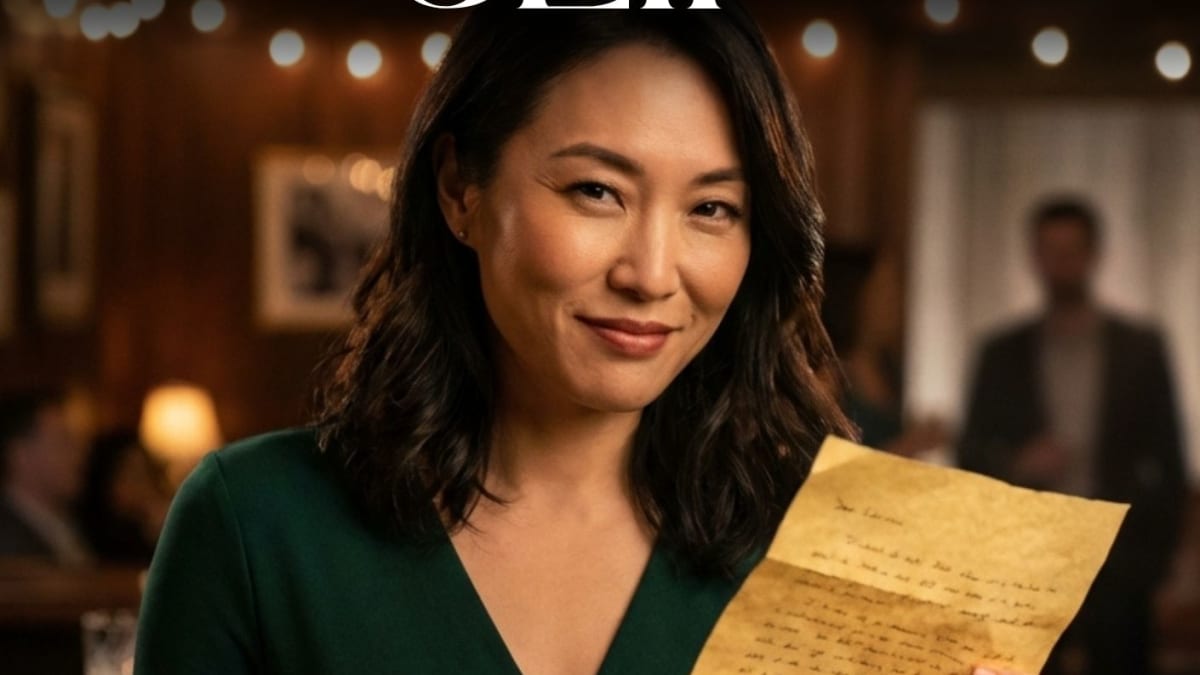
A fake marriage is a romance where two people marry for a practical reason and agree to keep feelings out of it, then fail. The paperwork is real, the ceremony might be real, the vows are technically binding, and both parties insist none of it counts.
You already know how this ends, and that is not a problem. The pleasure of a fake marriage story lives in the middle, in the stretch where they share a kitchen, split a mortgage, and lie to their families while slowly realizing the lie has stopped being a lie.
The trope is one of the most reliable engines in the genre, and it has been for as long as romance novels have existed as a commercial category. It survives because it solves a structural problem every romance writer has: how do you get two people into a legally, socially, domestically entangled situation before they are emotionally ready for it? The fake marriage skips straight to the entanglement. Everything after that is a slow descent into sincerity.
What Fake Marriage Actually Means
The name describes the arrangement from the inside. The characters call it fake, and the reader is supposed to understand that the marriage is anything but. That gap between the label and the reality is the entire point.
A fake marriage requires three things. First, a legal or ceremonial marriage that at least one character can walk away from.
Second, a stated practical motive that has nothing to do with love. Third, a private agreement that the couple is playing a role. Strip out any of those and it stops being the trope.
A marriage of convenience is the older cousin. In a historical, the convenience is usually financial: a dowry, an inheritance clause, a failing estate that needs an heir or a title to survive. In a contemporary, the convenience is more likely to be immigration, insurance, childcare, or a business deal dressed up in a wedding. The terminology overlaps heavily.
For clarity, here is how the common variants shake out:
- Marriage of convenience: the broad category. Any marriage entered for practical benefit, with or without an explicit agreement to keep feelings out.
- Fake marriage: narrower. The couple consciously performs being married, often publicly, and treats the whole thing as a transaction with an end date.
- Contract marriage: contemporary phrasing, popularized by K-dramas and streaming romance. There is usually a literal document with clauses.
- Arranged marriage: the match is made by a third party, family or broker, and the couple does not fully consent to the choice even if they consent to the wedding.
- Fake engaged: the prelude version. Same machinery, lower stakes, no legal paperwork, and usually a shorter runway.
- Marriage in name only: emphasizes the absence of sex, or the absence of a real life together. Often used for relationships that are legally romantic but functionally platonic.
What does not count: a real elopement that two people later regret, a couple who marries for love and hits a rough patch, or a relationship that only pretends to be married to other people without any legal or domestic entanglement. Those are different stories with different tensions.
The most common misconception is that the trope is about deception. It usually is not. The pretend couple is almost always deceiving a specific audience, and the reader is in on the joke from page one. The internal conflict is not "will they get caught" so much as "how long can we keep telling ourselves this is nothing."
Where Fake Marriage Comes From
The marriage of convenience is older than the modern romance novel. It shows up in eighteenth and nineteenth century fiction as a plot device long before it became a genre expectation: fortunes rescued by weddings, reputations salvaged by a ring, cousins married off to consolidate land. In those books, the marriage is often the ending rather than the beginning. The couple suffers through the arrangement and finds affection on the last few pages, if at all.
The shift that created the trope as readers know it today happened when romance novels moved the marriage to the front of the book. Once the wedding is in chapter two, everything afterward has to carry the emotional arc. Writers had to invent reasons two people would stay married in public while resisting each other in private: separate bedrooms, a businesslike schedule, a list of rules one of them keeps breaking.
Historical romance kept the financial version of the trope alive through the twentieth century, and it has never really died there. A titled hero with a crumbling estate and an heiress who needs respectability is a formula so durable that new versions still publish every year.
The contemporary boom came later and from a different direction. Two forces pushed it. First, immigration and health insurance plots gave modern writers real legal stakes, which made the "fake" part of fake marriage newly literal.
Second, Asian drama exports, particularly Korean and Chinese television, made the contract marriage a global shorthand. A show with a clean contract, a set of rules, and a handsome stranger who cooks has a template so efficient that romance novelists borrowed it wholesale.
The genre has also gotten more honest about the power dynamics. Older versions often had one party with vastly more money and control, and the story treated that as romantic by default. Recent versions tend to interrogate the imbalance: who benefits, who is trapped, what happens to the person with less leverage if the deal falls through. The tension is richer for it.
How It Shows Up in Erotica
On the page, the fake marriage is a proximity machine. The best versions of the trope lean hard into the logistics of shared life: one bathroom, one bed when the hotel is fully booked, a shared phone plan, a family dinner where they have to remember the cover story they invented three chapters ago.
The heat level can be anything, and the trope genuinely does not care. A closed-door fake marriage can be as tense as an explicit one, because the tension comes from restraint. If you want to calibrate how explicit you want your fake marriage to get, our guide to heat levels in romance breaks down where the line falls between sweet and high heat.
Enjoyed this? Get a free book.
Join the list and we will send a complete free story straight to your inbox, plus new releases every week after that. No credit card, no catch.
What makes a strong version work:
- A motive with a deadline. Immigration interviews, a custody hearing, a shareholder vote, a terminal relative who wants to see them settled. The clock forces both characters to stay in the arrangement past the point where they could gracefully bow out.
- A written or spoken set of rules. No sex, no sleeping in the same bed, no lying to each other about anything that matters, an agreed end date. The rules exist so one of them can break each one in order.
- Domestic detail. Who buys the groceries. Who learns how the other takes their coffee. Who has night terrors and who stops pretending not to hear them. The domestic texture is where the fake part starts to erode.
- One character who knows first. The moment one of them realizes the marriage is not fake to them anymore, and the other one is still performing, is the emotional spine of the whole book.
- A third party who sees through it. A best friend, a sibling, a housekeeper. Someone who says the quiet part out loud while the couple insists they are just being practical.
- A public performance that gets away from them. An anniversary party, a family Christmas, a press interview. Whatever forces them to act like a couple in front of an audience and to keep acting once the audience leaves.
The flat version of the trope treats the marriage as set dressing and lets the couple fall in love in a vacuum. The reader never feels the arrangement pressing on them. The strong version keeps the contract visible from the first page to the last, so that when the couple finally admits the truth, they are admitting it against something concrete.
The genre also has a specific pleasure the trope delivers better than almost any other: the courtroom or kitchen-table scene where one character finally says "I want this to be real." That scene lands harder in a fake marriage than it does in a normal romance because there is a document, a pact, a line in the sand, and one of them just crossed it.
A useful comparison point is secret baby, which shares the same engine: a hidden truth that exists to be revealed at the worst possible moment. Both tropes are built on a withheld fact, and both live or die on how honestly the characters handle the withholding.
If you like your forced-proximity machinery cranked even higher, the brat dynamic runs on a similar friction, and there is a reason reality TV romance keeps borrowing the same contract-marriage beats.
Fake Marriage vs Marriage of Convenience
These two get used interchangeably, and they are not quite the same. The difference is worth knowing if you are searching for a specific flavor of story.
A marriage of convenience is defined by the reason for the marriage. The couple marries because it solves a problem: money, status, papers, an heir. The feelings that develop are a side effect nobody planned for, and there is usually no conscious agreement to keep the marriage platonic. Many of these couples fall into bed early and spend the rest of the book arguing about whether that counted.
A fake marriage is defined by the performance. The couple is explicitly playing a role, usually for an audience, and there is a stated understanding that the marriage is not real. The ban on feelings is part of the contract. The audience might be family, immigration officials, a business rival, or a small town.
If the couple are the only two people who know the marriage is a sham, and their sole reason is paperwork, you are reading a fake marriage. If the whole point is that the marriage solves a practical problem and nobody is pretending otherwise, you are reading a marriage of convenience. The two overlap constantly, and a lot of books are both. The distinction matters mostly when you are trying to find more of exactly what you just finished.
Frequently Asked Questions
Is fake marriage the same as marriage of convenience?
Close, but not identical. Marriage of convenience names the reason for the wedding. Fake marriage names the performance around it. Plenty of books are both, and readers generally use the terms loosely, so you will find good recommendations under either label.
Why is fake marriage so popular in romance novels?
It manufactures forced proximity, gives the couple a legal reason to stay entangled, and guarantees a happy ending the reader can already see coming. That combination is hard to beat. It also lets a writer skip the will-they-or-won't-they and go straight to how-they-fall.
What is a contract marriage romance?
A contemporary version of the trope with an actual written agreement, often with numbered clauses about separate bedrooms, an end date, and prohibited feelings. The phrasing came into wide use through Korean and Chinese drama imports, and romance novelists adopted it almost immediately.
Can a fake marriage story be enemies to lovers?
Yes, and that is one of the most common pairings. The couple usually starts at a low simmer of irritation, gets forced into a wedding, and spends the middle of the book discovering the other person is not the monster they assumed. The two tropes stack naturally because both need forced proximity to work.
Do fake marriage romances always end happily?
The genre convention is yes. The two people who signed a contract for practical reasons fall in love for real, and the ending usually involves renewing the vows sincerely or having a second, private wedding that is not for anyone else. A fake marriage romance that ends without the marriage becoming real would be a different genre entirely.
What is the difference between fake married and fake engaged?
The stakes and the paperwork. Fake engaged has no legal tie, no shared assets, and an easy exit, which makes it a lighter, faster version of the same tension. Fake married adds legal entanglement, a shared home, and a much higher cost of ending the arrangement.
Final Thoughts
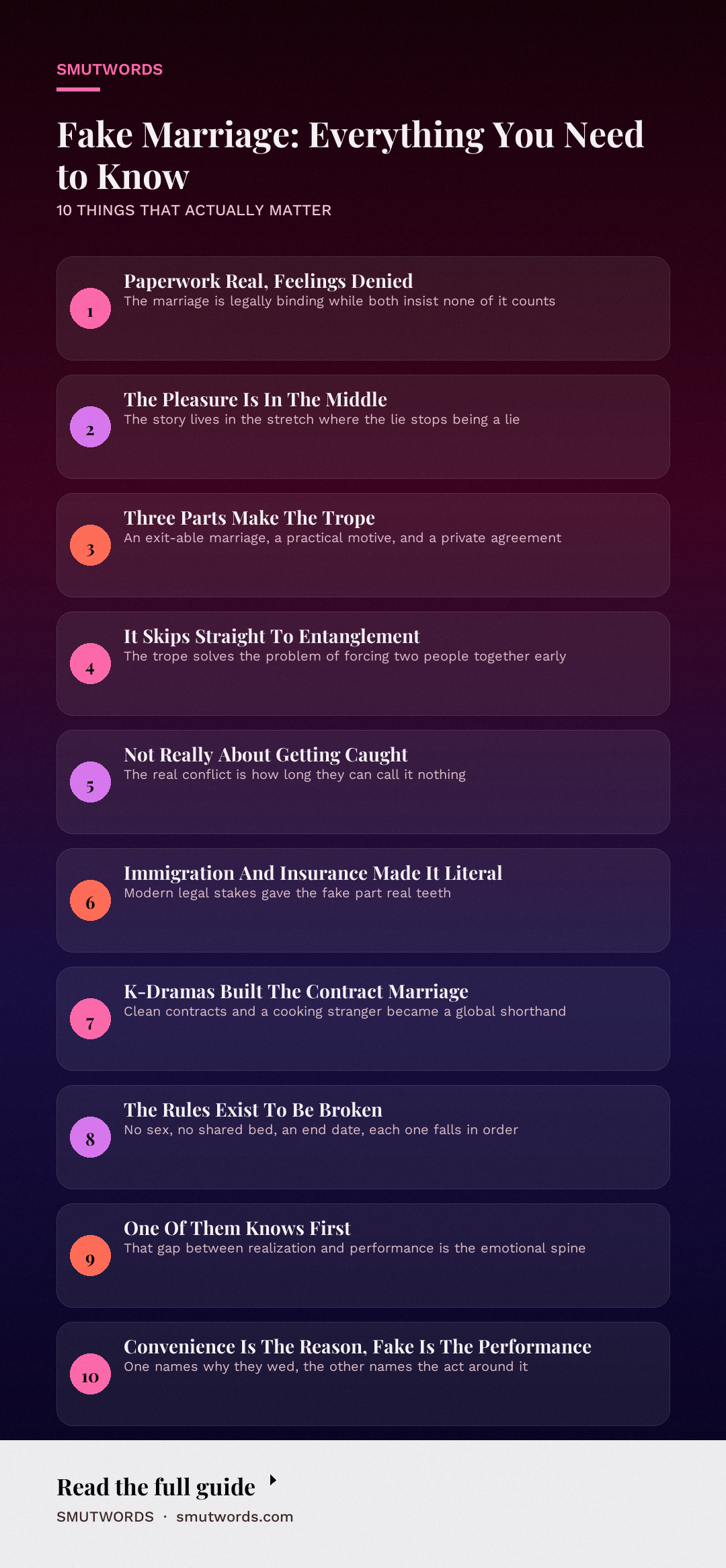
The fake marriage endures because it puts two people in a room together and gives them a reason to stay. Every good version of the trope is really about what happens after the performance stops being necessary and neither of them wants to leave. If you want a book that executes the full arc, the ranked list below has the ones the SmutWords team keeps going back to.






Loading comments…