
Reality TV romance is the subgenre where the love story happens on camera, inside a competition or a production, with a crew standing just out of frame. The protagonists meet in a villa, a kitchen, a survival camp, or a soundstage. They fall for each other while producers text them instructions and the edit decides what the audience sees.
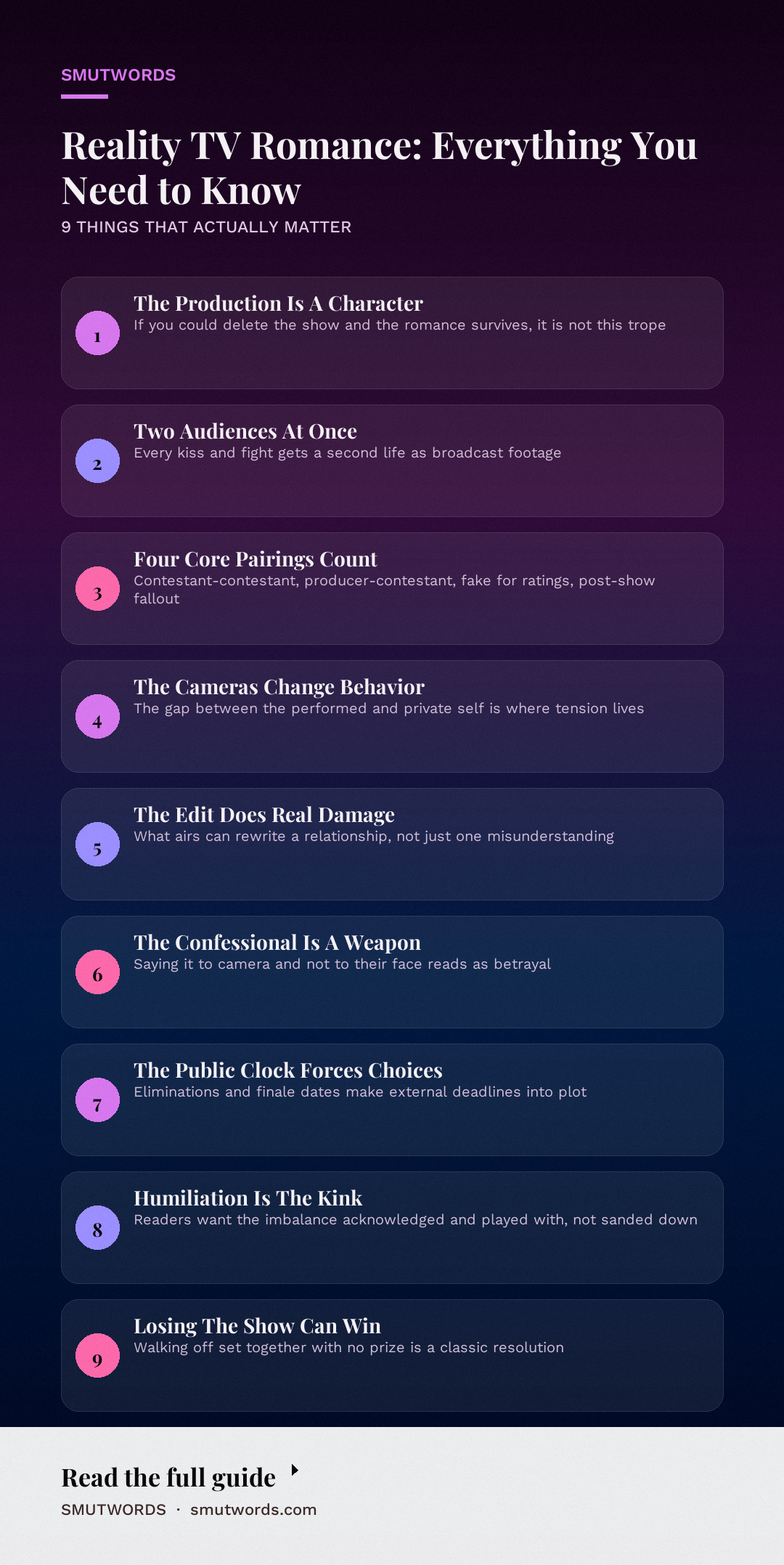
The reality tv romance hook: the relationship has two audiences at once. The two people in it, and the millions watching the broadcast cut. Every confession, every kiss, every fight gets a second life as footage.
That dual audience is the whole engine. A contestant can want someone and also want to win, and those two wants are not always compatible. A producer can fall for the talent and know that a single slip turns the season into a scandal.
The cameras do not just observe the romance. They create conditions for it, they incentivize it, and they threaten it. That is what separates this trope from a plain workplace romance with a film crew in the background.
What Reality TV Romance Actually Means
The term covers a specific story shape: a romance that develops while at least one lead is a participant in, employed by, or otherwise bound to a reality television production. The relationship is shaped by that production. Cameras, edits, votes, eliminations, and producer meddling are not set dressing. They are active forces in the plot.
Two elements have to be present for a book to earn the label. First, a real production with real rules: a show with a format, a host, a shooting schedule, a control room, a broadcast or streaming release.
Second, a romance that the production can affect, and that can affect the production back. If the show could be deleted from the manuscript and the love story survives untouched, it is not this trope. It is a romance that happens to have a camera in it.
What counts, roughly speaking:
- Contestant and contestant. Two people cast on the same season who fall for each other while competing, whether they are allies, rivals, or both.
- Producer and contestant. A crew member, showrunner, editor, or host who develops feelings for someone they are supposed to be managing. The power imbalance is baked in and usually part of the appeal.
- Fake relationship for ratings. A couple performs a romance for the cameras and the performance curdles into the real thing. Showmances, arranged pairings, and manufactured storylines all live here.
- Post-show fallout. The season has aired, the edit has done its damage, and the leads have to figure out whether what they had survives the broadcast version of it.
What does not count: a character who is famous for being on a reality show but whose actual romance happens entirely off-camera with no production pressure. A romance between two actors playing roles on a scripted series. A viral video, a livestream, or a podcast, unless a structured show with producers and an edit is doing real work in the plot. The production has to be a character.
Common misconceptions are worth clearing up. Readers sometimes assume this trope is automatically a comedy, because reality TV is easy to mock. Plenty of these books are dark and tense, especially the producer-contestant and post-show versions, where the exploitation is not a joke.
Others assume the romance is shallow by definition because the setting is. That gets it backward. The format applies pressure that makes people say true things fast, and pressure is where good romance lives.
Where Reality TV Romance Comes From
The trope is younger than most of the genre's staples, and its history is really a publishing history. It tracks the rise of reality television as a cultural default. The first wave of shows that made the format unavoidable, the early-2000s dating competitions and survival contests, gave romance authors a new set of settings almost overnight.
Early versions leaned on the dating-competition model. A heroine with a dozen suitors, elimination ceremonies, a finale, a proposal. Those books were essentially Regency courtship plots with a television crew, and they sold because the format was already a story machine. It produced suspense, jealousy, and a ticking clock for free.
The next shift came when authors got interested in the production side. Once the books moved behind the camera, the trope grew teeth. Producers became love interests, edits became weapons, and the question changed from who will she pick to what did they do to her to make her pick him on camera. That is roughly where the subgenre's center of gravity sits now.
A third, more recent shift: streaming-era shows and social media fallout. Modern entries often deal with the aftermath, the way a season follows a person for years, the way fans build narratives, the way a bad edit becomes a permanent search result. The romance has to survive not just the shoot but the discourse.
The trope remains a reliable seller because it updates easily. Every time the culture invents a new format, from dating islands to competitive baking to celebrity rehabilitation shows, the genre absorbs it within a year or two. For a sense of how fast the erotica side of publishing reacts to format trends, the Vera Nyx interview on building an 85-book alien universe is a good case study in how quickly a subgenre can scale once readers signal demand.
How It Shows Up in Erotica
On the page, this trope lives and dies on structure. The show provides a beat sheet: casting, first day, first challenge, first elimination, first scandal, finale. Strong books use that beat sheet deliberately, letting the format's milestones double as relationship milestones. Weak ones treat the show as wallpaper, describing a competition in the background while the couple's real arc happens in rooms the cameras never see.
Here is how the strongest versions tend to handle the craft:
Enjoyed this? Get a free book.
Join the list and we will send a complete free story straight to your inbox, plus new releases every week after that. No credit card, no catch.
- The cameras change behavior. Good books show characters performing for the edit and then dropping the performance in private. The gap between the two versions of a person is where the erotic tension lives.
- The confessional is a weapon. A talking-head interview where a character says something they have not said to their lover's face is one of the most efficient conflict devices in the subgenre. It reads as betrayal even when it is honest.
- The edit is a third character. What gets aired, what gets cut, and what a producer chooses to emphasize can rewrite a relationship. Books that let the edit do real damage, rather than a single misunderstanding, hold up better on reread.
- The clock is public. Eliminations, votes, and finale dates give the romance external deadlines. Deadlines force decisions. Decisions are plot.
- The audience is not neutral. Fan response, hate-watching, and shipping can push two people together or tear them apart. Modern entries use this constantly.
Common variations worth knowing, if you are deciding what to read or write next:
- Bachelor parody. One lead, many suitors, a rose-equivalent ceremony. Often comedic, occasionally vicious.
- Survival competition romance. Physical hardship, shared shelter, alliances that blur into attraction. The deprivation does a lot of the work.
- Cooking show love. Kitchen-set, high-pressure, often rivals-to-lovers with tasting and knife-work as foreplay.
- Fake relationship for ratings. A couple cast or paired for a storyline who have to keep performing after the feelings turn genuine. This overlaps heavily with the mechanics of hate to love, since the performance and the resentment often start in the same place.
- Producer-contestant romance. The power imbalance version. Break the rules, lose the job, lose the season, or lose the person.
- Post-show fallout. The season aired. The edit was unkind. Now what.
What makes a strong version work, in editorial terms, is a clear answer to one question: what does the camera make possible that would not have happened otherwise? If the answer is nothing, the show is scenery. If the answer is the couple would never have spoken, or would never have admitted the truth, or would never have been in the same room, then the format is doing its job.
The sex scenes in this subgenre have a signature texture. The characters are aware of being recorded, or of not being recorded, and the difference between those two states carries most of the charge. A kiss that is definitely on camera and a kiss that definitely is not are two different events. Skilled authors use that contrast constantly, sometimes within the same chapter.
The private scene often reads as the relief. The public scene reads as the confession.
One craft note for writers: the format is a machine for producing humiliation, and humiliation is a kink here, not a side effect to be apologized for. Readers who pick up a producer-contestant book are not hoping the exploitation turns out to have been misunderstood. They want the imbalance acknowledged, played with, and eventually resolved on the couple's terms. Authors who sand that down usually lose the readers they were trying to protect.
For a look at how another taboo-adjacent dynamic handles the same problem, the breakdown of nurse/patient romance is worth reading alongside this one.
Another note: the subgenre pairs well with others. A contestant with a hidden pregnancy is operating in secret baby territory, and the reveal timing is usually engineered for a finale.
A behind-the-scenes crew member who becomes dangerously fixated on a contestant slides toward stalker romance. Authors have to be careful there, because a show provides legitimate reasons for cameras and surveillance that a stalker plot would otherwise have to invent. The overlap is real. The morality is different, and good books keep them distinct.
Frequently Asked Questions
Is reality TV romance always a comedy?
No. The dating-competition and bachelor-parody versions lean comedic and satirical, but producer-contestant and post-show-fallout books are frequently dark, with real stakes around exploitation, contracts, and reputational damage. Reader expectation should come from the specific show format and the author's tone, not the trope label alone.
What is the difference between a showmance and a real relationship in these books?
A showmance is a romance performed for the cameras, whether for screen time, an alliance, or a producer's requested storyline. The genre's central move is the moment the performance stops being optional, when the couple realizes the feelings are genuine and the manufactured version is now a problem rather than a cover.
Why is the producer-contestant pairing so popular?
It stacks three things readers want: an explicit power imbalance, a forbidden-relationship obstacle, and a character who knows exactly how the show works and still cannot stay professional. The producer is the one person who understands the machine and is therefore the one person who can be ruined by it most completely.
Do these books require the couple to actually win the show?
Not at all. Losing the competition while winning the relationship is one of the subgenre's most common endings, and it is often more satisfying. The finale result is a plot device. The romance resolution is the point, and a couple who walks off set together having lost is a classic version of that resolution.
How realistic is the behind-the-scenes detail in these books?
It varies widely. Some authors clearly researched production schedules, release forms, and editing room politics, and the accuracy adds a lot of pressure to the plot. Others use a stylized, heightened version of television production that serves the fantasy. Both approaches work if the show's internal logic stays consistent across the book.
Can this trope work without a competition format?
Yes, as long as a real production is shaping the romance. Docusoaps, renovation shows, celebrity rehabilitation formats, and behind-the-scenes documentary shoots all work. The competition is optional; the production, with its crew and its edit, is not.
Final Thoughts
Reality TV romance works because it puts the relationship under a pressure that ordinary life rarely applies: being watched, edited, and voted on while you are still figuring out what you feel. The best books in the subgenre understand that the cameras are not the obstacle, they are the accelerant, and that a couple who survives the edit has survived something most romances never have to face.
If you want a starting point, pick a book where the production is unmistakably a character and the couple has something real to lose when the season airs. If you want to see how a single format can become an entire publishing category, the complete guide to mail order bride romance is a useful companion read. Same lesson, different camera.







Loading comments…