
Fantasy romance is the subgenre where a love story and a made-up world carry equal weight, and neither one works without the other. The romance drives the plot; the magic, politics, and nonhuman characters shape how that romance can possibly happen.
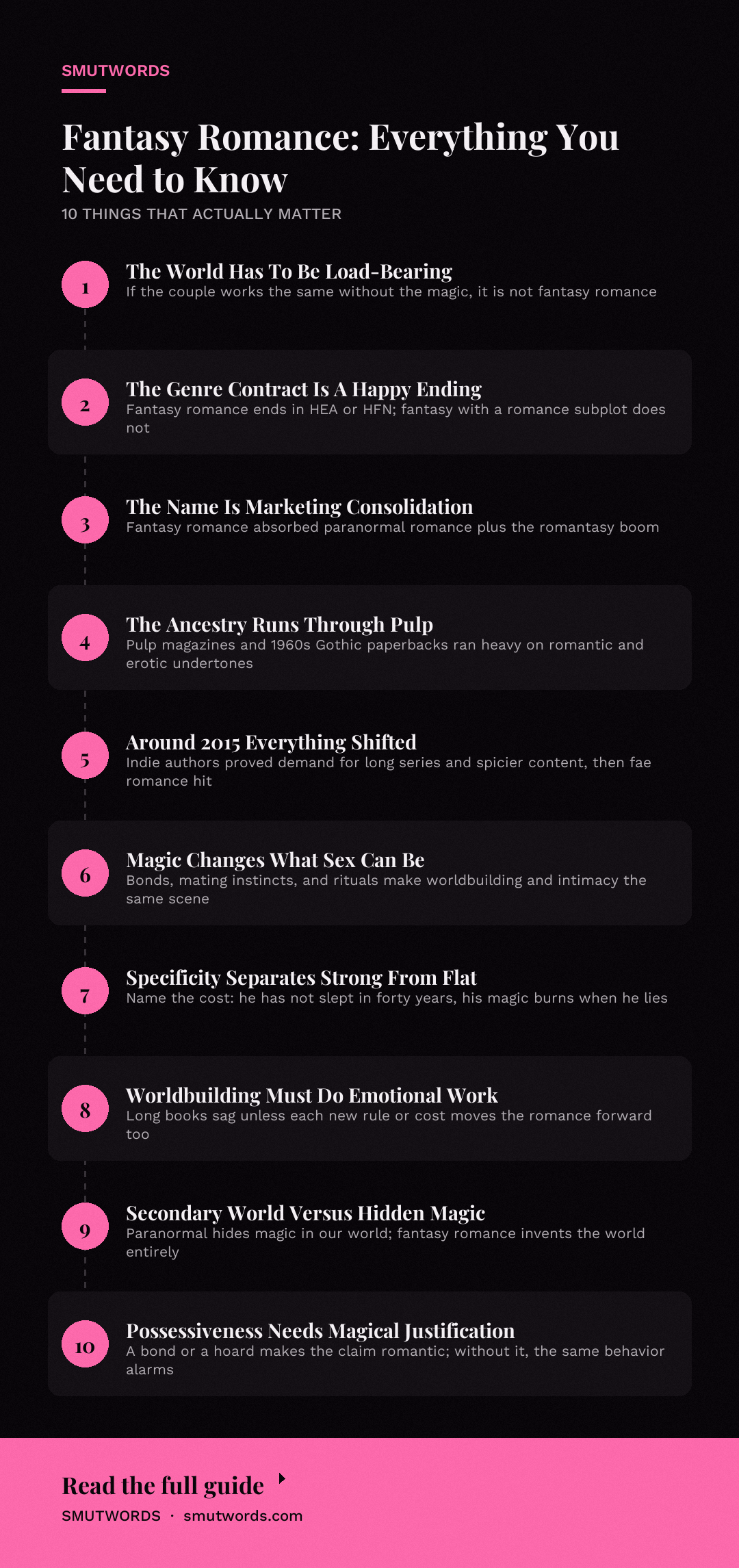
If you strip out the dragons, the fae courts, or the blood oath and the couple's relationship still functions exactly the same way, you are reading a contemporary romance wearing a costume. In a true fantasy romance, the worldbuilding is load-bearing. The magic system creates the obstacle, the bond, or the price the lovers have to pay, and the sex is usually bound up in it.
What Fantasy Romance Actually Means
The short definition covers the basics: a romantic relationship at the center of a world where magic, mythical beings, or supernatural forces are integral to the plot and to who the characters are. The longer answer involves a question of emphasis that the industry argues about constantly.
Romance as a genre has one hard rule: the central love story must end in a Happily Ever After or a Happily For Now. Fantasy romance keeps that rule. Fantasy with a romance subplot does not.
That distinction sounds pedantic until you are 400 pages into a book where the couple finally admits their feelings in chapter thirty-two and one of them dies heroically in chapter thirty-six. That is epic fantasy. It is not fantasy romance, and readers who came for the romance will riot in the reviews.
The name itself is a marketing consolidation. For decades, books about witches, vampires, and werewolves falling in love were shelved as horror, general fiction, or "women's fiction with a supernatural element" because publishing did not know what to do with them. Paranormal romance carved out its own shelf in the 1990s and 2000s. Fantasy romance is the newer, broader umbrella that absorbed it, plus the romantasy boom that followed.
What counts:
- A romance between two or more characters that ends in a committed, satisfying union.
- A speculative world where magic or the supernatural is essential, not decorative.
- Stakes that are personal and world-scale at the same time, often the same stakes.
What does not count: a contemporary story where one character happens to be a witch and nothing about that changes the relationship. A fantasy epic where the couple kisses twice and one of them dies. A book where the magic exists purely for aesthetic flavor and could be deleted without consequence.
The most common misconception is that fantasy romance is a "beginner" version of fantasy, or that it is romance for people who do not like romance. Neither holds up. The best books in this category are doing structural work in two genres at once, and the ones that fail usually fail because the author shortchanged one side to protect the other.
Where Fantasy Romance Comes From
The lineage runs through fairy tale retellings, Arthurian romance, and Gothic fiction long before it runs anywhere near a modern bookstore. "Romance" originally meant a narrative of adventure and marvel, which is why medieval tales of knights and enchantresses were called romances while containing almost none of what we now call romance.
The modern genre's actual ancestry is pulp. Mid-century pulp magazines ran sword-and-sorcery stories with heavy romantic and erotic undertones, and the Gothic paperback boom of the 1960s and 1970s sold millions of copies of books where a heroine arrived at a remote estate and met something that was not quite a man. Those books were marketed with the same breathless cover copy as contemporary romance, because that is what they were.
The 1990s is when the genre became recognizable as a commercial category. Paranormal romance exploded first: vampires, werewolves, demons, and the women who loved them, often in long-running series with an overarching couple. These books were shelved in romance, sold in romance, and reviewed by romance readers. The worldbuilding was often lighter than what came later, and the sex was frequently more explicit than anything on the general fiction shelf.
The shift that created the current fantasy romance category happened around 2015. Two things drove it.
First, indie and self-published authors found that readers would follow a series across multiple books with a single couple, and that they would pay for spicier content than traditional publishers were greenlighting. Second, the fae romance wave landed. Books built around courts, bargain bonds, and beautiful inhuman love interests sold in numbers that made traditional publishers reconsider everything they had rejected in the previous decade.
The genre has since split into visible lanes. Romantasy for the crossover hits with heavy romance and lighter worldbuilding. Epic fantasy romance for the doorstoppers with maps and political machinations.
Dark fantasy romance for the books where the love interest is genuinely dangerous and the content warnings are long. Paranormal romance still means vampires and shifters in a roughly contemporary setting to most readers, even though the two categories overlap constantly.
One more historical note worth making: the explicitness levels have moved further and faster than any other change. What was considered shocking in a 1995 paranormal romance is a fade-to-black scene in a 2024 fantasy romance. Readers now expect on-page sex in most of this category, and the higher heat levels have become a selling point rather than a liability.
How It Shows Up in Erotica
This is where fantasy romance earns its keep. The speculative elements are not just set dressing around a sex scene. They change what sex can be, who can have it, and what it costs.
A magic system gives an author tools no contemporary setting can match. Bonding marks that let lovers feel each other's arousal from across a continent. Mating instincts that override rational thought. Ritual sex that literally powers a spell or seals a treaty.
Then there's the anatomy. Wings, tails, claws, and other configurations that require a writer to actually think about logistics. None of that works if the author treats it as decoration.
The strongest fantasy romance sex scenes are the ones where the worldbuilding and the intimacy are the same scene. A soulbond that links two characters' emotions creates a scene where every touch is doubled, and where one partner cannot hide how much they want it. That is soulbond territory, and it is one of the most reliable engines in the subgenre because it makes consent, exposure, and vulnerability structural instead of conversational.
Possession runs second. The possessive love interest is a staple of fantasy romance because the world can justify it: an ancient being who has waited centuries, a bond that makes him physically ill when she is threatened. Handled well, it produces the kind of scene covered in our guide to possessive sex, where the claim is verbal and physical and total. Handled badly, it produces a love interest who reads as a control freak with extra steps.
Enjoyed this? Get a free book.
Join the list and we will send a complete free story straight to your inbox, plus new releases every week after that. No credit card, no catch.
Here are the variations authors return to most:
- Fated mates. The bond exists before the characters want it. The tension is whether they accept it or fight it.
- Enemies to lovers across a war. Political or species conflict supplies the obstacles. See enemies to lovers for the mechanics.
- Bargains and oaths. A magical contract forces proximity, obedience, or honesty. The sex usually either breaks the terms or fulfills them.
- Captive or conquered. The power imbalance is real and magical. The best versions give the captive genuine leverage.
- Monster and nonhuman love interests. Anatomy and instinct are the whole point. Monster breeding romance lives here.
- Courts, thrones, and arranged unions. Political marriage with magical consequences, which overlaps heavily with arranged marriage.
- Redemption of a villain or a monstrous love interest. The redemption arc romance structure adapts cleanly because the world can give him a curse to break.
What separates a strong version from a flat one almost always comes down to specificity. A weak fantasy romance gives you a love interest described as powerful, ancient, and dangerous without ever showing the cost of any of it. A strong one tells you he has not slept in forty years, that his magic burns him when he lies, that the last person he loved died because of something he did.
The magic has rules, the rules have teeth, and the teeth press into the relationship.
Pacing is the other fault line. Fantasy romance is long, and long books sag. The fix is to make the worldbuilding do emotional work on a regular schedule: a new rule revealed, a new cost, a new reason the couple cannot simply have each other yet. Every chapter should move the romance and the plot at the same time.
Heat level is not a quality marker here despite what readers argue about online. A slow-burn fantasy romance with three sex scenes can be better than a scorching one with twenty. What matters is whether the physical intimacy is doing what the rest of the book is doing, and whether the author commits to it.
The dirty talk in fantasy romance also has its own flavor, and it is worth studying how it differs from contemporary. When the love interest is a 900-year-old fae king, the dialogue has to sound like it came from someone who has been alive that long. Stilted modern slang breaks the spell instantly. If you want the practical mechanics of writing that kind of dialogue without it landing as cringe, our dirty talk guide covers the fundamentals.
Fantasy Romance vs Paranormal Romance
These two get used interchangeably and they are not quite the same thing, though the border between them is genuinely blurry and plenty of books sit on it.
Paranormal romance traditionally means vampires, shifters, witches, ghosts, or demons in a setting that looks like the real world. The magic is hidden. The heroine usually has a day job.
The supernatural intrudes on ordinary life instead of replacing it. Urban fantasy romance is the close cousin here, set in a city with a magical underworld running underneath the mundane one.
Fantasy romance traditionally means a secondary world. Invented geography, invented politics, invented species, often with a map in the front. The characters do not commute to work; they ride horses or fly. The magic is public knowledge, and the plot is usually about a realm rather than a neighborhood.
Epic fantasy romance takes the second category and scales it up: multiple POVs, sprawling wars, and a romance that has to survive centuries of politics. Fae romance is a subset defined by species rather than scope, and it currently dominates bestseller lists.
The practical difference for readers is tone and texture. If you want a love interest who can walk into your apartment building, you want paranormal. If you want one who rules a court you could never find on a map, you want fantasy. Both deliver the same core promise.
Frequently Asked Questions
What is the difference between fantasy romance and romantasy?
Romantasy is a portmanteau the publishing industry adopted for the crossover hits that combine romance and fantasy, usually with the romance front and center and the worldbuilding a notch lighter than epic fantasy. Fantasy romance is the older, broader genre term that includes romantasy along with darker, heavier, and more explicitly erotic work. Most readers use them interchangeably and nobody will correct you.
Does fantasy romance have to end happily?
Yes. That is the genre contract. If the couple does not end the book together and committed, you are reading fantasy with a romantic subplot. Some series stretch the happy ending across multiple books, which is legal, but the final book still has to deliver it or readers will feel cheated.
Is fantasy romance always explicit?
No. Heat levels run from closed-door to extremely graphic within the same subgenre and the same shelf. The explicit end has grown in recent years, especially in self-published and fae romance titles, but plenty of fantasy romance is slow-burn and restrained. Check content warnings and heat ratings before buying if that matters to you.
What is fae romance and how is it different?
Fae romance is fantasy romance built around fairies, usually depicted as beautiful, long-lived, morally ambiguous, and bound by strange rules about truth, bargains, and debts. The appeal is a love interest who is genuinely inhuman, which raises the stakes of every promise and every lie. It is a species-defined subset of the larger category.
Why are the love interests so often possessive in fantasy romance?
Because the worldbuilding can justify it. A magically bonded mate who has waited centuries, a dragon who considers his hoard incomplete without her, a king whose claim is legally binding. Possessiveness reads as romantic in this genre because the setting supplies a reason that has nothing to do with ordinary jealousy. When the magic does not justify it, the same behavior reads as alarming, which is why the execution matters so much.
Can fantasy romance be dark?
Considerably darker than most readers expect before they try it. Non-consensual magic, captivity, morally black love interests, and revenge plots are all common, and the darker end of the genre overlaps with stalker romance and revenge romance structures. Content warnings exist for a reason in this category, and the good authors list them clearly.
Final Thoughts
Fantasy romance rewards readers who want the world and the relationship to be the same story. The magic has to cost something, the cost has to land on the couple, and the couple has to earn their way through it. Get those three things right and the genre does something no other category quite manages: a love story where the fate of a kingdom and the fate of two people are indistinguishable, and the sex is part of the spell rather than a break from it.
If you want to start somewhere with real teeth, pick up a book where the bargain is binding and the love interest is not entirely safe. The possessive, dangerous, world-altering version of this genre is where it hits hardest, and it is the version worth clearing a weekend for.






Loading comments…