
Why Alien and Monster Romance Skips Straight to the Bond
There's a specific moment in alien and monster romance where the human protagonist meets her non-human counterpart for the first time, and something inside her just... knows. Not in a vague "he's attractive" way. More like "my body recognizes this creature as mine and I have no say in the matter." That's the fated mates alien romance formula, and it's been carrying the subgenre for years.
The reason it works is simple: this trope solves the biggest problem in erotic fiction. Getting to the good part without a hundred pages of hand-wringing about whether they should hook up.
The fated mates trope is a different engine for the story entirely. When the bond is biological, cosmic, or magical, the question stops being "will they or won't they." It becomes "how fast can they give in, and what happens when they do?"
That shift changes everything about pacing, tension, and payoff. Here's how it works.
What Is a Fated Mate Bond, Exactly?
A fated mate bond is a predetermined connection between two characters. In alien romance, it usually manifests as a biological or psychic link: the alien detects the human's scent, hears her thoughts, or feels a physical pull that can't be ignored.
Sometimes it's a mating heat that hits the alien the moment he catches her scent. Sometimes it's a psychic resonance that makes both of them dizzy. Sometimes it's a literal mark that appears on the skin.
In books like Taken by the Celestial King, the bond comes with cosmic weight, the kind that makes the human feel like the universe itself arranged their meeting. In Extraterrestrial Heat, it's more animalistic, a physical reaction that overrides every sensible thought the human has about hooking up with a seven-foot creature with scales.
The common thread is inevitability. The characters don't choose the bond. It chooses them. And that's exactly why readers keep coming back to monster romance stories that lean hard on this device.
Why the Instant Bond Works So Well in Erotica
Romance novels spend a lot of time on courtship. Erotica doesn't have that luxury, and it shouldn't have to. When you're reading for explicit scenes, you want the setup to be efficient but still feel earned. The fated mate bond gives you that efficiency without making the characters feel like they're behaving out of character.
Here's what the bond actually does structurally:
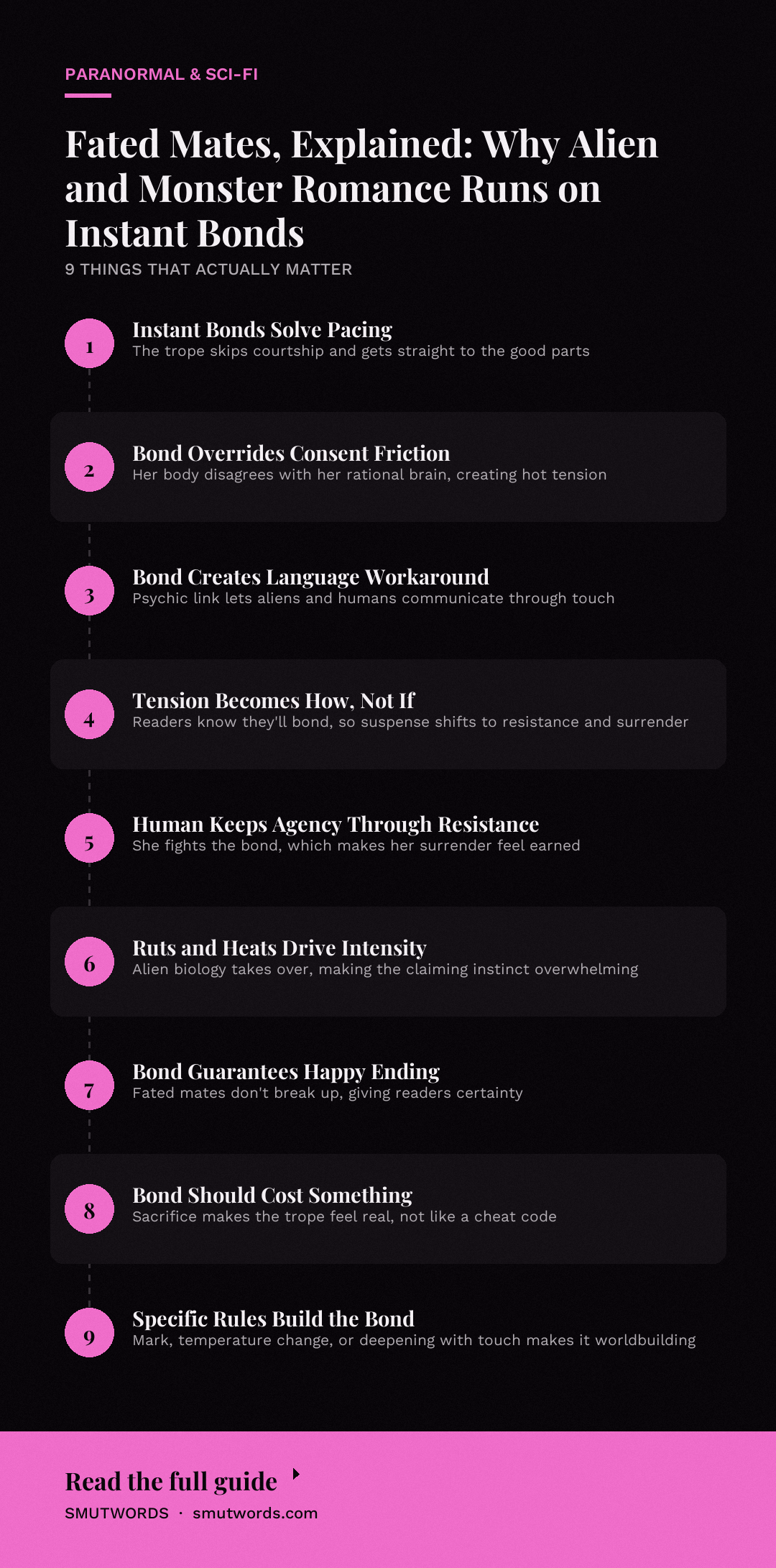
- It eliminates consent friction. The human can say "no" or "I shouldn't," but the bond makes it clear her body disagrees. That tension between her rational brain and her instincts is hot, and it lets the story move through hesitation quickly.
- It justifies instant physicality. No one has to explain why two strangers are tearing each other's clothes off within an hour of meeting. The bond is the explanation.
- It creates a language barrier workaround. When the alien can't speak English well or the human doesn't understand his customs, the psychic bond fills the gap. They communicate through touch, through the link, through how their bodies respond.
- It raises the stakes on every scene. Because the bond is permanent, every encounter has weight. This isn't a fling. This is destiny.
- It lets the author skip the boring parts. No dating montages, no awkward first conversations about work and hobbies. Straight to the part where he discovers her scent and loses his mind.
The result is a story that feels urgent from page one. The human might try to resist, but the reader knows it's futile. That knowledge isn't frustrating. It's the whole appeal.
The Tension Isn't "If" Anymore. It's "How."
When the fated mate bond is established early, the author trades one kind of tension for another. The classic "will they won't they" question disappears. In its place comes a more interesting set of questions. How will the alien convince the human to accept the bond?
How much resistance can she put up before her body overrides her brain? What happens when the bond is challenged by outside forces? That last one is where the story gets good.
The bond can be delayed, tested, or threatened. Maybe the human is captured by a rival species. Maybe the alien's society forbids bonding with off-worlders. Maybe the human's own fear of intimacy makes her fight the connection even though she feels it pulling at her.
In Planet of Orgasms, the entire premise runs on this idea: a planet where every interaction is heightened by the local biology, and the human visitor has to decide whether to accept what her body is telling her. The bond isn't just a plot device. It's the setting itself.
What the Bond Does to the Human Character
One of the most interesting things about fated mates alien romance is how it treats the human protagonist. She's not passive. She's often the resistant one, the skeptic, the person who doesn't want to admit that a four-armed blue creature is her soulmate. That resistance gives her agency even when the bond is pulling her toward surrender.
The best versions of this trope let the human wrestle with what the bond means for her identity. She was a scientist, a pilot, a survivor. Now she's someone's mate, and that feels like losing herself. The story's arc becomes about reconciling her old self with her new reality, and the sex scenes are where that reconciliation happens.
That's why the touch-starved angle pairs so well with this trope. The human characters in these stories are often isolated, emotionally shut down, or just desperately lonely.
The bond doesn't just offer sex. It offers connection. For a deep dive on that specific combination, check out the touch-starved monster trope and how it amplifies the bond's effect.
How Fast Is Too Fast?
There's a balancing act to instant bonds. If the characters are humping within three pages, the bond feels like an excuse rather than a device. If the author drags out the resistance for too long, the reader gets impatient because the bond already told us how this ends.
The sweet spot is usually one or two scenes of resistance followed by a full surrender. The resistance exists to show the human's personality and to make the surrender feel earned. Then the rest of the book can explore what happens after the bond is sealed, which is where the truly interesting stuff lives.
In Worship The Womb, the bond is revealed early and the surrender comes fast, but the book spends its length on what the bond means for the human's future, her safety, and her place in the alien's world. The sex scenes are frequent and explicit, but they're also doing narrative work. Every encounter deepens the bond and changes the characters.
Contrast that with Officer's Orders: Breed Her, where the bond is introduced alongside a power dynamic that complicates it. Yes, they're fated.
But he's also her commanding officer, and that authority adds layers to every interaction. The bond doesn't erase the power imbalance. It makes it hotter.
Enjoyed this? Get a free book.
Join the list and we will send a complete free story straight to your inbox, plus new releases every week after that. No credit card, no catch.
Alien Biology and the Bond
Alien romance has one advantage over human-set erotica: the author can invent biology that makes the bond literal. A human male in a contemporary romance can't lock in a mate with a glandular reaction. An alien can.
He can have a mating scent, a barbed appendage, a psychic frequency, a breeding cycle that only activates when he finds the right partner. That biological angle is why alien breeding romance overlaps so heavily with the fated mates trope. When the bond is tied to reproduction, every scene carries the weight of potential pregnancy, which raises the stakes and feeds into deep, primal fantasies about being chosen, claimed, and filled.
Tentacle romance leans into this especially hard. Star Sower: A Captive in the Tentacle Alien Breeding Chamber is a perfect example: the human isn't just fated to a single alien.
She's fated to a breeding chamber, to a reproductive system, to a species' survival. The bond isn't romantic in the human sense. It's utilitarian, biological, and all the hotter for it.
Ruts, Heats, and the Breeding Instinct
Once the bond is established, the alien's biology takes over. Many of these stories feature a "rut" or "heat" that hits the male when he's near his mate.
This is where the erotica gets its intensity. The alien is no longer in control. His instincts demand he claim her, breed her, anchor her to him physically and permanently.
Readers who enjoy free use erotica often find a familiar appeal here. In both cases, the character's consent is present but complicated by overwhelming physical need. The difference is that in fated mates stories, the need comes from the bond rather than from a rule or agreement. It feels organic, inevitable, and outside the character's conscious choice.
That loss of control is part of the fantasy. The human gets to experience being wanted so desperately that the alien can't help himself. And she gets to surrender to that want without guilt, because the bond makes it clear this was always going to happen.
Why This Trope Dominates Alien and Monster Romance
Look at the most popular books in the genre and you'll find fated mate bonds everywhere. There's a reason for that. The trope does heavy lifting:
- It justifies why a human would get involved with a creature society would call a monster.
- It makes the emotional arc short enough to leave room for extended explicit scenes.
- It gives the alien a vulnerability, since his need for his mate makes him emotionally exposed.
- It creates a built-in happy ending. Fated mates don't break up. The bond is forever.
That last point matters more than most authors admit. Readers come to this genre for the fantasy of certainty.
The bond provides it. No wondering if he's secretly using her, no fear that he'll lose interest after a few weeks. The bond is a promise the universe itself made.
When the Bond Goes Wrong: Angst Potential
Not every fated mates story is pure pleasure. Some authors use the bond for angst. What if the mate rejects the bond? What if the bond forms with the wrong person? What if the human is terrified of the alien's physical form and can't accept the pull she feels?
Those stories work too, but they walk a narrow line. Readers who picked up a fated mates alien romance usually want the bond to be a good thing. If the author spends too long making the bond painful, the book stops feeling like wish fulfillment and starts feeling like a tragedy. The best authors tease the angst without wallowing in it.
Tips for Writing Your Own Fated Mates Alien Romance
If you're an author trying to write this trope, you want to make sure the bond feels real and not like a cheat code. A few principles help. The bond should cost something. Whether it's the human's independence, her old life, or her ability to leave, the bond should create a sacrifice.
The bond should also reveal character. How the human responds to the bond tells the reader who she is. Does she fight it? Embrace it? Negotiate with it?
And the bond should have rules. Maybe it deepens with physical contact. Maybe it weakens when they argue. Maybe it has a physical manifestation like a mark or a temperature change.
Specificity makes the bond feel like actual worldbuilding rather than a plot convenience.
For a more detailed breakdown of the craft side, the definitive guide on how to write erotica covers pacing, scene structure, and how to keep explicit content from going stale. The fated mates trope works best when the author treats the bond as one element in a larger toolkit, not the only trick in the bag.
The Closing Scene: What the Bond Promises
The best fated mates alien romance books end where the bond promises from the start. The human has stopped fighting it. The alien has stopped holding back. They're together, often at the edge of a breeding cycle or a permanent mating ritual, and the reader gets to watch the final surrender happen in full, explicit detail.
Those endings land because the bond made them inevitable. The reader wasn't watching two strangers stumble toward each other.
They were watching two people caught in a current that had been pulling them together since before they met. The payoff isn't a surprise. It's a fulfillment.
Final Thoughts
The fated mates alien romance trope works because it understands what erotic readers actually want from this subgenre. Not a long slow burn. Not a realistic courtship.
A fantasy about being so completely, biologically, cosmically desired that resistance becomes impossible and surrender becomes the most honest thing a character can do. If you want to see the trope done well, start with Star Sower, where the bond is feral, biological, and utterly consuming. Then work your way through the rest. The bond has been waiting for you.





Loading comments…