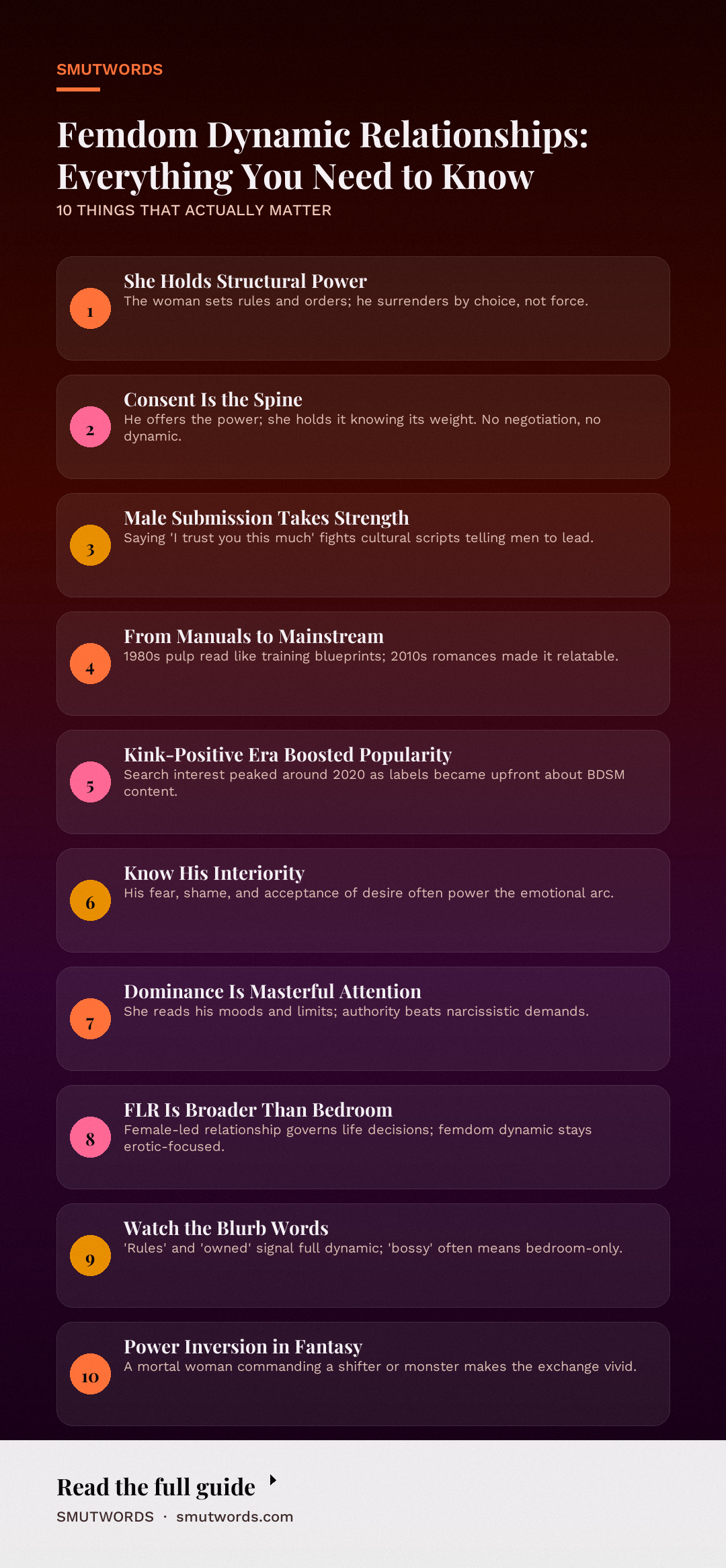
A femdom dynamic in a romance novel is one where the woman holds the structural power in the relationship and in the bedroom, and both characters want it that way. She sets the rules, gives the orders, and decides how pleasure happens. He surrenders control by choice and finds his release in that surrender.
You see this in everything from a light command during sex to a full 24/7 power exchange that governs their entire life together. It is a consensual, negotiated arrangement. The erotic charge comes from the trust it takes to hand over the wheel to a woman who knows exactly where she wants to drive.
The femdom dynamic is one of the most misunderstood pairings in romance. Plenty of readers assume it is all whips and chains, or that it is about degrading a man into worthlessness. The fiction that actually sells treats it with more depth.
A good femdom story is about a woman claiming her own authority without apology and a man who finds freedom, not shame, in being owned by her. That beats out a lot of one-dimensional power plays because the emotional stakes are as high as the physical ones.
What a Femdom Dynamic Actually Means
The femdom dynamic is a female-led power exchange where the woman is the dominant partner and the man is the submissive partner. The term itself comes from a blend of "female" and "dominance." In romance fiction it covers anything where the heroine actively directs the sexual and often relational choices of the hero. That can be as mild as her bossing him into the bedroom or as total as controlling his wardrobe, his schedule, and his orgasms down to the minute.
What does not count is a woman who just happens to be confident during sex. A dynamic implies structure. There has to be an agreement, spoken or unspoken, that she is in charge and he has consented to that arrangement.
If she pins him down once and he loves it but they never discuss it again, that is a scene, not a dynamic. The story needs to establish the pattern of who leads and who follows for it to qualify as a true femdom dynamic.
Common misconceptions riddle the category. It is not interchangeable with femdom about pain, although it can include it. It is not automatically a cuckold scenario, and it is not necessarily part of a polyamorous or hotwife setup.
The biggest misunderstanding is that male submission is about weakness. Every well-written version of this trope leans the other way: it takes substantial emotional strength for a hero to say "I trust you this much" and mean it, especially when our cultural default scripts tell men they should always be in charge.
Consent is the spine of the whole thing. In real hotwife rules romance, couples negotiate what is allowed, and the same rigor applies here between the page and the reader's imagination. The heroine is not taking power; he is offering it, and she holds it knowing exactly what weight that carries.
Where a Femdom Dynamic Comes From
The recognizable femdom dynamic has been in romance fiction long enough to have a real history, though it went by different names depending on the era. In the 1980s and 1990s, the small press and early e-publishing scene ran a lot of "female domination" pulp that was heavy on ritual, costuming, and formalized scenes.
Those stories were often structured like training manuals, complete with safewords and proper posture. They read more like fantasy blueprints than novels, which is probably why they stayed in the niche corner for so long.
The shift toward the mainstream happened when the romance genre itself widened its definition of heroines. As strong, take-charge female leads became the default rather than the exception in contemporaries, the natural next step was asking: what happens when that heroine takes charge of him too?
The 2010s saw erotica and romance writers fold power exchange into ordinary settings. A CEO heroine coming home to a kneeling boyfriend became as common as a billionaire hero with a list of rules. That reframing is what made the femdom dynamic feel accessible to newer readers.
Genres outside contemporary romance got in on the act early as well. Fantasy romance has long used female-dominant supernatural heroines, from vampire queens to fae romance rulers who command their human lovers. Paranormal settings gave authors a built-in excuse for a power imbalance that then got flipped into something explicitly erotic. Readers carried that appetite back into human-only stories.
Publishing data from the last decade shows the term peaking in search interest around 2020, coinciding with the wider embrace of kink-positive romance. Shelf labels that used to hide "BDSM" are now upfront about a femdom dynamic, and more authors are writing it without softening the heroine's control.
How It Shows Up in Erotica
The craft of writing a femdom dynamic that lands requires an author to solve one major problem: making dominance feel earned and submissive vulnerability feel powerful. A flat version of this trope reads like a shopping list of acts.
She says "kneel," he kneels, she says "thank me," he does, and the scene ends. That version works fine for short-form material, but for a story that holds a reader across chapters, the best authors understand that the dynamic lives in the spaces between orders.
Strong execution usually builds the relationship first. A heroine who dominates effectively has to know her submissive well enough to read his moods, his limits, and his secret desires. The best versions show her authority as a kind of masterful attention rather than a narcissistic demand for obedience. He matters to her, and that matters on the page.
Common variations authors play with:
Enjoyed this? Get a free book.
Join the list and we will send a complete free story straight to your inbox, plus new releases every week after that. No credit card, no catch.
- Gentle femdom, where the emphasis is on praise, reward, and worship rather than punishment or pain. The hero is the heroine's prized pet, and the cruelty is mostly affectionate teasing.
- Domestic discipline structure, where the dynamic governs arguments, chores, and decision-making, with erotic consequences layered on top.
- Female-led orgasm control, where she decides when he comes, whether that involves denial, forced orgasms, or scheduled release.
- Corruption arcs, where a prim, controlled heroine discovers she loves having a man on his knees, often in stages as she tests her own authority.
- Service-focused dynamics, where his submission is about practical acts of devotion, from cooking her dinner to giving her foot rubs, with the sex as a reward for good service.
The strongest books also spend time on his interiority. The hero's fear, his shame at wanting this, and his eventual acceptance of his own desires is often the emotional engine of the story. Readers want to know what it feels like from his side, not just watch her do things to him.
The heroines get their own arc too. A woman claiming dominance often has to unlearn other people telling her she is too bossy, too cold, or too much for wanting this.
Flow matters more than vocabulary. The best books do not need to announce "this is a femdom dynamic" in a sidebar. They demonstrate it through rhythm, through how she speaks to him, through the small moment where he hesitates and she notices, through the payoff when he lets go completely. The aftercare meaning breakdown at SmutWords covers the scenes where the tenderness of the arrangement becomes explicit, which is why the strongest books always include them.
Femdom Dynamic vs. Female-Led Relationship
The terms femdom dynamic and female-led relationship (FLR) get used interchangeably in blurbs and reader forums. They are not quite the same thing, and the distinction matters for finding your next read.
A female-led relationship is the broader umbrella. It describes a relationship where the woman makes the primary decisions, from finances to social scheduling to career moves, regardless of whether the sex life has any dominance in it. An FLR is a living arrangement first and a sex thing second.
A femdom dynamic is specifically about power exchange in the erotic and sexual realm. You can have a femdom dynamic where she dominates him only in the bedroom and they are fully egalitarian in the rest of their life. You can also have an FLR with a completely vanilla sex life where she handles the budget and he cooks dinner, no collars required.
Obviously, the two overlap constantly. Many romances combine both, using an FLR as the structural frame for the femdom dynamic. When a query line says "she runs his whole life and he loves it," you are getting both. When a book promises "a switch who meets a woman who takes over in the bedroom," you are likely getting femdom without the life structuring.
Watch the blurb language: the words "rules," "protocol," "serve," and "owned" signal full dynamic. "Demanding," "bossy," and "takes control" often mean bedroom-only play.
The same distinction separates it from cuckold humiliation fiction. In a femdom dynamic, the power exchange is between a woman and her man, often centering them intensely on one another. Cuckolding introduces a third party and uses his inadequacy, real or constructed, as the engine of humiliation.
Some femdom stories overlap with hotwife scenarios, but a pure femdom dynamic typically keeps the focus exclusive between the two leads. If you want the comparison point in plot terms, the complete guide to hotwife pickup shows how that umbrella handles jealousy and sharing, which a standard femdom book often avoids entirely.
Frequently Asked Questions
What does a femdom dynamic typically include in a romance novel?
The most common elements are the heroine giving direct commands, the hero asking permission for small things like touching her or coming, and a clear reversal of the usual chasing dynamic where he pursues her approval. Many books add discipline rituals, praise and rewards, and structured denial schedules.
Is a femdom dynamic always BDSM or kink-centric?
Not always. Some stories are pure dominance with no impact play, bondage, or pain at all. Others are deeply embedded in BDSM protocol. Each book sets its own level. It is worth checking the reader notes or review tags before buying, since the term covers everything from gentle instruction to heavy rigor.
Why is the man submissive in these stories if he is also the romantic lead?
Male submission in romance is a fantasy of release from the constant pressure to initiate, perform, and lead. The hero gets to stop carrying that weight and let the heroine decide. It is not about him being less than her; it is about him being trusted enough to be vulnerable without judgment.
Do femdom books ever feature a virgin or inexperienced male lead?
Yes, that is a hugely popular subgenre. The experienced domme heroine teaching a sheltered or inexperienced hero how to serve her is one of the strongest recurring patterns. It pairs well with other romance genres, including size difference romance where the much larger hero is nevertheless utterly compliant to a heroine half his size.
Can a femdom dynamic appear in fantasy or paranormal romance?
Absolutely. In supernatural settings, power balances get interesting when she is mortal and he is a powerful creature. A hybrid shifter romance might feature an alpha wolf who kneels for his human mate, or a territorial shifter trope where his possessiveness turns inward and he claims her as his leader instead of his property. Even a kraken romance can invert the expected scale of power when the human woman commands the sea monster.
How do authors show consent without breaking the heat of the scene?
The best books handle consent before the scene starts, often through a discussion where limits are set, then let the erotic energy flow uninterrupted during the act itself. A nod to "our safeword is still red if you need it" can work as a final check without killing the mood. Lighter books just show the hero asking for what he wants and her decision to grant or deny it, which establishes consent narratively.
Final Thoughts
The femdom dynamic has graduated from a niche catalog category into a staple of modern romance. It offers something vanilla power balances rarely touch: a heroine who is unapologetically in charge and a hero who finds his peace in yielding to her.
If you have not read one yet, start with a gentler entry point that leans into praise and domestic structure rather than heavy protocol. That gives you the emotional architecture of the trope without the shock of the deep end. For a sharper, spicier take served with fantasy distance, find one that flips a supernatural or monster lead into submission. Watching an ancient, powerful being kneel for a mortal woman makes the power exchange land in vivid relief.






Loading comments…