
When a scene ends with a sharp crack of a flogger or a whispered command to kneel, most readers flip the page expecting the next erotic beat. But writers who truly understand BDSM erotica know the most intimate moment often comes after the last impact lands. That is the territory of aftercare meaning: the deliberate, tender practice of bringing partners back from intensity to a grounded, ordinary state where they feel safe, seen, and cared for. It is the quiet counterweight to all that loud intensity, and frequently the scene readers remember longest.
What Aftercare Actually Means
Aftercare refers to the physical and emotional support partners provide each other following an intense BDSM or kink scene. It is the period of transition where adrenaline drops, endorphins fade, and both people shift out of their scene roles and back into their everyday selves.
The practice covers everything from wiping away sweat and checking for bruises to holding someone while their hands stop shaking and their breathing slows. The name comes straight from the medical and nursing world, where the term describes care given to a patient after a procedure. Kink communities borrowed it because the parallel fits: a scene is an intense physical and psychological experience, and the body and mind need active support during the recovery window.
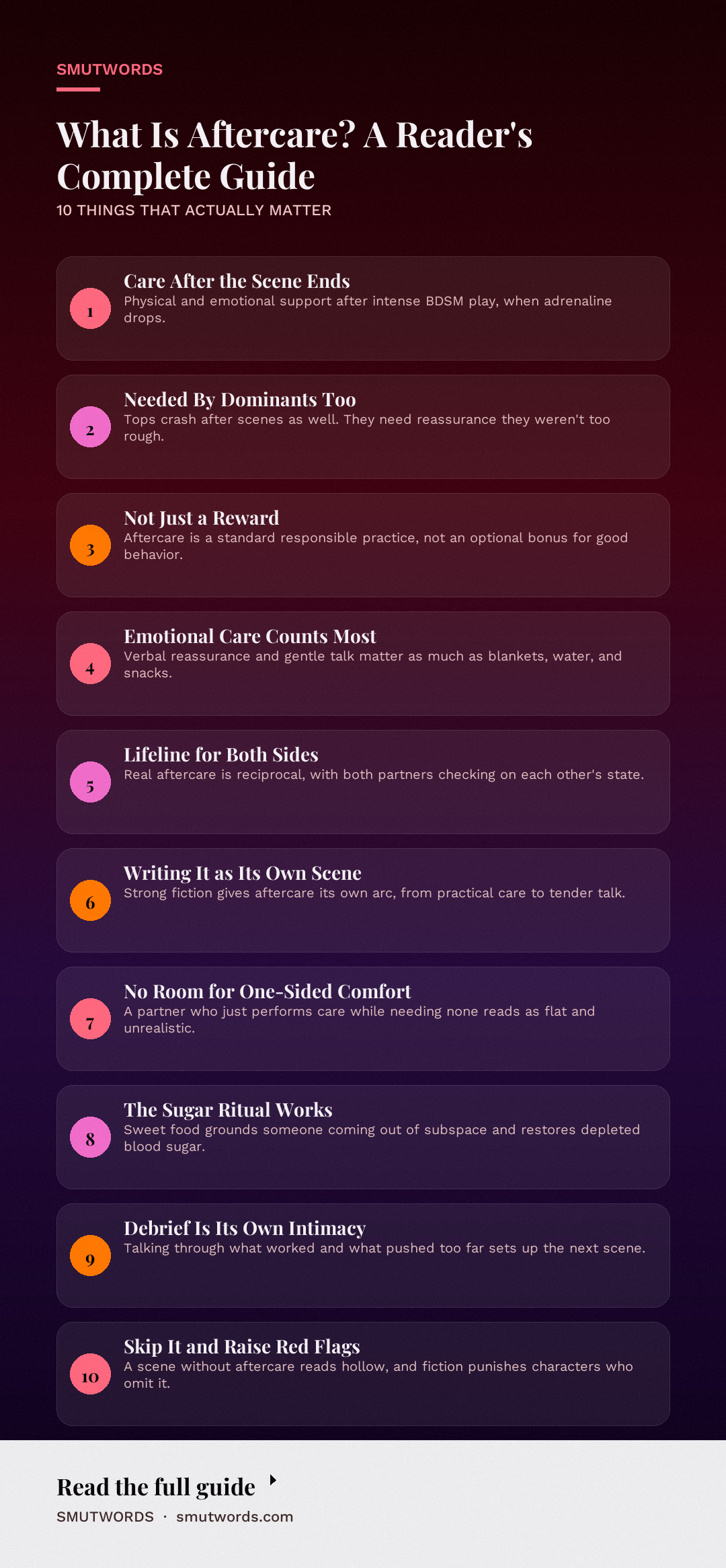
It is not an optional luxury, nor a reward for good behavior. It is a standard part of responsible scene play that begins during consent negotiation and continues until both partners are fully settled. Common misconceptions cluster around two ideas.
The first is that aftercare is only for submissives. Wrong. Dominants can experience a drop in mood and energy after a scene too, and they need care just as much. The second is that aftercare is purely physical, involving blankets, water, and snacks. Emotional aftercare matters just as much, and for many people it is the entire point. Verbal reassurance, gentle conversation, and a return to egalitarian touch all count.
A scene does not count as aftercare just because one partner says nice things while the other lies there. Real aftercare is negotiated beforehand, tailored to what each person knows they need, and checked in on after the fact. If a partner needs silence and the other keeps talking, that is not care; it is comfort performed for the giver. The practice demands awareness of the specific person in front of you, not a script.
Where Aftercare Comes From
The concept of aftercare as a named, structured practice has roots in the late twentieth century BDSM community, but the underlying human need is ancient. Anyone who has lived through an intense physical or emotional event, from a sporting victory to a deep crying session, recognizes the shaky, vulnerable period that follows. Kink simply gave that period a name and a set of standard practices.
The term gained traction in the 1980s and 1990s as the modern BDSM community codified its ethics. This was the era when concepts like SSC (Safe, Sane, Consensual) and later RACK (Risk Aware Consensual Kink) became organizing principles. Aftercare emerged as an essential component of that responsibility. If you were going to take someone into deep subspace or push their physical limits, you were obligated to bring them back out safely.
The community formalized what thoughtful tops and bottoms had always done instinctively. Yet in the publishing world, aftercare appeared in erotica long before it had the name. Classic romance novels featuring dominant heroes often included a scene where the hero bathes the heroine, feeds her, or holds her after an intense encounter.
The behavior read as romantic tenderness. What changed is that modern BDSM erotica, particularly the wave of popular fiction that followed the mainstreaming of kink in the 2010s, began naming the practice explicitly and treating it as a required beat in any credible power exchange scene.
That shift matters for writers. Earlier erotica often treated the post-scene moment as incidental, a quick bridge to the next plot point. Contemporary readers and writers understand that a scene without aftercare reads as hollow or even dangerous. The genre now treats aftercare as a marker of a trustworthy dominant and a sign of genuine connection. A character who skips aftercare is either a villain or a deeply flawed partner, and the narrative usually punishes that choice.
How It Shows Up in Erotica
The best erotic fiction treats aftercare as a scene in its own right, with its own arc, beats, and emotional payoff. It is not a denouement. It is the place where the power exchange resolves into intimacy, where the reader gets to see what the intensity was actually for.
A typical aftercare moment in a novel follows a recognizable shape. The physical action stops. One partner, often the dominant, notices the other is shaking, crying, or drifting. They move into practical care: water, a blanket, a warm towel, a hand on the back.
Then comes the emotional layer, the verbal reassurance that the submissive did well, that they are safe, that the dominant is proud of them. Finally the scene shifts into ordinary intimacy, cuddling, quiet conversation, sometimes food, reestablishing the equal footing the scene temporarily suspended. This structure mirrors the guidance in many beauty and the beast retelling guides, where the softening after conflict carries just as much weight as the confrontation itself.
Strong aftercare writing avoids several common failures. The first is rushing.
A single paragraph that says "he held her and she felt safe" before cutting to the next morning cheats the reader of the emotional resolution they have earned. The second is making aftercare one-sided. A dominant who performs care but visibly needs none, who never drops, who simply pats the submissive on the head and goes to make coffee, reads as cardboard.
Real aftercare is reciprocal. The dominant may need to hear that they did not go too far, that the intensity was wanted, that their partner trusts them. This is where the matchmaking mother kink trope gets interesting, since it often positions the dominant as someone who must learn to receive care rather than merely dispense it.
Subspace grounding is a specific variant worth knowing. Subspace is the floaty, euphoric, sometimes dissociative state a submissive can enter during intense play. Coming out of it requires patient, sensory-grounded care: slow breathing together, firm touch, naming objects in the room, eating something sweet. The sugar and water ritual exists because intense scenes deplete blood sugar and because the act of eating is grounding. Erotica that depicts a submissive drifting in subspace and a dominant patiently pulling them back with gentle questions and a glass of juice captures something deeply real.
The debrief is another common form. Some couples need to talk through the scene while it is fresh, naming what worked, what pushed too far, and what they want next time.
Enjoyed this? Get a free book.
Join the list and we will send a complete free story straight to your inbox, plus new releases every week after that. No credit card, no catch.
Written well, a debrief scene is hot in a completely different register. It is intimate in its honesty and its willingness to be vulnerable about desire. It also sets up the next scene beautifully, because the partners finish the conversation knowing exactly what the other craves.
Care routines vary wildly by character and dynamic. A regimented couple might have a checklist: water, blanket, specific food, a set amount of time in silence before talking. Another couple's aftercare might look like the dominant ordering takeout and putting on a comfort movie while the submissive curls into their lap, barely talking. Both are valid, and fiction benefits from showing characters who need different things and learning to give them.
Real-world considerations belong in the writing too, at least implicitly. Aftercare requires ongoing communication and checking in with both partners, not just the submissive, to ensure everyone feels safe and settled.
The best fictional couples model this naturally. The dominant asks "Are you okay?" and actually waits for the answer. The submissive asks "Was that too much for you?" without embarrassment. These small exchanges signal a healthy dynamic and give the reader emotional payoff beyond the physical.
Aftercare vs Power Exchange
Newer readers occasionally confuse aftercare with the broader dynamic it supports. A power exchange is the ongoing structure of a BDSM relationship, the agreement that one partner holds authority over the other within negotiated limits. It is the container. Aftercare is one specific practice that happens inside that container, the restoration of balance after a scene.
The comparison is worth making because the two are frequently discussed together. A power exchange relationship might include aftercare as a regular ritual, but the two do not inevitably go together. A one-night scene between strangers can include excellent aftercare. A long-term power exchange can neglect aftercare entirely, which is a red flag in fiction and in real life.
Domspace is another adjacent concept that gets tangled up in discussions of aftercare. It is the focused, altered mental state a dominant enters during intense play, similar to subspace but characterized by a sense of power, control, and heightened focus. Coming down from Domspace can be rough. The dominant may feel a crash of guilt, exhaustion, or confusion once the scene ends.
Aftercare for a dominant means the submissive recognizing that crash and offering reassurance. The submissive saying "I wanted that, I liked that, you did well" can be the most important care a dominant receives. This dynamic plays out with particular texture in forbidden beast tamer romance, where the tamer's control is constantly tested and the cost of that control needs acknowledgment.
These distinctions matter for anyone writing or reading BDSM fiction because they clarify motivation. A character who provides aftercare but resists the ongoing structure of a power exchange is a different figure than one who embraces both. And a narrative that shows a dominant crashing into Domspace fallout with no one to catch them tells a story about the limits of self-sufficiency in kink.
Frequently Asked Questions
Is aftercare only for submissives?
No. Dominants experience physical and emotional drops after scenes too, and they need reassurance that their actions were wanted and appreciated. Effective aftercare is reciprocal, with both partners checking in on each other's state and needs.
How long does aftercare last?
There is no universal timeline. It lasts until both partners feel grounded and settled, which can take twenty minutes or several hours. Some couples extend aftercare into a whole wind-down routine involving food, conversation, or shared quiet time, and that is a valid choice.
Can someone need aftercare for a non-BDSM sexual encounter?
Yes. Rough sex, intense emotional intimacy, or any encounter that leaves a partner feeling vulnerable or overwhelmed can create the need for grounding care. The practices of aftercare, water, blankets, verbal reassurance, are useful for anyone after any intense experience.
What is subspace and how does it relate to aftercare?
Subspace is a floating, euphoric, sometimes dissociative state some submissives enter during intense play. Aftercare includes the process of grounding a partner who is coming out of subspace, using slow touch, quiet talk, and sensory anchors to bring them fully back to the present.
Is sex a form of aftercare?
Sometimes, but not automatically. If both partners genuinely want sex as part of their wind-down, it can be a beautiful extension of the scene's intimacy. If one partner offers sex because they think it is expected, it is not care. The distinction comes down to negotiated desire, not assumption.
What should you do if a partner refuses aftercare?
Ask why. Some people genuinely do not need it and prefer to transition quickly to normal activity. Others refuse because they feel shame about being vulnerable or because they were taught that needing care is weak. Gentle conversation can clarify which case you are in, and the answer should guide how you proceed.
Final Thoughts
Aftercare is the proof that a scene was about connection rather than merely sensation. It is where the emotional truth of a power exchange surfaces, the moment when a dominant's control transforms into protection and a submissive's surrender transforms into trust. The best novels understand that the cuddle after the storm is not less interesting than the storm; it is the reason the storm was worth reading. If you want a masterclass in how this beat lands on the page, look for a contemporary BDSM romance with a dominant character who talks about their own needs after a scene. That reciprocal vulnerability is the gold standard.
For readers who enjoy exploring how kink dynamics shape character relationships in unexpected genres, the scar fetish guide covers another way vulnerability becomes intimacy, while the breakdown of cozy fantasy romance shows how gentle, caretaking dynamics can carry a whole narrative without ever needing a dungeon.








Loading comments…