
Friends to lovers is the romance arc where two people who already know each other, sometimes for years, cross the line from platonic to romantic and sexual. The friendship comes first. The wanting comes second, often without either person noticing it until it's already too late to pretend otherwise.
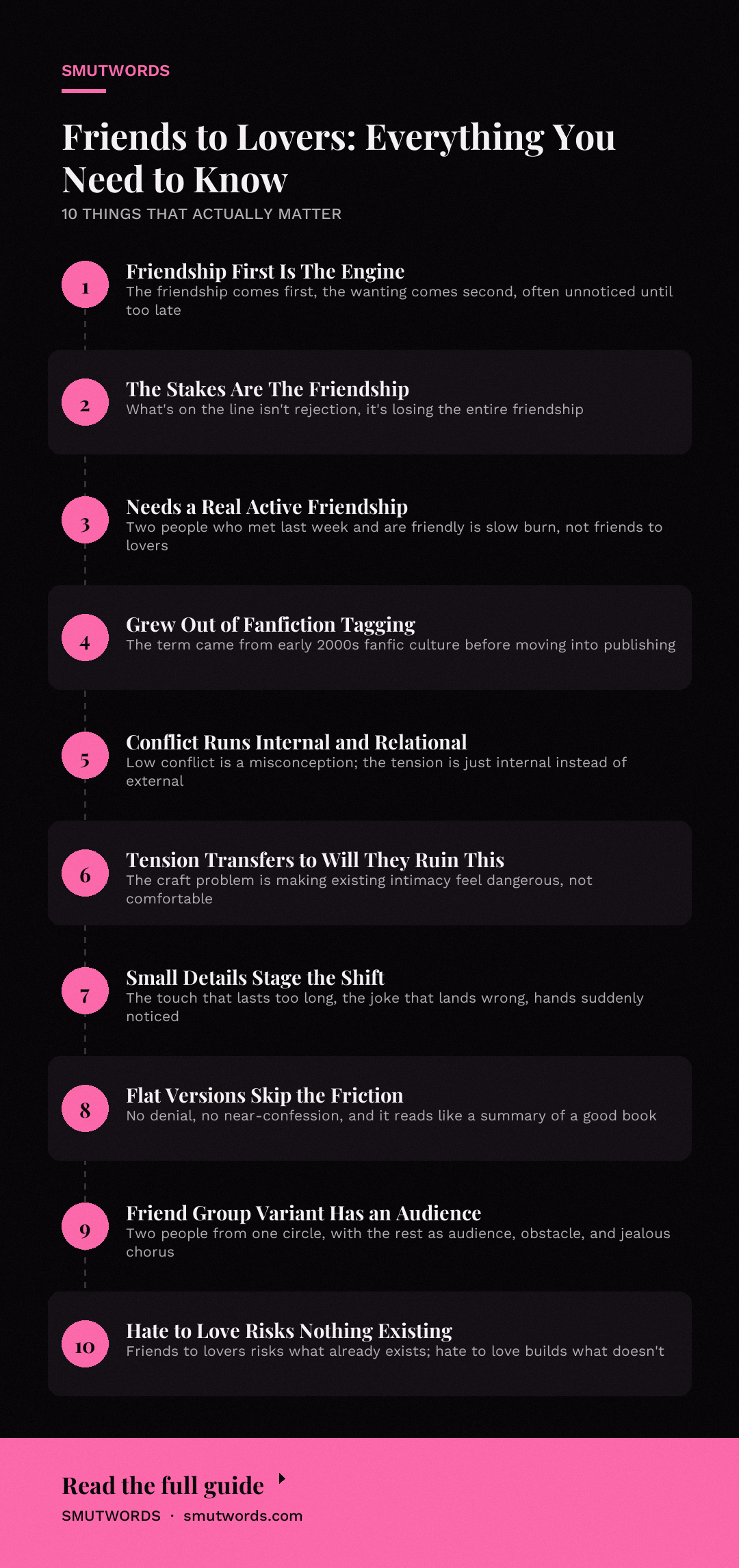
That order of operations is the whole engine of the trope. It's why friends to lovers keeps showing up at the top of reader polls, author to-write lists, and every "comfort read" recommendation thread on the internet. The stakes are low on paper and enormous in practice. What's on the line isn't a rejection; it's the entire friendship.
What Friends to Lovers Actually Means
The name is almost aggressively literal, which is part of why it travels so well. Two characters occupy the friend slot in each other's lives, then move into the lover slot, and the story is about that move.
The term itself grew out of fanfiction tagging culture in the early 2000s before migrating into romance publishing's marketing vocabulary. Now it sits alongside enemies to lovers and fake dating as one of the load-bearing tropes of the genre. Nobody coined it in a boardroom. Readers needed a way to sort the archive, and the phrase stuck because it described exactly what it delivered.
What counts: a genuinely established friendship, not a one-scene acquaintance. History that predates the first page. Shared context, inside jokes, a baseline of trust that both people can feel. The transition can be slow-burn across an entire novel or a single explosive scene, but the friend foundation has to carry real weight or the trope collapses into something else.
What doesn't count: two people who met last week and are being friendly. That's a slow-burn romance, not friends to lovers.
Also excluded, despite frequent miscategorization, is the couple who were childhood friends, lost touch for fifteen years, and reconnect as strangers. They have a shared past, but they don't have a friendship happening in the present tense, and the tension plays completely differently. The trope needs an active friendship to threaten.
Common misconceptions run in a few directions. Readers sometimes assume friends to lovers means low conflict, which is wrong; the conflict is just internal and relational instead of external. Authors sometimes assume it means slow pacing, which is also wrong, and leads to the flattest versions of the trope where nothing happens for two hundred pages.
Then there's the persistent idea that the two characters must be best friends. That ignores the entire friend-group variant, where the couple is two people from a larger circle who never spent much time alone together until something shifted.
Where Friends to Lovers Comes From
As a publishing phenomenon, friends to lovers has a much longer history than its tag suggests. Romance novels have been built on it since at least the mid-twentieth century, when category romance lines routinely used "the boy next door" as shorthand for the dependable alternative to the brooding stranger. Those books treated friendship as the sensible choice, a settling, and the heat came from somewhere else. That's a completely different animal from what the trope means today.
The real shift happened in the 2000s and 2010s, tracking alongside two things at once. First, fanfiction culture built an enormous body of work around slow-burn friendships turning romantic, and those readers aged into romance publishing as both consumers and authors.
Second, the romance genre itself started taking emotional interiority more seriously. That meant the friendship could stop being a plot device and start being the actual source of tension. Once authors figured out that the fear of losing a friend was more interesting than the fear of a first date, the trope got a promotion.
The last decade pushed it further. Contemporary romance made friends to lovers a top-tier category, sometimes outpacing enemies to lovers in reader surveys, and the variant list exploded: childhood friends, best friends, teammates, coworkers who became friends first, friends with benefits, fake relationship gone real.
The trope also got queered in ways that mattered, with m/m and f/f friends to lovers becoming some of the most consistently popular pairings in indie romance. Part of the reason: the friendship-to-romance arc maps cleanly onto coming-out and self-discovery narratives without needing to make those the whole story.
What's changed most recently is the pacing. Older friends to lovers novels ran long and gentle. Modern ones are short, sharp, and often start mid-realization, with the friendship already established before chapter one. The tag stopped meaning "cozy" and started meaning "the wanting has been there the whole time," which can be just as filthy as anything else on the shelf.
How It Shows Up in Erotica
On the page, friends to lovers does something structurally specific: it transfers the tension from "will they meet" to "will they ruin this." The characters already have proximity, already have permission to touch, already have late nights and shared food and the kind of access that a stranger couple has to earn across a whole book. The craft problem is making that existing intimacy feel dangerous instead of comfortable.
Strong versions of the trope solve this with specificity. The accidental touch that lasts two seconds too long. The joke that lands wrong because one of them is suddenly aware of their own mouth.
The moment one character notices the other's hands, or the way they look in a shirt they've worn a hundred times, and can't un-notice it. Good authors don't announce the shift; they stage the small physical details that make the reader feel the ground moving before the characters admit it.
Flat versions do the opposite. They tell the reader the characters are friends, then tell the reader they're attracted, then have them fall in love. No friction, no denial, no scene where one of them nearly says it and chickens out. The result reads like a summary of a good book rather than the book itself.
Common variants authors use, roughly in order of how often they show up:
Enjoyed this? Get a free book.
Join the list and we will send a complete free story straight to your inbox, plus new releases every week after that. No credit card, no catch.
- Childhood friends to lovers. The friendship predates sexual awareness entirely. The tension comes from the characters renegotiating a bond that was fixed in childhood, often with families and hometowns watching.
- Best friends to lovers. The highest-stakes version, because the friendship is load-bearing in both characters' daily lives. Losing it costs more than any other variant.
- Friend group to lovers. Two people from the same circle, with the rest of the group as audience, obstacle, and occasionally Greek chorus. Often uses jealousy mechanics, and the tension of "what happens to the group if this goes wrong" drives at least half the plot.
- Friends with benefits to lovers. The physical line gets crossed first, the emotional line lags behind. Requires the author to make the sex scenes do double duty, which is exactly where a guide like Writing Sex Scenes That Matter to the Plot earns its keep.
- Fake relationship with feelings. Two friends pretend to date for a wedding, a job, a family thing, and the performance stops being performance. The mechanics are close enough to friends to lovers that readers sort them together, though the trope has its own deep history, covered in the guide to fake marriage.
The friendship-to-sex pipeline also borrows freely from the device canon. A shared hotel room with one bed is almost a cliché of the trope at this point, for good reason: it puts two people who already trust each other into proximity that suddenly means something else.
The only one bed device functions differently here than it does in an enemies to lovers book, where it's about forced proximity between people who don't want to be near each other. In friends to lovers, the two of them have shared a bed before and thought nothing of it. The whole scene is about the gap between then and now.
What separates a strong version from a flat one usually comes down to a single question: does the author let the friendship be genuinely good? If the friendship is hollow, the risk of losing it doesn't land. If the friendship is real, warm, specific, full of tiny details only these two people would know, then every step toward romance feels like it might cost something irreplaceable. Readers come for the cozy and stay for that fear.
There's also a queer-specific craft layer worth naming. When the couple is same-gender, friends to lovers often carries extra weight because the friendship is sometimes the space where one or both characters figured out their own sexuality. The transition isn't just friend to partner. It's sometimes self-understanding to self-disclosure to partnership, and the strongest versions of these books handle all three beats without turning the story into a coming-out novel with a romance stapled on.
Friends to Lovers vs Hate to Love
The two get compared constantly, and the comparison is worth making because the difference is cleaner than readers sometimes expect. Friends to lovers runs on pre-existing trust and the fear of losing it. Hate to Love runs on hostility that converts into attraction, with the relationship starting from nothing and building up.
Both are slow burns. Both rely on tension.
But the direction of the emotional arc is inverted. Friends to lovers risks what already exists. Hate to love builds what doesn't.
A reader who wants the ache of "I can't believe I want you" will find friends to lovers delivers it through recognition, and hate to love delivers it through resistance. There's overlap, of course.
A friendship with an old wound can read almost like enemies to lovers. Two people who used to be close and drifted apart can carry both flavors at once. But as categories, they reward different reader moods, and authors who confuse them end up with a book that doesn't quite land for either audience.
Frequently Asked Questions
Is friends to lovers the same as slow burn?
No. Slow burn describes pacing; friends to lovers describes the relationship setup. A friends to lovers novel can be a fast burn, with the physical line crossed in chapter three.
A slow burn can run between two strangers who meet on page one. The tags overlap often but mean different things.
Why is friends to lovers so popular in erotica and romance?
Because the emotional groundwork is prepaid. Readers don't need to be convinced the two characters care about each other; the friendship does that work in the first few chapters. That frees the author to spend the rest of the book on the transition itself, which is where the heat lives. The combination of established intimacy and real risk of loss is unusually efficient at generating tension.
Does friends to lovers need to be a slow burn to work?
No, and assuming it does is a common reason the trope falls flat. The friendship can be established in a prologue or a few pages of history. What matters is that the reader believes in the friendship before the romance starts moving. Pacing is a tool, not a requirement.
What's the difference between friends to lovers and friends with benefits to lovers?
In friends with benefits to lovers, the sexual relationship starts first and the romantic awareness lags behind it. In pure friends to lovers, both the romantic and sexual shifts happen together or close to it. The friends with benefits version leans harder on the gap between what the characters do and what they're willing to admit.
How do authors avoid making friends to lovers boring?
By making the friendship specific and the fear real. The best versions put small physical and emotional details on the page that show the shift happening before either character names it. Authors who skip that stage and move straight to declarations end up with a book that reads like a summary instead of a story.
Can friends to lovers work in a short story or novella?
Yes, and it's one of the easier tropes to compress because the history can be implied in a few lines rather than fully dramatized. Novellas often start in the middle of an established friendship, with the reader meeting the characters the same day their dynamic changes. The risk is that short versions sometimes skip the friendship entirely and just label the couple as friends, which flattens the trope.
Final Thoughts
Friends to lovers earns its spot at the top of the trope hierarchy because it does what erotica and romance are best at: it takes something ordinary and safe and makes it feel like it could ruin a life.
The best way to understand the trope's range is to read across its variants rather than at one end. Start somewhere mid-list if you want a clean entry point, then work toward the sharper, filthier ones once you've got the friendship dynamic in your head. This trope rewards readers who pay attention to the small moments, since those small moments are where the whole thing lives.







Loading comments…