
Pet play is a kink and a power-exchange dynamic where one partner takes on the role of an animal and the other acts as its handler or owner. The animal role usually lands on a puppy, kitten, or pony, though foxes, bunnies, and less specific creatures show up too.
The handler sets rules, gives commands, offers praise, and takes responsibility for the pet's care. The pet gives up human speech, human dignity, and human decisions for a while, and gets to exist as something simpler and more devoted in return. That exchange, not the ears or the collar, is what makes pet play work on the page.
Readers come to it for two things at once: the total clarity of the power dynamic and the strange, specific freedom of getting to stop being a person for an hour. The handler gets nurturing control. The pet gets to stop performing humanity. Both are erotic in ways that have almost nothing to do with actual animals and everything to do with surrender, attention, and being kept.
What Pet Play Actually Means
The name is literal in a way that trips people up. "Pet" refers to the role being played, and "play" refers to the fact that this is a negotiated scene or ongoing dynamic rather than a lifestyle identity for most people who enjoy it. The term covers a wide range, from a collar worn during sex to a full-time household protocol where the pet eats from a bowl and sleeps at the foot of the bed.
What counts as pet play is mostly a question of role and ritual. If one partner is animal-coded and the other is in charge of them, and both are getting off on that arrangement, you're in the territory. The animal behavior can be as light as a nickname and a collar, or as involved as training sessions, commands, rewards, and a documented set of rules.
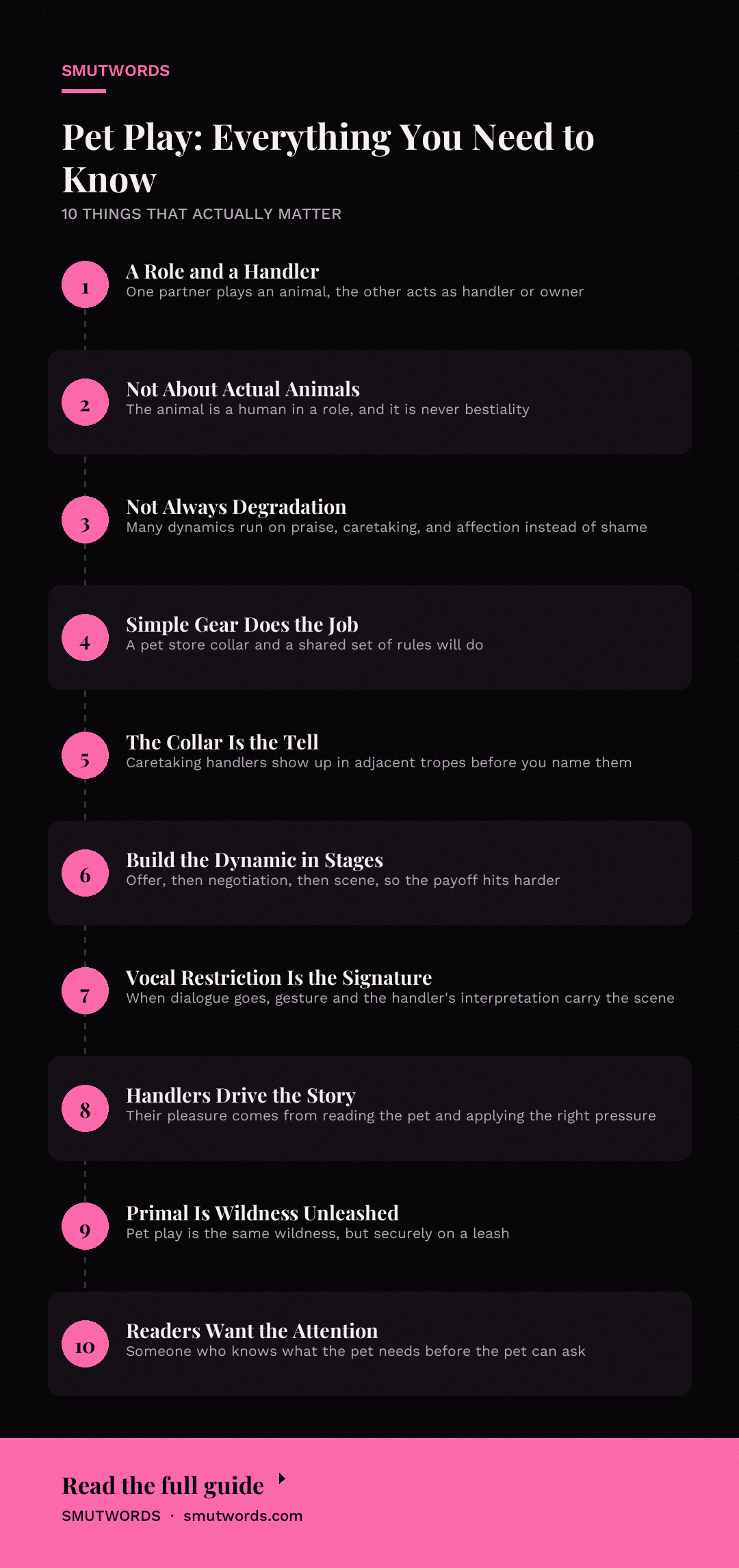
What doesn't count matters just as much. Pet play is not bestiality, and it is not about actual animals. The animal is a human being wearing a role.
It is also not automatically degradation, though humiliation and degradation kink can overlap with it. Plenty of pet play dynamics are built on praise, caretaking, and affection rather than shame.
Three misconceptions come up constantly.
- It's always sexual. Some pets and handlers run entirely non-sexual dynamics built on routine, obedience, and companionship. The erotic charge can be in the ritual itself.
- The pet is always submissive and the handler always dominant. Usually true, but switches exist, and some dynamics rotate roles depending on the day.
- It requires expensive gear. A collar from a pet store and a shared set of rules will do. Gear deepens the headspace for some people and does nothing for others.
The role a reader picks shapes the whole flavor of the story. Puppy play tends to read as eager, loyal, physical, and a little chaos-driven. Kitten play is usually softer, more spoiled, more about being petted and adored.
Pony play is the most formal, with tack, reins, gait work, and a discipline that borders on equestrian. Those three alone give an author wildly different tools.
Where Pet Play Comes From
The honest history here is thin on the kink side and much richer on the publishing side, so that's where this belongs. Pet play as a named, recognized fetish has only been a visible subculture since the late twentieth century, when it grew alongside the broader leather and BDSM communities.
Puppy play in particular organized into public munch groups and conventions in the 1990s and 2000s. Pony play has older roots in equestrian fetishism and Victorian-era riding culture, though the documented record is patchy.
Erotica got there earlier than any of that, under other names. The trope of a person reduced to an animal, kept, trained, and adored, shows up across nineteenth-century decadent literature and early underground publishing. It ran as a metaphor for total submission long before anyone called it a kink. What changed is that the metaphor became a genre.
The recognizable modern shift happened in the 2010s, when self-publishing let kink romance grow into its own category rather than a niche inside it. Pet play moved from a single scene inside a larger BDSM book to the whole premise. Collars on covers went from transgressive to expected. The vocabulary of handlers, pets, and training entered romance readers' search terms, and authors started building entire series around it.
A second shift is still happening. Early pet play erotica leaned hard on humiliation, punishment, and the pet as degraded object. Current books are far more likely to foreground the caretaking: the handler who feeds, bathes, praises, and protects. The appeal has moved toward devotion and away from shame, and the genre has followed the readership there.
How It Shows Up in Erotica
On the page, pet play is a craft problem before it's a kink problem. A scene needs to establish the rules fast, make the animal headspace legible to a reader who has never been in one, and keep the power exchange visible in every line. Books that do this well are specific. Books that do it badly hand a character a collar and assume the collar is doing the work.
The strongest versions build the dynamic in stages. First comes the offer or the discovery, where one character reveals what they want and the other has to decide whether to hold the leash. Then negotiation, which is where the good stuff lives: what the pet is allowed to do, what commands exist, what happens when they break a rule. The scene itself comes last and hits harder because of the buildup.
Vocal restriction is the signature move of the genre, and the hardest to write. When the pet can only bark, whine, or purr, dialogue goes away and the author has to communicate through gesture, eye contact, and the handler's interpretation.
Done well, this is intensely intimate: the handler becomes the only person who understands the pet. Done lazily, it turns into a mute character with nothing going on. The fix is internal monologue that stays in the pet's head, showing what's being restrained.
Handlers are usually the story's engine. Their pleasure comes from reading the pet correctly, applying the right pressure, and being the person who gets to decide. That's a very specific flavor of dominance, closer to caretaking than to cruelty.
Enjoyed this? Get a free book.
Join the list and we will send a complete free story straight to your inbox, plus new releases every week after that. No credit card, no catch.
The best handler characters are attentive, a little amused, and completely in control of their own reactions. A handler who loses composure constantly reads as a switch who wandered into the wrong book.
Common variations authors work with:
- Puppy play: energetic, praise-driven, often playful. Fetch, treats, and training drills show up regularly, and the dynamic usually centers on loyalty and eagerness.
- Kitten play: softer and more indulgent. Petting, laps, and a certain spoiled haughtiness are the stock in trade.
- Pony play: formal and physical. Tack, reins, bit gag equivalents, and gait work create the most elaborate power exchange of the three.
- Pet training: the story is the learning curve. Commands, rewards, and progression give the book a plot spine beyond the romance.
- Handler dynamics: the relationship architecture itself, whether that's a single scene, a weekend, or a permanent contract.
Gear matters, and it's where a lot of writers over-reach. A collar does its job when it's touched, adjusted, or used to pull someone closer during dialogue. Ears, tails, gloves, and bowls function best when the prose treats them as props that change behavior rather than as a shopping list. One well-placed collar, described physically and used in an actual moment, beats a paragraph of costume inventory.
The overlap with other kinks is worth knowing for authors who want to layer. Bondage gear like shibari pairs well with pony play for obvious reasons. Blindfolds intensify the vocal restriction problem, and the trust mechanics are close enough that the advice in our blindfold play for beginners guide applies almost directly.
Keyholding shares the custody-of-something-precious logic. Anyone writing a pet play scene inside a larger group scenario should read our guide to threesome dynamics first, since a third party watching the exchange changes the handler's attention in interesting ways.
What makes a strong version work versus a flat one comes down to three things.
- Specificity of rules: a pet who can only speak in short phrases, or who must ask permission to sit on furniture, gives the reader something to track.
- Reciprocity: the handler has to be getting something visible from the arrangement, or the book becomes a one-sided service manual.
- Stakes that don't collapse: the dynamic has to matter even when the scene is over. A pet who returns to ordinary life with nothing changed is a missed opportunity.
Plenty of readers arrive at pet play through adjacent tropes and don't realize it. A character who is possessive of a partner, keeps them close, feeds them by hand, and refers to them with a possessive nickname is running a handler pattern. Authors who want to escalate that can do it in one line: the collar is the tell.
Pet Play vs Primal Play
These two get confused constantly, and the confusion is understandable because both involve animal behavior. The distinction is worth getting right, because the scenes feel completely different.
Primal play is about instinct and animalism unmediated by structure. It usually involves chasing, wrestling, biting, growling, and a loss of the rational mind. Roles are fluid and often unlabeled. The animalism is the point.
Pet play runs on the opposite engine. Roles are explicit, rules are negotiated, and the animal behavior is performed within a framework one partner controls. A pet play scene can include primal elements, but the handler's authority is never in question. A primal scene can have nothing to do with pet play at all.
The shorthand: primal play is wildness with no leash. Pet play is wildness securely on one. Readers searching for books about "shifting" and beast instincts belong in primal. Readers who want a collar, commands, and a handler who keeps the rules belong here.
Frequently Asked Questions
Is pet play always sexual?
No. A large share of real pet play dynamics are non-sexual and built around routine, obedience, and companionship. In erotica it's almost always sexualized to some degree, but the erotic charge usually comes from the power exchange rather than the animal behavior itself.
What's the difference between puppy play and pet play?
Puppy play is one form of pet play, alongside kitten, pony, fox, and less specific animal roles. Pet play is the umbrella term for the whole category, and puppy play is the most common and most visible version within it.
Do you need a safeword for pet play if the pet can't talk?
You need a safeword system that works without speech. Most experienced partners agree on a physical signal, like a bell, a hand squeeze, or dropping an object, so the pet can stop the scene even when verbal communication is restricted. Regular check-ins from the handler matter even more when the pet is deep in the headspace.
Can the pet be in charge?
Sometimes, in the sense of a pet who brats, negotiates, or tops from below. The handler almost always retains formal authority, but the pet often drives the scene through demands and misbehavior. A switchy pet who knows what they want is one of the more popular character types in pet play romance.
What does "handler" mean in pet play?
The handler is the partner taking on the owner or trainer role. They issue commands, provide care, and enforce rules. In fiction, handlers are usually written as calm, attentive, and possessive rather than harsh, because the appeal is custodial control.
Is pet play the same as furries?
No. Furry fandom is about animal personas and often costume, with no required power exchange. Pet play is a dominance dynamic first, and the animal role is the vehicle. The overlap exists, but the two communities are distinct and the genre treats them differently.
Final Thoughts
The collar is a symbol. What readers keep coming back for is the handler's attention: someone who watches closely enough to know what the pet needs before the pet can ask. Write that, and the ears are just decoration.
If you want a book that gets the dynamic right, start with a why choose title that lets a single pet play partner work a whole household's worth of handlers, and see what changes when more than one person is holding the leash.








Loading comments…