
A munch (kink social) is a casual, non-play gathering where kink and BDSM community members meet in ordinary spaces like bars, cafes, and diners to talk, trade stories, and build the kind of friendships that hold a community together outside of any scene. No rope, no floggers, no dungeon furniture: just a table, a drink, and people who already understand the shorthand.
In erotica it shows up as the place where a character's kink life stops being a secret and becomes a social world, complete with in-jokes, elders, awkward newcomers, and the particular charged intimacy of talking about desire with your clothes on. That last part is the engine of it.
A munch puts characters in a room where the topic is kink and the activity is conversation, and the gap between those two things is where a lot of excellent fiction lives.
What a Munch Actually Means
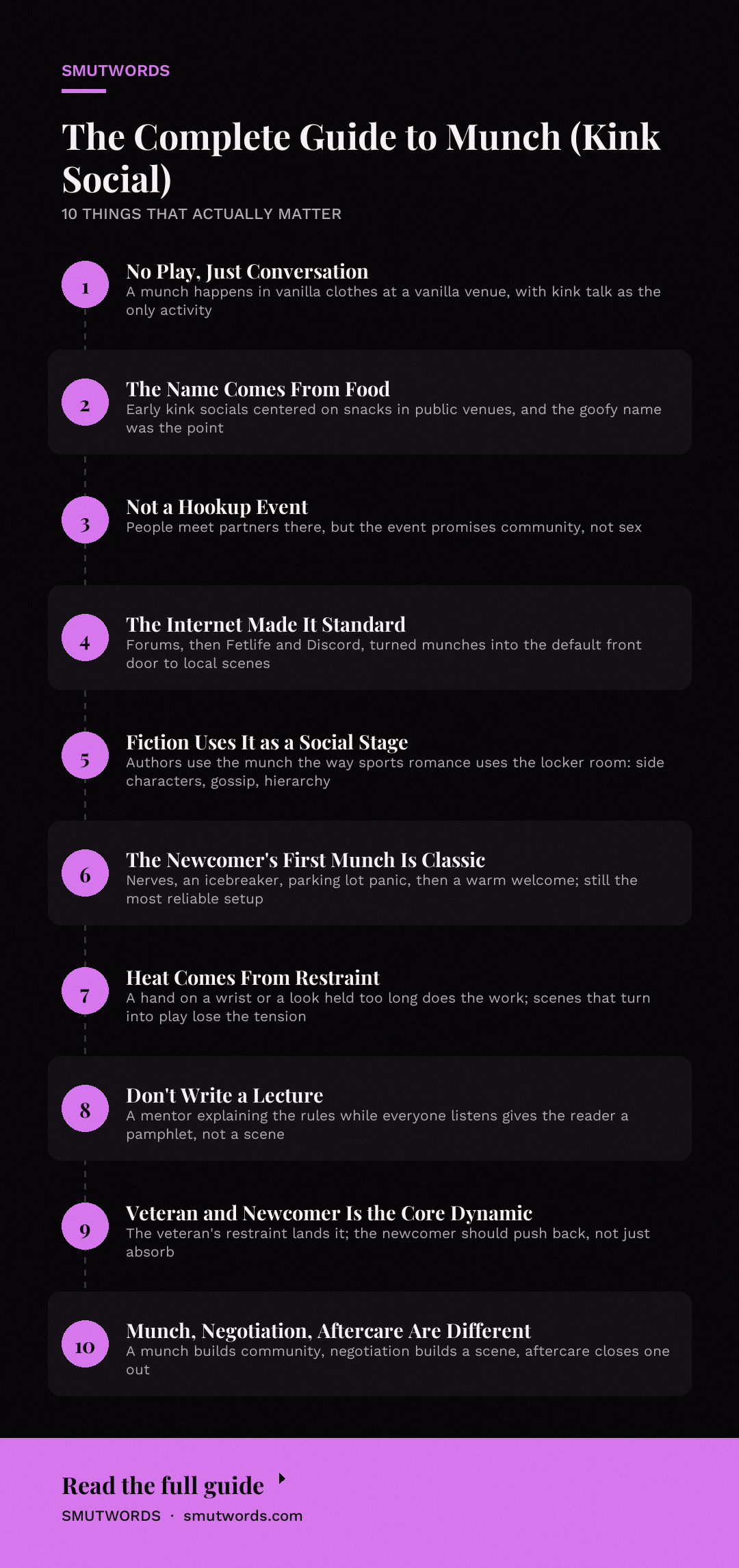
The name comes from the food. Early kink socials were organized around a meal or snacks in a public venue, and "munch" stuck because it was goofy and unthreatening, the kind of word that fits a group of people eating nachos in the back room of a pub. The whimsy is deliberate. A munch is designed to sound like the least intimidating thing in the world, because for a lot of attendees it is the first step.
The defining feature is the absence of play. A munch is not a play party with a different name, and it is not a hookup event, though people absolutely meet partners there.
It is a social gathering with conversation as the activity. Vanilla clothes, vanilla venue, kink-aware conversation. That's the whole format.
There is usually an organizer or two, sometimes a recurring schedule (first Tuesday of the month), often a private room or reserved tables, and frequently some kind of low-stakes icebreaker for newcomers. Many groups run a "newbie night" variant where first-timers get an orientation before or alongside the main social.
What Counts as a Munch
- A public or semi-public venue. Bars, cafes, diners, community halls, sometimes a rented back room. The venue matters because it keeps the event low-pressure and forces a certain discretion.
- No play, no protocols, no scene space. A munch with a rope demo is a workshop. A munch with a spanking bench is a party.
- Conversation as the point. People talk about kink openly, but they also talk about their jobs, their dogs, and the terrible parking.
- Some organizing structure. Even a loose one: a host, a group chat, a recurring time and place.
What Doesn't Count
A play party is not a munch. A workshop or skills class is not a munch, though the same people attend both. A private dinner among four friends who all happen to be kinky is not really a munch either; the term implies a group with some openness to new attendees, sometimes a formal newcomer process.
The most common misconception is that a munch is a soft entry to sex. It is a soft entry to community. People flirt, people pair off, people go home together, and none of that is the event's purpose or its promise.
The second misconception is that munches are for beginners only. Plenty of longtime community members attend the same monthly munch for a decade because it is where their friends are.
Where the Munch Comes From
Kink socials organized around food and drink have existed as long as kink communities have had to be discreet, which is to say a very long time. The specific word and format that most people mean today took recognizable shape in the 1990s, when early online discussion boards and mailing lists started producing offline meetups.
A person who had spent a year talking to strangers about bondage on a Usenet group wanted to find out whether those strangers were as reasonable in person. The answer was usually yes, and the munch format spread because it solved a real problem: how do you meet kinky people without walking into a club and hoping?
The internet moved the munch from useful to standard. Local groups on forums, then Fetlife, then Discord and event platforms gave organizers a place to post a time and a venue, and gave nervous newcomers a way to lurk and ask questions before committing to a Tuesday night at a bar. Munches became the default front door to most local kink scenes.
Romance and erotica publishing caught up later than you'd think. For a long time, kink fiction jumped straight from lonely protagonist to dungeon, because the dungeon is where the heat is. The munch was background noise, something a character mentioned having gone to.
That changed as the genre got more interested in community as setting. Contemporary BDSM romance started using the munch the way sports romance uses the locker room: a recurring location full of side characters, gossip, hierarchy, and stakes that aren't sexual. Once authors realized a munch scene could introduce six characters, establish a power structure, and generate three future conflicts in four pages, it became a staple.
There's also been a shift in tone. Older portrayals often treated the munch as evidence that the community is real and legitimate, a slightly defensive move. Newer fiction treats it as a genuinely fun social space, which is more accurate and better reading. The munch has gone from a credibility prop to a scene type with its own craft rules.
How Munches Show Up in Erotica
On the page, a munch is a pressure cooker with the lid on. Everyone is dressed, everyone is polite, and everyone in the room knows something about desire that the venue does not. That gap between surface and subtext is the whole reason the scene works, and strong writers exploit it hard.
The best munch scenes are almost entirely about watching. A character arrives early, orders something, and observes. Who greets whom, who touches whom, who gets a nickname, who is clearly senior.
The reader learns the social order the same way the protagonist does, through small behavioral cues. Far more engaging than a paragraph of exposition about how the local scene is structured.
The Common Variations
Certain munch setups recur across the genre because they reliably generate tension. A few of the most effective:
- The newcomer's first munch. Nerves, an icebreaker, a moment of panic in the parking lot, then a warm welcome. The classic structure, and still the most reliable.
- The newbie night. A dedicated orientation session with the veterans kept behind a glass wall, metaphorically. Great for exposition and for pairing a novice with a mentor figure.
- The vet's perspective. The protagonist has been going for years and is now the one doing the welcoming. Shifts the scene from anxiety to authority.
- The awkward ex. A former partner is at the same table. Everybody is very polite. Nobody means it.
- The stranger at the meet-and-greet. Someone new arrives who does not read as a newcomer, and the room quietly tries to figure out what their deal is. Useful for introducing an antagonist or a love interest with a mystery attached.
- The group chat before and after. Often braided in as a parallel track, showing conversation continuing outside the room and giving the munch an afterlife.
What Makes a Munch Scene Work
Specificity. A strong munch scene names the venue, mentions the terrible acoustics, and puts a specific drink in the protagonist's hand. It gives at least one side character a memorable tic. It lets a conversation about something mundane (a bad date, a work story) turn on a dime into something charged.
Strong versions also respect the non-play constraint. The heat comes from restraint: a hand on a wrist, a look held too long, a whispered joke with a double meaning. When a munch scene cheats and turns into a scene, it loses the very thing that made it worth writing.
Weak versions treat the munch as a lecture. A mentor character explains the community's rules while everyone else listens, and the reader gets a pamphlet instead of a scene. Anything that could have been a conversation involving three people with competing interests should be that.
Another reliable failure: the munch scene that only exists to introduce the dominant. A room full of people who function as a spotlight. Give the side characters their own agendas and the scene does double duty.
The Craft Details That Sell It
Consent etiquette shows up in a hundred small ways at a munch, and taking those seriously makes the scene more interesting, not less. Nobody assumes anyone's role, level of experience, or willingness to touch. A character asking before sitting next to someone, or checking in before asking a personal question, tells the reader exactly what kind of community this is. For more on how that etiquette plays out once clothes come off, the guide to consent negotiation covers the language.
The venue itself imposes constraints that can be played for comedy or tension. The bartender who keeps drifting near the reserved table. The group that has to keep its voice down when a topic gets explicit. The question of whether the back room really is private.
Enjoyed this? Get a free book.
Join the list and we will send a complete free story straight to your inbox, plus new releases every week after that. No credit card, no catch.
A confident writer also uses the munch to seed later scenes. A throwaway mention of a whip in someone's car, a joke about mummification that gets a nervous laugh, a veteran's quick aside about bondage safety and the proper use of bondage furniture before the couple has even kissed. Each of those is a promise to the reader, and the payoff lands better when the promise was made over drinks.
Where the Scene Goes After the Munch
The munch is usually the ground floor of a longer arc, and the strongest versions leave the reader with a concrete sense of what's coming. A conversation at the table about limits. A partner's first mention of aftercare and how much of it they need, which tells the protagonist (and the reader) exactly how serious this is about to get.
Some books then go straight to a full scene play chapter, while others spend more time in the social world before opening the bedroom door. For a model of how to keep a scene grounded while the stakes climb, the piece on how to check in during a scene is worth a read, because the same conversational register that works at a munch tends to work mid-scene too.
A certain subgenre uses munch conversations to test taboo topics before committing to them. Characters who have just met can say things at a munch they couldn't say anywhere else, and a scene that floats the idea of a cuckold pregnancy fantasy over a pint is a nice example: the culture of the room makes the conversation possible.
The Veteran and the Newcomer
The most-used munch dynamic in fiction is the gap between someone with experience and someone without it, and it holds up because it's genuinely dramatic. The veteran knows the etiquette, the unwritten rules, the local dramatis personae. The newcomer doesn't know whether to shake hands or hug or wait to be addressed.
What makes the dynamic land is the veteran's restraint. A good mentor character explains just enough, lets the newcomer make their own mistakes, and then steps in when a mistake actually matters. The reader gets the orientation without a lecture.
A weak version has the newcomer simply absorb the veteran's worldview, becoming a follower rather than a character. Better books let the newcomer push back, ask awkward questions, and reveal that the veterans have blind spots too.
Some stories flip it entirely: the veteran is burned out, disillusioned with the local community, and the newcomer's eagerness is what brings them back. That version is arguably richer than the first, and it's the one that gives a munch scene emotional stakes rather than just expositional value.
The Munch as Social Stage
In the best books, the munch is a recurring stage that the reader learns to navigate, like a favorite bar. Specific characters hold specific roles: the guy who always orders the same thing, the woman who quietly runs the group chat, the couple who've been together for a decade and act as informal parents to the whole scene.
When a recurring munch is done well, a single line of dialogue can carry a load of backstory. A character arriving at the table with a new partner and the table falling silent tells the reader everything about the group's opinion of the last one.
That kind of shorthand is the reward for building a social world across a book or series. It's also why munch-heavy stories tend to be longer and more community-focused than pure dungeon romance; there are simply more people whose lives matter.
Munch (Kink Social) vs Aftercare and Consent Negotiation
Readers sometimes blur three adjacent terms, so a quick distinction helps. A munch is a social gathering, full stop. The other two are things that happen around and after scene play.
Consent negotiation is the structured conversation before play: what happens, what doesn't, safewords, limits, expectations. It's often conversational and it's often calm, which is why it can feel munch-like, but it's a private negotiation between the people about to play, not a social event.
Aftercare is the care that follows a scene, from blankets and water to check-ins and talking things through. A munch is not a group aftercare session, though you will occasionally see one character quietly checking on another at the table. That's just being a decent human being.
The confusion is understandable: all three involve talking. The difference is the function.
A munch builds community. Negotiation builds a scene. Aftercare closes one out.
Frequently Asked Questions
What happens at a munch?
People eat, drink, and talk, often in a reserved area of a bar or cafe. There's usually a host, some kind of welcome for newcomers, and a lot of conversation that ranges from totally mundane to frankly kinky. No play happens, and nobody is expected to reveal their role or experience level.
Do I have to identify as kinky to go to a munch?
Most groups welcome curious newcomers, partners of attendees, and people still figuring things out. The etiquette is the same either way: ask before touching, don't assume anyone's experience, and keep the conversation consensual. A few groups ask newcomers to message the host first, which is worth checking.
Can I meet a partner at a munch?
Absolutely, and many people do. What a munch doesn't promise is a hookup or a date. The culture generally discourages treating the event like a singles night, and the people who fare best are the ones who show up for the conversation and let connections develop.
What should I wear to a munch?
Whatever you'd wear to a normal social outing at that venue. The point of a munch is that public spaces stay public, so vanilla clothing is standard. Some groups suggest avoiding obvious kink symbols, mostly out of respect for the venue's other customers.
Are munches private or public?
Usually a bit of both. The venue is public, but organizers often reserve a private room or set of tables and may ask attendees not to name the group in public reviews. Some groups are openly advertised, others are invite-only or require a screening message. Check the listing before showing up.
What's the difference between a munch and a play party?
A play party involves actual kink play, often in a private or purpose-built space, with negotiated scenes going on around the room. A munch has none of that. It's a conversation-only event, and if someone tries to turn it into a scene, the host will shut it down.
Final Thoughts
The munch is where a kink scene stops being an idea and becomes a cast of people: the over-earnest organizer, the veteran with the dry sense of humor, the newcomer with three questions and a lot of nerve. Read well, it's a scene about how desire gets talked about before anything is acted on, which is half the pleasure of the genre in the first place.
If you want a book that uses the munch as a real social stage, with a newcomer finding their footing and a community with its own politics, start with a contemporary BDSM romance that builds its world there. The list below has the right ones to begin with.





Loading comments…