A love/hate relationship in romance fiction runs on the question every character refuses to answer out loud: do I want to fuck them or fight them? The dynamic locks two people in passionate conflict, swinging between intense attraction and fierce antagonism, often unable to tell if they want to kiss or kill each other. Every argument crackles with unresolved sexual chemistry, and it remains one of the most reliable ways to get readers turning pages deep into the night.
The appeal is primal. Readers love watching characters who openly despise each other fight their way into love because it validates that raw, messy feelings can be real intimacy. The push-pull creates high stakes and delicious frustration, making the eventual surrender that much more satisfying.
But a well-written love/hate dynamic doesn't just make you wait for the kiss. It makes you desperate for it.
What a Love/Hate Relationship Actually Means
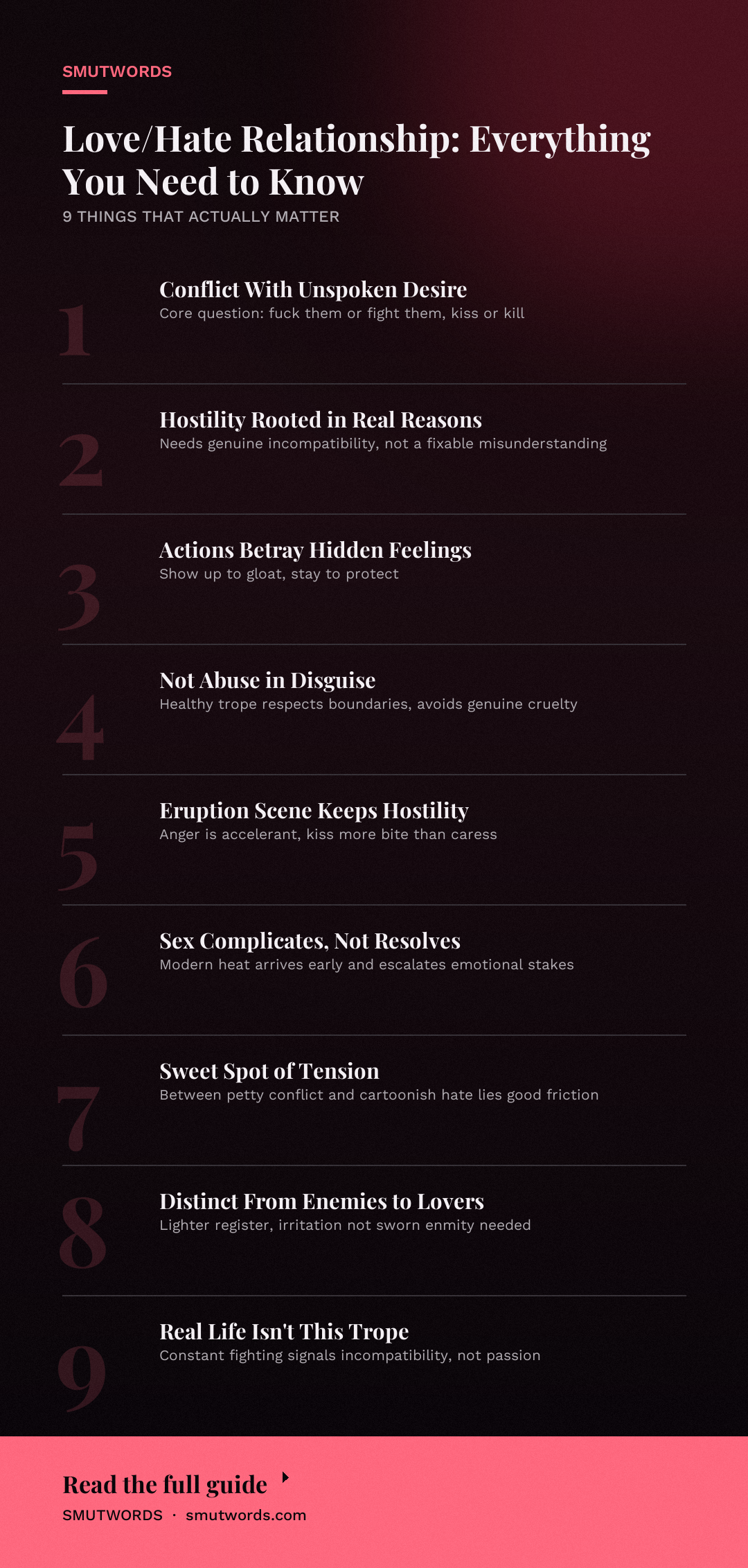
The love/hate relationship is a specific flavor of romantic tension where the central conflict is baked into the characters' own feelings. These two people do not dislike each other because of a simple misunderstanding that a single conversation could fix.
Their antagonism comes from genuine incompatibility, competing goals, or history that gave them real reasons to be hostile. What distinguishes the trope from a simple argumentative couple is the duality at its core. Every insult carries an undertone of fascination. Every physical confrontation reads as barely restrained foreplay.
The characters themselves often struggle to untangle their own motivations. They will tell themselves, and anyone who asks, that they want the other person to lose, to leave, to fail. But their actions betray them at every turn.
They show up to gloat and stay to protect. They pick a fight just to have an excuse to be in the same room.
The dynamic does not require the characters to literally hate each other at the story's start, despite the name. Many of the best examples open with mutual irritation or professional rivalry that intensifies as the attraction becomes undeniable. The key ingredient is visible, sustained opposition that coexists with visible, growing desire.
If the hatred is one-sided, or if the attraction only appears after the conflict resolves, you have a different story on your hands.
Common misconceptions muddy the waters. A love/hate relationship is not simple bickering where the characters secretly like each other from page one with no real stakes. It also is not an abusive relationship dressed up in romantic language. In healthy examples of the trope, the antagonism is rooted in pride, fear, or circumstance, not a desire to genuinely harm the other person. The line between delicious tension and red flag territory comes down to whether the characters respect each other's boundaries even while they drive each other crazy.
Where the Love/Hate Relationship Comes From
The love/hate dynamic has roots as old as storytelling itself. Shakespeare built entire plots on it, most famously in "Much Ado About Nothing," where Beatrice and Benedick trade barbs so sharp they could draw blood while everyone around them sees the obvious attraction.
The tradition carried through the romantic comedies of the 1930s and 1940s, where screwball comedy pitted strong-willed leads against each other in verbal sparring matches that served as foreplay for the final embrace. In romance publishing specifically, the trope solidified its place during the rise of the category romance in the 1970s and 1980s.
Harlequin and Silhouette built whole lines around the antagonistic hero and the woman who refused to be cowed by him. These early versions often framed the conflict as the heroine softening the brooding, difficult hero, a pattern that modern readers have pushed back against in favor of more mutual dynamics.
The biggest evolution came alongside the rise of the enemies-to-lovers subset. Where classic love/hate often stemmed from personality clashes, contemporary versions introduced real structural opposition. Characters became business rivals fighting over a contract, rival detectives solving the same case, or political opponents across the aisle. Read more about how this adjacent structure plays out in the full breakdown of the enemies to lovers trope.
The genre shift toward high-heat romance in the 2010s further transformed the dynamic. Modern love/hate stories do not wait until the last chapter for the physical payoff. The sexual tension gets resolved midway through, often in a furious, angry encounter that complicates the emotional conflict rather than ending it. This raised the stakes on the hate side of the equation, since the characters now have to grapple with the fact that the sex is incredible even when they still cannot stand each other.
How the Love/Hate Relationship Shows Up in Erotica
In erotic romance, the love/hate dynamic gives writers a ready-made structure for high-stakes scenes. A strong version of this trope on the page follows a recognizable rhythm that readers crave.
The first beat is the setup of genuine opposition. The characters need a real reason to be at odds. In a rockstar romance, the heroine might be the no-nonsense publicist assigned to clean up the image of a lead singer who thrives on chaos. In a workplace setting, they might be competing for the same promotion. The conflict has to matter to both of them, or their fighting reads as manufactured.
The second beat is the escalation of tension through forced proximity. The structure of a romance novel gives the author the perfect tool here: circumstances that throw the characters together even as they try to avoid each other. A wedding to attend with no plus-ones, a storm that traps them in a cabin, a duet they have to perform together. The proximity turns verbal sparring into physical awareness.
The heroine notices the way the hero's jaw tightens when she wins an argument. He notices the way she bites her lip when she is about to say something cutting.
Enjoyed this? Get a free book.
Join the list and we will send a complete free story straight to your inbox, plus new releases every week after that. No credit card, no catch.
The third beat is the eruption. In modern high-heat romance, this often comes as an explosive confrontation that tips over into a sexual encounter. The anger is the accelerant. A shout escalates into grabbing, into pushing against a wall, into a kiss that is more bite than caress. The best scenes preserve the hostility even in the intimacy. The characters do not suddenly soften and whisper sweet nothings. They fuck with the same ferocity they fight with, and the scene works because the emotional truth carries through.
The final beat is the reckoning. After the physical barrier falls, the emotional conflict remains unresolved. The characters have now added sexual entanglement to an already complicated dynamic. This is where weaker versions of the trope falter and stronger ones thrive.
The best books force the characters to confront why they fight so hard. The love has to win through acknowledged vulnerability, not through one character simply giving up the fight.
Strong versions of this trope share recognizable traits. The dialogue is sharp and fast, with each character giving as good as they get. The physical attraction is established early, often before the characters themselves admit it, through stolen glances and accidental touches that linger a beat too long. The conflict escalates in believable increments rather than through recycled arguments.
Flat versions of the trope usually fail for one of two reasons. Either the conflict is petty and insubstantial, making the characters seem childish rather than passionate, or the hate is so cartoonishly vitriolic that no reader believes these two people could ever share a healthy relationship. The sweet spot sits between genuine friction and obvious affection, where the reader knows the truth even when the characters refuse to see it.
The trope adapts well to a range of subgenres. In revenge romance, the hatred is structural, often tied to past wrongs that one character must forgive or the other must atone for. In motorcycle club romance, the dynamic often pits a strong-willed heroine against a possessive biker who is used to getting his way without argument. The specific flavor of the conflict shifts, but the underlying engine stays the same.
Common Variations Authors Use
- Antagonistic attraction with no past history: The characters meet and dislike each other instantly, with the friction building from the first scene. This works best when the author quickly establishes a concrete reason for the instant hostility.
- History-grounded resentment: The characters share a past that went badly, leaving unresolved bitterness that resurfaces on reunion. The anger has depth because it comes from real, remembered pain.
- Professional rivalry with collateral heat: The characters are competitors in a field that matters to both of them. Their professional clashes spill over into personal territory as the attraction takes hold.
- Betrayal-based antagonism: One character did something that hurt the other in the past, and their current dynamic is colored by that wound. The love/hate elements emerge as forgiveness becomes possible.
- The forced alliance: Two people who cannot stand each other must work together toward a common goal, providing a steady stream of proximity and tension with a ticking clock for urgency.
- The reluctant protector: One character is honor-bound to protect the other despite genuine irritation. The care shows through actions even as the words stay cutting. This pairs well with a soldier romance setup.
Love/Hate Relationship vs Enemies to Lovers
The most common point of confusion in modern romance discourse is the relationship between the love/hate dynamic and the enemies-to-lovers trope. They overlap heavily, and many books qualify as both, but they are not interchangeable labels.
Enemies to lovers carries a weightier implication: the characters are actual enemies, positioned in genuine opposition where one succeeding means the other fails. The histories in these books often include real damage, whether physical, professional, or emotional. The scale of the enmity tends to be larger, with characters who might genuinely wish the other harm at the story's opening.
A love/hate relationship can function on a lighter register. The characters do not have to be sworn enemies. They can be colleagues who grate on each other, neighbors who bicker constantly, or former flames who cannot let go of old grievances. The "hate" in the name often reads more accurately as intense irritation or competitive frustration than true hostility.
For readers looking specifically for the high-stakes version where the characters start as legitimate adversaries, the full treatment is available in the enemies to lovers glossary entry. For the broader category that includes everything from workplace spats to royal family feuds, the love/hate label is the better fit.
Frequently Asked Questions
What is the difference between a love/hate relationship and an enemies-to-lovers story?
Enemies to lovers implies a higher level of genuine opposition, often with real stakes or past harm between the characters. A love/hate relationship can be built on lighter friction, like professional rivalry or personal annoyance, and does not require the characters to be actual enemies at the start.
Can a love/hate relationship be healthy in real life?
In fiction, the dynamic works because both characters clearly respect each other underneath the conflict and never cross the line into genuine cruelty or boundary violation. A real-life relationship marked by constant fighting and mutual contempt is not a sign of passion; it is a sign of incompatibility or worse. The trope is fantasy, not a relationship model.
Why do I like reading about couples who argue all the time?
The appeal comes from the tension. Constant opposition creates uncertainty, which makes the eventual surrender feel earned. Readers also enjoy the verbal sparring itself, the sharp dialogue that shows characters who are intellectually matched and unafraid to challenge each other. The arguing is foreplay for the emotional and physical payoff.
How do authors keep the love/hate dynamic from getting repetitive?
Strong authors escalate the conflict in increments, giving the characters new reasons to clash as old grievances resolve. They also allow moments of vulnerability to peek through the antagonism, so the reader sees the potential for connection early. The best versions do not stay in a holding pattern of identical arguments; the fights get more personal and the attraction gets more undeniable.
Is a love/hate relationship the same as an anti-hero romance?
Not exactly. An anti-hero romance features a protagonist who operates outside conventional morality, which can certainly create conflict with a love interest, but the focus is on the hero's moral ambiguity. A love/hate relationship focuses on the dynamic itself, which can exist between two perfectly decent people who simply drive each other crazy. The two tropes often overlap, and the complete guide to anti-hero romance explores how they combine.
What are some popular book settings for this trope?
The dynamic is flexible enough to work in any setting. Contemporary workplace romances use it heavily, as do sports romances where rival athletes have to share a training facility. It shows up in fantasy with political rivals and in historical romance with feuding families. The workplace free use article covers one specific office-flavored variation of forced proximity and tense dynamics.
Final Thoughts
The love/hate relationship endures because it dramatizes a universal truth: the people who get under our skin the most often hold the greatest power to move us. It is the friction that generates heat, the resistance that makes surrender meaningful. When the characters finally stop fighting their feelings and each other, the payoff lands with real weight because the reader watched them earn it through every argument and every stolen glance.
For the strongest expression of the modern take on this dynamic, look to the books where the hate is credible, the love is inevitable, and the sex is furious enough to match the fighting. The catalog rankings on this page will point you toward the stories that do it best.






Loading comments…