
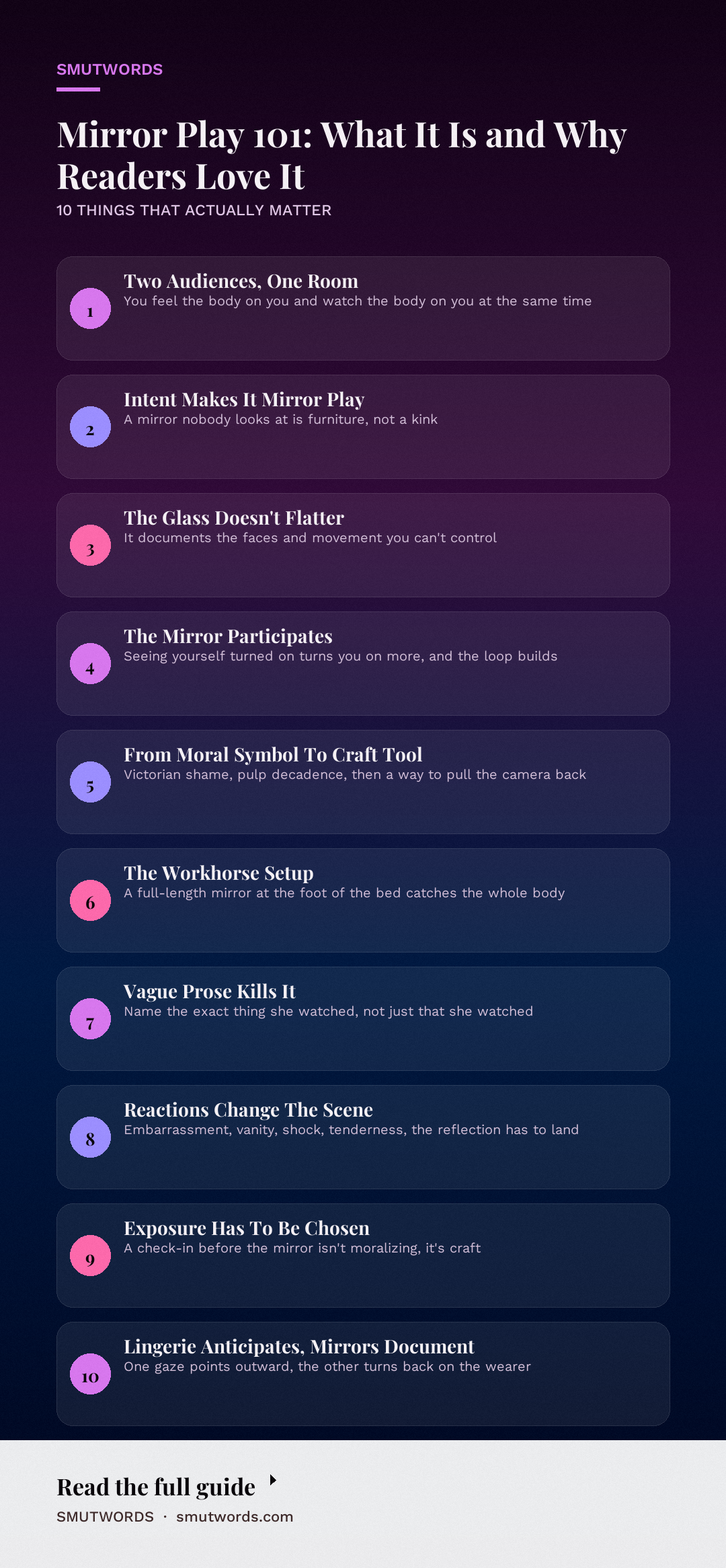
Mirror play is sex with a second audience built into the room. One or both partners position a mirror (bedroom vanity, closet door, bathroom wall, ceiling tile) so they can watch the act while it happens, turning fucking into a live performance with themselves as both cast and crowd.
The kink lives in that split attention. You feel the body pressed against you and you watch the body pressed against you, and the gap between those two experiences is where the heat pools.
Mirror play runs from a single full-length mirror leaned against a dresser to an entire ceiling done in reflective panels. It works on exhibitionist wiring, voyeuristic wiring, and plain old vanity at the same time. No third person required. No camera, no audience, no aftermath to manage. Just two people and the sudden, bracing fact of their own reflection mid-thrust.
What Mirror Play Actually Means
The name is literal. Mirrors get placed, angled, and used during sex so that the people having it can see themselves or each other from an angle their own eyes can't reach. That's the whole mechanism. Everything else is variation.
What counts as mirror play is broader than most readers assume. It includes a full-length mirror at the foot of the bed, a mirrored closet door left open at exactly the right angle, a bathroom counter scene where the sink mirror catches everything, a mirrored headboard, a ceiling mirror over the mattress, and the solo version where someone watches themselves masturbate on purpose rather than by accident.
It also includes the two-way glass fantasy, which is mirror play's more paranoid cousin: the mirror that might be a window, the reflection that might have company behind it.
What doesn't count is a mirror that just happens to be in the room. If nobody is looking at it, if nobody is positioning for it, if the reflection is incidental background clutter, that's furniture, not a kink. Mirror play requires intent. Somebody in that scene made a decision about where the glass points and who gets to see what.
The common misconception is that mirror play is a vanity kink, all preening and self-regard. Readers who've actually spent time with it know the opposite is often true. Watching yourself get fucked is frequently uncomfortable in a way that reads as intensely erotic: the faces you make, the way your body moves when you're not controlling it, the sheer unedited volume of your own arousal.
The mirror doesn't flatter. It documents. That documentation is the point.
A second misconception: that mirror play is inherently performative in a fake way, like the characters are putting on a show for nobody. In practice, the self-watching creates a feedback loop. You see yourself getting turned on, which turns you on more, which changes what the mirror shows.
The glass participates. It's less a camera and more a third body in the room that happens to be made of glass and has no hands.
Where Mirror Play Comes From
Mirror play as a named erotic trope is old, but it's had a specific and traceable life in erotic writing, and that's the history worth telling here. The mirror as an erotic device shows up in classical painting and early erotic literature for centuries, usually as a symbol of vanity or a way to frame a nude body for the viewer.
The shift that matters is when the mirror stops being a prop for the audience and becomes a prop for the characters.
Victorian and Edwardian erotic fiction used mirrors as transgression markers. A character catching her own reflection during an illicit encounter signaled shame, awareness, the moment she saw herself clearly as a sexual being. The mirror was a moral instrument. It judged.
Twentieth-century erotica flipped that. By the mid-century pulp era, mirrors in sex scenes signaled sophistication and appetite. The mirrored ceiling became shorthand for a certain kind of decadent, no-rules sexuality, the hotel room that has seen things.
Mirrored headboards followed. The kink was starting to separate from the shame.
The real turning point for mirror play as readers understand it today came with contemporary romance and the mainstreaming of explicit sex scenes. Once authors started writing explicit heat for a mass audience, the mirror became a craft tool.
It let a writer show a character's body from outside the character's own head, which solves a real technical problem: first-person and close-third narration make it hard to describe what the protagonist actually looks like mid-scene. A mirror is a legitimate in-world reason for the camera to pull back.
That's the evolution in one line. Mirror play went from moral symbol to decadence shorthand to narrative device. Modern erotica uses it mostly as the third thing, and the best versions still carry traces of both earlier stages: the character sees herself, judges herself a little, and gets off on the judgment. The history stacks up inside the scene.
How It Shows Up in Erotica
Mirror play is a director's kink. It's about sightlines, blocking, and who is allowed to look where. That makes it unusually fun to write and unusually easy to write badly.
The flat version is a single sentence. Something like "he fucked her in front of the mirror and she watched." That's a location note, not a scene. It tells you glass was present. It does nothing with the fact that glass was present.
The strong version treats the mirror as a character with opinions. It gets positioned on purpose. It gets discussed. It catches something the characters didn't plan to see, and the reaction to that unplanned image is where the heat lives.
A good mirror play scene has at least one beat where a character is genuinely startled by their own reflection: the expression on their face, the angle of their spine, the way their hands look gripping someone's shoulders. Startle is erotic here. It strips control.
The Variants Authors Actually Use
- The full-length mirror at the foot of the bed. The workhorse. Easy to justify in any contemporary setting, easy to position, and it catches the whole body, which makes it the most exhibitionist-friendly option.
- The mirrored closet door. Popular in romance because it's free. No set dressing required. A character just leaves the door open, and the scene changes.
- The bathroom counter scene. Tight framing, harsh light, both partners standing. This one leans hard into the vulnerability angle because bathroom mirrors are unforgiving and the position is exposed.
- The mirrored ceiling. High-glamour, hotel-suite, wealth-signaling variant. Reads as decadent and slightly impersonal, which pairs well with class difference dynamics and one-night scenarios. If you want that energy in a longer book, the SmutWords breakdown of class difference romance covers how settings like this do narrative work.
- The two-way glass fantasy. The mirror that might be a window. Nobody is actually watching, or maybe someone is, and the not-knowing is the engine. This variant is pure exhibitionist fantasy and requires almost no physical setup, which makes it a favorite in shorter work.
- Solo self-watching. One character, one mirror, deliberate eye contact with their own reflection during masturbation. Often used as a character-establishing beat before a partner ever appears on the page.
- Reflective surfaces in roleplay. Polished headboards, glass tabletops, dark windows at night, even a phone screen left on. The mirror doesn't have to be a mirror. It has to reflect.
What Makes It Work on the Page
Specificity of image. The mirror only earns its place if the writer commits to describing what's in it. Not "she watched herself" but the exact thing she watched: her own mouth, the other person's hands on her hips, the way her thighs looked from that angle.
Vagueness kills mirror play faster than any other flaw because the entire kink is visual. If the prose doesn't render the picture, there's no picture.
Enjoyed this? Get a free book.
Join the list and we will send a complete free story straight to your inbox, plus new releases every week after that. No credit card, no catch.
Reaction beats matter just as much. The mirror should produce a response in a character, and that response should change the scene. Embarrassment that makes someone try to look away. Vanity that makes someone arch harder. Shock. Pride. A sudden, unwelcome tenderness at seeing the two of them together in the glass. Whatever it is, the reflection has to land on somebody.
Power dynamics between the partners. Mirror play pairs naturally with scenes where one person is directing the other's gaze: look at yourself, don't close your eyes, watch what you're doing to me. That's a control move, and it lands hardest when the dynamic is already established.
Books built on that kind of structured authority tend to use mirrors well. The SmutWords guide to alphahole characters is useful here, since that archetype is often the one issuing the look-at-yourself order.
Consent that's actually on the page. The best mirror scenes include a beat where the exposure gets acknowledged. A check-in, a question, a pause where someone could say no and doesn't.
This isn't moralizing, it's craft. The heat of exposure depends on the exposure being chosen. A character who never had the option to decline the mirror isn't exposed, they're just managed, and readers feel the difference immediately.
Fetish detail layered underneath. Mirror play stacks beautifully with other visual kinks because it multiplies whatever's already in frame. A scene with a high heel fetish element gets an extra charge when the shoes are visible in the reflection the whole time. Same with gloves, same with nylons.
The mirror doubles the visual real estate, and visual fetishes cash in on that directly. A writer who understands this will position the glass to catch the specific thing the scene is already worshiping.
Real physical logistics, handled lightly. Mirrors are heavy, they're breakable, and they have to be aimed. The best scenes acknowledge this with a line or two of practical action: dragging the mirror over, angling it, bracing it against something solid. That small bit of realism makes the whole setup feel earned instead of summoned.
Where It Goes Flat
Mirror play fails when it's decorative. If the glass doesn't change anyone's behavior, cut it. It fails when the writer describes the mirror instead of the reflection.
It fails when the characters never react to what they see, which turns the whole device into a camera that nobody's watching. And it fails when the scene treats self-consciousness as a problem to solve rather than fuel to burn. The awkwardness is the good part.
Mirror Play vs Lingerie Fetish
These two get compared because both are visual, both are about looking, and both show up constantly in scenes where one partner is presenting themselves for the other. The difference is where the looking happens and who benefits.
Lingerie fetish is about what covers the body before anything starts. The garment does the work, the reveal is the event, and the gaze is usually directed outward at whoever's watching.
Mirror play is about the body in motion during the act, and the gaze is at least partly directed inward. Lingerie is anticipation rendered in fabric. Mirror play is documentation rendered in glass.
The overlap is real, though, and the best scenes use both. A character who puts on something deliberate and then gets positioned in front of a mirror is doing both kinks at once, and the reflection doubles the payoff of the outfit because now the wearer sees what the partner sees. If you're writing that combination, you're writing two visual kinks stacked, and you should describe the garment in the glass, not just on the body.
Frequently Asked Questions
Is mirror play a real kink or just a scene detail?
It's a real named kink, though it functions more as a mode than a standalone fetish for most people. Mirror play describes how a scene is staged and who's watching, which means it stacks on top of whatever else is happening. Plenty of readers who'd never call it their main kink still light up at a well-written mirror scene.
Is mirror play the same as voyeurism?
They overlap but they're not identical. Voyeurism is about watching someone who isn't watching back, usually without their knowledge or participation. Mirror play is consensual and shared, and the person being watched is often watching themselves. It borrows voyeuristic charge without the secrecy.
Can mirror play work in a scene with only one person?
Yes, and it's common. Solo mirror play usually involves deliberate eye contact with the reflection during masturbation, often used in fiction as a way to show a character's relationship with their own desire before any partner enters the story. It's one of the few kinks that works identically solo and partnered.
What safety issues come up with mirror play in real life?
Two real ones. First, mounting and stability: mirrors need to be securely fixed or braced so they can't tip, slide, or shatter during movement, and glass near a bed or floor is a genuine hazard if the scene gets vigorous. Second, psychological exit: exposure can tip into genuine distress fast, so the scene needs an easy way to stop, cover up, or turn the mirror away without it becoming a whole negotiation.
Why do so many romance novels use mirrored ceilings and mirrors in hotel rooms?
Because they solve a setting problem. A hotel room with mirrored surfaces signals wealth, anonymity, and permission all at once, and it gives the author a reason for the characters to see themselves in a place where they're already behaving differently than they would at home. It's efficient worldbuilding disguised as furniture.
Does mirror play require any particular dynamic between partners?
No, but it lands differently depending on one. In an authority-driven dynamic, the mirror becomes a tool for the dominant partner, who controls what the other person is allowed to look at. In a more egalitarian scene, it's shared spectacle, both people equally exposed. Both versions work; the dynamic just changes who's directing the gaze.
How much description is too much when writing a mirror scene?
There's no ceiling as long as every detail is doing something. The failure mode isn't length, it's redundancy: describing the same reflection three times in slightly different words. Pick the two or three images that carry the most charge and let the rest of the scene breathe around them.
Final Thoughts
Mirror play is one of the most efficient heat multipliers in erotica because it costs nothing to set up and pays off immediately. One character, one glance, one decision about where the glass points, and suddenly the scene has an audience without adding a single body to the room.
If you want to see it executed with real precision, the SmutWords catalog has plenty of scenes that treat the reflection as seriously as the act. Start with something in the monster romance range if you want mirror play paired with nonhuman anatomy and the extra visual chaos that comes with it.
Readers who like their exposure rituals a little more structured should look at the SmutWords guide to 24/7 dynamics, where watching and being watched becomes part of the standing arrangement rather than a single scene.






Loading comments…