
A 24/7 dynamic is a relationship structure where the power exchange between Dominant and submissive never clocks out. There's no scene that starts when the door closes and ends when someone showers. No weekend-only protocol.
It's a continuous arrangement that shapes how two people talk to each other, make decisions, divide labor, and live their daily lives together. It's one of the most intense structures in kink fiction, and one of the most requested.
What 24/7 Dynamic Actually Means
The short definition covers the bones: power exchange that's continuous rather than scheduled. What it misses is the texture. A 24/7 dynamic is less a single activity than an ongoing agreement about who holds authority and how far that authority reaches.
In practice, the term covers a wide range of arrangements. Some couples live a strict version where the Dominant makes nearly every meaningful decision: finances, wardrobe, meals, schedule, even who the submissive speaks to and how. Others keep the exchange constant in tone and ritual but narrow in scope, an always-on framework of titles, protocols, and small daily acts of submission layered over an otherwise ordinary relationship.
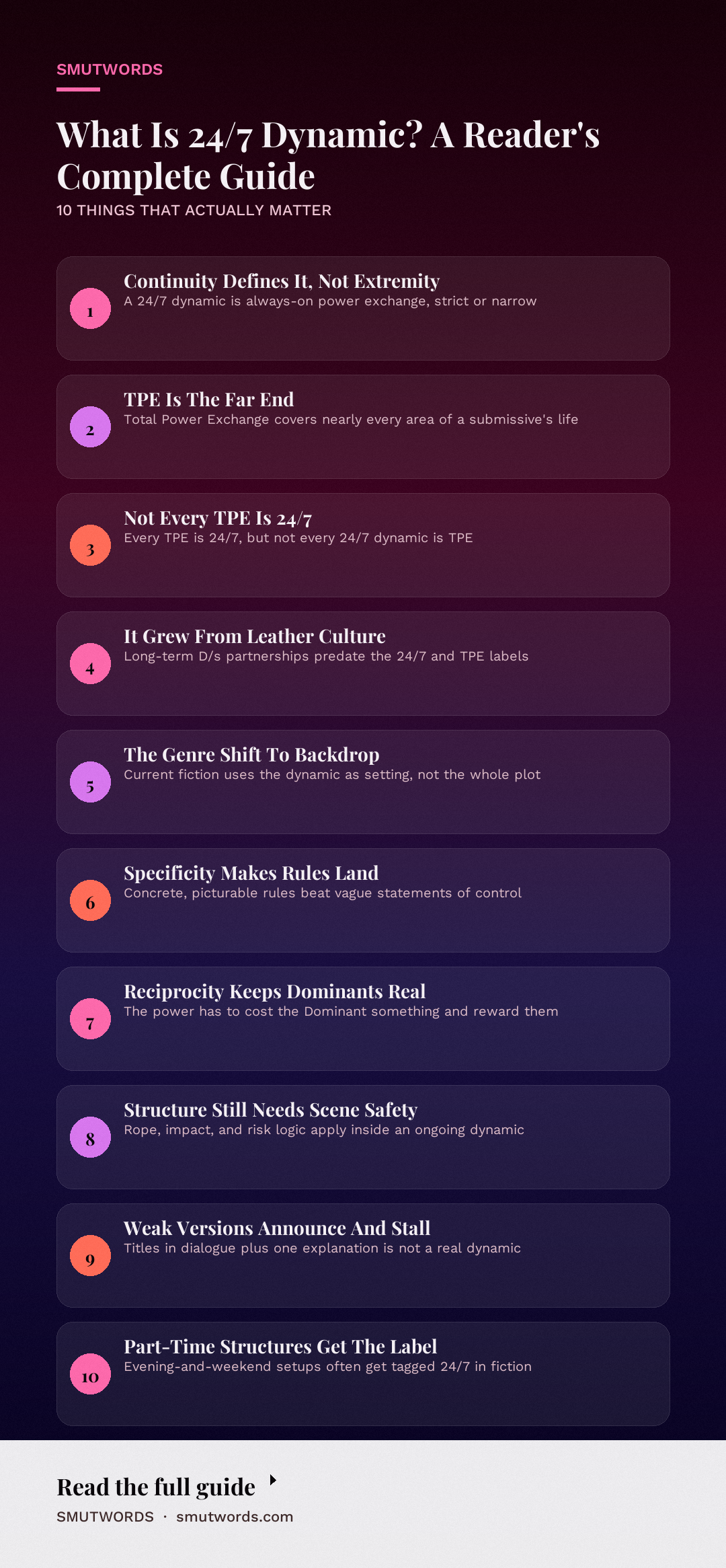
Both are 24/7 dynamics. The defining feature is continuity, not extremity.
Several related labels get used around this. Total Power Exchange, usually shortened to TPE, sits at the far end: the Dominant holds authority across essentially every area of the submissive's life, with very little carved out. "Lifestyle D/s" is the broader umbrella term for any power exchange that runs through daily life rather than staying in the bedroom. "Domestic Discipline" is a narrower sibling, focused on household rules and correction within a marriage-like structure.
All of these can be 24/7. None of them is automatically 24/7, which is where a lot of reader confusion starts.
What Does and Doesn't Count
- Counts: A standing protocol the submissive follows every morning, not just on scene days. A title that's used in the kitchen as often as in the bedroom. A Dominant who handles a recurring life decision because the couple agreed that's their role.
- Doesn't count: A single long scene that runs all weekend. A relationship where the power exchange is real and intense but only during scene play. Vanilla couples who just enjoy a bossy streak in bed.
- Grey area: Part-time structures like "every evening after work" or "weekends only." These are often called 24/7-adjacent or structured power exchange. Some communities count them, some don't. In fiction, the label gets applied loosely.
Common Misconceptions
The biggest one is that 24/7 means the submissive has no life, no opinions, and no say. That's a fantasy version, and even in fiction it makes for thin characters. A working 24/7 dynamic is negotiated, revisable, and specific to the two people in it.
The second misconception is that it's the "real" or "advanced" form of kink and everything else is a warm-up. Plenty of people who play hard and deeply have zero interest in a continuous structure. Neither is a higher tier.
The third is that a 24/7 dynamic means unlimited sex. It usually means more sex, more charged daily contact, and more ritual, but the structure itself is about authority and care, not constant arousal. Books that treat it as nonstop fucking miss the thing that makes it hot to begin with.
Where 24/7 Dynamic Comes From
The concept grew out of mid-twentieth-century leather culture, where long-term Dominant/submissive partnerships were common long before anyone wrote them down as a named structure. The gay leather scene of the 1950s and 1960s built households and long-term pairings around formal roles, protocol, and service. Those relationships were lived, not scheduled.
The language came later. "Total Power Exchange" was popularized in online kink communities in the 1990s, and "24/7" spread alongside it as the shorthand for the same idea. BDSM nonfiction of that era, the how-to guides and community zines, treated 24/7 as a legitimate long-term lifestyle rather than an extended scene, and that framing carried into fiction.
In erotica specifically, the timeline looks like this:
- 1970s-1980s: Published BDSM fiction, much of it from small presses and lesbian feminist imprints, features long-term D/s pairings but rarely uses "24/7" as a label. The structure is there; the term isn't.
- 1990s-early 2000s: Online communities standardize the vocabulary. Fan fiction and early erotic ebooks start tagging works as "24/7" or "TPE," often to distinguish them from single-scene stories.
- 2010s: Mainstream romance discovers the trope. Billionaire and mafia romance adopt continuous power exchange wholesale, usually without the label, and the "he controls everything about her life" fantasy becomes a genre staple. Kink romance starts using the actual terms.
- 2020s: The label gets more precise in indie and self-published kink fiction, and readers start expecting the logistics on the page: contracts, safewords, check-ins, what happens when real life intrudes.
The genre shift worth noting is the movement from "this is the whole book" to "this is the baseline the plot happens on." Early 24/7 fiction tended to be about the structure itself. Current fiction often uses it as the established setting and drops an external plot on top: a rival, a pregnancy scare, a family crisis, a business threat. The dynamic is the water the characters swim in, not the story.
How It Shows Up in Erotica
On the page, a 24/7 dynamic changes the physics of a story. There's no natural scene break, so authors have to build the structure into the ordinary fabric of the book: the way a character is addressed at breakfast, who signs the lease, what happens at a work event when the submissive can't use their title.
The strongest versions do the work in small beats. A Dominant who picks out the submissive's clothes for a Tuesday meeting. A submissive who asks permission for something minor and gets a look instead of an answer. A rule that exists purely because the Dominant noticed something the submissive needed and codified it.
Weak versions announce the structure and then do nothing with it. The characters use titles in dialogue, the narrator explains the arrangement once, and the rest of the book is a standard romance with kink-flavored vocabulary. Readers notice.
Common Variations Authors Use
- The protocol framework: A set of explicit rules, often written down, that govern daily life. Great for scene-by-scene tension because every interaction can be measured against the rules.
- The service-based structure: The submissive's role is defined by acts of service rather than obedience. Cooking, organizing, anticipating needs, managing the household. Quiet and often very intimate.
- The high-control fantasy: The Dominant genuinely controls money, movement, and contact with the outside world. Popular in dark romance. Requires careful handling to stay erotic rather than just bleak.
- The negotiated-in-real-time version: The couple is figuring it out as they go, adjusting rules, blowing past limits, course-correcting. This is the most common structure in contemporary kink romance because it generates conflict naturally.
- The hidden-in-public version: The dynamic is intense at home and invisible to everyone else. The tension comes from the gap between the private structure and the public performance.
What Makes One Work
Specificity. The books that land are the ones where the rules are concrete enough to picture. "He was in charge" is nothing. "She wasn't allowed to open a door he could reach first, including car doors, including in the rain" is a whole character in one line.
Reciprocity. A 24/7 dynamic in fiction works when the Dominant is visibly getting something from it and visibly giving something back. The power has to cost them something and reward them something. A Dominant who just takes reads as flat fast.
Friction inside the structure. Perfectly smooth power exchange is boring. The interesting version has the submissive pushing against a rule, or the Dominant uncertain about a decision, or the structure straining because the outside world is asking questions.
Consequences that aren't just punishment. The best 24/7 novels understand that the dynamic is about care as much as control. What a Dominant does after a bad day matters as much as what they do during one. That's the same instinct behind impact play aftercare, scaled up to a whole relationship.
Enjoyed this? Get a free book.
Join the list and we will send a complete free story straight to your inbox, plus new releases every week after that. No credit card, no catch.
Attention to the reality of daily life. Does the submissive work? Have friends?
Have a mother who calls on Sundays? These are the questions a dynamic has to answer. Without them, the structure reads as a diorama.
24/7 Dynamic vs Total Power Exchange
These two get used interchangeably, and they're not quite the same thing. A 24/7 dynamic is any continuous power exchange, regardless of how much ground it covers. Total Power Exchange specifically implies the exchange covers nearly everything: the Dominant holds authority across all or almost all areas of the submissive's life.
A couple with a standing daily protocol around meals, titles, and bedtime is 24/7. A couple where the Dominant makes the career decisions, the financial decisions, the medical decisions, and the social calendar is TPE. Every TPE is 24/7. Not every 24/7 dynamic is TPE.
In fiction, TPE is rarer and higher-stakes because it leaves the submissive fewer outs. Books that go that far usually build in an explicit escape hatch or a mechanism for the submissive's real desires to still shape outcomes, because a TPE arrangement with no agency anywhere is hard to sustain for a whole novel.
Frequently Asked Questions
Is a 24/7 dynamic the same as a master/slave relationship?
Often, but not always. Master/slave is one specific style of 24/7 dynamic, typically with a strong ownership framing and formal protocol. Many 24/7 couples use Dominant/submissive language instead and skip the ownership piece entirely. The overlap is large but the labels aren't synonyms.
Does a 24/7 dynamic mean the submissive has no free will?
No. The submissive consented to the structure, can renegotiate it, and usually retains a safeword or equivalent that halts things immediately. In real life, ongoing consent and check-ins are what separate a 24/7 dynamic from abuse, which is why SSC (Safe, Sane, Consensual) frameworks show up so often in discussions of it.
How do 24/7 couples handle work, family, and friends?
Most keep the visible parts private and the structural parts invisible. A submissive can hold a demanding job and still follow daily protocols at home. Full-time TPE arrangements that involve giving up outside work or contact exist, but they're a small subset and usually involve one partner having independent income or a caregiving role.
What's the difference between 24/7 and Domestic Discipline?
Domestic Discipline is one specific flavor of 24/7, focused on household rules, correction, and often a marriage-like structure. A 24/7 dynamic is the broader category. Some 24/7 couples have no discipline element at all and run on protocol and service instead.
Do 24/7 dynamics need a contract?
Many real-world couples write one, and it's a common device in fiction because it forces both characters to say what they want on the page. A contract isn't required, but the negotiation that produces one is the part that matters. That process is covered in detail under Kink Negotiation.
Why is 24/7 so popular in dark romance and mafia romance?
The structure gives the male lead total authority without the couple having to justify it scene by scene, which fits genres already built around possessive, high-control heroes. It also creates constant low-grade tension: every ordinary interaction carries weight. For readers coming from those genres into dedicated kink fiction, a series like the free-use books covered in this reading order guide is a natural next step.
Can a 24/7 dynamic be part-time?
The label usually implies always-on, but plenty of couples run structured power exchange during defined hours or days and call it 24/7 anyway. Within fiction, the term is applied loosely. If a book describes an evening-and-weekend structure, that's what it is, regardless of the tag.
What to Look For When You're Reading It
A few signals separate a 24/7 dynamic that's doing real work in a story from one that's just a label on the cover.
- Rules with texture. You can picture them happening. They affect small moments, not just big declarations.
- A Dominant who gives as much as they structure. Watch what they notice about the submissive. Watch what they sacrifice.
- A submissive with agency inside the structure. They negotiate, they push, they choose. Passing compliance is dull on the page.
- Daily-life friction. Jobs, families, and friends put pressure on the arrangement and the couple has to respond.
- Real aftercare logic. Even outside scenes, there's a rhythm of intensity and repair. Aftercare in a 24/7 context looks different than it does after a single scene, but the principle is the same.
Books that hit all five tend to be the ones readers reread. Books that hit two or three are fine for a fast read but won't stick.
The Real-World Layer
Fiction gets to compress and stylize, but the mechanics that make a 24/7 dynamic work in real life make the fictional version more convincing too. Ongoing negotiation, a safeword that's respected, regular check-ins about whether the structure still fits, attention to the submissive's mental health and outside relationships.
Readers who want to see the ethical scaffolding handled well should look for books where the Dominant checks in, where rules get revised, and where both characters have a life outside the arrangement. Those details read as confidence. They signal that the author knows the difference between a fantasy and a blueprint.
The other thing worth naming: an established 24/7 dynamic doesn't eliminate the need for scene-level safety. If there's rope involved, the same rope safety thinking applies. If there's impact, the same warm-up and cool-down logic.
If there's a scene that goes further than usual, the same risk-awareness that shows up in RACK (Risk-Aware Consensual Kink) discussions still governs it. The structure is bigger than any one scene; it doesn't replace what happens in one.
Final Thoughts
The 24/7 dynamic earns its popularity because it turns an entire relationship into a container for power, care, and ritual. When it's written well, the exchange becomes the pulse of the book: quiet, constant, and load-bearing in every scene. When it's written badly, it's a tag on a cover. The difference is almost always specificity and reciprocity.
If you want a place to start, the free-use series covered in the Penny Pepper reading order guide is a solid entry point for a continuous-power-exchange structure that never clocks out. And if you're curious how far the negotiation piece can go, the fluid bonding discussion breaks down the kind of agreement that often sits inside a longer-term dynamic. Start there, then find a book where every breakfast scene carries weight.








Loading comments…