Paddling is impact play with a flat, rigid implement: a wooden or leather paddle brought down on the buttocks or thighs to produce a broad, stinging smack that blooms into a hot, throbbing ache. In erotica, paddling is rarely just a sex act. It's a scene, a ritual, a power exchange made physical and audible, and it's one of the most reliable shorthand moves an author has for establishing who is in charge and who is about to find out.
The paddle itself does a lot of narrative work before it ever lands. It's an object with weight, a thing that gets taken off a wall or out of a drawer, and the moment it appears on the page the dynamic shifts. Readers come to paddling for that shift: the clear transfer of authority, the sound that fills a room, the way anticipation builds for both characters long before the first strike.
What Paddling Actually Means
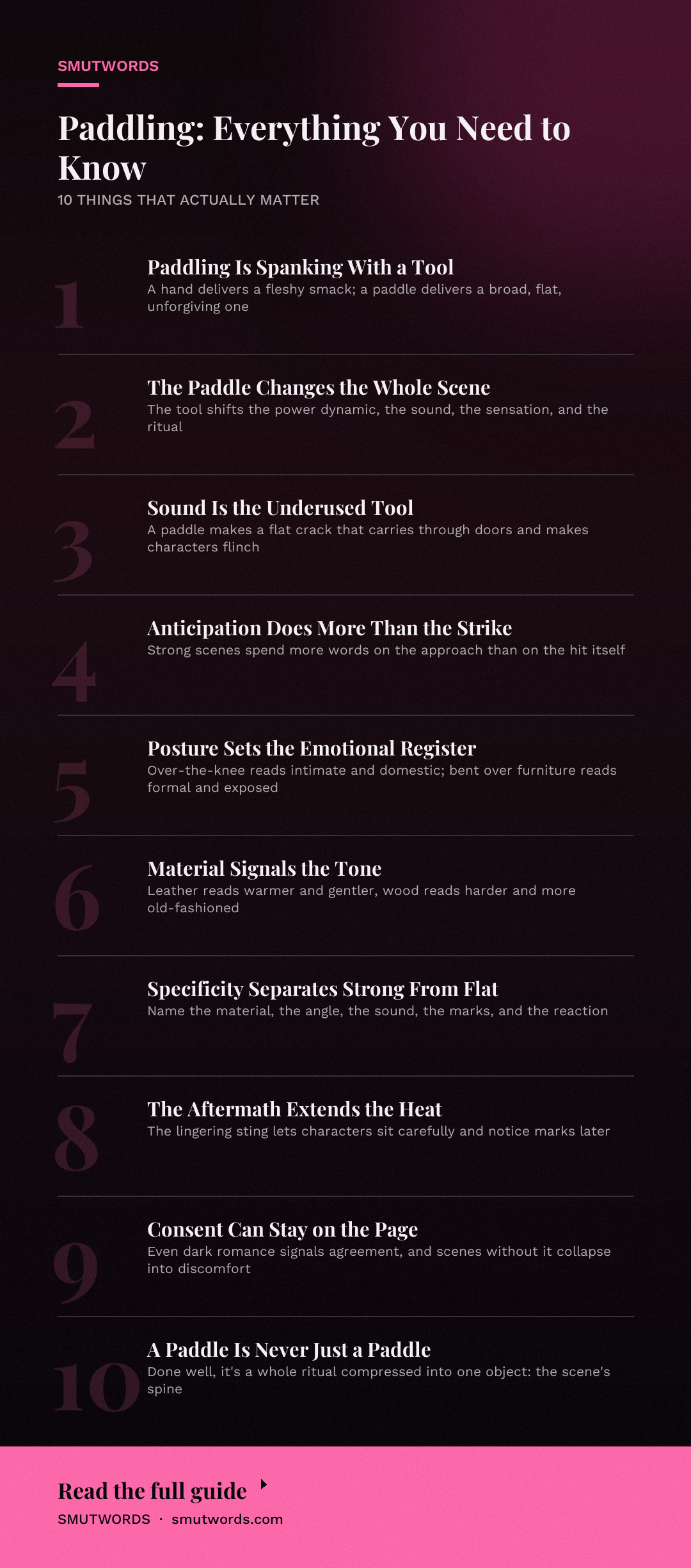
At its core, paddling is a spanking variant defined by the tool. A hand delivers a cupped, fleshy impact; a paddle delivers a broad, flat, unforgiving one. The surface area is larger, the material is harder, and the sensation is sharper and more diffuse, a sting that spreads across the whole cheek rather than concentrating in a palm-shaped spot.
The word comes straight from the object. A paddle is a flat blade, originally for moving boats through water, and the shape was borrowed for the punishment implement: a handle, a wide flat striking surface, sometimes with holes drilled through it to cut air resistance. That design detail matters, because a paddle with holes hits harder and leaves a different mark than a solid one.
What counts as paddling is broad. It includes the classic wooden paddle, the leather paddle with its duller thud and warmer sting, the ping-pong paddle pressed into service as a cheap and nasty little implement, the back of a hairbrush, and any rigid flat object a scene decides to repurpose. Over-the-knee paddling, where the receiving partner is draped across a lap, is a distinct posture within the category.
What doesn't count is anything without that flat, broad impact. A crop, a cane, a flogger, and a belt all belong to the wider family of implements, but they deliver different sensations: the crop stings in a line, the cane leaves welts, the flogger spreads a warm thud. Paddling is specifically the wide flat smack.
The most common misconception is that paddling is automatically severe. It can be, but intensity depends entirely on force, material, and placement. A light leather paddle warmed up slowly is a very different experience from a hardwood board swung hard, and good writing understands the difference.
Where Paddling Comes From
Paddling has a long, uncomfortable real-world history as a disciplinary practice in schools, military settings, and homes, and erotica didn't invent it so much as claim it. The implement arrived in erotic writing already loaded with authority, punishment, and institutional power, which is exactly why it translated so cleanly into kink fiction.
In published erotica and romance, paddling has been a recognizable feature since at least the mid-twentieth century, surfacing in the spanking-focused pulp and underground titles that circulated alongside the more mainstream discipline narratives. Those early appearances leaned heavily on the punishment frame: the paddle as correction, the scene as a lesson delivered by someone with the right to deliver it.
The bigger shift came with the rise of contemporary BDSM romance in the 2000s and 2010s, when the genre moved paddling out of the pure punishment frame and into negotiated power exchange. The paddle became something a dominant chose with care and a submissive consented to, and the writing started naming safewords, aftercare, and limits alongside the sting.
Today paddling shows up across the whole spectrum: dark romance where it's raw authority, contemporary kink romance where it's negotiated and tender, historical settings where it's pure institutional discipline, and monster and fantasy romance where a paddle might be anything the author wants it to be. The implement stayed the same. The framing multiplied.
That's the real history of paddling as a genre phenomenon: a disciplinary object that migrated into erotica, got claimed by power-exchange romance, and then fragmented into a dozen tonal registers that all still rely on the same flat, stinging smack.
How It Shows Up in Erotica
A strong paddling scene is built on anticipation, and the best authors spend more words on the approach than the strike. The paddle comes out. It gets shown. It gets described in the character's hand, felt against skin before it's ever swung.
The receiving character hears it move through the air. That pause is where the heat lives.
The sound is the underused tool in most mediocre paddling scenes. A paddle makes a specific noise, a flat crack that carries, and it's audible to anyone nearby in the scene's world. Good writing uses that: the sound reaching through a door, the sound making a character flinch before contact, the sound telling a room exactly what's happening.
Authors also vary the posture to change the emotional register. Over-the-knee paddling reads intimate and almost domestic, a lap and a lap-held position that keeps the two characters close. Bent over furniture reads more formal and exposed. Bound and positioned reads stricter, and a scene that brings in shibari to hold the receiving character in place is doing a very different thing than one that just asks them to bend over.
The common variations readers will find across the genre:
- Punishment paddling: the implement arrives as consequence, usually after a rule is broken, and the scene leans on accountability and ritual.
- Negotiated scene paddling: consent is on the page, limits are named, and the heat comes from the exchange rather than the surprise.
- Over-the-knee paddling: close, contained, often tender, and frequently a first-time scene for one character.
- Leather versus wood: leather reads warmer and gentler, wood reads harder and more old-fashioned, and authors use the material to signal tone.
- Hairbrush spanking: the domestic implement, borrowed from a vanity table, often deployed in historical or small-town settings.
- Discipline with a crowd: a public or semi-public scene where others watch, which pushes the paddling toward the same charged territory as an orgy or a shared scene.
What separates a strong paddling scene from a flat one is specificity. Weak writing describes the paddle hitting and someone moaning. Strong writing describes the material, the angle, the sound, the marks, and the reaction: the flinch, the held breath, the heat that lingers after the strike and bleeds into everything that follows.
Enjoyed this? Get a free book.
Join the list and we will send a complete free story straight to your inbox, plus new releases every week after that. No credit card, no catch.
The other marker of a good scene is aftermath. Paddling leaves a sting that keeps working on the body, and skilled authors use that: the character sitting carefully, the warmth under clothes, the mark noticed later in a mirror. That lingering sensation is where paddling blends punishment and pleasure, and where a scene earns its heat rather than just describing a hit.
For writers, the biggest avoidable mistake is treating the paddle as interchangeable with a hand. The tool changes the power dynamic, the sound, the sensation, and the ritual. A scene that swaps in a paddle has to feel the weight of that choice on the page.
The other mistake is skipping consent entirely. Even dark romance can signal agreement without deflating the tension, and the genre's best paddling scenes usually do. If a scene reads as pure surprise with no signal that the receiving character wanted it, the heat usually collapses into discomfort.
A useful question when you're stuck on whether a paddling scene is working: would the dominant character in it know what kind of submissive they're dealing with? Ours on how to know which role fits you is written for people, but it doubles as a character-building tool for writers.
Paddling vs Spanking
Paddling and spanking get used interchangeably, and that's a real confusion worth clearing up. Spanking is the broader category: any impact to the buttocks, usually by hand. Paddling is a subset of spanking defined by the implement, which is why the two terms overlap so often in search and in readers' heads.
The distinction matters for the page because the tool changes the scene. Hand spanking is skin on skin, warm, and often more intimate and less formal. Paddling adds an object between the two characters, and that object carries authority, ritual, and a sharper, broader sting. A scene can be both, but the moment a paddle enters, the tone usually shifts.
The other term readers mix up is primal play, which is an entirely different kink built on animalistic pursuit and instinct rather than implements. Paddling is structured and tool-based. Primal play is unstructured and body-driven.
They can coexist in a scene, but they're not versions of each other. The same goes for a paddling scene that turns into something bigger with more bodies in the room; our guide to group sex covers where that can go.
Frequently Asked Questions
Is paddling the same thing as spanking?
No. Spanking is the wider category of impact to the buttocks, usually by hand. Paddling is a specific spanking variant that uses a flat implement like a wooden or leather paddle, which changes the sensation, the sound, and the power dynamic on the page.
What does paddling feel like?
A broad, sharp sting that spreads across the whole cheek rather than concentrating in one spot, followed by a hot, throbbing ache that lingers. Leather reads warmer and duller, wood reads sharper and harder. Intensity depends on force, material, and placement.
What are the common types of paddles in kink writing?
Wooden paddles, leather paddles, ping-pong paddles, and hairbrushes are the most common. Wooden paddles appear in stricter or more old-fashioned scenes, leather in warmer or more negotiated ones, and the hairbrush in domestic or historical settings.
Is paddling safe in real life?
With clear consent, agreed intensity limits, and a safeword in place, paddling can be practiced safely. The main risks are striking the lower spine or tailbone, so placement should stay on the meaty part of the buttocks and thighs. Anyone practicing impact play should read up on risk-aware consensual kink first; our guide to RACK (Risk-Aware Consensual Kink) covers the framework in detail.
Why is paddling so popular in romance and erotica?
It's a clean, visual way to establish authority and power exchange, and it comes with built-in anticipation: the implement, the sound, the pause before the strike. The ritual and the lingering sting give authors a lot to work with emotionally and physically.
Does paddling leave marks?
Often, yes. Paddling commonly leaves temporary redness, warmth, and sometimes bruising that fades over days. In fiction, marks are a useful device for extending a scene's aftermath, since the character can notice them long after the paddle is put away.
Final Thoughts
Paddling earns its place in erotica because it's a whole ritual compressed into one object: the authority, the anticipation, the sound, the sting, the aftermath. When an author writes it well, the paddle is never just a paddle. It's the scene's spine.
If you want to see the dynamic done with real craft, look for a book where the paddle arrives early enough to build dread and heat at the same time. A strong paddling scene will show you the implement before it uses it, make you hear it, and let the sting outlast the page.




Loading comments…