Two people who want to tear each other's clothes off after a screaming match, and two people who can't stop touching each other after a three-day silence, are running on completely different fuel. Readers lump them together because both scenes end with clothes on the floor and somebody breathing hard against a headboard.
The angry sex vs makeup sex distinction matters more than it looks, because one runs on what's still unresolved and the other runs on what just got survived. Get the fuel wrong and the scene reads flat no matter how explicit you make it.
Conflict and desire tangle up for a reason. Adrenaline, raised voices, and the specific intimacy of somebody seeing you at your worst all sit in the same part of the nervous system. A character who's furious at their partner is already flooded with the same chemistry that precedes a hookup. A good writer uses that overlap instead of pretending it isn't there.
What Angry Sex Actually Is on the Page
Angry sex happens while the fight is still live. Nobody has apologized. Nobody has explained themselves. The characters collide because the argument hit a wall and the only place left to put the heat is each other.
The tell is in the dialogue. There isn't any, or what's there comes out as orders and accusations. "Don't." "Shut up." "You started this." Hands that grip too hard, a door that doesn't quite close, clothing that gets shoved aside rather than removed. The scene should feel like it could tip into another fight at any second.
A marriage in trouble storyline is the natural home for this. Two people who've been circling each other for months, who know exactly which sentence will land hardest, and who end up against the bedroom wall because the alternative is walking out. The heat comes from the fact that neither of them has said the thing they actually mean.
The beats that make angry sex land
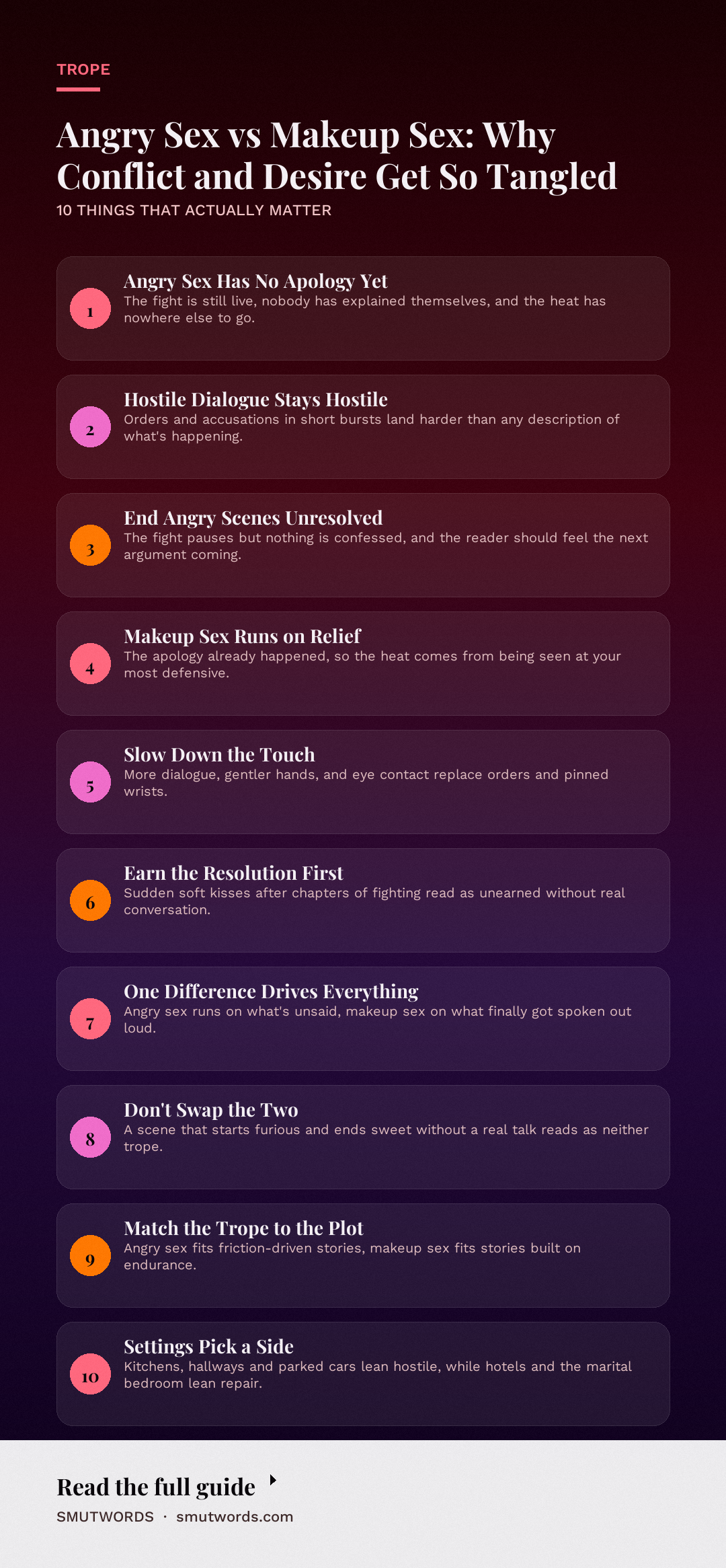
- No apology before the first touch. If somebody says sorry, the scene has already become makeup sex.
- Physical specifics that hint at force without crossing into assault. A wrist pinned, a jaw held, a back against a door that rattles.
- Dialogue that stays hostile right through the act. "Is this what you wanted?" lands harder than any description of what's happening.
- An ending that resolves nothing. The fight pauses. Nobody has confessed. The reader should feel the next argument coming.
The failure mode is when a writer softens the anger too early, turning the scene into a tender reconciliation halfway through. That kills the whole point. If the characters start stroking each other's hair and whispering "I'm sorry," you've written the other trope by accident.
What Makeup Sex Does Differently
Makeup sex comes after the fight has been settled. The apology happened, or the confession did, or somebody finally said the thing they'd been holding back for two hundred pages. The physical scene is the consummation of the emotional resolution, and that changes everything about how it reads.
The dialogue is different. There's usually a lot of it, and it's the point.
"I thought you were going to leave." "I never would have." "Come here." The hands are gentle. The pacing is slower. Somebody cries, sometimes, and it isn't played for weakness.
The heat in a good makeup sex scene comes from relief and the specific vulnerability of having just been seen at your most defensive. That's a different flavor of intensity than the angry version, and readers who love one don't always love the other.
Beats that make makeup sex land
- A verbal resolution before the physical one. The reader needs to believe the fight is genuinely over.
- Slower pacing, more attention to touch. Long descriptions of hands on skin, eye contact, somebody's name said out loud.
- Emotional confession inside the scene. The kind of thing that only comes out when both people are naked and raw.
- An ending that closes the door. Where angry sex leaves things open, makeup sex should feel like an exhale.
Makeup sex fails when the emotional resolution hasn't been earned. If two characters who've been at each other's throats for chapters suddenly fall into bed with soft kisses and no actual conversation, the scene reads as unearned. The reader hasn't seen the work.
The Real Difference: What's Still Unsaid
Angry sex runs on the thing neither character will admit. Makeup sex runs on the thing they finally did. That's the whole distinction, and everything else is downstream of it.
In an angry scene, the writer's job is to keep the wound open. In a makeup scene, the writer's job is to show the wound getting closed, which means the reader has to have seen the wound first. You can't get to makeup without earning the fight, and you can't get the most out of the angry version without leaving something unresolved at the end.
Some writers try to have it both ways in a single chapter, opening with a screaming match and ending with whispered apologies. That works, but only if the middle contains a scene of genuine conversation. Otherwise you've just skipped the work and gone straight to the reward, and readers notice.
For writers building this dynamic around a power imbalance or a particularly rough physical scene, the RACK (Risk-Aware Consensual Kink) framework is worth reading for how negotiation can itself become the emotional beat.
Where the Two Tropes Overlap (and Where Writers Get It Wrong)
The overlap happens when a couple fights, fucks angrily, and then has makeup sex in the next chapter. Some of the best slow-burn romance does exactly this, using the angry scene to raise the temperature and the makeup scene to reset the emotional stakes.
The mistake is treating the two as interchangeable. A writer who thinks "angry sex is just makeup sex but harsher" will produce a scene that hits the physical beats of one and the emotional beats of the other, and it reads as neither. The reader wants to know which mode they're in.
Enjoyed this? Get a free book.
Join the list and we will send a complete free story straight to your inbox, plus new releases every week after that. No credit card, no catch.
If your characters are still in the fight, keep them in it. If they've had the conversation, let them have the tenderness. The whiplash of a scene that starts furious and ends sweet without an interstitial conversation is the most common fumble in this territory, and it's worth being ruthless about cutting.
Which Trope Suits Which Story
Angry sex suits stories built on friction: enemies to lovers, rival coworkers, a revenge romance where the protagonist is sleeping with someone they intend to destroy. The scene matches the plot because the plot is also unresolved.
Makeup sex suits stories built on endurance: marriages in trouble, second-chance romances, long-running series couples who've survived something. The scene matches the plot because the plot has already been through the fight and needs a moment of relief.
Neither trope works well in a story where the central conflict hasn't been established yet. A debut chapter with angry sex between two characters the reader just met reads as gratuitous, because the anger has nothing to attach to. The same goes for makeup sex with no fight behind it. Both scenes need runway.
If your couple's conflict has a kinky dimension that the vanilla partner doesn't share, the fight leading up to either scene can become the entry point for a real conversation. When one partner is kinky and the other is vanilla covers how that negotiation plays out without killing the tension.
How the Setting Changes the Scene
A fight in a kitchen reads differently than a fight in a hotel room, and the setting dictates which trope fits better. Kitchens and hallways and parked cars sit naturally in angry sex territory, because the environment itself is a little hostile.
Hotels, cabins, and the marital bedroom belong to makeup sex. The location feels like a chosen container for something the characters are trying to repair.
Writers who switch settings mid-scene, dragging characters from a fight in the hallway into the bedroom, are usually reaching for angry sex and accidentally sliding into makeup. If that's the intent, own it: the corridor fight is the fight, and the bedroom is where the resolution has to happen. If it's not the intent, keep them in the hallway.
Dialogue That Reveals Which Trope You're Writing
Read your own dialogue out of context. If the lines could belong to people who've already made up, you've written makeup sex. If they could only belong to people still in the fight, you've written angry sex.
"Say you're mine" lands in either scene, but the tone flips depending on what came before it. "I'm not done being angry at you" only works in one.
One reliable test: does anyone in the scene say "I love you," and if so, does it come out as a weapon or a comfort? That single line tells the reader which mode you're in, and it does more work than three paragraphs of description.
Reading the Tropes Side by Side
If you want to study how these two beats feel when they're done well, read them back to back. A soldier romance is a natural home for the angry version, since the central tension is often the conflict between duty and desire and neither character can afford to resolve it. Pair it with a marriage-in-trouble novel and you'll feel the seam.
For writers exploring the physicality of a group scene with a similar emotional register, the FFM threesome and group sex guides cover how the same anger-versus-repair dynamic plays out with more bodies in the room. The mutual masturbation piece is worth reading for the makeup-sex version, where the physical scene is less about collision and more about watching each other.
Both tropes are worth writing and worth reading. The difference is what the writer leaves on the table at the end of the scene.
Angry sex leaves everything. Makeup sex leaves nothing but afterglow. Know which one you've chosen before the first sentence hits the page.
Final Thoughts
If you want a single book that runs both beats and earns them, start with a marriage-in-trouble title where the couple has an argument in chapter three, an angry scene in chapter five, and a genuine apology before the final act. That structure will teach you more about the angry sex vs makeup sex split than any craft book, because you'll feel exactly where the temperature changes.




Loading comments…