
Military romance is a love story built around someone who serves: an active-duty soldier, sailor, airman, or Marine; a veteran carrying the residue of deployment; or a contractor whose job keeps them inside a war zone. The relationship unfolds against deployments, base housing, chain of command, and the long quiet after service.
What separates military romance from a thriller with sex in it is simple. The mission exists to put pressure on the couple, and every stolen hour between them carries the weight of a world that could take one of them away.
What Military Romance Actually Means
The label covers a wide territory, and readers use it loosely. At its core, military romance requires that the military world be structural to the plot. A hero who happens to have served once, mentioned in a single paragraph, does not make the book a military romance. A hero whose deployment schedule dictates when the couple can even speak to each other does.
The protagonist is usually active-duty, recently separated, or a veteran whose service still shapes how they move through civilian life. It can also be a military contractor, a civilian working on base, or a military spouse or partner. The common thread: the institution is a living presence in the story, not a line on a character sheet.
Several things get miscategorized as military romance. A romantic suspense novel set on a military base with no real engagement with service culture is really a thriller in camouflage. A small-town romance where the hero's veteran status surfaces only as a personality quirk is a small-town romance.
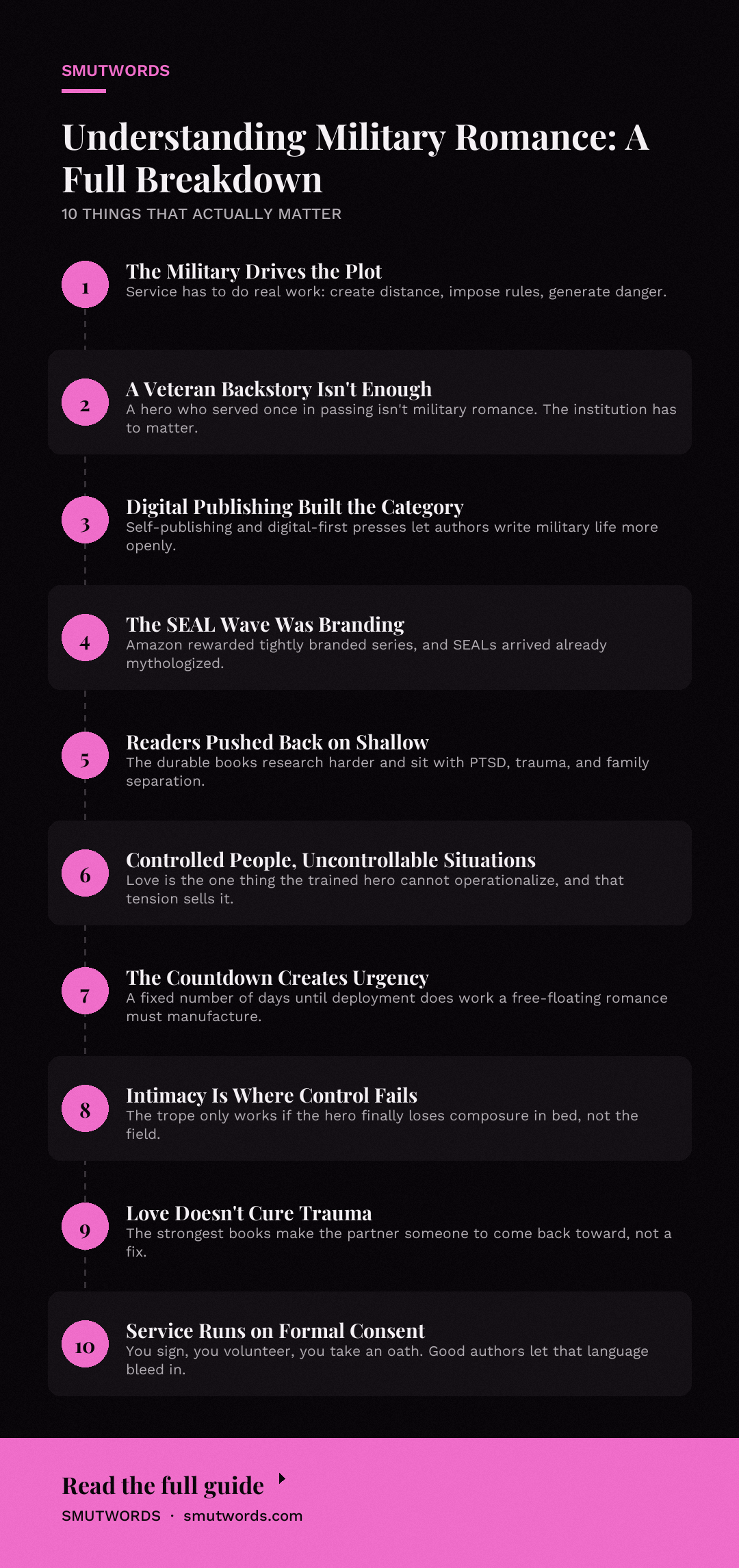
The military has to do work. Create distance, impose rules, generate danger, or shape the hero's sense of self.
The terminology splinters endlessly. Soldier romance, Navy SEAL romance, veteran romance, military contractor romance, second-chance military romance, and military romantic suspense all land under the same broad umbrella, and publishers market them interchangeably. Which subcategory a book belongs to often depends more on the branch of service and the heat level than on any structural difference.
Where Military Romance Comes From
Romance fiction has featured men in uniform since the genre's earliest mass-market days, but the modern military romance as a recognizable shelf category took shape through the 1990s and 2000s. The end of the Cold War, the first Gulf War, and then the long post-9/11 deployments all pushed military service into the foreground of American cultural life, and genre publishing followed.
The most significant publishing shift came in the mid-2000s through the 2010s, when self-publishing and digital-first presses let authors write more explicitly about military life than traditional houses had. Series like Suzanne Brockmann's Troubleshooters, which began in 1999, proved there was a mass readership for military romantic suspense. The success of Brockmann, then authors like Maya Banks and later Kristen Ashley, established the template: a team of operators, a serious external threat, and a love story that anchors the violence.
The "Navy SEAL romance" wave of the 2010s was a genre phenomenon as much as a fictional one. Amazon's algorithm rewarded tightly branded series, and SEALs made an ideal brand: elite, disciplined, and already mythologized in the popular imagination. Hundreds of titles appeared, many written by authors with no military background, operating off a shared set of conventions and a few accessible research sources.
Readers started pushing back on the shallowest of these books. The most durable military romance now reflects more honest research, more attention to PTSD, military sexual trauma, family separation, and the real friction between a service career and a marriage. The genre has not become grim. It has become specific, and specificity is what makes it land.
How It Shows Up in Erotica
On the page, military romance runs on a specific engine: controlled people placed in situations they cannot control. The hero or heroine has been trained to suppress emotion, follow orders, and keep their team alive. Love is the one thing that cannot be operationalized, and the book's tension comes from watching that discipline fail in ways the character never anticipated.
Authors deploy a reliable set of scene types. There is the goodbye scene, where a deployment looms and every touch has a deadline on it. There is the reunion, which can run from tender to frantic, depending on how long the couple has been apart.
Then there is the base or barracks scene, full of restriction and proximity and the constant risk of being caught. And the homecoming, where one partner has been changed by what they lived through and the other has to meet a version of them they have not seen before.
The pacing matters enormously. A strong military romance uses the countdown structure: a fixed number of days until deployment, a fixed number of hours on leave, a fixed window before a mission goes wrong. That ticker creates urgency that a free-floating contemporary romance has to manufacture from other sources.
What separates good from flat comes down to a few things this editor has learned from reading hundreds of these books:
- Research shows up in texture, not in exposition. A good book shows you what the hero's job feels like on a Tuesday, not a Wikipedia dump of a SEAL training pipeline. Bad books explain the acronyms at length and skip the smell of a barracks and the way a coffee cup tastes at 04:00.
- The couple's intimacy is the only place where the hero loses control. This is the core pleasure of the trope. In the field, they are disciplined and decisive. In bed, with the right person, they can stop being either. Books that let the hero stay composed during sex lose the whole point.
- Military life creates real obstacles. The chain of command forbids the relationship. The deployment takes them apart mid-argument. The burn pits or the IED or the one operation that did not go to plan changes the hero in ways the partner cannot fix. A good book uses these as genuine plot engines. A flat one uses them as an excuse for a dramatic chapter-two breakup.
- The homecoming has to cost something. The strongest military romances do not pretend trauma is simply cured by love. Instead, the partner becomes someone the hero can come back toward. That is a more honest and more erotic story.
Variants on the standard formula are worth tracking, since they signal to readers what kind of book they are picking up.
Enjoyed this? Get a free book.
Join the list and we will send a complete free story straight to your inbox, plus new releases every week after that. No credit card, no catch.
- Navy SEAL romance: The most heavily branded subcategory. Elite operators, a hostage extraction or training accident, and a competency scene in which the hero's professional skill is on full display.
- Soldier romance: Broader category covering Army infantry, Rangers, and Special Forces. Often more focused on the grunt-level reality of deployments than the SEAL branding.
- Veteran romance: The story begins after service. The hero returns to civilian life carrying something, and the love story is about making room for them at home rather than waiting for them to come back from the field.
- Military contractor romance: Trades the uniform for the contractor's badge, which allows more morally ambiguous heroes and more morally ambiguous missions. The "he's not really military" gap lets the author push the protagonist into darker territory.
- Second-chance military romance: A couple who loved before, one of them left for service, and now they are back in each other's orbit. Reliably one of the highest heat variants.
- Military romantic suspense: The mission forms the plot, and the love story forms the point of view. Often written as series arcs with a team of recurring operators.
One adjacent pleasure readers often do not name out loud: military romance borrows structural tools from a lot of other tropes. Stalker romance's surveillance and dangerous attention, consent negotiation in a context where power difference is baked into the setting, and degradation kink deployed as a kind of verbal flirting in the barracks all appear. The military setting keeps them feeling earned rather than tacked on.
Consent plays a peculiar role in these books. The military runs on formal consent in a way civilian life does not: you sign, you volunteer, you take an oath. Good authors notice this and let that formal language bleed into the sex scenes, which is one reason so many of these books land on consent negotiation as a natural erotic territory.
The best versions of the trope also understand that orgasm control is a near-perfect metaphor for military service itself: patiently holding, following rules, waiting for permission. The cleverest authors lean into the parallel.
Other adjacent tropes cross-pollinate more than you might expect. Secret baby plots show up frequently when the deployment schedule means the hero has been away for eighteen months. Revenge romance and military romance overlap when the hero has come back for someone who hurt them and has access to weaponized information. And the internet-era version frequently borrows tricks from reality TV romance, with the base acting as a fishbowl and every relationship under communal surveillance.
There is also a solid argument that a reader who loves military romance has a real appetite for cyberpunk romance's bleak, kinetic settings and heavy power differentials, and for stalker romance's watchful, obsessive hero. The military version just swaps the trench coat for a uniform and the obsession for "I have been thinking about you on every deployment since."
Military Romance vs Soldier Romance
These two terms get used interchangeably, and in practice they overlap almost entirely. The difference lives in marketing categories and in scope. Soldier romance usually implies Army or ground-forces specifically, and often leans toward the grittier deployment or veteran story. Military romance is the umbrella term: sailors, Marines, airmen, Coasties, and military-adjacent roles like contractors and military spouses all fit under it.
If you see a book branded as soldier romance, expect an emphasis on the infantry: boots, formations, and the specific culture of the Army or Marines. If the label is military romance, the world is wider and the details may include naval vessels, flight decks, or intelligence work. Neither term promises a particular heat level; both promise a story where service is a real force in the love story.
Frequently Asked Questions
Is military romance always about a man in uniform?
No. Female active-duty protagonists and female veterans are a substantial and growing corner of the category. Male-male military romance is also a major subgenre, particularly in self-published spaces. The trope cares about the service world, not the gender of the person in it.
Are military romances clean or explicit?
They run the full range, and the branding usually tells you where a given book falls. Traditional mass-market titles often land at the steamy-but-not-explicit level. Self-published and indie series often go much further, and a search for military romance frequently surfaces books with significant heat.
What is a veteran romance, and how is it different?
Veteran romance focuses on the period after service. The love story takes place in civilian life, with the protagonist adjusting to a world that has different rules than the one they left. The tension comes from re-entry rather than deployment, which makes it a quieter, often more emotionally driven read.
Why is the Navy SEAL so heavily represented in this genre?
SEALs come preloaded with cultural myth: elite training, impossible missions, a heroism that has already been narrated in media. They make a clean franchise, which is why publishers and self-published authors push them so hard. Other branches have their own fans and their own distinct conventions.
Do military romances deal with PTSD and trauma?
Increasingly, yes, and the most respected books handle it seriously. The trope's pleasure depends on the hero being a person whose experiences have cost them something, and PTSD, military sexual trauma, and survivor's guilt are part of the world these characters live in. Books that skip this tend to feel thinner than the ones that sit with it.
Can I find military romance in audiobook and ebook formats?
Yes. The category is enormous in ebook and audiobook, and most of the popular series are available in both. Audio is especially strong for military romance because the slower pace lets the deployment countdown land harder.
Final Thoughts
Military romance works because it pairs the discipline and physical intensity of service with the one thing no amount of training can prepare you for: being loved by someone who could lose you, and staying anyway. The best books in the category refuse to let love fix everything. They let it give the characters somewhere to come back to.
If you want a starting point, pick up a full-length SEAL or veteran romance and give the homecoming chapters the time they deserve. That's where the subgenre lives or dies.




Loading comments…