
Nurse/patient romance is the subgenre where the person checking your blood pressure has also been thinking about your mouth since the last shift change. It covers any love story built inside a medical or care setting, where one character holds clinical authority and the other is under their care, and the attraction develops across that gap.
The setting can be an ER, a long-term ward, a home health rotation, a psych unit, or a rehabilitation clinic. What unites the whole category is the intimacy of bodies being handled before hearts are confessed, and the professional line standing between the two.
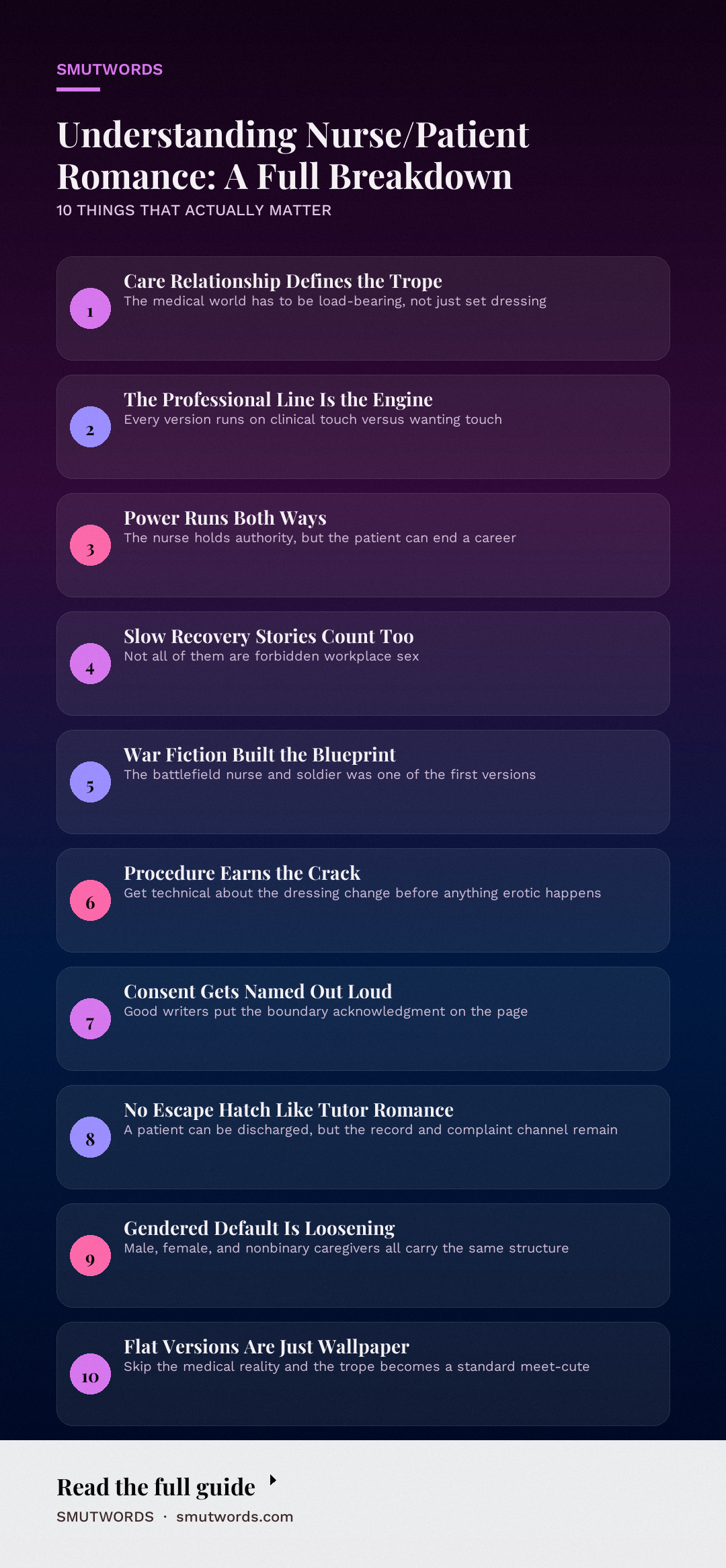
That line is the engine. Every good nurse/patient romance runs on the tension between clinical touch and wanting touch, between the oath and the pulse. Readers come for the vulnerability, stay for the moment the professionalism cracks.
What Nurse/Patient Romance Actually Means
The term describes a romance where the central relationship forms between a medical professional and someone receiving care. Most often the professional is a nurse and the patient is an adult under their observation, treatment, or recovery plan. The relationship can run from a flirtation across a nurses' station to a full secret affair conducted in supply closets and empty exam rooms.
What counts: a nurse and a patient in an ongoing care relationship. A nurse and a patient's adult family member. A home care provider and a long-term client. A nurse and a doctor, if the care hierarchy is the axis of the tension.
What doesn't count: two coworkers who happen to work in a hospital with no care relationship between them. A one-night stand with someone who mentions they're a nurse and never appears in a clinical setting again. The medical world has to be load-bearing, not set dressing.
The common misconception is that this trope is only about forbidden workplace sex. Plenty of nurse/patient romances are slow, tender, and built around recovery: a burn victim learning to be touched again, a veteran relearning his body after injury, a woman in long-term care who hasn't been looked at as desirable in years. The forbidden angle is one flavor, not the whole shelf.
Another misconception: that the power imbalance runs one direction. It doesn't. The nurse holds institutional authority, but the patient holds something equally destabilizing.
They can end the nurse's career with one complaint, or simply leave the hospital and never be seen again. Strong versions of this trope know that and play it. A nurse in love with a patient is professionally exposed in a way the patient usually isn't.
Where Nurse/Patient Romance Comes From
The trope's roots in erotica and romance are older than most readers assume. Nursing as a profession became culturally visible in the late nineteenth and early twentieth centuries, and almost immediately the culture produced stories about the charged proximity of nurse and patient. War fiction and wartime letters did a lot of the early work.
A battlefield nurse with a soldier was one of the first widely published versions of the caregiver/charge dynamic. It fed directly into what we now read as soldier romance.
In the mid-twentieth century, hospital romances became a distinct publishing category. Paperback imprints ran nurse-as-heroine lines for decades, usually pairing the nurse against a stern doctor. Somewhere between those and the pulp-era taboo paperbacks, the patient crept in as a legitimate love interest. The taboo was always implied: an affair with a patient was understood to be against the rules and therefore worth reading about.
The real shift happened in the past twenty-five years. As medical ethics became more precisely defined and openly discussed (HIPAA, professional boards, mandatory reporting), the term "forbidden" gained teeth. Contemporary nurse/patient romance no longer treats the professional boundary as a vague formality. It names the specific rules being broken and uses those rules for pacing.
The second shift is gendered and worth flagging. For most of the trope's history, the nurse was female and the patient male. That's still the dominant configuration, but the past decade has produced a real wave of male-nurse/female-patient, female-nurse/female-patient, and nonbinary-caregiver variations. The power structure of the trope translates across all of them; the gendered default is loosening but not gone.
Publishing itself is another part of the story. Medical romance, including the nurse/patient pairing, has become a serious volume category in indie and self-publishing. Serial writers in adjacent niches have shown how much runway a good premise can support.
Penny Pepper's approach to building a sixty-five-book free use series is a useful window into how writers sustain a single charged premise across dozens of titles. The same mechanics show up in long-running nurse/patient serials. Miss Dolly X's habit of writing a chapter a day also tracks with how fast this trope can be produced and consumed.
How It Shows Up in Erotica
On the page, the trope does most of its work before anyone touches anyone. The setup is almost always the same: a body in a bed, a chart, a uniform, a routine. The nurse is doing something specific and professional. The patient is watching.
The eroticism lives in the professionalism holding steady while everything underneath it tilts.
The best nurse/patient writing is procedural. It slows down and gets technical about what the nurse is doing. A dressing change. A catheter. A sponge bath. A set of vitals at 3 a.m.
The reader gets the exact protocol, which builds trust in the scene, and then the scene does something slightly off-protocol. That small deviation is what readers come for. Generic versions skip the procedure and jump straight to feeling, and they lose the charge that makes the trope worth reading.
Common variations authors run with:
Enjoyed this? Get a free book.
Join the list and we will send a complete free story straight to your inbox, plus new releases every week after that. No credit card, no catch.
- Injury recovery. The patient is healing from something physical. The nurse's hands are necessary, repeated, and clinical. The slow erosion of that clinical distance is the whole arc.
- Chronic illness or long-term care. Weeks or months of contact. Attraction builds across a hundred small interactions. The discharge date becomes a ticking clock.
- Night shift. Empty hallways, low light, reduced staff. The setting does a lot of the work for the writer.
- Home health. The nurse comes to the patient's house. The patient has authority in their own space but no authority over their own body. Good versions play both.
- Coworker complication. A nurse falls for another nurse, or a nurse and a doctor circle each other while a patient watches. The care hierarchy is still the axis of the tension even with no patient/charge relationship between the two leads.
- Established history. The patient is a former lover, an estranged spouse, or someone the nurse knew before the hospital. This overlaps with marriage in trouble when the leads are already married and the care setting forces them back into contact.
- Reverse power. The patient is wealthy, famous, or professionally powerful outside the hospital. Their status collapses in the bed, and the nurse runs the room. This is close cousin to celebrity romance when the patient is a public figure.
What makes a strong version: the writer commits to the medical reality before anything erotic happens. The reader should believe the nurse is competent. The line should be genuinely hard to cross, not just a piece of paper. And the emotional stakes should outpace the physical ones for at least the first third of the book.
What makes a flat version: the setting is decorative.
The nurse is a generic caretaker with a stethoscope. The patient has no life outside the bed. The rules exist only to be broken in chapter two. The trope becomes wallpaper over a standard meet-cute, and readers can feel it.
A related craft note: the medical setting makes consent an active feature of the writing, not a background assumption. A patient is, by definition, in a vulnerable position, and the nurse holds clinical authority. Good writers don't dodge that. They put the acknowledgment on the page, often through dialogue where the nurse names the boundary out loud before anyone crosses it.
This is where the trope overlaps with categories that run on other kinds of power differential. The tutor/student lineup carries the same charge. If you want to see how a comparable institutional boundary gets handled on the page, the tutor/student romance glossary entry is a useful comparison.
The trope also gets used as a delivery mechanism for other plot machinery. A secret baby reveal works well when the nurse discovers a pregnancy during a routine test. A stalker dynamic cranks up when the patient insists on reading the nurse's schedule. In each case the trope absorbs the plot device cleanly because the setting comes pre-loaded with secrets and monitoring.
Writers have also started to borrow staging tricks from other kink categories. A patient learning to look at their own recovering body in a mirror, for instance, can carry the same contemplative charge as a scene built entirely around mirror play. The overlap isn't required, but smart writers steal what works.
Nurse/Patient Romance vs Tutor/Student Romance
Readers often compare these two, and the comparison is legitimate because both run on the same engine: one person holds institutional authority, the other sits in a state of learning or need, and the attraction has to work around a rule that exists for good reasons.
The differences matter for craft. In tutor/student romance, the power imbalance is usually temporary. The student graduates, the tutoring ends, and the relationship can continue cleanly. The tutor/student romance arc often works because the exit is built in.
Nurse/patient romance doesn't have that exit. A patient can be discharged, yes, but the medical encounter leaves a permanent professional record, a formal complaint channel, and in some cases ongoing care that makes a clean cut nearly impossible. The stakes are sharper and the ending is harder to write.
Also: tutor/student almost always involves adults who made a choice to enter the situation. A patient didn't choose to be sick. That absence of choice is what gives nurse/patient romance its weight. It's also why the best versions spend real time on the patient's consent, autonomy, and dignity instead of treating those as items to check off.
Frequently Asked Questions
Is nurse/patient romance the same as medical romance?
Medical romance is the umbrella category covering any romance set in a medical environment. Nurse/patient romance is a specific slice of it, defined by a care relationship between the two leads. A book about two doctors falling for each other is medical romance, not nurse/patient romance.
Why is nurse/patient considered forbidden?
Professional codes of conduct in most countries prohibit romantic or sexual relationships with current patients because of the power imbalance and the patient's vulnerability. That formal prohibition is what gives the trope its forbidden charge. Books usually resolve it by ending the care relationship first.
Do the nurses in these books have to be female?
No. Male nurses, nonbinary nurses, female doctors with female patients, and same-gender pairings across the care line all exist in the genre. The default is still a female nurse with a male patient, but that's a market preference, not a rule of the trope.
Can the patient be the dominant one?
Yes, and it's one of the more interesting ways to run the trope. The nurse holds institutional authority, but the patient can hold sexual or emotional authority inside the private space of the encounter. Books that play those two hierarchies against each other tend to be the strongest in the category.
Is nurse/patient romance always explicit?
No. The category runs from sweet, closed-door romance through full explicit erotica. As with most tropes, the setting doesn't dictate heat level. The forbidden structure is compatible with anything from a slow burn to an immediate, high-heat affair.
Where does the story usually end up?
Most commonly, the care relationship ends (discharge, transfer, resignation from the case) and the couple continues outside the medical setting. Some books keep both leads in their original roles and rely on secrecy and eventual disclosure. A smaller number lean into a permanent, acknowledged version of the dynamic after the professional line has been formally cleared.
Final Thoughts
Nurse/patient romance is one of the few tropes in erotica where the setting and the kink are the same thing. The vulnerability, the trust, the repeated physical contact, and the professional rule that all of it has to stay clinical: you don't need to add anything. The scene is already loaded.
What separates a great version from a forgettable one is whether the writer respects the medical reality enough to earn the moment the professionalism cracks.
Look for books that stay procedural for at least the first act and hold the first kiss until the discharging doctor has signed off. That structure is the one that keeps the trope doing what it does best, whether the leads are a burn-unit nurse and a firefighter or a night-shift aide and a long-term resident.






Loading comments…