
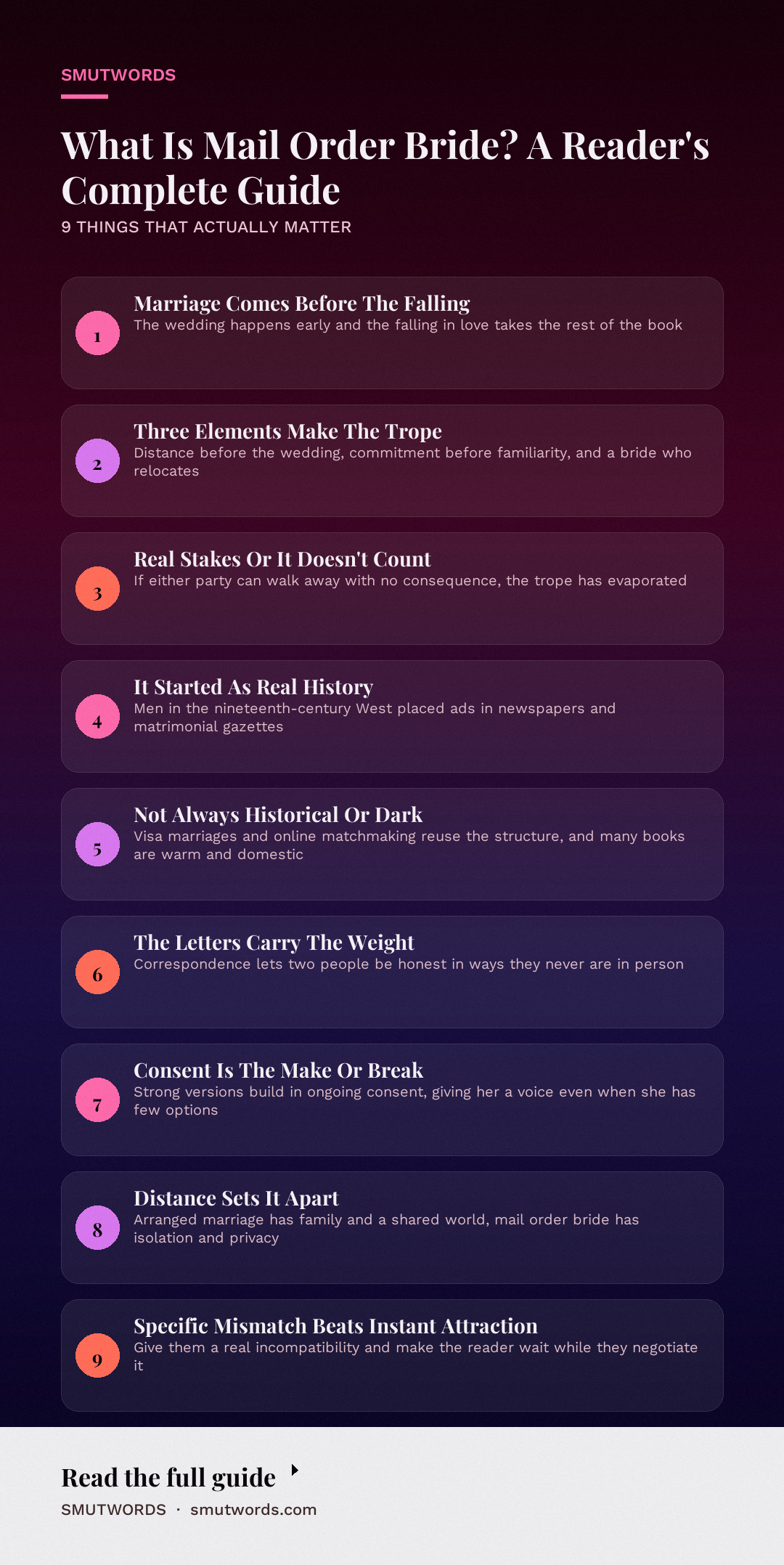
A mail order bride story is a romance where a woman agrees to marry a man she has never met, usually after a courtship conducted entirely through letters or an agency, then travels to his town, farm, or ranch to become his wife. The ink on the marriage certificate is dry before the first real conversation happens.
Everything readers came for, the risk, the strangers sharing a bed, the slow reveal of who this person actually is, takes place after the vows, not before. That inversion is the whole engine of the trope, and it is why the mail order bride has survived from nineteenth-century newspaper advertisements to modern historical romance shelves without losing an ounce of pull.
What Mail Order Bride Actually Means
The name comes from the literal mechanics of it: a man places an advertisement or writes to a matrimonial agency, a woman answers, they correspond, and she arrives by stagecoach, train, or ship to marry him. The "order" language is crude and transactional, and the best writers in the trope never pretend otherwise. That transaction is the point.
A true mail order bride story needs three load-bearing elements. There is a distance between the two people before the wedding, usually bridged only by letters. There is a legal or practical commitment made before genuine familiarity. And there is a relocation, the bride leaving everything she knew for a place she has never seen.
What doesn't count matters just as much. A mail order bride story is not the same as a modern blind date that goes well, and it is not a pen pal romance where the couple meets casually and takes years to warm up. If either party can walk away with no social or financial consequence, the stakes that define the trope have evaporated. The bride who boards that train has usually spent her last dollar, burned her bridges, or both.
It also isn't automatically a dark or coercive story, though it can be. Plenty of mail order bride books are warm, funny, and domestic. The tension comes from uncertainty, not villainy.
She doesn't know if he's kind. He doesn't know if she'll stay. Both of them signed up for something enormous on the strength of a few handwritten pages.
A common misconception is that the trope is purely a historical curiosity, frozen in the 1870s. It isn't.
Contemporary versions exist, built around visa marriages, military deployments, rural towns with a shortage of eligible women, and online matchmaking services that are functionally mail order agencies with better websites. The costume changes. The structure doesn't.
Where Mail Order Bride Comes From
This is one of the rare romance tropes with a real, documented, non-literary origin. In the nineteenth-century American West, mining camps, homesteads, and railroad towns were overwhelmingly male, and women who could be persuaded to relocate were scarce. Men placed advertisements in newspapers and matrimonial gazettes. Women answered, often because their own options back East or abroad were worse.
Those advertisements ran for decades, and the correspondence that followed was frequently published, collected, and read as entertainment. By the late 1800s the mail order bride was already a recognizable figure in American popular writing, sometimes treated romantically and sometimes as a punchline or a cautionary tale.
The trope's life in genre fiction is more recent and more interesting. Mid-twentieth-century Western pulp and film leaned hard on the mail order bride as a plot device, usually as a woman in peril or a comic misunderstanding. The romance genre reclaimed her in the 1980s and 1990s, when historical romance publishers discovered that the frontier setting offered something the Regency ballroom couldn't: total isolation and total dependence on one man.
That isolation is what authors kept. Over the following decades the trope shifted from "woman in danger" to "woman making a calculated leap," and the emotional interiority moved to the front of the book. Contemporary mail order bride romance now runs the full range, from sweet and faith-based to explicit and filthy, and the letters themselves have become a selling point rather than a framing device.
The publishing history here is a genre story, not a history lesson. When indie publishing opened up in the 2010s, mail order bride series exploded, often running to dozens of books, each following a different bride in the same town.
Authors like the ones in our interview with Penny Pepper on building a 65-book free use series have shown how a single high-concept premise can sustain a massive catalog, and mail order bride towns are a natural fit for that model.
How It Shows Up in Erotica
On the page, a mail order bride story lives or dies on the gap between the letter and the man. The craft problem is this: your reader already knows these two people will end up together. So the erotic charge cannot come from will-they-won't-they. It has to come from the slow, physical, often awkward process of two strangers learning each other's bodies and habits inside a marriage that is already legally binding.
The best versions lean into the strangeness. She has imagined his face for months and is wrong about it. He has written carefully and speaks clumsily. They share a bed on night one because there is nowhere else to sleep, and neither of them knows what is allowed.
Authors use that uncertainty in specific ways. Common variations include:
- The consummation delay: the marriage is legal but the bed is not yet shared, and the anticipation is stretched across chapters.
- The proxy wedding: a stand-in says the vows for an absent groom, so the couple's first meeting happens after they are already married. Frequently paired with a hate to love arc if the reality doesn't match the letters.
- The correspondence courtship: the letters themselves are reproduced on the page, sometimes months before the couple meets, and function as a slow burn adjacent to the physical plot.
- The soldier's bride: she marries a man she has never met because he is deployed or about to be, which pulls the story toward soldier romance territory and adds a countdown to every scene.
- The bride by contract: an explicit arrangement, sometimes with a deadline or an exit clause, often with a secret baby waiting in the epilogue.
- The modern visa marriage: the same structure in contemporary clothing, with immigration paperwork standing in for the train ticket.
What separates a strong mail order bride book from a flat one is the specificity of the mismatch. A weak version has her arrive, discover he's handsome, and fall into bed by chapter three.
A strong version gives them a real incompatibility, she is literate and he can barely write his own name, she is a city woman who can't cook and he needs a farm wife, she is running from something she hasn't told him, and makes the reader wait while they negotiate it. If you like the sound of that slow negotiation, it's the same muscle behind artist/muse romance, where two people spend the whole book working out what they owe each other.
The first kiss in a good mail order bride scene should feel like a transaction being renegotiated. That is where the eroticism lives: two people who agreed to a contract discovering they actually want each other, and having to admit it out loud.
There is also a craft lesson to borrow from authors who write at serious volume. Our breakdown of how Miss Dolly X writes a chapter a day is worth reading if you're writing a series of these, because mail order bride books reward tight chapter structure. Each chapter is usually one negotiation, one discovery, or one scene of physical escalation.
Why the Letters Matter
The correspondence is the emotional load-bearing wall of the trope. Two people writing to each other before they meet get to be honest in a way they never are in person. She tells him things she would never say to a suitor at a dance. He confesses loneliness he would never admit to a neighbor.
When they finally meet, all of that honesty is at risk. The erotic tension is not "will he want me" but "will the man in front of me match the man who wrote those letters." A skilled author will make the answer complicated.
Enjoyed this? Get a free book.
Join the list and we will send a complete free story straight to your inbox, plus new releases every week after that. No credit card, no catch.
Consent and the Arranged Marriage Problem
Any honest guide to this trope has to address the elephant in the bed. She agreed to marry a stranger, sight unseen, often with limited ability to leave. Authors handle this differently, and the difference is usually what makes or breaks a book.
The strongest modern versions build in explicit, ongoing consent. She has a voice in what happens, even when she has few options.
He asks. She answers. The arrangement is unequal in circumstance but not in dignity.
Weaker versions let the contract do the work of consent, which flattens the characters and drains the eroticism. If she has no real say, the reader has nothing to root for. If she chooses him again and again, in bed and out of it, every scene sharpens.
Pacing the Wed, Then Bed
The trope's signature move is that the wedding happens early and the falling in love happens late. That means the usual romance structure is inverted. Instead of a slow burn toward marriage, you get marriage first and burn after.
The pacing challenge is real. You have to make the wedding feel like a beginning, not a finish line, and you have to earn the first kiss the way other books earn the first meeting.
Readers who come for a mail order bride story are patient by nature. They know the payoff is coming. Spend the runway.
Mail Order Bride vs Arranged Marriage Romance
These two get confused constantly, and the confusion is understandable. Both involve a marriage that happens before real familiarity. Both are built on obligation rather than courtship. Readers searching for one routinely end up with the other.
The distinction is the distance. An arranged marriage romance usually has the families, the social world, and the negotiation in the same room. The couple may know each other by reputation. The stakes are about class, alliance, and family expectation.
A mail order bride story removes all of that. There is no shared social world. She has no family watching. He has no community that knows her story.
The entire relationship begins in private, between two people who have only ever read each other's handwriting.
That isolation is why mail order bride stories often read as more intimate and more dangerous at the same time. There is no chaperone, no ballroom, no aunt to intervene. If you enjoy the arranged marriage stakes but want them stripped of all social cushioning, mail order bride is the sharper version.
Some readers also compare it to prince/princess romance, which shares the "she changes her whole life for a man she barely knows" structure but swaps the frontier cabin for a palace, and usually trades dependence for power dynamics. Same leap of faith, very different climate.
Frequently Asked Questions
Is a mail order bride story always historical?
No. While the trope originated in the nineteenth-century American West, contemporary versions exist and are popular. Modern mail order bride romance often uses visa marriages, military correspondence, or online matchmaking to recreate the same structure in present-day settings.
What makes mail order bride different from a regular arranged marriage romance?
The distance and the privacy. In a traditional arranged marriage, the couple usually shares a social world. In a mail order bride story, they almost never do, and the relationship develops in isolation with no community to mediate it.
Do mail order bride books always end in marriage?
They usually begin with marriage, not end with it. That's what distinguishes the trope from a standard romance arc. The wedding is early and the falling in love is the rest of the book.
Are mail order bride stories considered dark romance?
They can be, but most aren't. The trope is a natural fit for darker takes because of the power imbalance, but a large portion of the genre is warm, domestic, and sometimes explicitly sweet. It depends entirely on how the author handles consent and agency.
What is a proxy bride?
A proxy bride is a variant where a stand-in participates in the wedding ceremony in the groom's absence, often a brother or a friend. The couple is legally married before they have ever met in person, which intensifies the first-meeting scene.
Why do readers love the mail order bride trope so much?
It compresses the two most satisfying parts of romance into one structure: total uncertainty and total commitment. The bride has no idea who she is marrying, and she has already thrown her entire future into the bargain. That combination is almost impossible to find anywhere else.
Can a mail order bride story work as an erotic romance?
Yes, and it's one of the trope's biggest strengths in explicit fiction. The delay between the wedding and the physical consummation gives authors room to stretch tension across many chapters, which is exactly what long-form erotica needs.
Final Thoughts
The mail order bride trope endures because it does something almost no other romance structure can: it puts a legally binding commitment before a first kiss and then asks the reader to wait for the slow reveal of two strangers learning each other. Every letter read aloud, every first night in a shared bed, every moment of doubt about the man who wrote those pages, is the trope doing exactly what it has done for a century and a half.
If you want a version that leans into the darker side of the bargain, start with a frontier wife story that lets the husband be genuinely dangerous before he becomes safe. The letters got her there. What happens next is the whole point.





Loading comments…