
A rut/heat dynamic is a consensual power-exchange setup, most common in omegaverse and paranormal romance. One partner enters a fictional biological state (rut for alphas, heat for omegas) marked by intense arousal, possessiveness, and instinct-driven behavior. The other partner either submits to it or steadies them through it.
It works as a compressed, high-voltage metaphor for desire and bonding. Characters strip away social politeness and communicate through raw physical need. The dynamic has become one of the most recognizable engines in modern erotic romance, and it rewards writers who understand both its biology-style logic and its psychological stakes.
What the Rut/Heat Dynamic Actually Means
The term covers two mirror-image states. Rut belongs to the partner in a dominant, often alpha-coded role: a periodic window of heightened aggression, territorial instinct, and near-insatiable sexual drive. Heat belongs to the partner in a receptive, often omega-coded role: a cycle of overwhelming arousal, vulnerability, and physical need that can leave them desperate for contact and reassurance.
In most published fiction the two states are designed to interlock, so one character's rut is answered by another's heat. Plenty of books run just one side of the equation.
The "dynamic" part is what separates this from a simple horny werewolf scene. It describes a relationship structure: who holds control during the state, who cares for whom afterward, and how the two partners negotiate the loss of ordinary restraint. Even when the biological fiction removes the characters' ability to reason clearly, the genre almost always frames the arrangement as chosen in advance. Consent is baked into the premise, not bolted on at the end.
What does not count is worth naming too. A character who is simply powerful and possessive is not running a rut/heat dynamic unless there is a cyclical, involuntary, body-driven state at the center of it. A single intense sex scene, however feral, is not the same thing either, because the dynamic depends on the rhythm of buildup, peak, and recovery. The state has to have a shape.
Common misconceptions cluster around three ideas. First, that heat or rut means the character has no agency at all; in strong writing the opposite is true, since the whole appeal is watching someone choose surrender while fully aware of what they are giving up.
Second, that the trope is only for shifters. It shows up constantly in alien romance, angel and demon stories, and straight-up science fiction with no animal element in sight. Third, that it is inherently non-consensual. Vanilla-adjacent readers sometimes assume the biology excuse erases consent, when the best examples treat it as the reason consent matters more.
Where the Rut/Heat Dynamic Comes From
The recognizable version of this dynamic is younger than most readers assume, and its history is almost entirely a publishing story rather than a folk or real-world one.
The omegaverse framework, with its alphas, betas, and omegas organized into pack hierarchies, grew out of fan fiction communities in the early 2010s, spreading fast across multiple fandoms before original fiction writers picked it up. The biology was never meant to be literal. It was a shared sandbox that let writers explore dominance, need, and protection without importing real-world power baggage.
Once original indie publishing got hold of the framework, it moved quickly. Paranormal romance and monster romance authors recognized that a rut/heat cycle solves a structural problem: it gives two characters a built-in reason to collide hard and fast without the slow-burn courtship that traditional romance requires.
By the mid-to-late 2010s, "alpha" and "omega" had migrated from fan spaces into mainstream self-published romance, and the rut/heat dynamic rode along with them. The rise tracked closely with the broader indie erotica boom, which you can read about in The State of Erotica Publishing Right Now.
The trope has since branched well beyond its shifter origins. Alien breeding stories borrow the cycle wholesale, swapping wolves for off-world species with compatible biology. Angel and demon romance uses it to dramatize forbidden union. Cryptid and monster romance keeps the instinct-driven state but drops the pack structure.
The mechanism survived the transplant every time because it is portable. Any pairing with a biological difference can be given a rut or a heat.
What changed most over the decade is how the consent question gets handled. Early omegaverse often treated the state as an excuse for force. Contemporary published romance overwhelmingly frames it as a negotiated arrangement, with characters discussing triggers, safewords, and aftercare before the cycle hits.
That shift mirrors the wider genre's move toward explicit consent, which the SmutWords guide to SSC (Safe, Sane, Consensual) lays out in detail. The dynamic did not soften; it got more deliberate.
How It Shows Up in Erotica
On the page, a rut/heat scene is a pressure cooker. The writer establishes a countdown (the cycle is coming, or it has already started), then lets the characters lose their grip on normal behavior in stages. A strong version keeps the escalation legible: the omega's scent sharpens, the alpha's patience thins, small courtesies fall away one at a time. The reader should be able to track exactly how far each character has drifted from their baseline.
The caregiving half of the dynamic is where the real craft lives. Anyone can write two people tearing each other's clothes off. What makes the trope land is the partner who stays present enough to guide, soothe, and check in, even mid-brutality.
That character proves devotion by staying coherent while the other cannot. This is why the dynamic reads as romance rather than pure smut: it is a trust exercise disguised as a biological emergency.
Enjoyed this? Get a free book.
Join the list and we will send a complete free story straight to your inbox, plus new releases every week after that. No credit card, no catch.
Authors lean on a fairly stable set of variations. The list below covers the ones you will hit most often:
- Fated mates heat: the cycle triggers the moment two destined partners meet, collapsing any courtship arc into a single explosive encounter.
- Suppressed heat: the receptive partner has been medicating or hiding the cycle, and the story is about the dam breaking.
- First rut: a younger alpha's inaugural cycle, with an experienced partner guiding them through it.
- Feral rut: the dominant partner loses nearly all reason, raising the stakes on the other partner's role as anchor.
- Bonding heat: the cycle is the mechanism for a permanent mate bond, often a bite or mark, which raises the commitment stakes.
- Shared heat or synchronized cycles: two receptive partners or a full pack cycle together, common in pack dynamics stories.
What separates a flat version from a strong one usually comes down to whether the biological state does any emotional work. A weak scene uses heat or rut as a costume for arousal, then discards it. A strong scene uses the state to expose something the characters could not say sober.
Maybe the alpha's possessiveness is really fear of loss. Maybe the omega's surrender is the first time they have stopped performing competence. The biology is the lever that pries the confession loose.
Pacing matters enormously here. Because the state is inherently urgent, writers who rush straight to the peak lose the tension that makes the peak worth reaching. The best versions spend real time on the approach and the comedown.
The comedown especially, since aftercare is where the dynamic pays off emotionally. Two people who just went through something overwhelming, now quiet and careful with each other, is often the most affecting scene in the book.
The trope also interacts heavily with physical contrast. A rut/heat pairing frequently leans on size difference romance, since the visual of a much larger, stronger partner losing control while a smaller one holds the reins is part of the appeal.
In alien variants the same instinct-driven state gets layered onto alien breeding trope conventions, where the cycle serves a reproductive plot. The mechanic travels well because it is about power and need, not about species.
Rut/Heat Dynamic vs Cryptid Romance
These two get confused because both involve non-human partners with instinct-driven behavior, but they are doing different jobs. Cryptid romance, covered in the glossary entry on cryptid romance, centers on a mysterious, often folkloric being whose otherness is the point: Bigfoot, mothman, a lake monster. The tension comes from encountering something outside known categories.
A rut/heat dynamic, by contrast, does not require a cryptid at all. It needs a cyclical biological state and a partner willing to meet it. You can run a rut/heat story with two otherwise ordinary werewolves, two aliens, or two angels.
The distinction is that cryptid romance is a category of partner, while rut/heat is a category of relationship structure. A cryptid romance can include a rut/heat dynamic, but neither term contains the other.
Frequently Asked Questions
Is a rut/heat dynamic the same as omegaverse?
Not exactly. Omegaverse is the world-building framework with alphas, betas, omegas, and pack hierarchies. The rut/heat dynamic is the specific relationship pattern inside that framework, and it can appear in stories with no omegaverse structure at all, including alien and angel romance.
Do rut and heat always happen together?
No. Plenty of books write only one side. A story might follow an omega through a solo heat with a caretaker partner, or an alpha through a rut without a receptive counterpart in the scene. The pairing is common but not required.
Is this dynamic non-consensual by nature?
The biology is fictional, so real-world consent rules still govern how the scene is written and read. Most contemporary romance frames the arrangement as pre-negotiated, with a safeword and aftercare plan established before the cycle starts. The loss of control is a fantasy layer, not an exemption.
What is a safeword for in this kind of roleplay?
Because these dynamics mimic losing control, a safeword gives either partner a way to stop or pause without breaking the scene's internal logic. Agree on it in advance, along with hard limits, and check in during and after. The pre-agreed boundaries are what make the surrender safe to explore.
Why do readers find heat and rut so appealing?
The state removes social performance. Characters say and do what they actually want, and the partner who stays steady proves their devotion by guiding someone through a vulnerable, all-consuming moment. It is a shortcut to the kind of intimacy that usually takes a whole book to earn.
Can a rut/heat dynamic work outside paranormal romance?
Yes. Science fiction, fantasy, and even contemporary stories with a speculative element have used it. The only hard requirement is that the biological state feel internally consistent within the story's own rules, whatever those rules are.
Final Thoughts
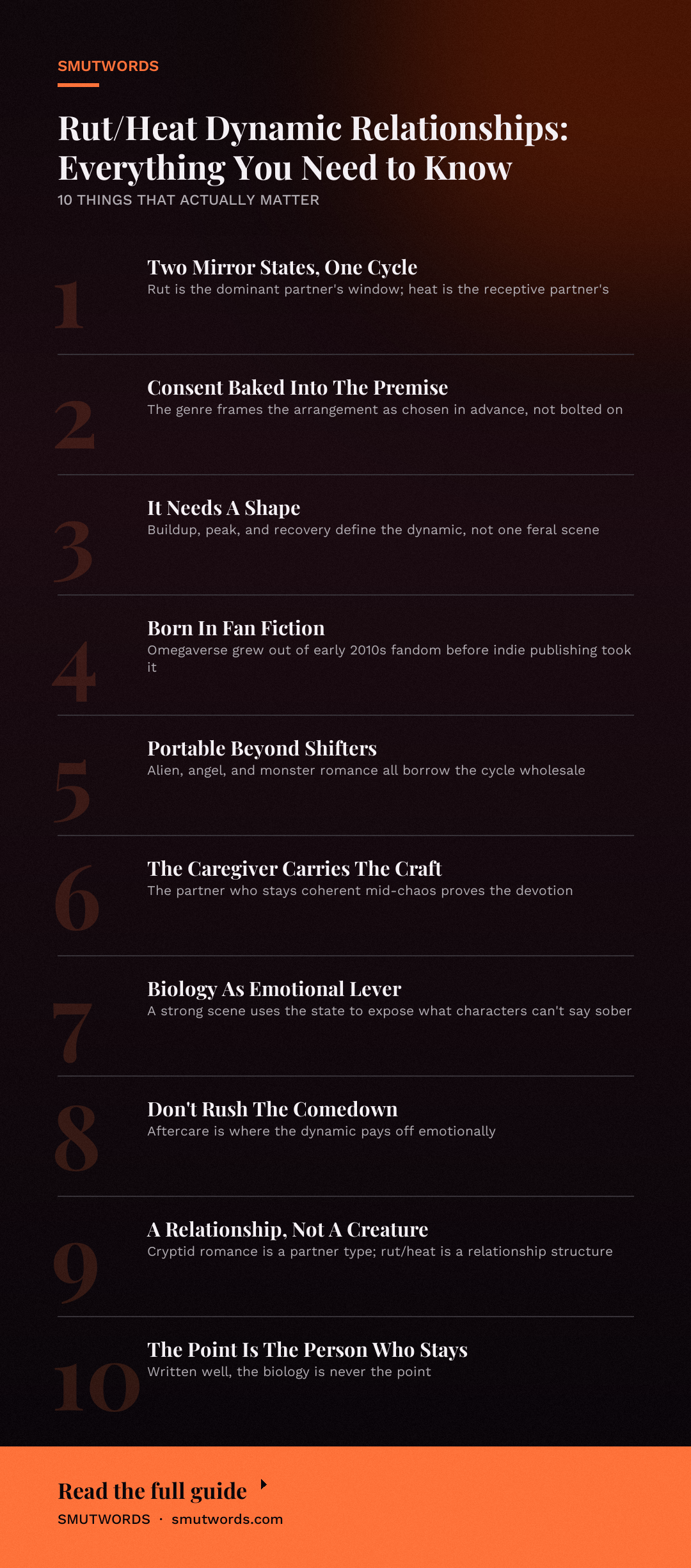
The rut/heat dynamic endures because it does two things at once: it delivers urgency and physical intensity, and it tests whether two characters can be trusted with each other at their most unguarded. Written well, the biology is never the point. The point is the person who stays.
If you want to see the dynamic pushed toward its darker, stranger edge, where instinct and something far older collide, start with the SmutWords guide to cosmic horror romance, then work your way back to the comfort of a clean, well-negotiated heat.








Loading comments…