
A mermaid romance is a love story built on the fault line between two worlds: one partner breathes air, the other breathes water, and every kiss costs somebody something. The term covers novels and stories pairing a human with a mermaid, merman, siren, or selkie, and it has become one of the most reliable engines in paranormal and monster romance.
The obstacle isn't a misunderstanding a conversation could fix. It's biology, geography, and time. Mermaid romance works because the lovers can't simply move in together and split the rent.
That structural impossibility is what readers keep coming back for. The genre has grown from YA fairy-tale retellings into explicit adult romance with full worldbuilding, and the best examples treat the sea as a character rather than a backdrop.
What Mermaid Romance Actually Means
At its core, mermaid romance is a cross-species love story where one partner is a merfolk being: human from the waist up, fish or cetacean from the waist down, bound to water and often to a specific body of it. The human partner is usually the outsider, the one who stumbles into the mer world by accident, shipwreck, or research expedition.
The name itself is older than the genre. Merfolk appear in Assyrian myth, in Homer, in Chinese and Japanese folklore, and in the European bestiaries that gave us the familiar fish-tailed woman.
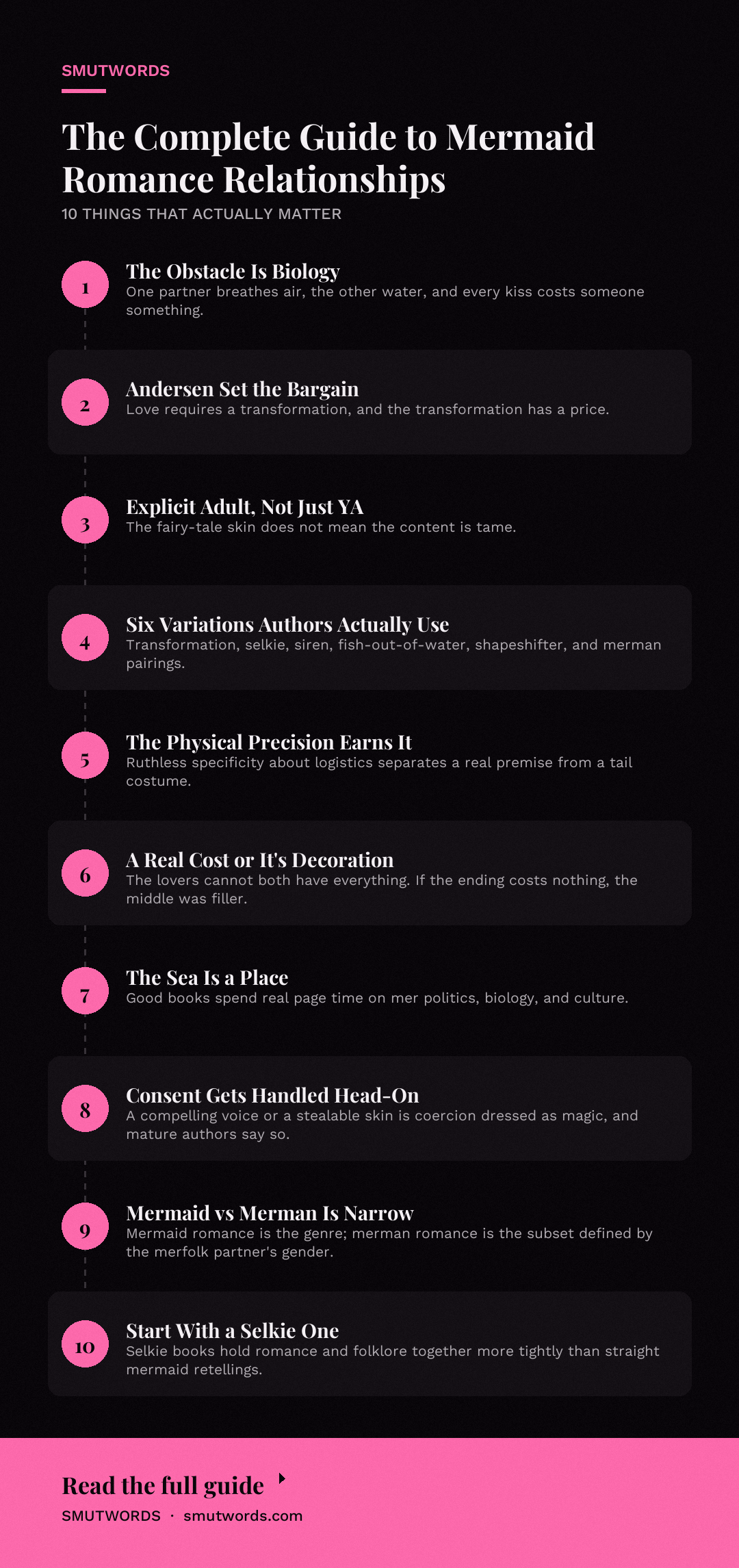
The romantic framing is much newer, and it borrows from Hans Christian Andersen's "The Little Mermaid" more than from any folk source. Andersen's 1837 tale is where the central bargain enters the DNA: love requires a transformation, and the transformation has a price.
What counts as mermaid romance is fairly broad. A novel about a marine biologist and a merman counts. A novel about a woman who wakes up with a tail counts. A selkie story, where a seal sheds its skin to walk on land, counts as a close cousin and gets shelved alongside it.
What does not count: a romance where a character merely swims well, or a fantasy with a mermaid side character and no romantic arc. The romance has to be the point, and the water has to matter.
Common Misconceptions
- That it is automatically sweet or YA. Plenty of mermaid romance is explicit, dark, and thoroughly adult. The fairy-tale skin does not mean the content is tame.
- That it is always about a mermaid and a human man. Gender runs both directions and beyond. The merman romance variant flips the pairing and has its own dedicated readership.
- That mermaids are always gentle. Siren variants are predators. Some of the most popular books in the genre lean hard into the danger.
- That the transformation is the whole plot. The interesting books treat the change as a starting condition, not the ending.
Where Mermaid Romance Comes From
The honest history here is a publishing history. Mermaids have been in literature forever, but the romance genre only started treating them as love interests in a sustained way in the late twentieth century, and only started publishing them at real volume in the 2000s and 2010s.
Andersen's tale set the template: the mermaid trades her voice for legs, walks in agony, and dies of unrequited love. That story is not a romance in the genre sense because it ends in loss. Disney's 1989 film softened the ending into a marriage and put a generation of readers in the mood for merfolk. The direct response was a wave of YA mermaid novels in the early 2010s, most of which kept things chaste.
The adult shift happened in the mid-to-late 2010s, when self-publishing and Kindle Unlimited let authors write monster romance at explicit heat levels and find an audience without a gatekeeper. Mermaid romance arrived in that wave alongside alien romance and other cross-species subgenres. The conventions carried over: fated mates, biological compatibility problems, and a partner who is not human and never pretending to be.
The selkie thread has its own history, rooted in Scottish and Irish folklore where a man steals a seal woman's skin to keep her ashore. That story is darker than the mermaid tale, and modern selkie romance often interrogates the coercion built into the original myth rather than reproducing it uncritically.
How It Shows Up in Erotica
This is where the genre earns its keep. Mermaid romance on the page has to solve problems no other subgenre has: how do they touch, where do they meet, what is physically and anatomically possible, and what does the human give up to stay.
Strong books treat those problems as the erotic engine. The cold water, the unfamiliar body, the tail, the gills, the skin that feels different under a hand. The sensory mismatch is the whole point, and the best authors lean into it rather than papering over it.
Variations Authors Actually Use
- Human transformed into merfolk. The classic bargain. The human takes on a tail, gills, or both, and the change is slow, partial, or sexual. Often reversible, which lets the author crank the tension.
- Selkie romance. The seal-skin myth in modern dress. Usually involves a stolen or hidden pelt, and the consent question that comes with it. Contemporary selkie authors often rewrite the theft as a rescue or a gift.
- Siren romance. The predatory version. The merfolk partner is a hunter, the human is potential prey, and the romance has to negotiate the danger on the page.
- Fish-out-of-water (literally). The merfolk partner is the one who ends up on land, learning to walk, to breathe, to use a shower. Comedy and heat in equal measures.
- Merfolk shapeshifter. The partner can switch between tail and legs at will. Convenient for logistics, and it opens up the same territory as a hybrid shifter romance, though the mechanics are different.
- Merman pairing. The human is a man, the merfolk is a merman, and the books often overlap with the dedicated merman romance shelf.
What Makes a Strong Version Work
The best mermaid romance books are ruthlessly specific about the logistics. Where do they have sex? If the answer is a tide pool, what does that feel like in the description, what is cold, what is wet, what is awkward? The physical precision is what separates a book that earns its premise from one that uses the tail as a costume.
The second mark of a strong version is a real cost. The lovers cannot both have everything. Someone moves to the sea, or someone leaves it, or someone becomes something new. If the ending costs nothing, the middle was decoration.
The third is worldbuilding that treats the ocean as a place rather than an aesthetic. Good books in this subgenre spend real page time on mer politics, mer biology, and mer culture. That is the same craft move that makes pack dynamics land in werewolf romance: the social structure is the plot.
Weak versions fail on the reverse of all three. The anatomy is hand-waved. The obstacle evaporates the moment the characters get honest. And the sea is reduced to a moody background.
The Consent Question
Mermaid romance has a built-in consent problem and mature authors handle it head-on. A voice that compels, a song that lures, a skin that can be stolen: all of these are coercion devices dressed as magic.
Enjoyed this? Get a free book.
Join the list and we will send a complete free story straight to your inbox, plus new releases every week after that. No credit card, no catch.
The interesting books figure out how to make the human's choice genuinely free, and they often use a formal consent model to structure the negotiation. If you want the framework, our piece on SSC vs RACK is a good place to see how that plays out on the page.
Selkie books especially have to reckon with this. The original folklore is a story about a man who traps a woman by stealing her ability to leave. Modern selkie romance usually engages that directly, which is one of the reasons the variant has more going on than the average fantasy retelling.
The Heat Level Question
Mermaid romance spans every heat level from closed-door to graphic. The explicit end of the shelf tends to attract readers who want the anatomy question answered, not evaded, and it overlaps with other forms of monster-adjacent erotica. If you like the creature-feature register of these books, our complete guide to teratophilia covers the wider appetite for nonhuman love interests.
Public and semi-public scenes also show up a lot, simply because the ocean is a public place. Readers who like the risk of being seen or caught during a swim will find the same appeal in our guide to semi-public sex, which covers how that tension works in prose.
Mermaid Romance vs Merman Romance
These two get confused constantly, and the distinction is narrower than most readers expect. Mermaid romance is the umbrella term for the whole human-meets-merfolk subgenre. Merman romance is the specifically male-merfolk variant, usually with a human woman as the protagonist, and it has its own shelf conventions and its own devoted readership.
The confusion is real because many books sit in both categories. A mermaid romance with a merman love interest is a merman romance by any honest measure, and publishers label them inconsistently.
The practical rule: mermaid romance is the genre, merman romance is a subset defined by the merfolk partner's gender. If the merfolk lead is a woman, you are buying mermaid romance. If the merfolk lead is a man, you are buying merman romance.
There is a related cross-species confusion worth naming. Mermaid romance often gets shelved next to pack mates romance because both use fated-mate mechanics.
The difference is the obstacle. Werewolf books negotiate pack politics and hierarchy. Mermaid books negotiate water, air, and the body itself.
Frequently Asked Questions
Is mermaid romance always about a mermaid and a human?
No, though that is the dominant pairing. Some books pair two merfolk, or pair a merfolk with another nonhuman, or build the romance entirely underwater between two members of the same mer society. The only consistent element is that the romance is the point of the story.
What is the difference between mermaid romance and siren romance?
Siren romance is a subcategory where the merfolk partner is a predator and the human is potential prey. Mermaid romance can be gentle, sweet, and closed-door. Siren romance usually is not. Many authors use the siren framing to write a darker, more dangerous, and more explicit love story.
Do mermaid romance novels have sex scenes?
Some do and some do not, and the range is wide. The adult side of the shelf is often explicit, with the anatomy and logistics problems worked out in detail. The YA-adjacent side is chaste. Check the heat level before you buy if that matters to you.
What is a selkie romance?
A selkie romance is a love story built on the Scottish and Irish folklore of a seal who sheds her skin to become a woman on land. Modern versions often rewrite the theft of the skin as a rescue or a mutual choice. It sits on the same shelf as mermaid romance and attracts readers who want the darker original myth.
Why is the transformation such a common plot in mermaid romance?
Because the transformation is the only way to answer the central question: what would a person give up to follow the one they love into a world they cannot survive in? That bargaining scene, where the human chooses the change and pays for it, is the emotional center of the whole subgenre.
Where do the lovers actually meet in mermaid romance?
The best books treat the meeting point as a character in itself. A tide pool, a jetty at night, an underwater grotto, a research vessel. The place has to work for both species, which is why mermaid romance authors spend so much time building a location that can hold the two of them at once.
Final Thoughts
Mermaid romance lives and dies on the cost of the water. A book that makes the crossing feel impossible, then makes it happen anyway, earns the ending. A book that waves the obstacle away only borrowed the tail.
Start with a selkie one. The selkie books tend to hold both the romance and the folklore together more tightly than the straight mermaid retellings, and they will show you what the subgenre can do when it takes its own myths seriously.





Loading comments…