
A ritual collaring ceremony is the formal moment a Dominant fastens a collar around a submissive's throat to mark a D/s commitment. It comes dressed in whatever ceremony the couple has chosen: vows, kneeling, witnesses, a private altar, a locked clasp, a spoken promise.
In erotica and romance, it works as the milestone scene that turns an abstract power exchange into something visible and witnessed, with all the weight a promise carries. Readers land on the ritual collaring ceremony as the payoff of a slow build, the chapter where everything the dynamic has been quietly meaning gets said out loud and sealed around someone's neck.
This guide covers what the term means in practice, where it came from as a genre fixture, how authors actually stage it on the page, and what separates a ceremony that lands from one that reads like costume jewelry. It also covers the real-world version, because a scene rooted in clear agreements and mutual consent is both more honest and better writing.
What Ritual Collaring Ceremony Actually Means
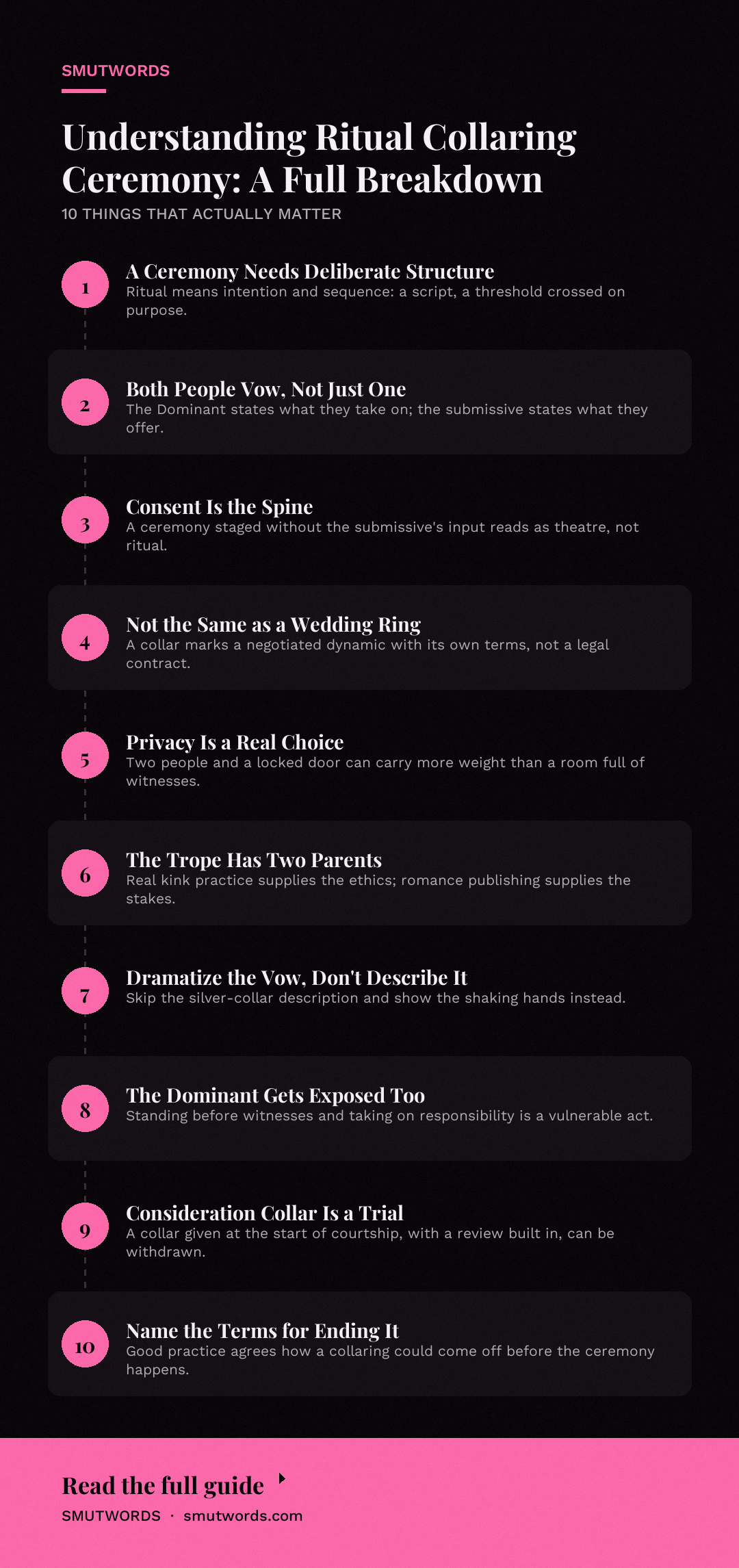
The word "ritual" is doing real work here. A collaring is the act of putting a collar on a submissive; a ritual collaring ceremony is that act wrapped in deliberate structure. The structure can be a full vow exchange in front of a kink community, or two people alone in a bedroom with a candle and a sentence each. What makes it ritual is intention and repetition: a script, a sequence, a threshold crossed on purpose.
In the fiction, the ceremony usually marks a beginning (the couple formalizing a dynamic they have already been living) or a deepening (a consideration collar becoming a permanent one). The short version in a glossary names the milestone. The long version is that the ceremony converts private feeling into public or witnessed form, and that conversion is the emotional engine of the whole scene.
What counts as a ritual collaring ceremony
Not every collar is a ceremony. A play collar handed over before a scene is gear. A day collar worn under a shirt is a private signal. A ritual collaring ceremony has these markers:
- A discrete event. It happens once, at a set time, and the people involved prepare for it.
- Spoken or written vows. The Dominant states what they take on; the submissive states what they offer. Sometimes both write them.
- A body posture that carries meaning. Kneeling is the standard; it can be a formal kneel, a bow of the head, or a hand placed on the chest.
- A collar that is distinct from the everyday. Often a permanent collar, a locked one, or one with personal engraving.
- Witnesses or a declared privacy. Either the community watches, or the couple explicitly chooses no witnesses and the privacy is itself part of the vow.
What doesn't count
A collar used only inside a scene is play gear, and that is fine; it is not a ceremony. A collar given as a surprise gift with no conversation about meaning is a gesture, not a ritual.
A "ceremony" staged for an audience without the submissive's active participation in designing it is theatre, and readers can smell a staged ceremony from a page away. The consent is the spine of the thing. Take it out and the scene collapses into decoration.
Common misconceptions
The biggest one is that a collar equals a wedding ring. It can borrow from marriage language, and some couples do treat it as a lifelong bond, but in the kink world a collar marks a negotiated dynamic with its own terms. Those terms may include an end date, a review clause, or a defined process for removing it.
Another misconception: that the Dominant gives and the submissive receives. In well-written ceremonies, both parties vow. The Dominant takes on responsibility, care, and accountability, and says so out loud.
A third: that a ritual collaring ceremony has to be public. Plenty of the strongest versions in fiction are two people and a locked door, where the witnessing is the couple witnessing each other. Privacy is a legitimate ceremonial choice, not a lesser one.
Where Ritual Collaring Comes From
The collar itself has a long, messy history in kink practice, borrowed in part from animal collars and in part from the leather and BDSM communities that formalized D/s structures in the mid-to-late twentieth century. The ceremony as a recognizable set piece is more recent as a publishing phenomenon, and that is the history worth telling here. It arrived in erotica and romance as the genre learned to write commitment without marriage as the only template.
In the early decades of published kink erotica, the collar showed up mostly as an object of erotic charge: leather, a leash, a symbol of ownership with little ceremony attached. The D/s dynamic was often the whole plot, and the collar was the visual shorthand.
The formal ceremony came later, as romance readers pushed the genre toward emotional arc and long-form commitment. Once a book needed a third-act turning point that was not a proposal, the collaring ceremony was sitting right there.
The shift tracked the rise of D/s romance as its own shelf. As the genre matured, authors started writing negotiation scenes, safewords, and aftercare into the story, and the collar moved from prop to promise.
The ceremony absorbed the vocabulary of weddings (vows, witnesses, an altar, something old and something locked) while keeping the kink-specific meaning: a negotiated exchange of power with terms both people signed off on. The BDSM community's own practice of formal collaring, which exists in real life with varying degrees of ceremony, gave the fiction a template to borrow from and embellish.
The result is a trope with two parents: real kink practice, which supplies the structure and the ethics, and romance publishing, which supplies the emotional stakes and the tropes readers come for. The best-loved versions honor both. The worst borrow the aesthetic of one and the plot beats of the other and forget what either was for.
How It Shows Up in Erotica
On the page, the ritual collaring ceremony is a scene about anticipation. Half the heat is in the preparation: the kneeling cushion set out, the collar chosen and hidden, the submissive told only that tonight matters. If you want a craft reference for how to stretch that waiting into its own pleasure, the genre's treatment of anticipation play maps cleanly onto a well-built ceremony. The vows do not land unless the reader has been made to wait for them.
Structurally, the ceremony tends to sit at one of three points in a book. It can be the climax of the central romance, the moment the couple stops pretending the dynamic is temporary. It can be a mid-book deepening, where a consideration collar becomes a permanent one and the stakes escalate.
Or it can be a turning point in a longer series, where the collar commits the couple to a future the reader will keep reading about. Each placement changes what the ceremony is for, and strong authors know which one they are writing.
Common variations authors use
The variants cluster around two axes: how public the ceremony is, and what kind of collar gets fastened. Here is how they show up in practice.
- Public collaring. Witnesses from the local community, a dungeon or club setting, a formal vow exchange. The heat is in being seen, and in the submissive kneeling in front of people who understand what the kneel means.
- Private collaring. Two people, a locked room, a written vow read aloud, no audience. The heat is in the intimacy and in the fact that no one will ever verify it happened.
- The consideration collar. A trial collar, given at the start of a formal courtship period, with a review built in. Writers love this for the tension: it is a promise that can still be withdrawn.
- The training collar. Given when a submissive enters a structured training period. The ceremony is smaller, more workmanlike, and the emotional beat is submission to a process.
- The permanent collar. Locked, engraved, or otherwise meant to stay. This is the version that most resembles a wedding, and readers treat it accordingly.
- The day collar swap. A private ceremony where the public-facing day collar is exchanged for something the submissive will wear under clothes in ordinary life. The ceremony is quiet and domestic, and the heat comes from the secrecy.
- The vow exchange scene. Not always a full ceremony, but the moment the vows are spoken. Sometimes folded into a larger scene where the physical consummation follows immediately.
There is a whole vocabulary of collars to keep straight. The scene play collar is gear. The consideration collar is a trial.
The permanent collar is the vow. Readers who know the difference will notice when an author blurs them, and it reads as sloppy.
What a strong ceremony does on the page
The strongest versions do four things at once. They make the power exchange visible, so the reader can see who kneels and who stands and what it costs each of them. They build the vow out of the couple's specific history, so the promises reference the things this particular pair fought about and survived.
Enjoyed this? Get a free book.
Join the list and we will send a complete free story straight to your inbox, plus new releases every week after that. No credit card, no catch.
They give the Dominant real exposure, which is the part weaker books skip: standing in front of witnesses and taking on responsibility is a vulnerable act. And they keep the physical charge alive through the whole ceremony, so the vows and the collar and the kneeling all read as erotic and not just solemn.
The flat versions share a failure mode: the ceremony is described instead of dramatized. The author tells us it was beautiful and meaningful and the collar was silver, and the scene skips the part where the submissive's hands shake or the Dominant has to clear their throat before speaking. Ritual lives in the specifics. A book that gets the specifics right can make a single sentence of vow carry more heat than a whole chapter of scene.
The physical scene that usually surrounds it
Ceremonies in this genre rarely end at the clasp. The collaring tends to open into a consummation scene, and what the author does with that depends on the dynamic. Some books move straight into impact play aftercare-style tenderness, where the ceremony is followed by holding and quiet. Others go the other direction and let the ceremony be the prelude to something more intense, since the collar has just formalized the Dominant's authority.
The range of what can follow is wide. A book might use the newly formalized dynamic to justify a scene of cock warming, where the submissive's new status is expressed through stillness and service.
It might push into elaborate setups like a milking table scene, where the collar is the signal that the Dominant can now ask for things the couple had been circling. It might even use the ceremony as the entry point to edge play like sounding or blood play, where the formalized trust is the precondition for the risk. The ceremony is the permission slip, and what the author does with that permission is the rest of the book.
If the scene moves into anything breath-related, the craft reference is the genre's treatment of breath play JOI and, for the real-world side, the SmutWords guide to combining breathwork and jerk off instructions safely. A ceremony that is followed by a breath scene earns its intensity from the vows; a book that gets the safety wrong undercuts the trust the ceremony just established.
Where the ceremony sits in the wider kink world of the book
Many books set the ceremony inside a community, and the community details do a lot of work. A public collaring at a dungeon or a munch gives the author a supporting cast, a set of rituals to borrow, and a reason the couple cannot simply skip the formalities.
If a book introduces a collaring in a munch setting, the SmutWords guide to the munch is the reference for how those gatherings actually run. The ceremony reads more convincing when the author knows what the room looks like, who is allowed to speak, and how the community treats a new collaring.
Rope and restraint also show up around collaring ceremonies, since the collar is the most permanent of the restraints and the ceremony often involves some binding.
For books that get the physical details right, the SmutWords piece on choosing a first restraint safely is a good model for how a scene can be explicit and careful at the same time. The collaring ceremony needs that same balance: the collar is erotic, and it is also a real object with a real clasp and a real person wearing it.
Collaring Ceremony vs Scene Play
These two get confused constantly, because a collaring ceremony often happens inside a scene and a scene often features a collar. The distinction is worth keeping straight. A scene play is a bounded encounter: it has a start, a negotiated shape, and an end, usually followed by aftercare.
A ritual collaring ceremony is a status change that exists across scenes. The collar put on during a scene can be a play collar that comes off when the scene is done. The collar put on in a ceremony is meant to outlast the scene, and the ceremony is the moment the couple says so.
The practical difference matters for writing. Scene play is about what happens in the next hour; the ceremony is about what happens in the next year.
A book that stages a full vow exchange and then treats the collar as ordinary gear has broken its own promise. A book that treats every scene collar as a lifelong bond has made the ceremony meaningless by making everything a ceremony. Readers notice the contrast, and authors who keep the two categories clean get more credit from the kink-literate half of their audience.
Frequently Asked Questions
What is a ritual collaring ceremony in BDSM?
It is a formal event in which a Dominant collars a submissive to mark a negotiated D/s commitment, usually involving vows, kneeling, and either witnesses or a deliberate choice of privacy. The collar is the visible symbol; the ceremony is the agreement made legible. In fiction it functions as a milestone scene, and in real practice it is anchored in consent and clear terms.
Is a collaring ceremony the same as a wedding?
No, though it borrows the language. A wedding is a legal and social contract recognized by the state; a collaring ceremony is a private or community commitment with its own negotiated terms. Some couples treat their collar as lifelong, but the ceremony's meaning is set by the people in it rather than by law or religion.
What is the difference between a consideration collar and a permanent collar?
A consideration collar is a trial collar, given at the start of a formal courtship or consideration period, and it carries an implicit or explicit review. A permanent collar is the one given at the ceremony that ends the trial, meant to stay. The distinction is one of the most common tension devices in collaring-ceremony fiction.
Do collaring ceremonies have to be public?
No. Public ceremonies with witnesses from the local community are one common form, and private ceremonies where the couple is the only witness are another. The private version is often the more intimate in fiction, because the vow is made to one person with no audience to perform for.
Can a collaring ceremony be ended or reversed?
Yes, and good practice says the terms for ending a collaring should be agreed before the ceremony, in the same negotiation that sets out what the collar means. In fiction this matters because a book that treats the collar as permanent without ever addressing how it could come off reads as a warning sign rather than a romance. The strongest couples in the genre have talked about it.
What does the collared person actually wear after the ceremony?
It depends on the couple's agreement. Some wear a permanent collar daily; others wear a discreet day collar under clothes and keep the formal collar for ceremonies; others keep the ceremony collar boxed and wear nothing. The choice is part of the negotiation, and in fiction the day collar is a favorite device for keeping the commitment visible in ordinary life.
Final Thoughts
The ritual collaring ceremony earns its place in the genre because it does something a proposal scene cannot: it makes power explicit, names who holds it, and asks both people to say out loud what they are taking on. A book that stages it well gives readers the commitment and the vulnerability in a single gesture, and the collar becomes an object with weight instead of a prop with a clasp.
Pick up a book where the ceremony is the whole point and let it show you what the trope can carry when the vows are written for the couple instead of the audience. Then read the next one with a critical eye. You will start to see the difference between a ceremony that dramatizes the vow and one that just describes the jewelry.





Loading comments…