
Most people learn how to say no in kink the hard way: mid-scene, heart pounding, trying to find the words while someone waits on an answer. The skill doesn't appear when you need it. You build it beforehand, in low-stakes conversations, with phrases you've already said out loud once or twice. This guide gives you the scripts.
Because the fear underneath the question is always the same. You worry that turning something down will kill the mood, offend your partner, or make you look like a bad submissive, a fussy top, a boring date. None of that is true, and the people worth playing with already know it.
Why Turning Down a Scene Feels So Hard
Kink asks you to be vulnerable in ways vanilla sex usually doesn't. You're offering to be restrained, humiliated, bossed around, or used. That offering is intimate enough that rejecting a scene can feel like rejecting the person who proposed it.
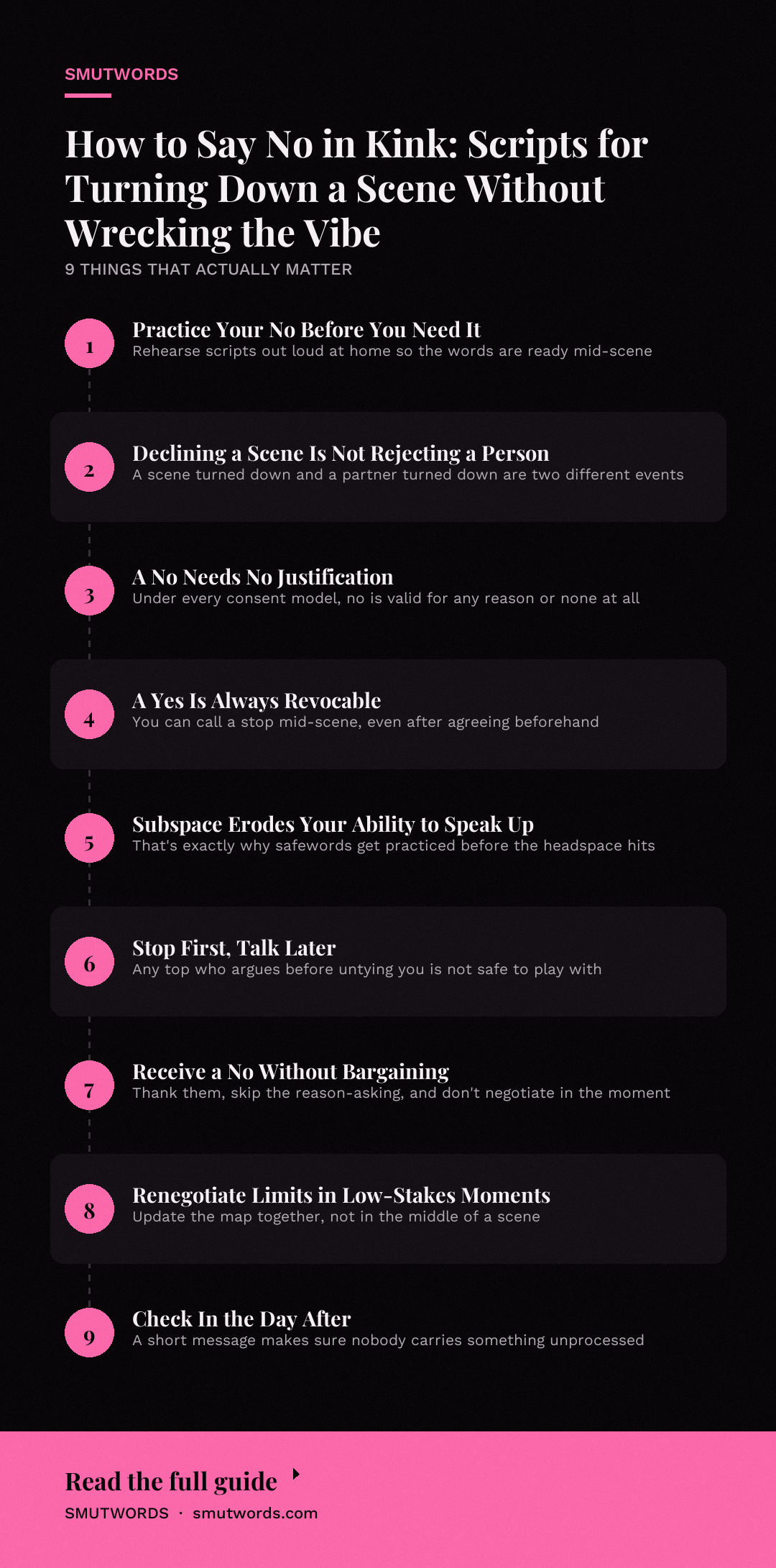
It isn't. A scene declined and a partner declined are two different events, and the distinction matters enough to say out loud.
There's also a practical problem. Many of us grew up with no script for refusal at all. No one taught us how to say "I don't want to do this" without an apology attached or an excuse to soften it. And when someone is kneeling in front of you with rope in hand, "I'd rather not tonight" can feel like the hardest sentence in the language.
It gets easier once you accept a plain premise: the person who hears your no and gets annoyed is giving you useful information. That reaction tells you what their stated respect for your limits is actually worth. People who take a no gracefully are the ones you keep.
The Consent Models That Make a "No" Legitimate
Most kink communities run on one of a few models, and knowing which one you and your partner are using prevents a lot of accidental fights. The differences are real even when the overlap is large, and a single scene can use more than one at once.
- SSC (Safe, Sane, Consensual): the oldest of the named models. Play should carry acceptable risk, involve sound judgment, and be fully agreed to.
- RACK (Risk-Aware Consensual Kink): accepts that kink carries risk and asks you to name and manage it rather than pretend everything can be made safe.
- PRICK (Personal Responsibility, Informed, Consensual Kink): adds that each person owns their own decisions and their own risk. You say yes with information, and you can withdraw it.
- FRIES (Freely given, Reversible, Informed, Enthusiastic, Specific): a checklist for what real consent looks like. The reversible part is the one most relevant here: a yes is always revocable, including while the scene runs.
Under every one of these models, a no is a valid answer for any reason or no reason. You don't need a justification. You don't owe a debate. If the negotiation framework you use requires a reason, the framework is doing you a disservice.
If the mechanics of this are new to you, a fuller primer on what consent negotiation actually involves walks you through the prep conversation the day before, which is where most good refusals get discussed and most bad ones get prevented.
Before the Scene: How to Decline a Kink at Negotiation Stage
The easiest place to say no is at the planning stage. Before anyone takes their clothes off, before the rope comes out, before you're in a headspace where saying no feels harder than going along with it. That's where the scripts below live. Use them when a partner proposes something you don't want to do.
Script: The Direct Decline
"That one's a hard no for me. I'm glad you said it out loud so we could check before we got into it, but it's not something I want to do."
Clean, warm, final. Notice that it lets the partner have offered the thing without penalty. The no lives in the first sentence and the reassurance (that the asking was welcome) lives in the second. That structure tells them they can keep proposing things even when the answer is no.
Script: The Soft Decline with a Pivot
"I'm not into the belt, but I really like the idea of you holding my wrists. Can we do that instead?"
This one works when you're in the mood for the general shape of what they want but not the specific act. It keeps the negotiation open. Don't reach for it, though, if you don't actually have a substitution you'd enjoy. A fake alternative is worse than a clean no, because it puts you back in the same position with a different prop.
Script: The Hard Line on a Risky Ask
"I don't do breath play at all, not with anyone, and that's not negotiable. If that's something you need, we're probably not a match for this kind of scene."
Some things are non-negotiable, full stop: breath restriction, unsupervised heavy restraint, anything involving injuries that need a doctor. When you decline one of those, be clear that the no is a hard boundary and not a mood the partner can talk you out of.
The classic bestseller framing of edgy dynamics, the kind you'd find in Claimed Under Twin Suns: Stranded on an Alien World with a Savage Warlord, works because the characters negotiate in the gap between what the fantasy wants and what the person needs. Real life demands the second half of that equation, every time.
Script: The "Not with me, but I'll help you find it"
"The mummification thing isn't mine. I don't want to be the one who does that with you, but if you want to explore it, I'll help you find people who are into it."
This is generous and it protects the relationship. It also takes the sting out of the refusal for a partner who has been hiding a kink they thought they couldn't voice. You're not the only person on earth who can top them.
Changing Your Mind Mid-Scene: Scripts for Calling It
Every consent model on this list agrees on one point: a yes given before the scene can be revoked during it. People change their minds. Sensations that sounded fine in theory turn out to be too much.
A headspace collapse, a physical pain spike, a panic response, or just losing interest all count. You don't need to clear it with anyone before you call it.
What makes mid-scene refusal hard is that the headspace itself can erode the will to speak. Subspace, topspace, whatever names you use for the dizzy or floaty or fight-or-flight state you enter, it reduces your ability to keep track of your own discomfort. That's why the scripts below need to be practiced before you need them. It takes a lot less executive function to say "yellow" than to compose a sentence.
Script: The Safe Word Pause
"Yellow. Hold up, I need a minute."
A yellow in the traffic-light system means slow down or check in without necessarily ending the scene. It's for the moment you're not sure yet whether you want to stop or just need a second. A good top will pause on yellow, get your eyes, and ask what you need. If your partner treats yellow as a request to keep going or an annoyance, that's a stop sign of the more metaphorical kind.
Script: The Full Stop
"Red. We're done. Get me out of this."
Red is the universal stop across most systems. If your partner uses a different red equivalent (and some do, including non-verbal signals like dropping a set of keys to the floor when a gag is in), use theirs.
The point is that the stop has to be automatic. It happens first, conversation happens later. Any top who argues first and unties second is not safe to play with.
Enjoyed this? Get a free book.
Join the list and we will send a complete free story straight to your inbox, plus new releases every week after that. No credit card, no catch.
Script: The "I need reassurance" request
"I'm okay, but I need you to hold me for a minute before we keep going."
This isn't a refusal exactly, but it belongs here because it's one of the most common things people are afraid to ask for mid-scene. Asking for a pause to be held, to be reminded that you're safe, to have your hands untied so you can rub the feeling back into them, is always allowed. A scene that can't absorb a two-minute cuddle is a scene that needs to end.
When Your Partner Says No: How to Receive It Without Wrecking the Vibe
This is the half most guides skip. Being the person who hears the no well matters as much as being the person who can give one, and it's often harder to learn. You were excited. You had a whole scene mapped out in your head, and the other person just landed on the part you were most invested in.
Your first job is to receive the no cleanly and without bargaining. "Okay, thank you for telling me," gets it done. So does "Got it. What do you want to do instead?" if you're still in play, or "We can stop there for tonight" if you're not.
What you absolutely do not do is ask for a reason, offer to change their mind, or say "but you said earlier..." That last one is the fastest way to teach a partner to say nothing at all until it's a crisis.
Take the no as a gift. It's evidence that they trust you enough to be honest, which is the only foundation a scene can be built on. The opposite case is worse: you spend a whole evening with someone who never turns you down and find out afterward that they were too uncomfortable to say anything. That's not a successful scene.
A quick list for receiving a no well
- Thank them. Every single time.
- Don't ask for a reason. If they offer one, listen without rebutting.
- Don't negotiate in the moment. If they want to renegotiate, they'll bring it up.
- Offer a pivot only if you have one you'd genuinely like, not a consolation prize.
- Follow through with whatever comes next: stopping, aftercare, a check-in later.
The wider play community tends to accept this standard, which is one reason a first play party is often a gentler introduction than an internet search suggests. Watching people decline things cleanly and get thanked for it is a strange kind of rehab for anyone who's been conditioned to say yes to everything.
Renegotiating Limits Without Turning It into a Fight
Limits change. Something that was a hard no two years ago might become a soft maybe later, because you trust your partner more or worked through a hangup in therapy. Soft limits can become hard ones, too, as you learn more about your own body.
Renegotiation is a formal conversation. Ideally not in the middle of sex and not the night of a scene. Pick a low-stakes moment.
State what has shifted. Ask what has shifted for them. Update the map together, and both of you honor the new map until it changes again.
A couple of practical scripts for opening that conversation:
- "Something's changed and I want to tell you about it. My limit on X has softened. I don't want to do it tonight, but I want to talk about whether we could try a version of it sometime."
- "I'm pulling X off the table for now. I'm not sure why, and I don't want to figure it out with you in the middle of a scene. I just need you to know it's off."
- "I'd like to renegotiate what aftercare looks like. Last time I went home shaky and I don't want to do that again."
The framing that makes renegotiation work is the same every time: you're both on the same side, updating a shared document, not one of you asking the other for permission. The Caregiver's Covenant builds its whole dynamic on that reciprocal maintenance, and it's a useful reminder that play rooted in caretaking holds up better when both people are honest about what they can and can't do.
Specific Lines for Tricky Situations
Some scenarios need their own lines. These are the ones that trip people up most.
Declining a scene from someone you just met
"That's not something I'm up for, but thanks for asking." The "thanks for asking" is doing real work. It signals that the asking was welcome even though the answer is no. It also makes it clear you're not looking for a negotiation. If they push back, "I said no, and I'm not going to keep talking about it" is a complete sentence.
Declining a specific act with an established partner
"I want to play with you tonight, just not that. Can we do [X] instead?" Long-term partners can feel more pressure to say yes, not less, because a no in a relationship feels like it carries more weight. It doesn't. A partner of five years is just as entitled to a hard no as a hookup on Tinder.
Declining something you know your partner loves
"I know how much you like this. That's exactly why I want to be honest with you that it's not working for me right now. I'd rather you know than have me do a bad version of it." This one requires a partner who can handle the honesty. That's part of the work.
Declining while in a roleplay or headspace where you can't "break"
This is the case where safewords exist. If you're playing the sort of owner-and-owned dynamic that runs the plot of Tested by the Tech Alpha, the safeword is the mechanism that lets the submissive stay inside the fiction until they reach the point where they need to step out of it. The fiction needs an honest off switch, and both people need to agree on the switch before the scene starts.
Aftercare, Follow-Up, and Where the Conversation Goes Next
The conversation about a no doesn't end when the scene ends. In the twenty-four hours after, check in with each other. Not to relitigate, but to make sure nobody is carrying something unprocessed. A short message the next day ("hey, want to check in about last night, no pressure") is enough.
If the scene involved a no that ended play, be extra generous. The person who said no often feels guilty afterward, which makes the follow-up critical.
For readers who enjoy the fantasy and want to see the negotiation part handled well, a few of the books on the site do it with real care. Weekend at the Bull's runs a hotwife dynamic that only works because the characters are painfully explicit about what's on the table at each step.
The Cum Throne does something similar in a darker register, where the surrender reads as meaningful only because both people keep consenting to it out loud. And for anyone curious about the specific conversations around orgasm denial or control, the fuller breakdown in understanding orgasm control is a good place to see how the check-in conversation is supposed to go.
The best fiction models the refusal even when it doesn't center it. The characters have the conversation. They tell each other what's off the table.
Sometimes they say "not tonight," and the other person says "okay," and the scene continues in a different shape. That's not a mood killer. That's the thing that makes the rest of the scene possible.
Final Thoughts
If you take one thing from this guide, take the rehearsal part. Pick two of the scripts above and practice them out loud in your kitchen. Say them until they come out without a wobble. When the moment arrives, mid-scene, breathless, with someone waiting on your answer, your mouth won't have to go looking for the words.
If you want a book that models the whole negotiation as part of the pleasure and not a cold shower around it, start with Free Use Dentist: The Dentist Everyone Uses. It's darker than some readers will want, but it handles the "is this okay?" conversation with a specificity worth studying.





Loading comments…