
Boss/employee romance is the workplace love story where one person on the page signs the other person's paycheck, and both of them know exactly how much trouble that creates.
The boss/employee romance trope puts a direct power imbalance at the center of the relationship and then makes the reader feel every second of it: the closed-door meeting, the performance review that turns into something else, the fear that HR will find out before the characters figure out what they actually want.
At its best, it uses the org chart the way other romances use distance or duty, as a real obstacle that makes the eventual surrender cost something.
What Boss/Employee Romance Actually Means
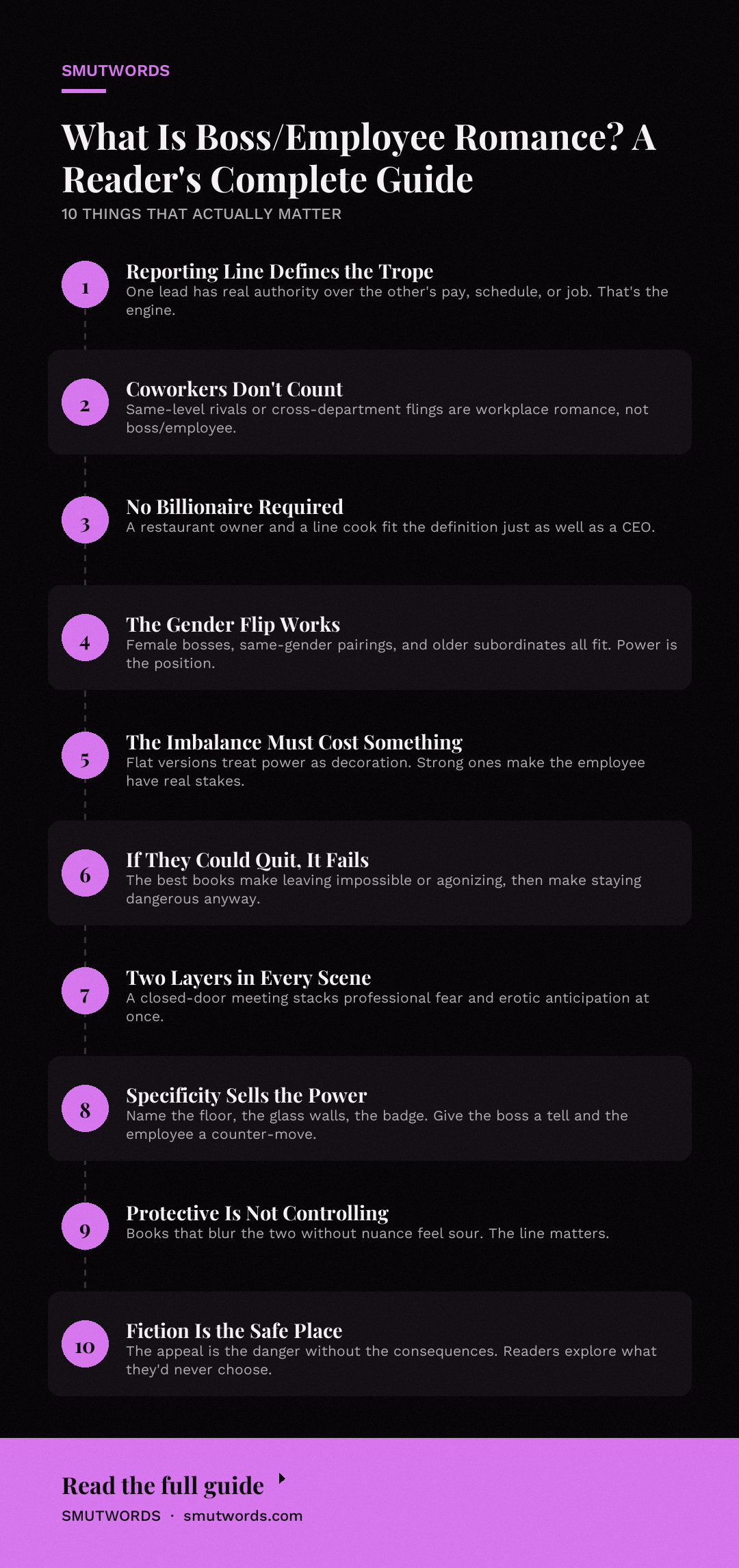
The name describes the reporting line, not the job title. One protagonist has formal authority over the other's pay, schedule, promotion, or continued employment. The dynamic comes from that specific vertical relationship, and the tension is inseparable from it.
What counts as this trope is narrower than "two people who work together." Coworkers on the same level, rivals gunning for the same promotion, or an intern and a different department's manager all produce different chemistry. The defining feature is a chain of command that runs directly between the two leads, so that every romantic move also reads as a professional one.
Common misconceptions are worth clearing up. Readers sometimes assume the trope requires a billionaire, a giant corporation, or a corner office with a skyline view. It doesn't.
A restaurant owner and a line cook, a head librarian and a page, a farm manager and a seasonal hand all fit the definition. The wealth is a popular flavor, not a requirement.
Another misconception: that the boss is always the man and the employee always the woman. Plenty of the strongest entries in this category flip the genders, put two women or two men in the pairing, or make the subordinate the older and more experienced person. Power is about the position, and authors who understand the trope know how to play with who actually holds it.
Where Boss/Employee Romance Comes From
The workplace has been romantic territory in popular fiction since the rise of the modern office itself. Mid-century category romance publishers built entire lines around doctor-nurse and secretary-executive pairings, and the secretary-boss story in particular became a recognizable formula by the 1950s and 1960s. Those early versions were often about a young woman proving her competence to a stern older man who eventually noticed her as a person.
The 1980s and 1990s brought the corporate setting into sharper focus, with boardroom settings, hostile takeovers, and a boss who was as likely to be a tycoon as a doctor. Harlequin's category lines ran thousands of these, and the "billionaire boss" became a distinct sub-brand with its own cover conventions.
The real shift came in the 2010s with digital publishing. Indie romance exploded the category, and self-published authors could go much further with the sex, the power play, and the moral messiness than traditional publishers would allow.
Boss/employee romance became one of the most reliable bestseller categories on every major platform, and the trope absorbed new variants: the contract relationship, the fake engagement to save the company, the office rivals who hate each other until a business trip changes everything.
Contemporary versions also engage more directly with the ethics. Modern authors write the HR problem into the plot instead of pretending it doesn't exist, and a lot of the genre's recent energy comes from characters who actively negotiate the imbalance rather than ignoring it. If you want to see how that negotiation looks in practice outside fiction, the SmutWords guide to consent negotiation covers the same conversational moves that make a good boss/employee scene land.
How It Shows Up in Erotica
On the page, this trope runs on proximity and consequence. The characters can't avoid each other, because they share a building, a calendar, and a set of deadlines. Every interaction carries a second layer of meaning, and a skilled author writes both layers at once.
Watch how a strong version handles a simple scene. The boss calls the employee into the office to discuss a missed deadline. In a flat version, this is just an excuse for them to be alone. In a strong version, the employee's heart rate spikes for two reasons at once, and the reader feels the professional fear and the erotic anticipation stacking on top of each other.
The best authors in this category are ruthless about specificity. They name the floor, the glass walls, the security badge, the sound of the door locking. They give the boss a tell, like straightening a cufflink before saying something devastating, and they give the employee a counter-move, like holding eye contact a beat too long.
The power dynamic also creates natural room for kink. Boss/employee setups frequently overlap with dominance and submission, praise kink, and degradation play in the bedroom. A boss who praises the employee's work in the conference room and then uses that same voice in private is doing a lot of work with very few words. The SmutWords breakdown of degradation kink is useful for understanding where that register comes from and how authors keep it consensual on the page.
The most common variants
- CEO/assistant: The classic. Maximum proximity, maximum imbalance, and the assistant usually knows the boss better than anyone else in the building.
- Billionaire boss: Leans hard into wealth fantasy. The office is a penthouse, the stakes are global, and the boss's money solves problems that money shouldn't be able to solve.
- Intern/coworker: Lower stakes, younger energy, and often more mutual embarrassment. The power gap is real but smaller, so the conflict pivots toward reputation and gossip.
- Office rivals: Two people at the same level, or nearly, whose competition becomes foreplay. Technically a sibling trope, but frequently shelved alongside boss/employee because the power struggle is the point.
- Workplace hate-to-love: Usually starts with a new manager arriving and upending everything. The antagonism is loud, and the eventual softening hits harder because of it.
- Contract relationship: A fake engagement, a marriage of convenience to satisfy a board or a visa, or a pretend-to-be-my-date-for-the-gala arrangement that stops being pretend.
What separates a strong version from a flat one
A flat boss/employee romance treats the power imbalance as decoration. The boss has money and a nice suit, the employee is plucky, and the conflict resolves the moment they admit they like each other. Readers can feel the missing resistance in the first chapter.
Enjoyed this? Get a free book.
Join the list and we will send a complete free story straight to your inbox, plus new releases every week after that. No credit card, no catch.
A strong version makes the imbalance expensive. The employee has something real to lose, whether that's the job, a visa, a reputation in a small industry, or a promotion they've worked years for. The boss has to confront the fact that their desire could cost the other person everything, and that recognition is often where the heat actually lives.
One reliable test: if the characters could both just quit and the plot would be unchanged, the trope isn't doing its job. The best books make leaving impossible or agonizing, and then make staying together dangerous anyway.
Another marker of quality is how the author handles the secret. Some books keep the relationship hidden from the whole company and mine every near-miss for tension. Others let the secret break early and spend the rest of the book on consequences.
Both work. What doesn't work is a secret nobody cares about.
Strong authors also differentiate their boss from the possessive-kink cliché. There's a real distinction between a boss who is protective and a boss who is controlling, and the books that blur it without nuance tend to feel sour. The SmutWords piece on possessive kink vs jealousy kink is a good calibration tool for where that line sits.
Boss/Employee Romance vs Office Rivals
These two get shelved together constantly, so it's worth separating them. Boss/employee romance requires a direct reporting relationship, where one lead has formal authority over the other's career. Office rivals places both leads on roughly equal footing, competing for the same promotion, the same account, or the same recognition.
The distinction matters because the conflicts run in different directions. Boss/employee plots pivot on vertical power and the risk of coercion. Office rival plots pivot on horizontal competition and the question of whether two ambitious people can want the same things and still want each other. Some books stack the two, starting as rivals and then adding a promotion that flips one of them into a manager, but the underlying engine changes when that happens.
If you find yourself drawn to the rivalry version, the more useful comparison is with another trope entirely. Readers who love rivalry tend to love ambition as a character trait, and that overlaps more with something like the drive and ego of rockstar romance than with a boardroom. The mutual professional obsession is the shared thread.
Frequently Asked Questions
Is boss/employee romance the same as billionaire romance?
No. Billionaire romance is about extreme wealth and the fantasy of being chosen by someone whose resources change your life. Boss/employee romance is about a reporting line and the professional consequences of crossing it. One can include the other, but plenty of boss/employee books feature a small-business owner or a department manager with a modest salary.
Why is boss/employee romance so popular?
It combines a forbidden dynamic with a built-in plot. Readers get the tension of a secret relationship without the author having to invent reasons to keep the characters apart. The professional stakes also feel grounded, because most readers have had a job and can imagine how bad it would go.
Does it always include a power imbalance kink?
Not always, but often. The setup lends itself to dominance and submission, praise, and control dynamics that carry over from the office into the bedroom. Some authors keep the workplace power strictly professional and write the sex as egalitarian, which is its own satisfying version.
What's the difference between boss/employee romance and workplace romance?
Workplace romance is the broad umbrella for any romance set at work. Boss/employee romance is one specific version where the two leads have a direct manager-subordinate relationship. Coworkers, rivals, and cross-department flings are workplace romance but not boss/employee.
Are there boss/employee romances with a female boss?
Yes, and the subcategory has grown considerably. Female-boss/male-employee pairings are popular, and so are same-gender versions in both directions. The dynamic works the same way: the person with the checkbook has to decide whether their desire is worth the risk to the other person's career.
Is it okay to read boss/employee romance if I'd never date my own boss?
Absolutely. Fiction is exactly where readers go to explore dynamics they'd never choose in real life. The whole appeal is the danger without the consequences, and the best books know how to make the danger feel real while keeping the reader safely outside it.
For readers curious about where the line between hot and genuinely uncomfortable sits, the SmutWords article on how to say no in kink translates well to boss/employee fiction. A scene where the subordinate can't say no is a different scene than one where they choose not to. The best authors know the difference.
Final Thoughts
Boss/employee romance earns its shelf space because the obstacle is real. The reporting line, the HR file, the promotion at stake, the thing you'd lose by saying yes: all of it turns every glance across the conference table into a decision. When an author respects that weight, the payoff is enormous, and readers keep coming back for exactly that collision between career and desire.
If you want a starting point that handles the dynamic with real craft, start with the ranked recommendations on this page. The top pick is the one most readers should read first.




Loading comments…