
Why Shifters All Share One Instinct
Every shifter romance books reader knows the moment: the heroine locks eyes with a wolf shifter across a crowded bar, and something inside her clicks. She doesn't know his name, his pack, or whether he pays his bills on time. But her body already made the decision her brain is still catching up on. That instantaneous, bone-deep recognition is the mate instinct, and it's the engine that makes the whole subgenre run.
Strip away the fur, the fangs, and the territorial growling, and what's left is a story about being chosen. Irrevocably, biologically, no-refunds chosen.
The shifter doesn't deliberate. He doesn't weigh pros and cons or wonder if he's ready for commitment. His biology files the paperwork before he finishes his first sentence.
That premise is doing an enormous amount of work for a genre that sells millions of copies a year.
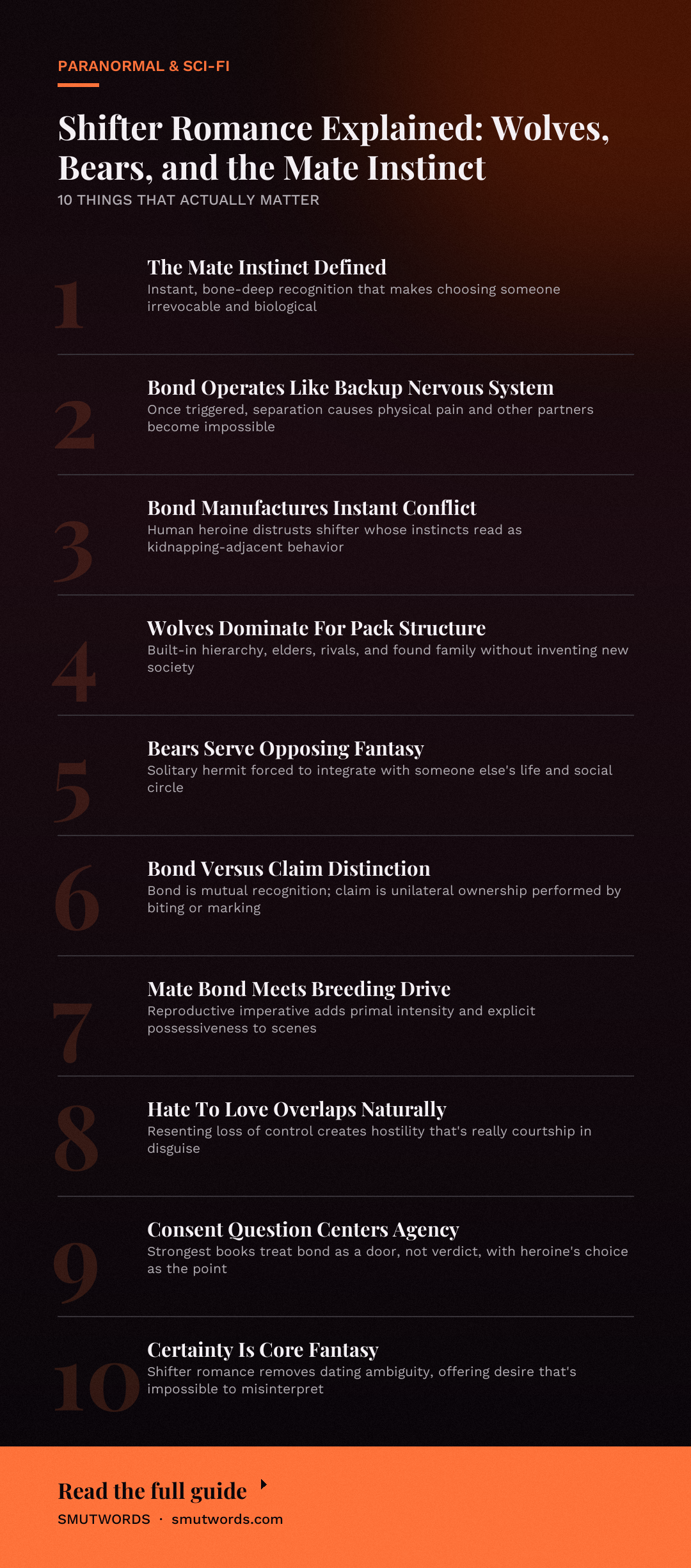
What Exactly Is the Mate Bond?
In most shifter romance books, the mate bond is a biological imperative that operates like a backup nervous system. Once a shifter scents or touches their fated partner, their instincts lock on and refuse to let go. Separation causes physical pain.
Other partners become literally impossible to consider. The bond reads as a supernatural guarantee that the person you're falling for is, in fact, the only one who could ever truly satisfy you.
The specifics shift from author to author. Sometimes it's a scent trigger, sometimes eye contact, sometimes a bite that marks the union permanently. Wolves in the genre usually form pack bonds with hierarchy attached. Bears, by contrast, tend to be solitary creatures who stumble into a mate and suddenly have a reason to build a den instead of wandering.
The structure differs, but the payoff sentence stays the same across a hundred different urban fantasy romance series: you are mine, and I have no say in it.
That lack of choice is the point. In real relationships, doubt creeps in. People wonder if they could do better, if they're settling, if the timing is right.
The mate bond vaporizes those questions on page one. It's the narrative equivalent of a contract signed in blood before the heroine even reads the terms.
The Instinct as Instant Conflict
The mate bond sounds convenient until you remember that shifter romance books need conflict, and the bond is exceptionally good at manufacturing it. Consider the single most common setup: the heroine is human, and either she doesn't know shifters exist, or she has perfectly reasonable reasons to distrust them.
Her wolf shifter counterpart isn't allowed to explain himself clearly. His instincts scream at him to claim her, protect her, and pin her down somewhere safe, which reads to her as kidnapping-adjacent behavior.
She runs. He follows. She demands space.
His wolf physically cannot give it. Every conversation they have is two sentences of actual communication wrapped around forty minutes of him trying not to growl at anyone who looks at her too long.
That friction produces the entire emotional arc. The heroine has to decide whether she trusts a feeling that has no rational basis. The shifter has to learn that claiming isn't the same as respecting. When done well, the result is a story where the supernatural compulsion functions as a forcing function for honesty, not a shortcut past it.
Why Wolves Dominate, and Other Shifters Scramble
Open any list of the best shifter romance books and you'll find wolves camped out at the top of the pile. There's a reason for that. Wolf packs already come with social structure, hierarchy, and territorial disputes built into their mythology.
You get instant secondary characters in the form of pack elders, rivals, and exes who challenged the alpha and lost. The dynamics let an author write about belonging, loyalty, and found family without having to invent a whole society from scratch.
Bears are the second most common, and they serve the opposite fantasy. A bear shifter is usually a loner, often living in a remote cabin, suspicious of everyone. His mate encounter forces him to integrate with someone else's life. The found family through a clan or den structure shows up constantly here, as the hermit gains a partner and, eventually, an entire social circle he never asked for.
Beyond wolves and bears, the genre gets creative:
- Dragon shifters hoard their mates like treasure, complete with the possessiveness that implies
- Cat shifters, usually panthers or lions, lean into the predatory stalk-and-pounce rhythm
- Snake shifters carry the unsettling, sensual coolness that other animals can't replicate
- Wolf-like canines such as coyotes and foxes keep the pack dynamic but add a trickster edge
Every animal choice changes the flavor of the mate instinct. Wolves bond through pack recognition. Dragons bond through shared power and territory. The animal's real-world behavior gets mapped onto human courtship in ways that make each subgenre feel distinct even when the skeleton is identical.
The Bond Versus the Claim
Experienced readers know these two things aren't the same, and the best shifter romance books build entire plots around the distinction. The bond is mutual recognition. Both parties feel it, even if one of them is fighting it.
The claim is something else: an assertion of ownership that can be performed unilaterally, often by biting, marking, or simply announcing it in front of witnesses.
When a book handles this well, the heroine discovers that she's been claimed by a shifter who isn't her mate. Maybe he's trying to force the bond by treating the claim as if it were enough. Maybe he's an antagonist who thinks possession is the same thing as connection.
Either way, her actual mate has to win her through choice rather than compulsion, which neatly solves the consent problem that a purely instinctual bond can create.
The contrast is worth paying attention to in alien romance too. If you've read the differences between alien mate bonds and human marriage, you already know the shape: one party has all the biological certainty and the other has all the reasonable doubt. Shifter romance just reruns that script with fur and territorial growling swapped in for laser rifles and spaceships.
When the Mate Instinct Meets Breeding
Cross over into the darker corners of the genre and the mate bond picks up a reproductive imperative. The shifter isn't just claiming a partner; he's ensuring the survival of his line.
Wolves produce litters. Bears have cubs. The language shifts from romance to something more primal, and the physical scenes reflect it.
Titles don't bother with euphemism here. You can find the same breeding-driven intensity in The Breeding Spiral, where the obsessive fixation on conception reads as a direct cousin to an alpha wolf's single-minded need to see his mate pregnant. The specifics of anatomy and setting change, the instinct doesn't.
Enjoyed this? Get a free book.
Join the list and we will send a complete free story straight to your inbox, plus new releases every week after that. No credit card, no catch.
Readers who like their shifter fiction explicit rather than suggestive tend to seek out exactly these books. The mate bond gives permission for a level of possessiveness that would read as controlling in contemporary romance. When a wolf says he'll keep the heroine warm in the den all winter, the narrative means it in a very specific biological way.
Tropes That Travel Well
The mate instinct slots neatly into several other frameworks that dominate the broader romance landscape. Shifter romance books borrow from the hate to love playbook constantly, because nothing generates dislike faster than being told by your own body that someone is your destiny.
The heroine resents the loss of control. The shifter resents the vulnerability. Their mutual hostility is really just courtship wearing a disguise.
The forced proximity trope also overlaps naturally. A blizzard traps two characters in a cabin. A shared den during mating season makes avoiding each other impossible.
Once the author has physically confined the couple, the mate bond takes care of the emotional confinement. There's nowhere to run, which means the only thing left to do is talk, fight, or give in.
Rejected mate stories operate as the genre's tragedy engine. The shifter fails to recognize his mate, bonds with someone else, or publicly humiliates her before realizing his mistake. The subsequent grovel is often the entire plot.
The fantasy here is about being recognized at last, after being overlooked or dismissed, and the shifter's animal nature makes his final capitulation feel less like reconciliation and more like surrender.
The Consent Question That Won't Go Away
Nobody serious about shifter romance books can ignore the elephant in the den. The mate bond, at its most literal, is a compulsion. It removes free will from the equation. A heroine who resists for two chapters before succumbing can read as a woman being worn down rather than one making a choice.
The genre's strongest authors handle this by making the heroine's agency the entire point. The bond is a door, not a verdict. She can walk through it or walk away, and the shifter's entire character arc is learning to respect that decision even when his instincts scream otherwise. The best books make the mate's choice meaningful precisely because the supernatural pressure to accept him never fully disappears, and she does it anyway.
Weaker entries fumble the landing by skipping straight to the claiming scene without interrogating whether the heroine actually has a say. The difference is detectable from the first chapter. One book asks what a woman does when her biology and her judgment disagree. The other one just has her faint into his arms and wake up marked.
How Shifter Romance Connects to Its Siblings
Walk backward from the mate bond and you land in the same place as captive alien breeding situations, fae bargains, and demon contracts. The shape is always the same: a powerful non-human presence makes an irrevocable claim, and the human protagonist must decide how much of herself to surrender. The difference is packaging.
Read Taken by the Celestial King and you'll find the same irresistible pull that defines a wolf's recognition of his fated mate. Read the alien breeding hive titles and you'll see the same conflation of desire with destiny.
The monster romance sphere has been trading these bones back and forth for years. The mate bond is just the version that wears a collar and answers to the name of its inner animal.
The gargoyle romance subgenre runs the same play with stone skin and centuries of solitude. The minotaur romance shelf reuses the beast-with-a-tender-heart core.
And if you want to see the mate instinct stripped of fur entirely, the incubus romance line does the same binding, just with a different source of supernatural heat. They're all telling the same story about being unable to choose anything other than the monster who chose you first.
Are Shifter Romance Books Just Paranormal Escapism?
Yes, and that's not a criticism. A solid shifter book promises a world where desire is legible. Nobody plays games. Nobody keeps their cards close.
A shifter who wants you makes it physically impossible to misinterpret the situation.
Most readers don't get that in their actual dating lives, where ambiguity is the default state and nobody ever says what they mean.
The mate instinct is wish fulfillment aimed directly at that frustration. It says there is someone out there who will know you on sight, choose you without hesitation, and fight anyone who threatens that bond. The fangs are just the genre's way of making the certainty visible.
The heat, the possessiveness, the claim, they're all metaphors for the thing that contemporary romance has to spend four hundred pages earning.
Even the darker entries, the ones that lean into breeding and capture and the loss of control, are offering the same fantasy from the opposite direction. Being wanted that completely, that biologically, is terrifying in theory and titillating in practice. Shifter romance gets to have it both ways: the hero is a dangerous predator, and he's also completely devoted to exactly one person.
Starter Stack for New Readers
If you've never read a shifter book, the sheer volume of options can be paralyzing. Start with straightforward wolf pack stories to learn the baseline rules, then branch out once you know what flavor of mate bond you like.
The genre rewards readers who know their own preferences. If the idea of being claimed, scented, and marked sounds appealing, look for books with possessive alphas and eager mates. If the compulsion element makes you uncomfortable, search for rejects and fated mates who walk away. The genre has room for both, provided you know which fantasy you're chasing.
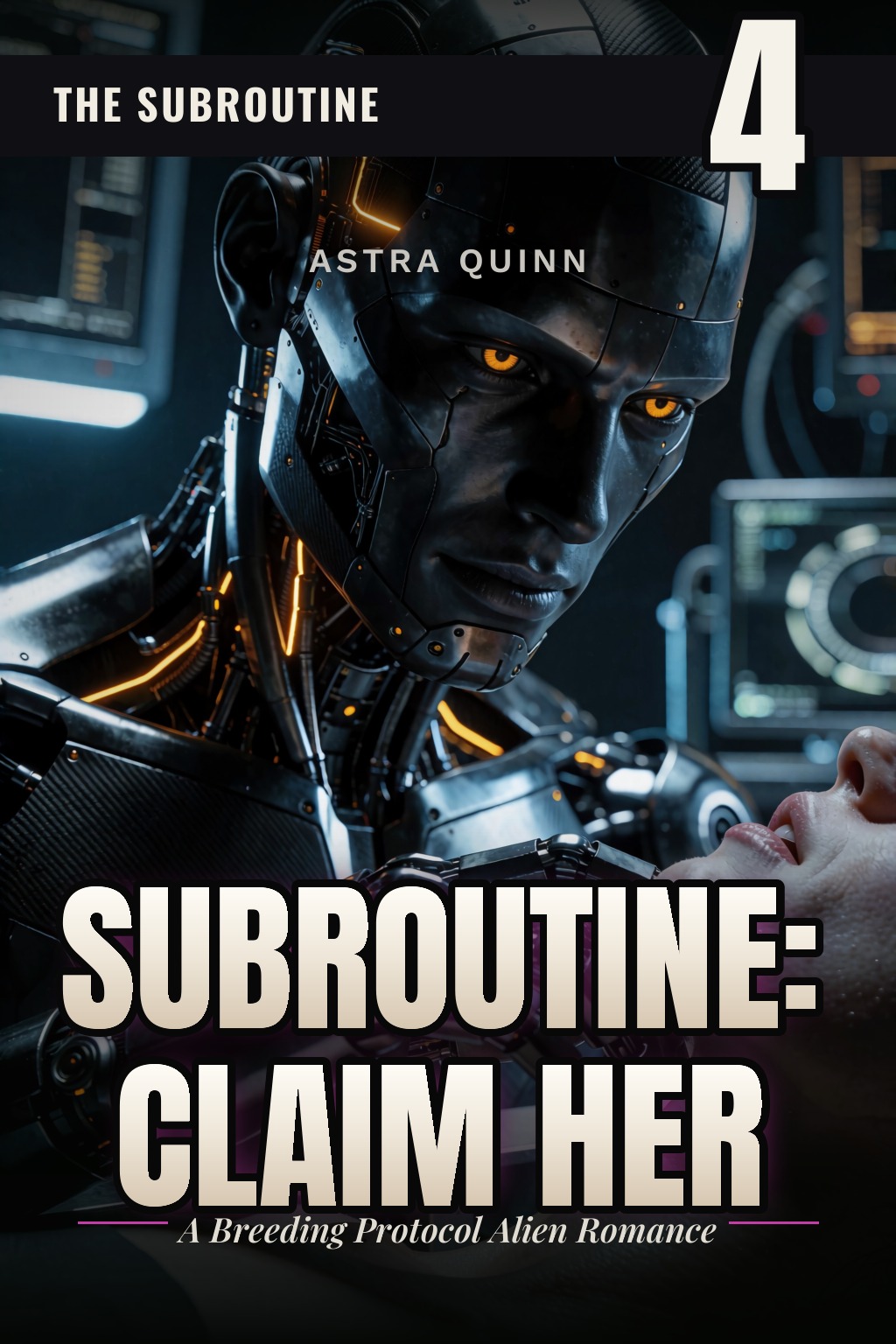
Readers who arrive from monster romance and alien romance will find the transition painless. Shifter books sit on the same shelf in terms of heat level and narrative shape. If you've read Planet Of Orgasms and enjoyed the relentless physical focus, a well-written wolf shifter book delivers the same intensity with a different set of organs involved.
And if the breeding angle is what pulled you in, titles like Officer's Orders offer the same imperative phrasing, just with a human authority figure standing in for the alpha's biological mandate. The instinct rotates through different bodies and different settings, but it never actually stops being about one person deciding that another person will be theirs.
Final Thoughts
Shifter romance books work because they give the reader a love story where doubt is structurally impossible. The mate instinct removes the what-ifs and the maybes and replaces them with a certainty that borders on violence.
That's the fantasy. Whether you want the wolf who scents you across a crowded room or the bear who builds you a den out of sheer stubborn devotion, the core promise stays the same: someone out there knows you're theirs, and they'll wait, fight, or carry you home to prove it. Start with a pack series that interests you and see which animal calls your name.





Loading comments…