
Soldier romance is a love story built around military service: one or both leads wear the uniform, and the relationship has to survive deployments, distance, injury, command structure, and the particular silence of someone trained not to flinch. The tension comes from outside the bedroom as much as inside it.
A soldier romance can be a slow-burn letters-across-an-ocean story, a scorching reunion between two people who haven't touched in fourteen months, or a quiet veteran narrative about a man relearning how to sleep in a bed that isn't a cot. The category holds all of it.
What separates soldier romance from war fiction with a love interest is simple: the romance is the point. The combat, the chain of command, and the trauma exist to pressure-test the relationship, not to replace it. The reader came for the love story, and the love story has to pay off.
What Soldier Romance Actually Means
The term covers a surprisingly wide range. At its core, a soldier romance features at least one protagonist who is active-duty military, reservist, veteran, or otherwise embedded in a martial world (a private contractor, a military medic, a defense analyst who deploys). The other lead is often, but not always, a civilian.
The name itself is loose. "Soldier romance" functions as an umbrella term in reader communities rather than a rigid subgenre label. Publishers have used "military romance," "military hero romance," and "military uniform romance" interchangeably for decades. The word "soldier" specifically tends to signal ground forces, Army or Marine, though readers apply it generously to Navy SEALs, pilots, and anyone who salutes.
Here's what counts, in practice:
- Active-duty deployment romance. The relationship is conducted across distance, through letters, video calls, or brief leave windows.
- Homecoming romance. The bulk of the story happens when the soldier returns, and the couple has to rebuild intimacy around someone who came back different.
- Veteran romance. The military service is in the past; the present is about PTSD, civilian reentry, employment, and learning to be a person again.
- Wounded warrior romance. Injury, amputation, burns, or traumatic brain injury drives the emotional and physical arc.
- Soldier falls for civilian. The most common pairing. A woman running a bakery in a base town, a therapist, a journalist, a sibling's best friend.
- Two soldiers. Fraternization rules, don't-ask-don't-tell era secrecy, or a shared deployment that forces proximity.
What doesn't count is worth naming too. A romance where a character has a military backstory that never surfaces again isn't soldier romance. A book where the love interest is a mercenary in a fantasy kingdom is adjacent at best; the category carries a specifically modern, real-world military texture. And a story where the soldier is a cardboard prop, present for the uniform and nothing else, may technically be in the subgenre but won't satisfy anyone who actually reads it.
A common misconception: that soldier romance is inherently conservative or jingoistic. In practice, the subgenre has a long progressive streak. Plenty of it is critical of war, of command, of the VA system, of what gets asked of young people who enlisted because they had no other option. The uniform is a setting, not a politics.
Another misconception: that soldier romance has to be dark. Some of it is. Some of it is warm, funny, and set entirely on a stateside base with a meddling sergeant and a dog. Tone varies wildly across the category.
Where Soldier Romance Comes From
The love story built around military separation is older than the paperback. Wartime correspondence culture in the 1940s created an entire genre of longing-by-mail that fed directly into mid-century romance publishing. The post-WWII years saw a wave of novels and films where the returning soldier had to win back the girl, or where the girl had to decide whether the man who came home was the man she married.
The modern soldier romance as a publishing category took recognizable shape in the 1980s and 1990s. Silhouette and Harlequin both ran military-themed lines and one-offs, usually featuring a Navy pilot or a Marine returning to a small town. These were short, focused, and often ended at the moment of reunion, with the homecoming kiss as the emotional climax.
Everything changed after 2001. Two prolonged wars produced a generation of readers with personal stakes, and authors responded with longer, more granular books about deployment cycles, combat trauma, and the particular bureaucratic hell of veterans' care. The Romance Writers of America added and then expanded military romance categories.
Independent publishing blew the category open in the 2010s, and the Kindle Unlimited era made serial soldier romance viable for authors who wanted to write a whole battalion, one hero per book. If you want the business side of that shift, the SmutWords breakdown of going wide versus Kindle Unlimited explains how the payout structures shaped what got written and how long it ran.
The wounded warrior variant grew up alongside the broader disability romance conversation. Twenty years ago, an injury was usually a plot device that got magically softened by love. Now, the better books treat recovery as ongoing, incomplete, and specific: prosthetics that need adjusting, a temper that flares without warning, sex that has to be renegotiated because the body changed.
A more recent shift worth tracking: women in uniform. Heroines who serve are no longer a novelty, and the best of these books don't flatten them into "one of the guys." They deal with the specific double-bind of being a female officer who has to be harder than everyone else and can't afford to be seen softening for anyone, which is exactly the pressure a love story can detonate.
How It Shows Up in Erotica
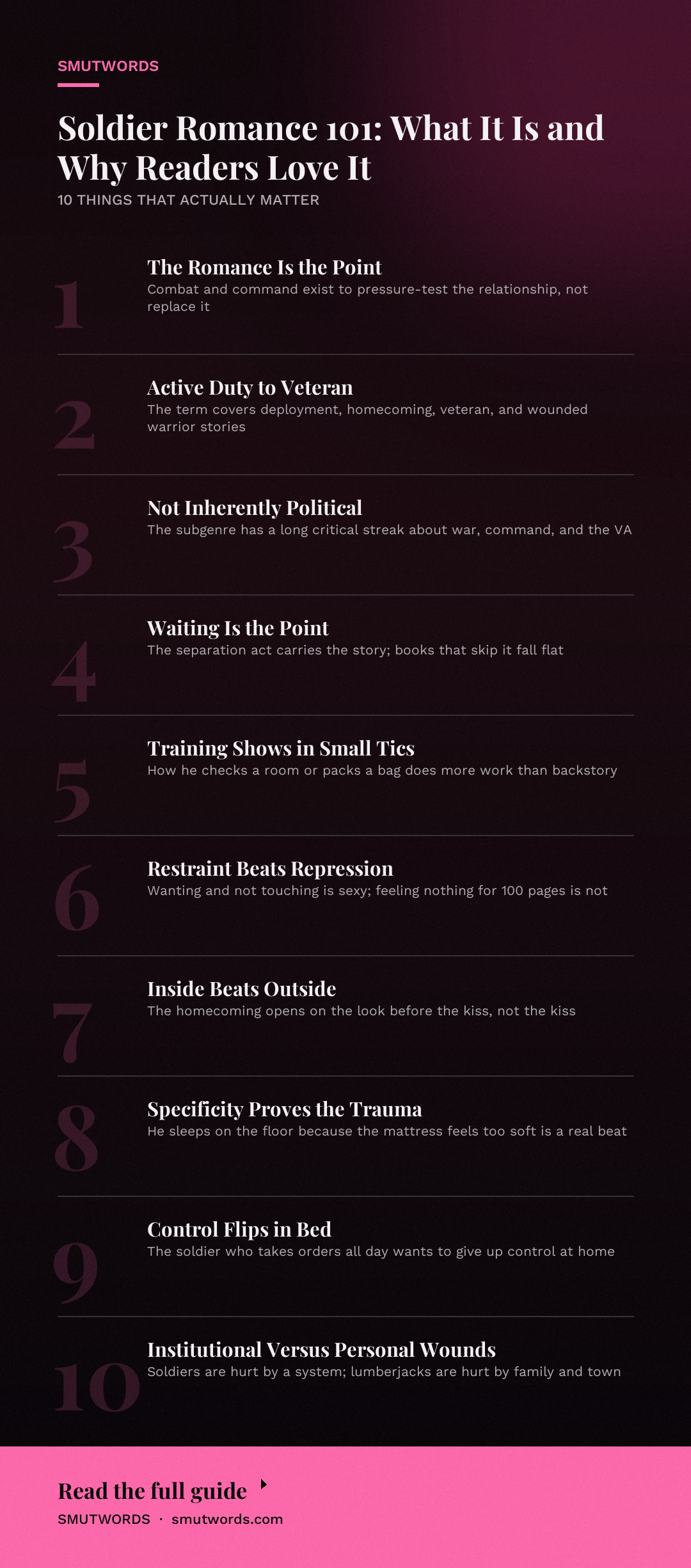
The craft of soldier romance lives in its structure. The category has a natural three-act shape: the meeting (often compressed, often during leave or in a deployment-adjacent setting), the separation (weeks or months of longing, frequently told through letters, texts, or a dual timeline), and the return (where the actual emotional work happens). Authors who skip the middle act tend to write flat books. The waiting is the point.
Strong soldier romance does specific things on the page:
- It uses physical detail to signal training. How a man checks a room when he enters it. How he wakes at 0400 without an alarm. How he packs a bag in four minutes. These small tics do more character work than a paragraph of backstory.
- It makes the body a site of both competence and damage. The same hands that field-strip a rifle shake when someone touches the scar tissue. The physicality of a soldier is erotic because it's controlled, and it's devastating because control is exactly what's been taken from him.
- It writes silence well. Soldiers in these books often don't talk about the worst thing. The love interest has to learn to read the not-talking. Dialogue scenes where one person refuses to answer and the other keeps asking are the emotional engine of half the subgenre.
- It relocates power. He can bench his bodyweight and he still can't make her stay. She can run a base clinic and she still can't stop him from reenlisting. The eroticism comes from the mismatch.
A strong soldier romance also knows the difference between restraint and repression. Restraint is a man who wants to touch a woman and doesn't because the timing isn't right. Repression is a man who can't feel anything until a plot event forces the dam open.
The first is sexy. The second is exhausting if it runs more than a hundred pages. Editors who handle a lot of this category will tell you the single most common fix is giving the soldier something he wants badly enough to break his own rules for.
Common variations, from most to least common:
- Soldier returns to small town. Usually paired with a second-chance or friends-to-lovers structure, since the pair often grew up together. If you like the slow familiarity of that dynamic, the SmutWords guide to friends to lovers covers the mechanics.
- Soldier on leave, time-limited affair. Compressed timeframe, high heat, usually bittersweet or full-happily-ever-after depending on how the author handles the goodbye.
- Deployed and separated. Dual POV, letters or video calls, frequently the most emotionally brutal variant.
- Wounded warrior recovery. Slow-burn, often with a caretaker arc. Physical therapy as foreplay, essentially.
- Two soldiers, forbidden. Fraternization rules, rank differentials, secrets kept from command.
- Soldier and the person he was assigned to protect. A close cousin of the protective hero trope, with the added pressure that the protection is literally his job.
The homecoming scene matters more than any other single scene in the category. A good one doesn't open with a kiss. It opens with the moment before the kiss, where both people are looking at each other and neither one is sure the other is real.
Enjoyed this? Get a free book.
Join the list and we will send a complete free story straight to your inbox, plus new releases every week after that. No credit card, no catch.
Authors who understand this can write a homecoming that lives in a reader's head for years. Authors who don't will write a homecoming that reads like an airport commercial.
Trauma gets handled well or badly, and the difference is usually specificity. "He had PTSD" is not a character beat. "He can't sit with his back to a door and he flinches at fireworks in July and he sleeps on the floor next to the bed because the mattress feels too soft" is a character beat.
The best books in the category have done their reading, or talked to someone who has, and they show it in the small things rather than the big dramatic ones.
Consent scenes in soldier romance tend to run hotter than average because the stakes feel heavier. A soldier who has spent months in a chain of command where he takes orders all day is often written as someone who wants to give up control in bed. The inversion is the point. He's in charge of everything else; he doesn't want to be in charge here.
That dynamic is a big part of why the category has crossover with reader communities who like power exchange, even when the book itself doesn't label it that way.
One note for readers who want the darker end of the spectrum: soldier romance occasionally intersects with tropes like a soldier who comes home obsessed. The SmutWords glossary entry on stalker romance covers what's happening in those books, and it's a different category with a different contract with the reader.
Soldier Romance vs Lumberjack Romance
These two get confused more often than you'd think, because both feature a physically imposing man with a difficult past and a tendency to communicate in grunts. The reader who liked one will often be told to try the other. Sometimes that works, sometimes it doesn't.
The reliable difference is the source of the damage. A soldier's wounds are institutional: they were inflicted by a system that asked him to do something and then sent him home without a plan for the aftermath. A lumberjack's wounds tend to be personal or familial: a dead wife, a family falling-out, a town he left and can't quite come back to.
Soldier romance is about reentry into civilian life after a government-issued rupture. Lumberjack romance is about solitude as a chosen state and the slow intrusion of another person into it.
Practically, that means soldier romance tends to have more plot machinery: deployments, base politics, VA appointments, a squad of secondary characters. Lumberjack romance is quieter, more insular, and usually set in one location for the entire book. Both are valid. They scratch different itches.
If you like the soldier's rigid competence and the way it comes apart in bed, lumberjack romance has a version of that. If you specifically want the deployment structure, the letters, and the homecoming, that's soldier romance and nothing else quite replaces it.
Frequently Asked Questions
What is soldier romance in books?
It's a romance subgenre where one or both leads serve in the military, and the relationship is shaped by deployment, duty, injury, or the transition back to civilian life. The love story is central; the military setting provides the pressure that tests it. It overlaps with military romance, veteran romance, and wounded warrior romance to the point where the labels often get used interchangeably.
Is soldier romance the same as military romance?
Mostly, yes. Military romance is the broader publishing category label; soldier romance is the more common reader term, and it usually implies ground forces rather than Navy or Air Force. In practice, books get shelved under both, and readers searching either term will find the same list.
Why is soldier romance so popular?
It combines two very reliable reader pleasures: a competent, physically capable man who is emotionally locked down, and a love interest who is the only person he opens up to. The fantasy isn't the uniform. It's being the one person who gets past the training. There's also a real appetite for stories that take trauma seriously and still end in a happy, functional relationship.
What's the difference between soldier romance and wounded warrior romance?
Wounded warrior romance is a variant of soldier romance where physical or psychological injury is the central conflict. In a standard soldier romance, the service is the stressor. In wounded warrior romance, the recovery is the story, and the couple has to build a relationship around a body and mind that have changed in ways neither of them planned for.
Does soldier romance always have a happy ending?
In the traditional romance genre sense, yes: most soldier romance ends in a committed, hopeful relationship, even when the road there includes loss. Some indie and dark-romance-adjacent entries subvert that, but the category convention is a hard-won happily-ever-after. Reader reviews will tell you fast if a book breaks that contract.
Where can I find soldier romance that handles trauma respectfully?
Look for authors with a note in the front matter about research or sensitivity readers, and check reviews from readers with military connections. Specificity is the tell: books that name real details about recovery, prosthetics, or VA bureaucracy tend to be the ones that did the work. Books that use trauma as a shortcut to drama usually don't.
Can soldier romance have a female soldier as the lead?
Yes, and it's a growing slice of the category. The best of these books deal directly with the double bind of a woman in a male-dominated command structure, including the way any visible softness becomes a liability. The romance often becomes about finding one person she doesn't have to perform strength for.
Final Thoughts
Soldier romance keeps producing bestsellers because it's fundamentally about a person who was trained not to need anyone, learning to need one specific person anyway. That's a durable engine, and when it's written with real specificity about what military service does to a body and a marriage, it lands harder than almost anything else in the genre.
If you want the version that gets the homecoming right, start with a wounded warrior romance set in a small town where the heroine already knows the hero from before. The gap between the boy she remembers and the man who came back is where the whole category lives. Pick one, and let the waiting do its work.





Loading comments…