
Sounding is a BDSM practice in which a thin, smooth rod called a sound is inserted into the urethra, usually the penis, sometimes the vagina, and in some scenes a constructed or healed piercing opening. The rod slides down the urinary channel. In fiction the act gets written as extreme edge play: clinical, controlling, and intimate at a scale the body almost never experiences.
If you landed here from a scene that left you curious or unsettled, this guide covers what sounding actually means, where the trope came from, and how authors make it work on the page.
What Sounding Actually Means
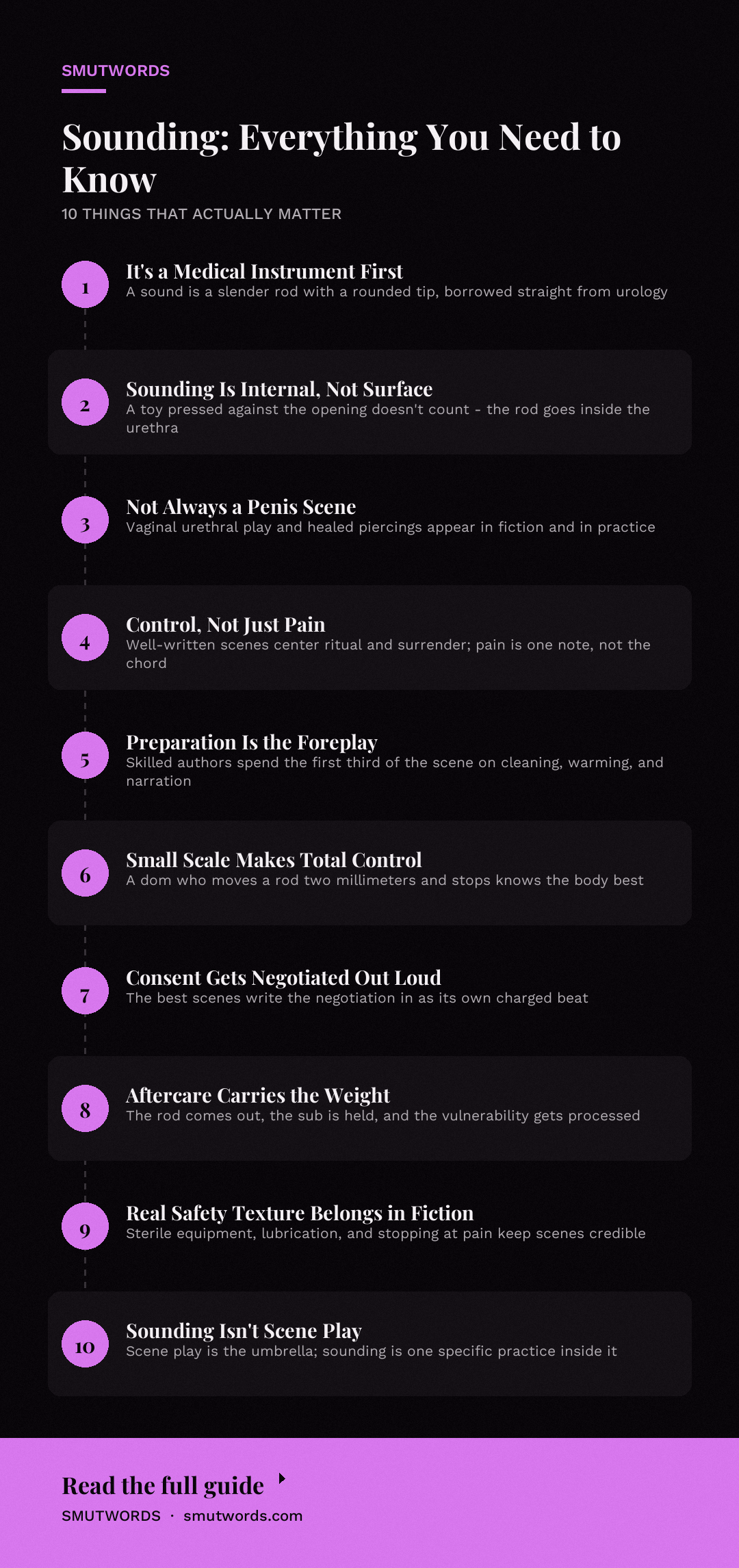
The name comes from the medical instrument, not from noise. A sound (also called a dilator or urethral sound) is a slender rod, historically metal, with a rounded tip designed to pass into the urethra without scraping tissue. In clinical settings, sounds and catheters check for strictures, drain the bladder, or dilate a narrowed channel. In kink, the same hardware gets repurposed for sensation, surrender, and control.
Sounding sits in the same family as catheter play and dilator play, and the terms overlap in erotica. What counts as sounding is specifically the insertion and movement of a rigid or semi-rigid rod into the urethra.
Catheter play usually implies a flexible tube and a drainage or fluid angle. Urethral stretching is the subset where the channel is gradually worked to take a larger diameter. Some authors use all four terms interchangeably in a single scene.
What does not count: penetration of the meatus with a fingertip, a toy pressed against the opening without insertion, or anything that stays outside the body. Sounding is an internal practice, and that is the source of both its taboo charge and its real-world risk.
Common misconceptions
- That it is always a penis scene. Urethral play on the vagina (the short female urethra) exists in fiction and in real practice, and some scenes involve constructed openings or healed piercings.
- That it is purely about pain. Most well-written sounding scenes center control, ritual, and unusual sensation. Pain is one possible note, not the whole chord.
- That it is safe because it is "medical." Medical hardware does not make a scene clinical or safe. Sterility, lubrication, and consent do that work.
- That it is a modern internet kink. Urethral instrumentation is centuries old. Its erotic framing in print is what is relatively new.
Where Sounding Comes From
The device has a long clinical history. Urethral sounds appear in surgical and urological texts going back well before the twentieth century, used for stricture treatment and bladder access. The shape we picture now, a curved rod with a bulbous tip, is a medical design. Kink borrowed it wholesale, which is why sounding scenes in erotica so often carry a medical-play flavor whether the author intends it or not.
The term's life in erotic publishing is shorter and more scattered. Urethral play shows up in twentieth-century underground and fetish publishing, in medical fetish zines, and in the niche corners of BDSM nonfiction manuals from the 1970s onward, usually as a brief warning-heavy entry in an encyclopedia of practices. Mainstream romance and erotica mostly ignored it until the self-publishing boom of the 2010s, when dark romance and hard BDSM authors started writing edge practices that traditional publishers would not touch.
Then the framing shifted. Older fetish writing treated sounding as a clinical curiosity or a shock-value gag. Contemporary erotica treats it as a trust ritual: the sub is opened at the smallest possible scale and watched while it happens.
That reframing moved the practice from the "extreme practices" appendix into the emotional center of full-length dark romance and BDSM novels. It is now a recognizable trope with its own scene beats, not a footnote.
The genre history is also a publishing history. Readers who want this content search for it by name, which means authors who write it well get discovered through the term itself. Sounding scenes have become a signature move for writers building a reputation for genuine edge play and for the medical-play crossover audience.
How It Shows Up in Erotica
A sounding scene on the page is usually built like a ritual, and the ritual is the point. The rod is chosen, cleaned, warmed, lubricated. The dom narrates what is about to happen.
The sub is positioned, often restrained, and the first contact is written in slow motion. Skilled authors spend the first third of the scene on preparation because preparation is the foreplay: the reader watches the sub get opened, not just penetrated.
The sensation gets written as something the sub has no vocabulary for, which is a gift to a writer. Sounding produces a feeling that is not quite pain and not quite pleasure, a deep internal pressure with an electric edge. Authors lean on that ambiguity, letting the sub's reaction shift from alarm to stillness to something like awe. The strongest scenes resist naming the feeling too early.
Scale is the other engine. Everything in a sounding scene is small: one rod, one channel, a few centimeters of movement.
That smallness makes the control total. A dom who can move a rod two millimeters and stop knows the sub's body better than the sub does. That is the fantasy, and it is why sounding pairs so well with anticipation play, where the wait and the threat carry as much charge as the act.
Common variations authors use
- Medical play framing. The scene is staged as an examination. Gloves, a tray of instruments, clinical language, a dom playing doctor with total authority. The medical props do the work of making the sub's body a subject of study.
- Ownership and testing dynamics. The dom uses sounding to prove the sub can hold still under something extreme, and the sub's obedience becomes the emotional payoff. This variant leans on degradation and praise in alternation, a pairing worth reading up on in its own right via degradation kink.
- Graduated stretching. The scene moves through progressively larger sounds, and the pacing becomes the plot. Each size is a threshold, and the sub's willingness to take the next one is the story.
- Restraint and sensory deprivation. The sub is bound and blindfolded so the only input is the rod. Authors use this to heighten the internal sensation and the sub's helplessness.
- Aftercare as the emotional resolution. The scene ends with the rod removed, the sub held, and the vulnerability processed. This is where sounding scenes earn their emotional weight.
What separates a strong sounding scene from a flat one is specificity and consequence. A flat scene describes insertion and reaction and stops there. A strong scene details the equipment, the sub's physical state, the dom's attention, and what the experience does to the relationship afterward. The reader needs to feel the sub's heart rate, the temperature of the metal, the sound of the dom's voice giving instructions.
Enjoyed this? Get a free book.
Join the list and we will send a complete free story straight to your inbox, plus new releases every week after that. No credit card, no catch.
Consent shows up in the best scenes as an active, spoken exchange, not an assumed backdrop. The consent negotiation is often written into the scene as its own charged beat: the dom naming what will happen, the sub agreeing, the safeword confirmed. Authors who skip that beat produce scenes that read as reckless rather than intense.
Real-world practice matters here because readers do search these scenes for information, and authors who write sounding responsibly include the safety texture even in fiction. In real practice, sounding carries genuine infection, tearing, and urinary-tract risks. It calls for sterile equipment, generous lubrication, a clear safeword, and stopping at any sign of pain or bleeding. A scene that ignores those realities reads as naive to experienced readers and dangerous to newcomers.
Aftercare deserves its own paragraph because sounding scenes live or die on it. The sub has been opened somewhere intensely private, and the physical aftermath includes tenderness, possible soreness, and emotional rawness. Authors who write good aftercare borrow the beats of impact play aftercare: warmth, checking in, slow return to the ordinary. The difference is the tenderness is aimed at a much more vulnerable place.
The medical-play crossover is worth naming because it changes how a scene is read. When the dom wears gloves and speaks in clinical terms, the scene draws on the same charge as a milking table scene: the sub is positioned, examined, and handled by someone with total authority over a body that has been reduced to a subject. That is a distinct kink with its own audience, and sounding sits comfortably inside it.
Sounding also pairs well with orgasm control, because the dom can bring the sub to the edge and hold them there with a rod instead of a hand. The combination produces scenes where the sub's climax is entirely in the dom's hands, a favorite structure in dark romance. Authors who write both together get a double dose of surrender in a single scene.
One more craft note: the dialogue in a sounding scene carries unusual weight because the sub often cannot speak fluently while it is happening. Authors use short, broken lines from the sub and full, calm sentences from the dom. That contrast in speech rhythm does more for the power dynamic than any description of the rod itself.
Sounding vs Scene Play
Readers sometimes file sounding under scene play as if the terms were interchangeable. They are not the same category. Scene play is the umbrella: any negotiated, time-bounded kink encounter with a beginning, a middle, and an end. Sounding is one specific practice that can happen inside a scene.
The confusion is understandable because sounding scenes are so structured that the practice and the scene look identical on the page. The distinction matters for readers browsing for content: a book tagged scene play might contain anything from a wooden paddle scene to a sounding scene, while a book tagged sounding promises urethral play specifically. If you are searching for the practice itself, the narrower term is the better search.
The distinction matters for writers too. A sounding scene needs the same scaffolding as any scene play (negotiation, safeword, aftercare) plus the specific safety and ritual beats that urethral play requires. Getting the umbrella right and the practice right are two separate jobs.
Frequently Asked Questions
Is sounding safe?
It carries real risks of infection, tearing, and urinary-tract injury, and it is not a practice to improvise. Done with sterile equipment, generous lubrication, a clear safeword, and a willingness to stop at any pain or bleeding, it can be practiced with informed caution. Anyone considering it in real life should research thoroughly and treat medical-grade hygiene as non-negotiable.
What does sounding feel like?
Readers and practitioners describe a deep internal pressure that is neither pure pain nor pure pleasure, often with an electric or invasive edge. The sensation is unusual and intense because the urethra is densely innervated. Most descriptions emphasize the psychological charge as much as the physical one.
Why is sounding so popular in dark romance and BDSM erotica?
It combines total vulnerability with extreme control at a scale the body almost never experiences. The sub is opened and watched at their most private point, which reads as maximum surrender. Medical-play and discipline fantasies also fit naturally with the clinical hardware.
Can sounding be done on a vagina?
Yes. The female urethra is short and can be sounded, and some erotica includes it as a variant. It is less commonly written than penile sounding but appears in medical-play and hard BDSM scenes. The same safety principles apply.
What is the difference between sounding and catheter play?
Sounding uses a rigid or semi-rigid rod for sensation and stretching, while catheter play uses a flexible tube often for drainage or fluid play. The two overlap in erotica and are sometimes used interchangeably. Authors usually pick the term that matches the hardware in the scene.
What should I look for in a well-written sounding scene?
Preparation, specificity, and consequence. The best scenes detail the equipment and the sub's physical state, include active consent negotiation, and show what the experience does to the relationship afterward. Scenes that skip preparation and aftercare read as flat or reckless.
Final Thoughts
Sounding turns the smallest possible penetration into the largest possible act of trust, which is why it has become a signature move in edge-play erotica. If you want a book that does it with real craft, start with one that treats the rod as a ritual rather than a shock prop, and read the aftercare closely. That is where the scene proves whether it earns the intensity it asked for.





Loading comments…