
Orgasm control is a kink in which one person decides when, how, or whether another person gets to come. The controlling partner might delay a climax for hours, grant it only on request, refuse it outright, or wring one out by force. The person on the receiving end hands over something genuinely intimate: the timing of their own body.
In erotica, orgasm control is a pressure device. It keeps a scene running long past the point where a standard sex scene would have ended, and it turns every touch into a negotiation about permission.
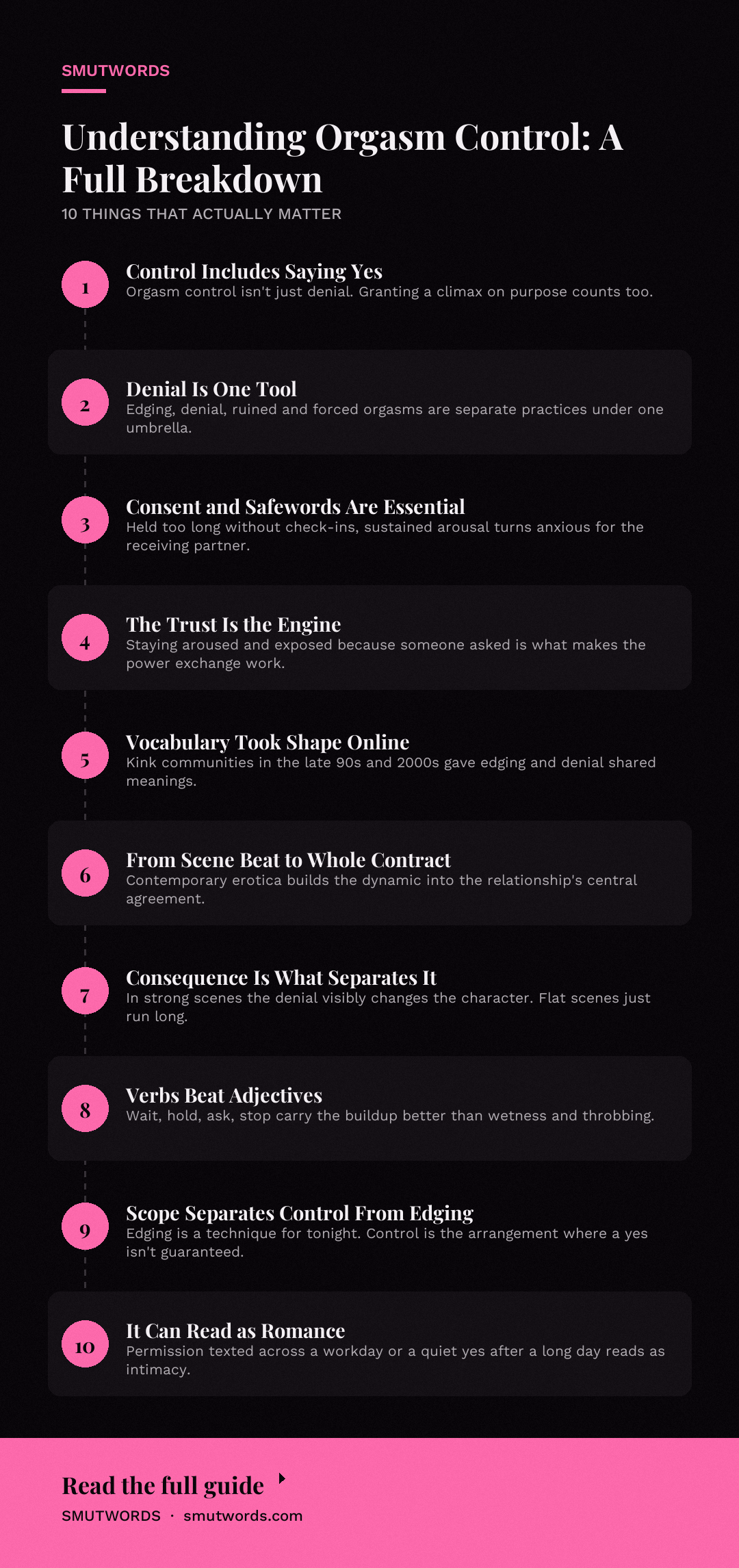
What makes it a durable trope is the trust underneath the tension. Someone is staying aroused, uncomfortable, and exposed because another person asked them to. That exchange of power is the engine, and everything else (the rope, the timer, the command) is just machinery bolted onto it.
What Orgasm Control Actually Means
The term covers a family of practices rather than one specific act. At the center is a simple arrangement: the person in control sets the terms of climax, and the other person follows them. The arrangement can last twenty minutes or three months. It can be playful, severe, domestic, or ceremonial.
Where the name comes from is straightforward: control over orgasm, held by someone other than the person having one. The common misconception is that orgasm control means denial. Denial is one option among several, and plenty of orgasm control scenes end in a climax that the controlling partner hands over on purpose. Control includes saying yes.
Here is the clearest way to sort what counts and what doesn't:
- Edging: bringing someone to the edge of orgasm and stopping, repeatedly. The climax is delayed, not forbidden, and the delay is the point.
- Orgasm denial: refusing climax outright for a set period. A night, a week, a whole arrangement with no end date.
- Ruined orgasm: the receiving partner is allowed to peak but stimulation stops at the exact moment of release, killing the good part. Deliberate, frustrating, often humiliating in a way readers enjoy.
- Forced orgasm: the receiving partner is made to climax, or made to climax again, past the point where they would have chosen to stop. Overstimulation is the tool.
- Permission rituals: asking before coming, and waiting for a yes. The verbal layer that can be bolted onto any of the above.
- Tease and denial: a long-form version that mixes all of the above across days or weeks, usually measured in builds and refusals rather than single scenes.
What doesn't count: anything the receiving partner can end at any time without consequence isn't really orgasm control in the sense the kink means. And a partner who ignores a safeword isn't practicing control; they're assaulting someone with extra steps.
Clear negotiation and a safeword are essential to this dynamic, because sustained arousal is mentally taxing for the person being controlled. Held too long without check-ins, it curdles.
Real-world scenes around orgasm control can look like anything from a couple testing edging for one evening to a long-distance arrangement where permissions are granted by text. The sustained mental load means most practitioners build in breaks, aftercare, and check-ins. Erotica rarely shows the check-ins, but the good books imply them.
Where Orgasm Control Comes From
Orgasm control has been a recognizable feature of erotic writing for well over a century, though the vocabulary has shifted. Victorian and Edwardian erotic texts played with denial as punishment and delay as moral discipline, often framed in religious or medical language. The kink was there; it just dressed in robes. As explicit publishing loosened through the twentieth century, denial started appearing as its own pleasure rather than a punishment from a stern authority figure.
The bigger shift happened in the late nineties and 2000s, when internet kink communities popularized terms like edging and tease and denial and gave them shared, searchable meanings. Erotic fiction picked that vocabulary up fast. What came next was structural: the orgasm control scene grew from a single hot sequence to a plot that could stretch across an entire novel.
The publishing-side shift is worth naming clearly. Early erotica often used denial as a punishment beat inside a larger power exchange. The scene would be a scene: someone is refused, learns their lesson, gets their reward.
Contemporary erotica moved orgasm control into the architecture of the relationship itself. The dynamic becomes the central agreement of the book, with the romance plot built on top of it.
This mirrors how other kinks graduated from set pieces into full structures. Shibari moved from illustrating restraint into becoming its own aesthetic language; voyeurism became a plot engine in the voyeur husband trope. Orgasm control followed the same path, from a scene-level beat to a whole contract.
Another honest historical note: one night stand stories rarely carry orgasm control, because the kink needs a recurring relationship to mean anything. The late-night, first-time hookup can include a delay, but the trust dynamic takes time to build. Most orgasm control fiction is about established or ongoing relationships, even if the relationship is only a few weeks old by page fifty.
If you want a sense of how a first-time kink event handles negotiation and check-ins in practice, our guide to your first play party covers the same trust machinery orgasm control runs on.
How It Shows Up in Erotica
On the page, orgasm control is a tension machine, and writers who use it well treat the tension as the product. A scene is not about the orgasm; it's about everything leading up to it. The delay is the point. The book has to keep that delay interesting without letting it flatten into a single repeated beat.
The strongest scenes do a few things at once. They give the reader a physical timeline (how long, how many times, where on the body the pressure is building), they put the controlling partner's voice in the room, and they show the receiving partner's internal experience getting incrementally harder to manage. Three steady lines of information running at once is what keeps a long denial scene from getting boring.
Common variations authors use, and what each one does well:
- Flat-rate denial: a set number of refusals. Clean, easy to structure, and it gives the reader a countdown they can feel. Weak versions just repeat the same beat without escalation.
- Permission-based: the submissive has to ask, and asking is humiliating or erotic or both. This works when the asks get more desperate across the scene.
- Ruined orgasms stacked: repeated ruined climaxes build a specific kind of sexual anguish. This is a workhorse trope for high-heat scenes.
- Forced orgasms after denial: the reward becomes punishment. Useful when the writer wants to make a soft-domme scene mean something harder.
- Orgasm control across time: days or weeks of tease and denial, with permission granted remotely. This is where the trope turns into plot and can carry a full novel.
- Denial with a public edge: the receiving partner is denied while in public, and has to function. This pairs well with any book that already uses a voyeur husband or any public-facing dynamic.
What separates strong orgasm control writing from flat writing usually comes down to consequence. In a good scene, the denial changes the receiving partner in some visible way. They get clumsier, more pliant, more reckless, or more honest.
Enjoyed this? Get a free book.
Join the list and we will send a complete free story straight to your inbox, plus new releases every week after that. No credit card, no catch.
The book should show that change on the page. A flat scene just announces that the character is desperate and moves on to the next beat.
Language choices matter more than usual here. The best orgasm control scenes are careful with verbs (wait, hold, ask, stop, ruin, hold still) and stingy with adjectives. The buildup does the work. Writers who over-decorate the language with wetness and throbbing lose the specific, controlled precision that makes the kink read as kink.
One structural strength of orgasm control is that it fits nearly any subgenre without being swallowed by it. It shows up in why choose romance as a way for the group to manage rivalries and establish who's in charge of what. It appears inside primal play when the chase ends in a held-off climax.
It anchors a use kink scene whenever the narrative wants to lean on being used past the point of comfort. It can even sit inside a makeup sex scene as the slow-burn version of the reconciliation. For a kink that lives on withheld permission, the sharing kink read is a natural neighbor: both hinge on someone else holding the decision.
The pairing that's often underrated: orgasm control plus blindfold play. When the receiving partner can't see, the surprise of a stop or a granted climax gets a lot sharper. The two kinks share an assumption that the controlling partner is paying careful attention, which is what makes both feel intimate rather than random.
Narrators matter too. First person from the submissive's side is the workhorse POV for this kink, because the whole appeal is interior experience, and interior experience is hard to deliver in third person without getting stiff. First person from the dominant's side is rarer and can be devastating when done well: being in the head of the person who is choosing to grant or withhold turns the scene into a study in restraint.
What to look for if you want to write it well:
- Set the arrangement early. Even a single-scene denial is stronger when the reader already knows the terms.
- Make the safeword visible on the page or acknowledge its absence. The best writers do this without breaking the mood.
- Give the receiving partner interior time. They're not just a body in the scene; they're the point of view the reader is buying.
- Let the denial cost something. A character who can smile through it has no stakes.
- Earn the climax. Even the cruelest book needs a release valve. If the climax is withheld, the resolution has to be somewhere else.
- Aftercare, implied or shown. The reader's trust in the book comes from the certainty that the dynamic is held safely, even when the character's experience in the scene is intense.
Orgasm Control vs Edging
These two get confused constantly, and the confusion is real because edging is orgasm control's most common form. The distinction is scope. Edging is a specific technique applied to a specific session: bring someone close, stop, repeat. Orgasm control is the umbrella arrangement that edging often serves.
A useful test: if the climax is eventually going to happen tonight and the fun is in getting there, you're reading edging. If the climax may or may not be granted, and the uncertainty itself is the kink, you're reading orgasm control. Books that mix both tend to be the best kind, with a long edging buildup that ends in a permission or refusal the reader couldn't have predicted.
For readers who want the mechanics without the relationship, standalone one night stand stories usually use edging rather than full orgasm control. It's short-form. Orgasm control needs time to develop, which is why it usually lives inside a longer slow burn.
Frequently Asked Questions
Is orgasm control safe in real life?
Yes, with negotiation and a safeword, but the load is real. Denial can create genuine anxiety and physical discomfort if it runs too long, and the mental weight of being held at high arousal matters. Most practitioners prefer to check in often and keep the control time-limited rather than open-ended.
What is the difference between orgasm control and orgasm denial?
Denial is one tool inside control. Control decides when and how someone gets to climax. Denial is the specific choice to say no. Plenty of orgasm control scenes include no denial at all because the controlling partner grants the climax on purpose.
Is orgasm control always dominant/submissive?
Not always. There are switchy and playful versions, and plenty of couples who wouldn't identify as D/s enjoy edging and permission games as pure novelty. The dynamic can be intense or light, and the label doesn't have to come with a whole lifestyle.
Why do readers like forced orgasm scenes?
The forced version flips the emotional angle. Denial is about being held back; forced orgasms are about being pushed past what the character would have chosen. Both are ways of taking the climax out of the character's hands, and both deliver the same core appeal: the surrendering of control over their own body.
What makes a good orgasm control story instead of just a long sex scene?
Consequence and change. The character on the receiving end should be different by the end, more honest, or more pliant, or more exposed, than they were at the start. The scene needs stakes beyond the physical. A weak scene just runs long; a strong one earns its length.
Can orgasm control be romantic?
Frequently. The whole kink runs on trust, and the version that reads softest is often the domestic one: permission texted across a workday, a hand on a knee in public, a quiet yes or no after a long day. Some of the most romantic contemporary erotica uses orgasm control as a language for intimacy rather than dominance.
Final Thoughts
Orgasm control earns its following because the payoff is psychological. The body gets used as a clock, and the person holding the clock is trusted completely. That combination writes itself once you have the right character dynamic, which is why the kink keeps turning up in books that are billed as romance but reach further than the category usually allows.
If you want to read one of the best-executed versions of it, start with a contemporary that runs the tease and denial across the whole book rather than a single scene, so the permission structure is already load-bearing when the first real denial lands. That is the version of this kink that sticks to your ribs.





Loading comments…