
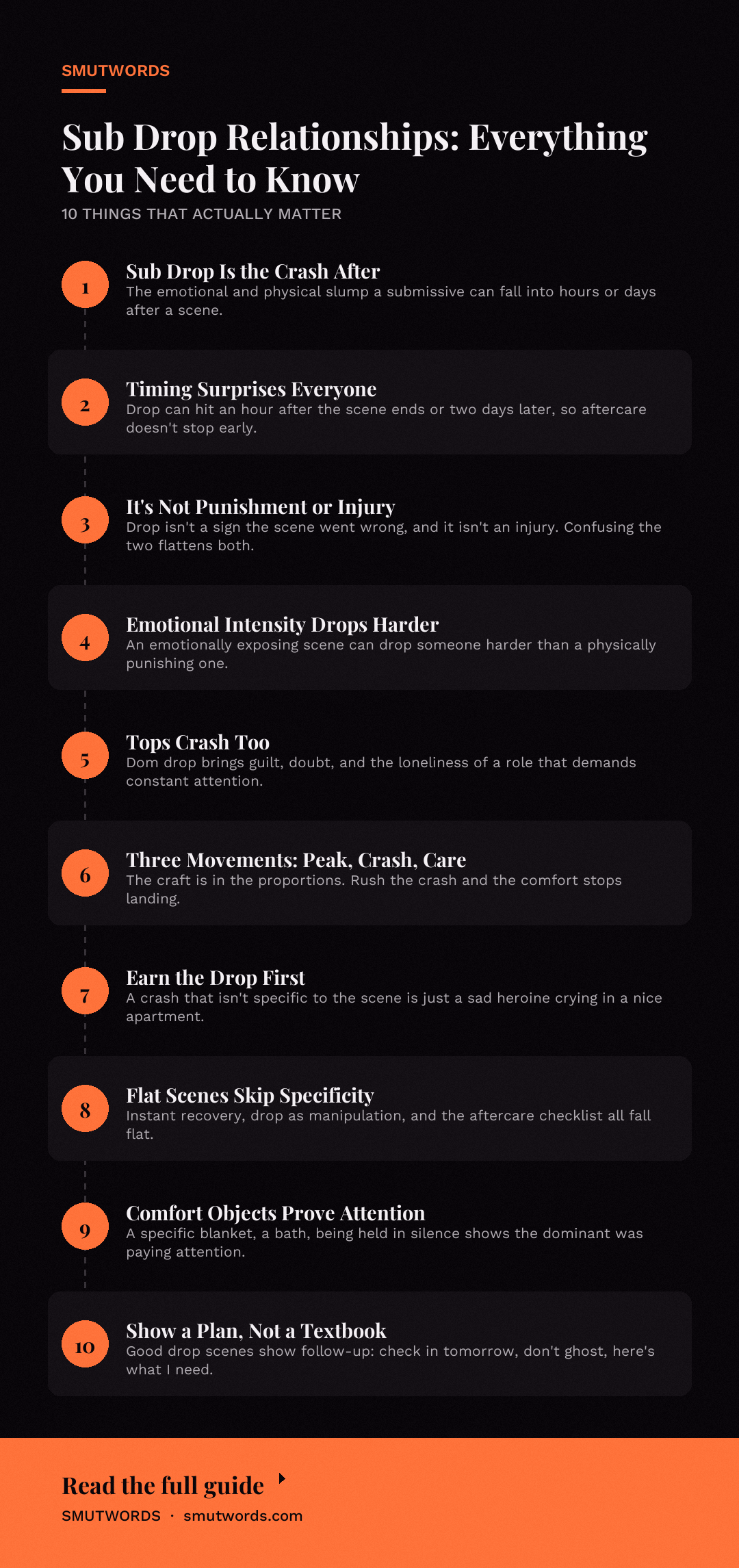
Sub drop is the crash that comes after the high. It's the emotional and physical slump a submissive can fall into hours or even days after an intense scene, a stretch of submission, or the sustained rush of a dynamic.
In real life it's a documented, manageable part of kink practice with a plan attached. On the page, sub drop is one of the most reliable engines in erotic romance: the moment the powerful, wanted submissive goes raw and needy, and the dominant's tenderness in that window becomes the proof of love the whole book has been building toward.
If you've ever finished a scene in a book and felt the floor tilt under the characters, you've met it. Sub drop is where hurt/comfort stops being a tag and becomes a plot. It's also where a lot of authors get it wrong, treating the crash as automatic or as a convenient excuse for a grand gesture. This guide covers the real thing, the fictional thing, and the wide gap between them.
What Sub Drop Actually Means
The name is plain. A submissive drops. After the neurochemical flood of a scene (endorphins, adrenaline, the floaty dissociation people call subspace), the body comes back down, and the landing can be rough. The drop is the gap between the peak and the return to baseline, and it isn't always gentle.
What it looks like on the ground: sadness with no obvious cause, flat exhaustion, irritability, anxiety, tears, a hollow or lonely feeling, self-doubt, sometimes shame. Physical symptoms show up too, including chills, headaches, and a bone-deep tiredness.
The timing is what surprises people. Drop can hit an hour after the scene ends or two days later, which is why a scene's aftercare doesn't stop when the toys go in the drawer.
What sub drop is not matters just as much. It isn't a punishment, a sign the scene went wrong, or evidence the submissive is too fragile for the dynamic. It isn't the same as an injury, either, and confusing the two flattens both.
Drop also isn't the exclusive property of submissives. Tops crash too, and that has its own name.
The vocabulary you'll see in the wild
The community and the fiction share a shorthand. You'll run into these terms in author's notes, content warnings, and reader group threads:
- Sub drop / subdrop: the standard term for the submissive's crash.
- Post-scene crash or post-scene drop: the clinical-ish phrasing, common in discussion of timing.
- Drop drop: affectionate shorthand for the same thing.
- Top drop or dom drop: the dominant's version, often guilt, doubt, or a hard emotional landing after topping.
- Subspace hangover: the specific foggy, tender state after coming out of subspace.
- Sub frenzy: a different animal entirely, an overeager compulsion to scene constantly, usually early in a dynamic. Not a drop. Don't swap them.
- Crash and aftercare: a scene-structure label, meaning the book spends real page time on the come-down.
The most common misconception is that drop requires a brutal scene. In practice, an emotionally intense scene can drop a submissive harder than a physically punishing one, because the emotional exposure runs deeper. A first time in a new dynamic can drop someone too, even a scene that reads as gentle from the outside. Intensity is in the nervous system, not the flogger.
Where Sub Drop Comes From
Sub drop as a named phenomenon is a child of the modern kink community's emphasis on aftercare, and its migration into fiction tracks the rise of negotiated-scene romance. The term itself (along with top drop and sub frenzy) spread through community writing, workshops, and forum culture in the late 1990s and 2000s, as the language of risk-aware consensual kink solidified into a shared safety vocabulary.
The point of naming it was practical: if you know the crash is coming, you can plan around it.
The fiction timeline is separate and worth tracking on its own. Erotic romance spent decades offering dominance as fantasy without aftermath, the scene ending on the high. The aftercare beat arrived as a publishing phenomenon in the 2010s, driven by readers who wanted the tenderness written out rather than implied. Once readers had tasted the quiet chapter after the intense one, the crash and care structure became a trope in its own right, with its own fan expectations.
By the 2020s it had settled into recognizable shapes across subgenres. Omegaverse romance built it into the biology, and if you want the mechanics of that universe, the guide to Alpha/Beta/Omega Dynamics covers how heats, ruts, and drops interlock.
The knotting-heavy Pack Mates Romance subgenre leans on drop for its best comfort scenes, and so do the smaller, stranger niches: a kraken heroine's scene can drop her just as hard in kraken romance, and authors writing merman romance have found that a cold-blooded partner's careful handling of a crashing submissive is a shortcut to reader tears.
Two evolutions matter. First, drop moved from the final chapter to the middle of the book, which meant it had to generate plot rather than closure. Second, the top's own drop got written into the story, so the comfort goes both directions and the dynamic looks healthier for it. A third shift is still in progress: authors now write drops that a dominant handles imperfectly, and the repair becomes the emotional work of the scene.
How It Shows Up in Erotica
Sub drop in fiction is a scene structure with three movements: the peak, the crash, the care. The craft lives in the proportions. Spend too many pages at the peak and the crash feels like a footnote. Rush the crash to get to the sweet comfort and you lose the sting that makes the comfort land.
The strongest versions earn the drop. The scene establishes what the submissive risked, the specific exposure that leaves them unguarded when the rush fades, and then the crash cashes out that risk. A crash that isn't specific to the scene is just a sad heroine crying in a nice apartment. Readers can feel the difference immediately.
Variants authors actually use
The trope has recognizable shapes, and each one uses the drop for different emotional work:
- The delayed hit. The scene ends, the lovers are happy, then the crash arrives a day later and the submissive is alone. Maximum loneliness, maximum payoff when the dominant shows up.
- The first-scene drop. New partners, new dynamic, and the crash tests whether this person is actually safe. The dominant's attentiveness here decides the whole relationship.
- The dom drop mirror. The dominant crashes, flooded with guilt or doubt over how hard they topped. The submissive comforts them, and the power balance wobbles in a way that reads as love.
- The ignored drop. A submissive's needs go unaddressed, the reader knows the dominant failed, and the repair carries the next arc.
- The drop as turning point. The crash forces a confession, a collar discussion, or a first real conversation about what the dynamic means. The guide to a ritual collaring ceremony is worth reading if your drop scene ends with a commitment question, because the timing has real weight.
Non-human partners get their own flavor. A four-armed alien in alien breeding trope novels can physically wrap the submissive up in a way human comfort can't match, and dinosaur-shifter authors use a partner's size and heat to make the aftercare scene feel elemental. If your tastes run there, the dinosaur romance niche does this with surprising care. Fantasy authors writing elf romance tend toward long-lived, patient dominants whose calm is a deliberate contrast to the reader's own racing heart.
Enjoyed this? Get a free book.
Join the list and we will send a complete free story straight to your inbox, plus new releases every week after that. No credit card, no catch.
The comfort object matters, too. A specific blanket, a drink of water, a bath, being held in silence. The detail proves the dominant was paying attention before the scene, and readers reward that. Two related readings that sharpen the craft: the breakdown of feet worship vs leg fetish shows how tiny somatic details carry emotional weight, and the guide to possessiveness kink is useful if your dominant's care tips into ownership language during the drop.
What makes it flat
Three failure modes show up again and again. The first is instant recovery, where one hug and a line of dialogue dissolve the crash. Emotions don't resolve that way, and readers feel the cheat.
The second is drop as manipulation, where the submissive crashes to force a confession or a gift. It strips the trope of its honesty. The third is the aftercare checklist, where the dominant runs through water, blanket, snack, callback in a way that reads like a form being filled out. Ritual is good; a checklist is dull.
The fix for all three is specificity. Give the crash a texture that belongs to this submissive and this scene. Let the dominant fumble. Let the comfort arrive late.
That gap, the interval where the submissive is vulnerable and the dominant hasn't yet proven themselves, is where the reader's whole nervous system lives. A strong version of the trope knows that the drop is what tests the promise the dominant made during the scene.
There's also a real-world responsibility to mention here, because readers of this stuff are often also people in it. Good drop scenes show a plan: check in tomorrow, don't ghost, here's what I need. Fiction doesn't have to be a textbook, but a scene that ends with a submissive left alone and no follow-up so much as mentioned is failing both the character and anyone reading who has dropped hard at 2 a.m.
In the scar fetish vs marking kink piece, the messy business of consent and aftermath gets the same treatment. That's the standard.
Sub Drop vs Dom Drop
These two get confused constantly, and the confusion is worth untangling. Sub drop is the submissive's crash. Dom drop (also top drop) is the dominant's emotional slump after topping, usually colored by guilt, doubt, fear of having hurt their partner, or the loneliness of a role that requires constant attention.
Both can hit hours later. Both need care. The dominant's crash often goes unwitnessed in real life, which is exactly why writing it matters.
The key difference is direction. A submissive's crash tends to be about exposure, the raw feeling of having been seen and used and then left unheld. A dominant's crash is about responsibility, the fear that they took too much or handled it wrong.
Both resolve through reassurance, contact, and someone taking care of them. Good books use the two together and let the dynamic even out.
Frequently Asked Questions
How long does sub drop last?
It varies wildly from person to person and scene to scene. For some it's a few hours of flatness, for others a couple of days of low mood and fatigue. The peak is usually within the first 24 to 72 hours. Persistent drop beyond that is worth talking about with a partner rather than pushing through alone.
Does sub drop only happen after intense scenes?
No. Emotional intensity counts more than physical extremity, and a quiet but exposing scene can drop someone harder than a physically demanding one. Even a first nervous scene in a new dynamic can trigger it, because a lot of the crash is about coming down from anticipation as much as from the peak.
Can a sub drop during the scene?
Not usually while the endorphins are running, but some people can swing into a drop-like state mid-scene if they're pushed past their tolerance or the scene changes direction abruptly. If that happens, the scene should stop. The dominant's job is to notice and call it, which is why check-ins during scenes matter.
What should a dominant do during sub drop?
Stay, check in, and follow the lead of the person dropping. Practically, that means contact, warmth, food and water, calm presence, and reassurance that nothing that happened was wrong. Fight the urge to fix it or explain it away. The point is presence, not solution.
Is sub drop the same as subspace?
They're related but distinct. Subspace is the floating, altered state during the scene; sub drop is the descent that comes after it. You can drop without ever reaching subspace, and you can drop hours after subspace has worn off. A subspace hangover is one specific flavor of drop.
Do submissives always need aftercare?
Need is individual, and some people genuinely need less. But aftercare isn't automatic, it's negotiated, and its shape should be discussed before the scene rather than improvised during a crash. The plan, not the procedure, is the real care.
Final Thoughts
Sub drop is the trope that makes a dominant honest. Anyone can be commanding during the high. What a reader wants to know is what a dominant does at 2 a.m. when the submissive is shaking and can't explain why.
Write that scene specific, give the crash room to breathe, and let the care arrive a little imperfectly. It's the tenderness that proves the love, and it's worth the page. When you're ready to feel it in a full-length book, start with a romance that spends real time on the downswing: a story where the caretaking chapters matter as much as the kinky ones. You'll know in a single chapter whether an author understands the drop.





Loading comments…