
Angel romance is the subgenre where a celestial being (guardian, archangel, fallen, or something older and stranger) falls for a mortal, and the whole story runs on the friction between divine obligation and very human hunger. The angel has a job: protect, watch, deliver messages, keep the order of heaven intact.
The mortal has a body. Those two facts do not coexist peacefully, and that is the point. Angel romance stages the oldest conflict in erotic fiction on a cosmic scale, then makes it physical: hands that were never supposed to touch, wings that flare when control slips, a love that could get someone cast out or burned alive.
If you have already burned through the elf romance shelf and the cryptid romance shelf and you want something with more theology and more ache, this is the aisle you want.
What Angel Romance Actually Means
The term covers a specific cluster of stories, not every book that happens to contain a winged character. In angel romance, the celestial partner is defined by duty and hierarchy. They answer to something above them.
They have rules they did not write and cannot easily break. The love interest is usually mortal, or mortal enough that the relationship breaks a law.
Remove the duty and you are probably reading something else. A winged warrior with no divine chain of command is fantasy romance with feathers. An angel with no prohibition against wanting is a paranormal boyfriend who happens to glow.
Angel romance is also distinct from what people often assume. It is not automatically religious fiction. Most of it borrows Christian iconography (Michael, Gabriel, the fall, the war in heaven) as a mythic framework, then uses that framework to justify enormous stakes and forbidden desire. The theology is a pressure system, not a sermon.
What counts:
- A celestial being bound by divine law, duty, or hierarchy
- A mortal or near-mortal love interest who makes that law inconvenient
- A real cost to the relationship, whether exile, mortality, damnation, or death
- Physical desire that the angel experiences as new, overwhelming, or shameful
What usually does not count:
- A human with wings and no divine obligations
- A demon love interest with no celestial counterpart or fallen history
- A story where the angel's nature never complicates the relationship at all
The single most common misconception is that angel romance is soft, chaste, or inspirational. It can be tender, but the strongest examples are heavy on restraint, obedience, and the specific erotic charge of a being who has never been touched and is now being asked to want.
Where Angel Romance Comes From
The raw material is ancient. The Book of Enoch describes the Watchers, angels who descend to earth, take human wives, and teach forbidden knowledge; the story reads as the original fallen-angel transgression, and it has been mined by writers for centuries. The Book of Genesis gives us the sons of God and the daughters of men in a couple of lines, which is plenty of room for a novelist.
As a romance genre, though, angel romance is a publishing phenomenon of the last thirty years. Through the 1990s, angels in fiction were mostly inspirational or New Age: gentle guardians, message-bearers, comfort figures.
Then paranormal romance exploded in the 2000s, and every supernatural category got its erotic treatment. Vampires first. Then shifters. Then demons, and once you have demons, you need angels.
The real breakout period was roughly 2009 to 2014, when fallen-angel series dominated the young adult and new adult shelves, often with a love triangle and a heavy dose of forbidden longing. Those books were frequently closed-door or fade-to-black, but the tension they built trained a whole generation of readers to want the explicit version. That version arrived as indie publishing matured.
The shift since then has been one of heat and agency. Older fallen-angel books tend to frame the mortal love interest as a passive object of protection. Contemporary angel romance gives that character desire and a plan of their own.
The angel is often the one losing composure. The mortal is often the one setting terms.
The other shift is variety in the celestial cast. Independent publishing widened the bench beyond archangels and fallen warriors to include Grigori, seraphim, nephilim, and beings whose exact rank is deliberately unclear. That ambiguity helps: the less certain the angel's place in the hierarchy, the more room the story has to negotiate.
How It Shows Up in Erotica
On the page, angel romance runs on a very particular engine: restraint meeting appetite. The angel is generally the one holding back, and the story gets its heat from the gradual failure of that restraint. Editors who read a lot of these books can spot the strong ones within a chapter, because the good ones understand that the prohibition has to be specific.
"We can't" is weak. "I was assigned to your bloodline four hundred years ago and I have watched every one of your ancestors die, and if I touch you I lose the ability to watch you at all" is strong. The rule needs a mechanism, and the reader needs to feel what breaking it costs.
Common variations:
- Guardian angel: assigned to protect the mortal, which makes proximity mandatory and desire a professional hazard. The charge is often a job the angel cannot quit.
- Fallen angel: already exiled, often for a previous transgression, which lowers the stakes of this one and shifts the drama to redemption versus repetition.
- Celestial mate: the angel recognizes the mortal as a fated partner, sometimes a soulbond, and has to decide whether to claim it. This variant borrows heavily from shifter romance machinery, though the mechanism is destiny rather than scent.
- Angel and demon love triangle: two supernatural forces in opposition, one mortal caught between them. The angel represents order and duty, the demon represents appetite and honesty, and the mortal is the battlefield.
- Forbidden divine love: the broadest category, where the conflict is institutional rather than personal. Heaven is the antagonist.
- Nephilim and hybrid stories: the offspring of angel and mortal, which pushes the plot into inheritance, power, and persecution.
The Physics of the Scene
The best angel romance writers treat the celestial body as genuinely different. Wings are heavy. They knock things over. They make a sound when they unfurl.
Feathers get shed and found later, which is a wonderfully cheap and effective device for a love interest to hold evidence of the encounter.
Temperature is another common tool: an angel who runs cold until aroused, or one whose skin goes burning hot the moment control slips. Whatever the rule is, it has to hold consistently, and it has to be something the mortal notices and reacts to.
Then there is the sensory deprivation angle. A being who has never experienced taste, or physical weight, or the specific ache of wanting, experiences all of it for the first time with the love interest. That first-time quality is the genre's most reliable erotic asset. It lets the writer describe something as ordinary as a hand on a throat as a revelation.
What Makes One Work
Strong angel romance keeps three things in balance.
Enjoyed this? Get a free book.
Join the list and we will send a complete free story straight to your inbox, plus new releases every week after that. No credit card, no catch.
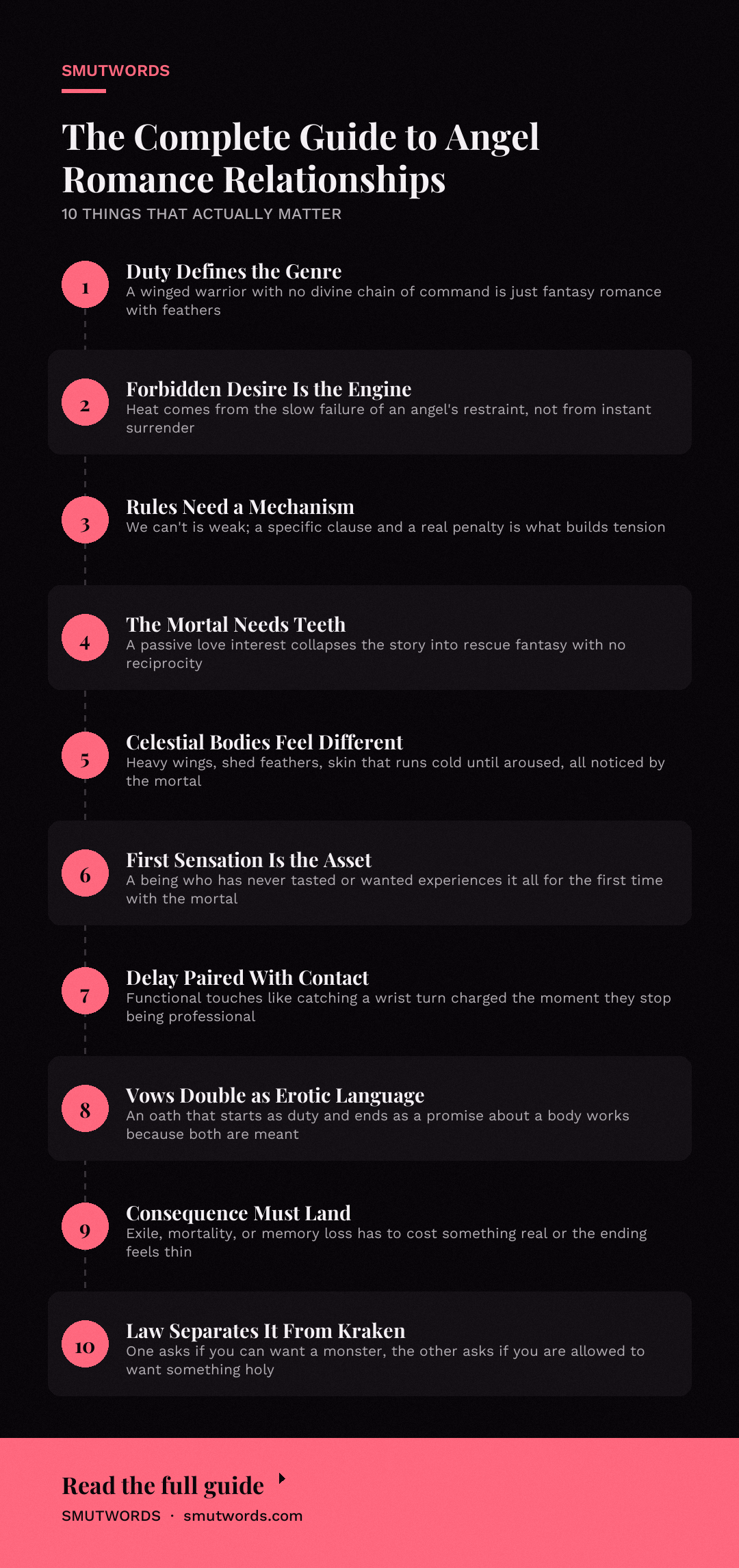
Specific rules. The divine law needs actual content. Not "angels are forbidden from loving mortals" but what happens when they do, who enforces it, how quickly, and whether the punishment can be negotiated. Vague rules produce vague tension.
A mortal with teeth. The love interest has to want, pursue, and occasionally push the angel past hesitation. A passive mortal makes the whole dynamic collapse into rescue fantasy with no reciprocity. If you like stories where the human sets terms and the powerful being has to keep up, the same appetite runs through the brat taming dynamic, just with a different power source.
Real consequence. Someone has to lose something. Fallen status, a mortal lifespan, a seat in the hierarchy, a memory. Books that threaten consequence and then quietly waive it in the final act feel thin, no matter how good the sex scenes were.
What Makes One Flat
The most common failure is treating the angel as a costume. Wings, a sword, a stern demeanor, no actual binding obligation. The second most common is making the mortal so fragile that the angel's desire reads as caretaking rather than lust.
A related problem: overcorrecting into purity language. Some writers lean so hard on "he was made of light and she was only flesh" that the mortal becomes an object lesson. Readers come to these books for mutual hunger, and the heat dies the moment one party is only a symbol.
There is also a pacing issue specific to this subgenre. Celestial courtship in fiction often runs long on grand declarations and short on physical escalation. The books that land build the physicality in stages, so the first time the angel takes off a glove matters as much as anything that happens in the final chapter.
Craft Notes From the Shelf
The single most effective technique in angel romance is delay with contact. The angel is allowed to touch the mortal constantly, because protection requires it, but only in ways that are functional: catching a wrist, standing between the mortal and danger, carrying an unconscious body. Every one of those professional touches becomes charged, and the reader tracks the moment a touch stops being professional.
The second most effective is vow language used erotically. Angels swear things. Oaths are their grammar. A vow that starts as duty and ends as a promise about a body is one of the genre's best tools, and it works because the angel means both versions literally.
If you like sacred obligation used as a restraint, the physical version of that idea shows up in cuffs, rope, and ties, and the two read well back to back.
Third: give the angel a tell. A wing twitch. A temperature drop. Eyes that go gold when the oath is strained.
Readers love a tell because it lets them read the angel's interior state before the mortal does, which is a small, delicious form of dramatic irony.
Angel Romance vs Kraken Romance
These two sit on the same shelf and get confused more often than you would expect, usually because both feature a nonhuman partner with a body that is dramatically wrong for the human one. The confusion is real, so it is worth separating.
Kraken romance runs on the monstrous and the abyssal. The love interest is ancient, tentacled, oceanic, and the eroticism leans on scale, grip, and the alien possibilities of a body with eight limbs. The conflict tends to be about the human accepting something visibly inhuman. If the tentacle angle is what's drawing you, our breakdown of tentacle creature romance goes deeper into how those stories handle the anatomy problem.
Angel romance inverts the axis. The celestial partner is beautiful, often painfully so, and the conflict is not disgust but law. The angel is forbidden, not frightening.
One subgenre asks whether you can want a monster. The other asks whether you are allowed to want something holy.
That difference shapes the entire plot. Kraken stories often move toward the human's acceptance and the creature's tenderness. Angel stories move toward a decision about obedience, and the tenderness has to survive a verdict.
Frequently Asked Questions
Is angel romance the same as fallen angel romance?
Fallen angel romance is one variant, not the whole category. In fallen angel stories the celestial partner is already exiled, so the central conflict shifts from "will they fall" to "what does the fall mean now." Guardian angel romance, by contrast, keeps the angel inside the hierarchy and makes the obedience the live wire.
Is angel romance always religious?
Rarely in a devotional sense. Most angel romance uses Christian and Jewish angelology as a borrowed mythology, the way fantasy uses Norse gods. The theology supplies stakes, hierarchy, and vocabulary. It is not usually making an argument about faith, and readers who are religious and readers who are not tend to enjoy it for the same structural reasons.
How explicit does angel romance get?
It spans the full range. Older traditionally published fallen-angel series were often fade-to-black. Contemporary independent angel romance frequently runs fully explicit, sometimes very much so. If heat level matters to you, check the content notes rather than the subgenre label.
Why is the forbidden angle so appealing?
Because it makes desire consequential. When wanting someone can cost them their place in the cosmos, every touch carries weight. Readers get a fantasy of being wanted so badly that a being with infinite alternatives and eternal patience breaks a rule that has held for millennia. For that being to choose you, specifically, is a very old and very durable fantasy.
What is a guardian angel romance, exactly?
The angel is assigned to the mortal, usually from birth or from a moment of crisis. Proximity is built into the premise, which gives the writer an easy way to keep the two characters together and a hard constraint on how physical things can get. The tension comes from doing a job and wanting the person you are doing it for.
Can angel romance be dark?
Yes, and some of the best examples are. Possessiveness, divine punishment, memory erasure, and the moral weight of a being who has killed on orders all fit the subgenre comfortably. The warmth of the subgenre is a ceiling, not a requirement. If you like nonhuman partners whose devotion runs possessive, the intensity here overlaps with what readers look for in the territorial shifter trope, though the justification is oath rather than instinct.
Final Thoughts
Angel romance lives or dies on the rule. Find a book where the divine law has an actual clause, a penalty, and someone willing to enforce it, and you have found the good stuff: a love story where a touch is a crime and both parties know it. Start with a fallen-angel book that keeps the hierarchy in the room even after the fall, because the ones that make the exile hurt are the ones worth rereading.








Loading comments…