
Erotic hypnosis trance is a power-exchange dynamic built on one adult guiding another into an altered, highly suggestible state and then using that state for arousal, obedience, or straight-up control play. In fiction it arrives as the mind-play scene: the hypnotist speaks, the subject drops, and desire stops feeling chosen. The erotic hypnosis trance trope turns suggestibility into foreplay and consent into something negotiated before the watch ever swings.
It overlaps with mind control, hypno play, hypnotic submission, and erotic mesmerism. It's also one of the most reliable engines in dark romance and speculative erotica, and it's been that for a long time.
What Erotic Hypnosis Trance Actually Means
The name is literal on both halves. Hypnosis is the induction and the trance state itself; erotic is what the scene does with it. The "trance" in the middle matters because it names the specific window of suggestibility the story cares about. A hypnotist and a subject, a voice and a drop, and then the play begins.
In practice, erotic hypnosis trance describes a dynamic where one consenting adult holds the psychological controls while another hands them over. The hypnotist sets the commands, the subject's body and responses follow, and the erotic charge comes from that asymmetry. The subject knows they are being led and chooses to be led. That's the engine.
What counts as this dynamic
- A formal induction (pendulum, vocal pattern, fixation, counting down) followed by a scene conducted inside the trance.
- Suggestion play that alters arousal, sensation, memory, or obedience while the subject is under.
- Triggers and post-hypnotic suggestions that fire after the trance ends.
- Deepener language and fractionation used to heighten suggestibility during play.
- A hypnotist/subject pairing where the power imbalance is explicitly psychological rather than physical.
What doesn't count
Possession, mind reading, and forced body control by aliens don't strictly count, though they borrow the same furniture. A story where the hypnotist genuinely removes the subject's ability to refuse is not erotic hypnosis trance in the consenting-adult sense. That's straight mind-control horror wearing the same coat.
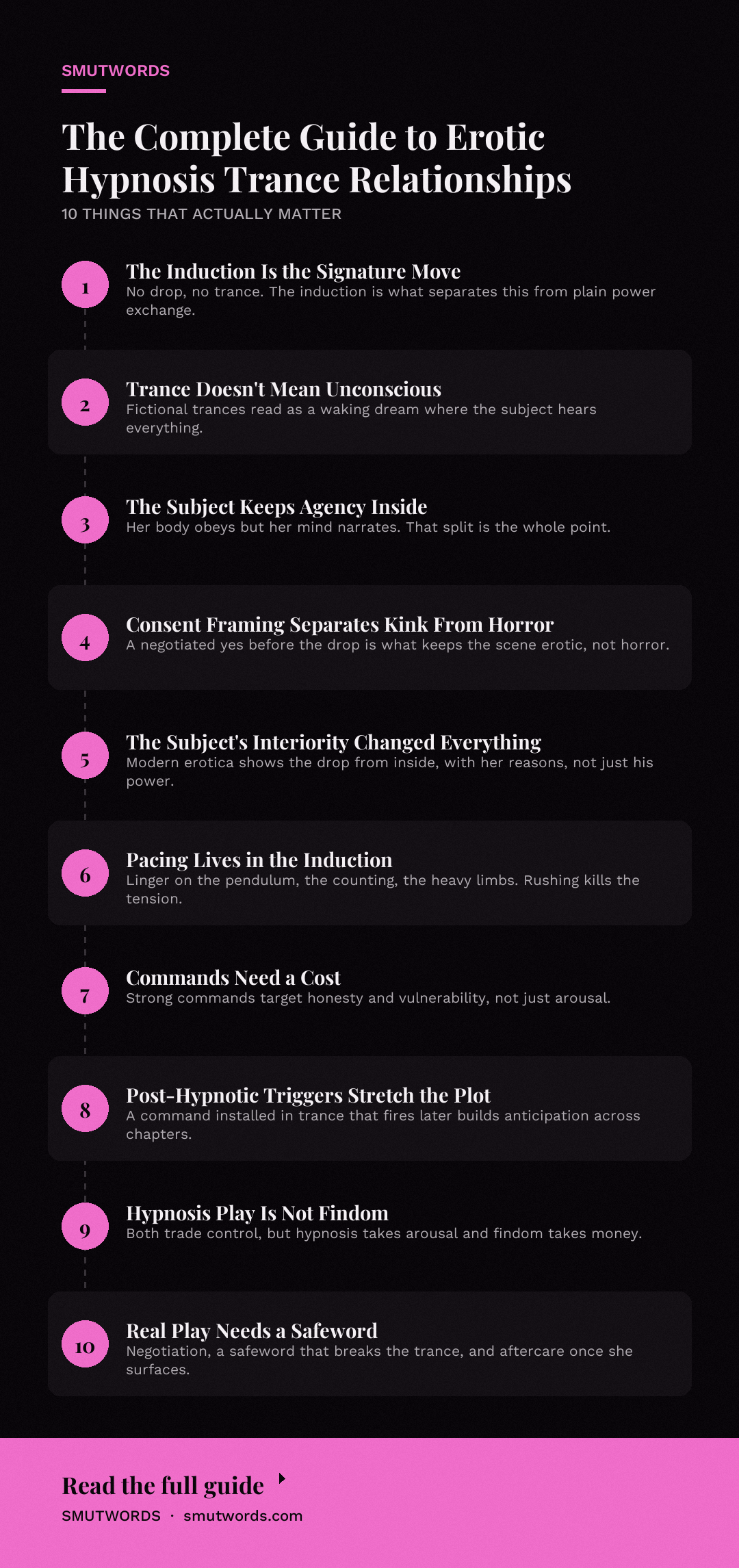
Romantic submission without any altered state also sits outside the term. If nobody drops, nobody is in trance, and the scene is just power exchange with a nice voice. The induction is the signature move.
Common misconceptions
The biggest one is that trance means unconsciousness. Fictional trances often read as a waking dream where the subject hears everything and simply cannot organize resistance. The second misconception is that hypnosis equals truth serum. Real hypnotic suggestion nudges perception and response; it doesn't override a person's core will.
Readers also tend to assume the hypnotist is always the dominant and the subject always the submissive. Plenty of stories play with a switch, a reluctant hypnotist, or a subject who engineered the whole drop to get what she wanted.
Where Erotic Hypnosis Trance Comes From
The hypnotist figure has been a fixture of gothic and sensation fiction since the nineteenth century, when mesmerism was a live parlor phenomenon and a live scandal. Stage magician and physician-mesmerist blurred together, and both became stock characters in fiction about dangerous influence. Erotic publishers noticed early. Hypnotic seduction turns up in Victorian underground writing and in the pulps that followed, usually with a Svengali-type figure and a beautiful subject who cannot help herself.
What changed is the subject's interiority. Older versions treated the trance as something done to a passive woman by a predatory man. Contemporary erotica flips the lens and shows the drop from inside: what suggestibility feels like, what the subject gets from it, and why she keeps coming back. The hypnotist is still powerful, but the subject is now a participant with her own reasons.
A second shift is the rise of consent-forward framing. Modern erotic hypnosis trance in published romance usually opens with an explicit negotiation, sometimes on the page, sometimes in the first act. The subject says yes to the drop before she goes under. That single beat is what separates the kink from the horror version, and readers have come to expect it.
The publishing history is thin on named authors because hypnosis erotica has lived mostly in indie romance, serial fiction, and short-story anthologies. The trope's real evolution happened in reader communities: forum threads, fanfic tags, and the steady appetite for mind-play scenes that cross genres. Today you'll find it in paranormal romance, sci-fi, dark contemporary, and even fairy-tale retellings, all using the same induction-and-command structure.
If you want a sense of how adjacent power-exchange tropes build their consent scaffolding, the guide to negotiating couple swapping lays out the same pre-scene conversation beats, and the complete guide to tantra sessions shows how altered-state intimacy gets written with that same deliberate pacing.
How It Shows Up in Erotica
A strong hypnosis scene does three things on the page: it builds the induction slowly, it makes the drop visceral, and it lets the commands do the erotic work. The craft lives in the pacing. Authors who rush to the trance lose the tension; authors who linger on the pendulum and the counting and the subject's heavy limbs earn it.
The induction
The induction is the foreplay. A fixation point, a counting-down pattern, a hand on the back of the neck, a voice that keeps repeating a phrase until the subject's breathing changes. Good scenes make the reader feel sleepy before the subject does. The best ones use rhythm on the sentence level, with short repetitions that mirror the hypnotist's cadence.
The drop
The drop is the sensory payoff. Authors describe the trance as heavy and warm, or as deep water, or as a room going quiet. The subject's thoughts slow down, the room recedes, and her awareness narrows to the voice.
This is where the prose has to slow down too. One sentence per beat, soft consonants, no clutter.
Enjoyed this? Get a free book.
Join the list and we will send a complete free story straight to your inbox, plus new releases every week after that. No credit card, no catch.
The commands
Inside the trance, the commands are where the erotic heat lands. A suggestion that her skin feels electric. An order to say something she'd never say awake. A post-hypnotic trigger that makes her knees go weak every time the hypnotist says a certain word.
The commands are often about arousal, but they're just as often about honesty, vulnerability, and cost, since suggestibility lets a character admit what she can't say in daylight.
The variations authors use most
- Clinical hypnosis: a licensed therapist crosses the line with a client, and the transgression is the tension. The breakdown of tutor/student romance covers the same forbidden-expert dynamic.
- Stage hypnotist: a performer pulls a volunteer from the audience and the commands get very personal. The public setting amplifies the heat and the humiliation.
- Post-hypnotic trigger: a one-time trance installs a command that fires weeks later, so the eroticism lives in the delayed payoff.
- Chosen submission: the subject asks to be hypnotized on purpose, aware of the risk, and the trance becomes a gift she gives herself.
- Pack or pack-like bonds: shifter and paranormal romances borrow the trance to intensify pack dynamics, where a dominant voice can pin a mate in place without touching her.
- Mind-play without a formal induction: a vampire, fae, or AI companion uses hypnotic phrasing to control a character's body, and the trance is literal magic dressed as suggestion.
What makes a strong version work
Strong erotica hypnosis trance scenes let the subject keep agency inside the surrender. Her body obeys, but her mind narrates, and that split between will and response is the whole point. She can hate how much she likes it and still say yes. The scene loses heat the moment she becomes a puppet with no internal voice.
Weak versions make the trance do all the work. If the subject has no reason to be there, the hypnotist is just a man with a pocket watch. The commands read like a grocery list.
Give the subject a motive. Give the hypnotist something to lose. Give the commands a cost.
There's also a real-world layer worth keeping in mind while reading or writing. Hypnotic suggestibility and trance states genuinely bend judgment, which is why real hypnosis play needs full pre-scene negotiation, a safeword that can interrupt the trance from inside, and aftercare once the subject surfaces. Authors who write that scaffolding in tend to produce scenes that feel more dangerous, not less, because the boundaries are clear enough to break interestingly.
Erotic Hypnosis Trance vs Financial Domination
Sexual mind control and financial domination share the same psychological spine: one person holds the controls, the other hands them over on purpose.
The difference is what gets surrendered. Hypnosis play takes over arousal, perception, and obedience; findom takes over money, with spending as the submission and the thrill living in voluntary depletion. Hypnosis can be currency-adjacent in fiction (a hypnotist who charges for sessions, a domination arrangement with hypnosis as the service), but the terms aren't interchangeable and readers looking for one can bounce hard off the other.
Frequently Asked Questions
What is erotic hypnosis trance?
It's a consenting-adult dynamic where one person guides another into a suggestible trance and uses that state for arousal, obedience, or power-exchange play. In fiction it usually shows as an induction, a drop, and commands that shape the subject's body and desire. The heat comes from the intimacy of one mind yielding to another.
Is erotic hypnosis the same as mind control?
In casual usage the terms blur, but they're not identical. Erotic hypnosis assumes a negotiated, consensual trance between adults with a way to call it off. Mind control is the broader fantasy, and it often drops consent or puts the power in magic or tech instead of a human hypnotist.
Do you need a hypnotic induction for a scene to count?
Most published versions include one, whether it's a pendulum, a counting pattern, or a verbally repeated phrase. Some authors imply the drop with sensory description alone. Without any induction or altered state the scene stops reading as hypnosis and becomes straight power exchange with a commanding voice.
What is a post-hypnotic trigger in romance?
A trigger is a command installed during trance that fires later, often outside the session. The subject hears a specific word or touch and her body responds before she can reason with it. Authors use it to stretch a single scene into a running plot thread and to build anticipation between sessions.
How does consent work inside a hypnotic trance?
Real hypnosis play requires negotiation before the session, a safeword that can break through the trance, and aftercare when the subject comes up. Fiction that skips the negotiation doesn't have to, but readers increasingly notice when it's missing. The consent framework is what lets the scene stay dark without tipping into horror.
Why do readers like hypnotist and subject stories?
They hit the same nerve as other mind-control fantasies: heightened vulnerability, spoken commands, and a subject who can't resist. The trance makes surrender feel involuntary even when it's chosen. It's an intimacy shortcut, and it lets a character be honest about what she wants without owning it out loud.
Final Thoughts
Erotic hypnosis trance lives or dies on pacing and consent scaffolding. Slow the induction, give the subject a voice inside the drop, make the commands cost something. If you're ready to see the dynamic done well, look for a hypnotist story where the subject asks for it on purpose and the trigger lands two chapters later.





Loading comments…