
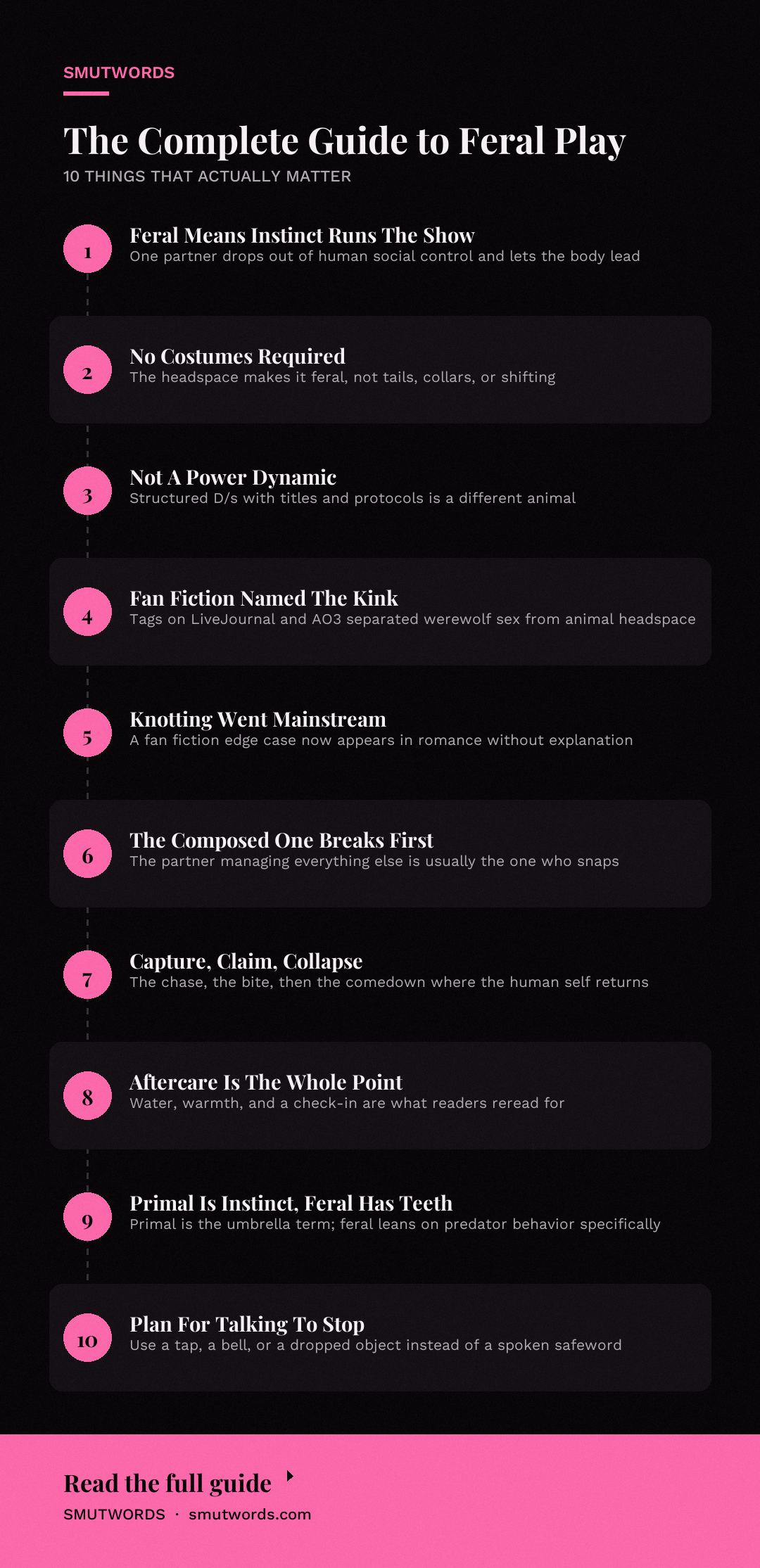
Feral play is a primal sex scene where at least one partner drops out of human social control and into an instinct-driven headspace: growling, biting, snarling, chasing, pinning, rutting. The body runs the show while the thinking mind steps aside.
In erotica, feral play usually signals a shift from negotiated seduction into raw physical need. That might mean two humans tearing at each other's clothes, or a shifter finally giving in to the animal half. It sits close to rough sex on the kink map, but the psychological texture is different.
The point isn't punishment or power exchange. It's the total loss of civilized restraint.
What Feral Play Actually Means
The word "feral" does most of the work here. It comes from the Latin fera, meaning wild beast, and English borrowed it to describe animals that escaped domestication or were never tamed at all. Applied to sex, it names a scene where a person stops performing humanity and starts operating on appetite.
That appetite is usually possessive and hungry rather than cruel. A feral partner wants to claim, mark, mount, and keep. Growling, snarling, biting, clawing, scenting, and circling are all part of the vocabulary. So is a certain loss of language.
A partner who normally narrates and negotiates in bed goes quiet, or drops into short animal sounds instead of sentences.
The headspace matters more than the props. Two people can have feral play with zero costumes, zero collars, and zero shifting. What makes it feral is the quality of the surrender to instinct, not the presence of a tail.
What counts as feral play
- Primal headspace. One or both partners describe thinking in urges instead of words, and the scene leans on that animal register.
- Predator and prey framing. Chasing, stalking, cornering, catching, or being caught all fit. So does the moment the "prey" turns and fights back.
- Animalistic physicality. Biting, scratching, gripping by the scruff, rutting, scenting, growling, whimpering.
- Loss of verbal control. Grunts, snarls, and broken syllables rather than clean dirty talk.
- A possessive charge. The feral partner acts like the other person belongs to them and has to be claimed or defended.
What doesn't count
Feral play is not the same as a power dynamic with rules. A structured dominant and submissive scene, with titles, protocols, and a leash, is a different animal. So is plain rough sex performed as athleticism with nobody changed by it.
It's also not the same as rough sex in every case, though the two overlap heavily. Rough sex can be playful and upright, performed with the full human personality present. Feral play requires the personality to step back.
Common misconceptions
The biggest one is that feral means out of control. It doesn't. It means the control moved from the thinking brain to an agreed script of intensity, and the safeword is still there underneath the growl.
The second is that feral play requires a monster or a shifter. Plenty of contemporary romance uses it between two ordinary humans who simply stop being polite about what they want.
The third is that it's always dominant-driven. In practice, a submissive partner can be the feral one. That reversal is one of the most reliable sources of heat in the whole trope.
Where Feral Play Comes From
Animalistic sex has been in erotic writing for as long as humans have written erotica. Ovid's metamorphoses gave the West its oldest durable image of a person crossing into animal form, and the werewolf has been a sexual figure since medieval folklore, always tied to appetite, night, and the loss of social standing. That's the deep root of the trope, and it never went away.
What's newer is feral play as a named, searchable, fan-organized kink inside romance and fan fiction. That happened in stages.
Fan fiction named the practice
In the late 2000s and 2010s, fan writers on LiveJournal and later Archive of Our Own needed tags that could distinguish "werewolf sex" from "sex where the character acts like an animal." The tag "primal play" appeared, and around it grew a body of writing about shifting, scenting, mating bites, and heats. Readers already knew the feeling. Now they had a word for it.
The word migrated into romance publishing once shifter romance became a commercial category of its own. Small digital presses and self-published authors proved there was a large, devoted readership for books where the hero is wild in bed and loyal outside it. Bigger publishers followed.
Knotting moved from fringe to mainstream
The knot is the clearest proof of how far the trope traveled. A decade ago, knotting lived at the edge of fan fiction, borrowed from actual canine anatomy and used as a shorthand for a bond that cannot be undone. Today it appears in mainstream monster and shifter romance without explanation, and knotting explained is a standard reference label in the genre's shared vocabulary.
Feral play and knotting grew up together, because both do the same emotional job. They make a physical act mean permanence.
Romance stopped apologizing for it
The other change is tone. Older paranormal romance often framed the animal side as a curse that the hero had to control, and the sex was about containment. Contemporary feral play, particularly in dark romance and omegaverse, often frames the animal side as honest. The beast has fewer lies in it than the man.
That flip is what gives the trope its current charge. The wildness isn't a defect the hero must beat. It's the reason the reader trusts him.
How It Shows Up in Erotica
On the page, feral play is a gear shift. Most scenes that use it well spend real space establishing order before tearing it up: fine clothes, formal rooms, careful manners, controlled conversation. The wildness has nothing to break if there's nothing civilized to break.
Once it starts, the prose usually changes shape. Sentences shorten. Dialogue thins out. Verbs take over.
A skilled author lets the meter get rougher as the characters lose their polish.
The mechanics authors use
The most common structural move is the moment of no return: a scent, a growl, a look held too long. The partner who crosses first is usually the one who's been managing everything else, which is why the scene lands. The composed one breaks first.
From there, the scene typically runs through capture, claim, and collapse. Capture is the chase or the pin. Claim is the biting, mounting, marking, and holding down. Collapse is the afterglow, where the human self comes back and the feral partner is often the one in need of soothing.
That final beat is where the best books separate themselves. A scene that ends on the wildness is titillating and forgettable. A scene that ends with a hand on a cheek, water, and a quiet check-in is the one readers reread.
Variations that recur
- Primal play between humans. No shapeshifting. Two people chasing and pinning each other because they agreed the rules are off.
- Shifter mating runs. The animal is literal. A run, a catch, and a bite that marks the bond.
- Predation and prey. One partner is stalked through a house, a forest, or a party, and the fear is part of the pleasure.
- Reversed feral. The quiet one snaps, usually after being cornered, and the partner who thought they were in charge gets hunted instead.
- Feral with power exchange underneath. The wildness is a drug the submissive partner consents to, and the dominant partner shepherds the comedown.
- Feral in a group. An orgy where the room stops being a social event and becomes a pack, with all the atmosphere that implies.
- Feral after forced restraint. A partner kept still and waiting for hours finally frees their hands, and the wildness is the release valve. The waiting half of that dynamic is its own craft, and the aftercare rules are worth knowing in advance.
Where feral play meets the shifter subgenre, the anatomy often goes further than the human baseline. The monster cock kink exists because readers want the claim to feel physically impossible to dismiss. Pairing that size difference with a feral headspace gives the scene a physical language for something emotional: this is bigger than I can argue with.
Enjoyed this? Get a free book.
Join the list and we will send a complete free story straight to your inbox, plus new releases every week after that. No credit card, no catch.
The instinct that drives all of these is a hunger to own and be owned. That hunger often shows up early in romance as a bond between people who are still telling themselves it's casual, like a friends with benefits arrangement. When the arrangement breaks, feral play is one of the gears the scene can drop into.
What separates a strong scene from a flat one
The strongest feral scenes are specific about the body. Cold air on the back of a neck. The sting of a bite through a shirt.
The strain in a wrist pinned to a mattress. Specificity does the work that generic growling can't.
The second marker is consequence. Something is different after the scene, and the characters know it.
They changed hands. They said the thing. They marked each other where a collar or a shirt might not hide it.
The weakest feral scenes do three things wrong, and they're easy to spot as a reader:
- The wildness is announced, not shown. The narration tells you a character has "gone primal" while the prose stays as tidy as a form letter.
- Nobody is transformed afterward. The scene is a set piece, not a turning point, and the next chapter picks up as if nothing happened.
- The aftercare is skipped. The scene ends mid-animal. It's hot in the moment and cold on reflection, because the reader knows what comedown needs.
A fourth failure is subtler. Some scenes push the feral partner into genuine cruelty and call it animal instinct. That's a mismatch.
In the best versions, the wildness is about honesty and appetite, not contempt. The partner who goes feral is the one who wanted too much to be polite.
Related craft rules from the gentler side of the same urge are useful wherever a partner loses the ability to speak. The vocabulary of praise, for instance, is what an author reaches for when the wild one needs to hear that they're good. That's the praise kink, and the two work as mirror images.
Authors who want a model for staging intensity also lean on the shape of escalation used in scenes where one partner keeps pushing past the other's limit, and the reader's understanding of who's actually in charge has to stay intact. That's the logic behind forced orgasm writing, and the same reasoning applies here. The wilder the scene looks on the surface, the more careful the construction underneath has to be.
Feral play also shows up as a move inside other tropes. Two colleagues who can't stop looking at each other can turn into a one night stand scene at the door, or run past the door entirely. A formal lesson can flip, collar to leash, claw to rope. Authors who mix in rope care often borrow techniques from shibari, using restraint as the thing the feral partner gets to strain against.
What makes the trope durable on the page is that it lets an author write desire without apology, then write tenderness in the aftermath. The reader gets the wreck and the repair.
Feral Play vs Primal Play
These two phrases show up in search bars together and get used interchangeably, so it's worth being clear. Primal play is the broader umbrella term, used in fan and kink circles for any scene built around instinct instead of language. It can include growling, scenting, nests, chasing, and wrestling without any animal transformation at all.
Feral play is a subset with more teeth. It leans on predator behavior specifically: hunting, cornering, pinning, biting, taking. A primal scene is about instinct. A feral scene is about instinct with a victim.
In practice, most books use both terms for the same scene without distinguishing, and readers rarely mind. The distinction is worth knowing if you're writing or tagging, because the word you choose tells a reader how much animal violence to expect.
Frequently Asked Questions
Is feral play the same as pet play?
No. Pet play is a roleplay with a handler and a pet, and it usually runs on rules, names, and ritual: collars, bowls, obedience, praise for a trick well done. Feral play runs on the absence of those things.
A pet has a keeper. A feral partner has a mate.
What's the difference between feral play and rough sex?
Overlap is high, and many scenes qualify as both. Rough sex describes the physical register: hard grip, hair-pulling, fast and forceful movement. Feral play describes the headspace, one or both partners running on instinct and dropping human polish. You can have one without the other.
Why do so many feral scenes involve biting or knotting?
Because both are physical marks that outlast the scene. A bite heals as a bruise or a scar. A knot locks two bodies together for a span they can't choose to end early. Both turn a moment of pleasure into a claim the characters have to live with afterward.
Does feral play require a safeword?
Yes, and it's one of the kinks where the safeword matters most. A partner who can't speak while feral needs a signal that doesn't rely on language, such as a tap, a bell, or a held object that gets dropped. Assume the talking will stop and plan for it.
What does aftercare look like after a feral scene?
The point of aftercare is helping a partner come back to the human self. Water, warmth, a blanket, a check-in, and language coming back slowly. The feral partner often needs to hear that they didn't go too far, which is why a few words of reassurance land harder than any gesture.
Can feral play be gentle?
It can end gently, and that's often the best version. The wildness itself will read as intense by definition, but the scene's real warmth lives in the slowing down: the growl fading into breathing, a hand loosening on a wrist, both people staying in the room.
Is feral play always dominant and submissive?
Not always, but the roles do appear in most scenes. One partner hunts and one is hunted. What changes from book to book is who ends up on top. The reversal, where the submissive partner is the one who snaps, is one of the most popular variations in the genre.
Final Thoughts
Feral play works because it gives characters a way to want each other past the point of politeness, then lets them come back and take care of each other. The chase is the hook. The quiet that follows is the reason people finish the book.
If you want a gateway into the trope, start with a shifter romance that takes the bond seriously enough to build real consequence around it, and pay attention to how the author handles the comedown. That's where the craft lives, and it's the part that keeps readers coming back.







Loading comments…