
Harem romance is a subgenre where one central character, almost always a woman, winds up romantically and sexually involved with a whole cast of partners who all know about each other, agree to the arrangement, and usually end up sharing a home and a life. The appeal sits in the arithmetic: more devotion, more variety, more people whose entire emotional world centers on her.
It's one of the fastest-growing corners of self-published romance, and it has its own rules, its own reader expectations, and its own particular craft problems that separate a harem romance that works from one that reads like a spreadsheet with feelings.
If you've searched for this term, you probably want more than the one-line definition. You want to know what counts, where it came from, how it actually functions on the page, and why some versions sing while others collapse under the weight of too many love interests and not enough personality. That's what this guide is for.
What Harem Romance Actually Means
The name borrows loosely from the historical harem: a household of women attached to one man, segregated from the outside world. Erotic romance flipped it. In the modern genre, the harem is usually a household of men (or a mixed group) attached to one woman, and crucially, it's chosen.
The historical harem implied ownership and confinement. The romance harem implies a woman deciding she wants all of them and building a structure where everyone consents.
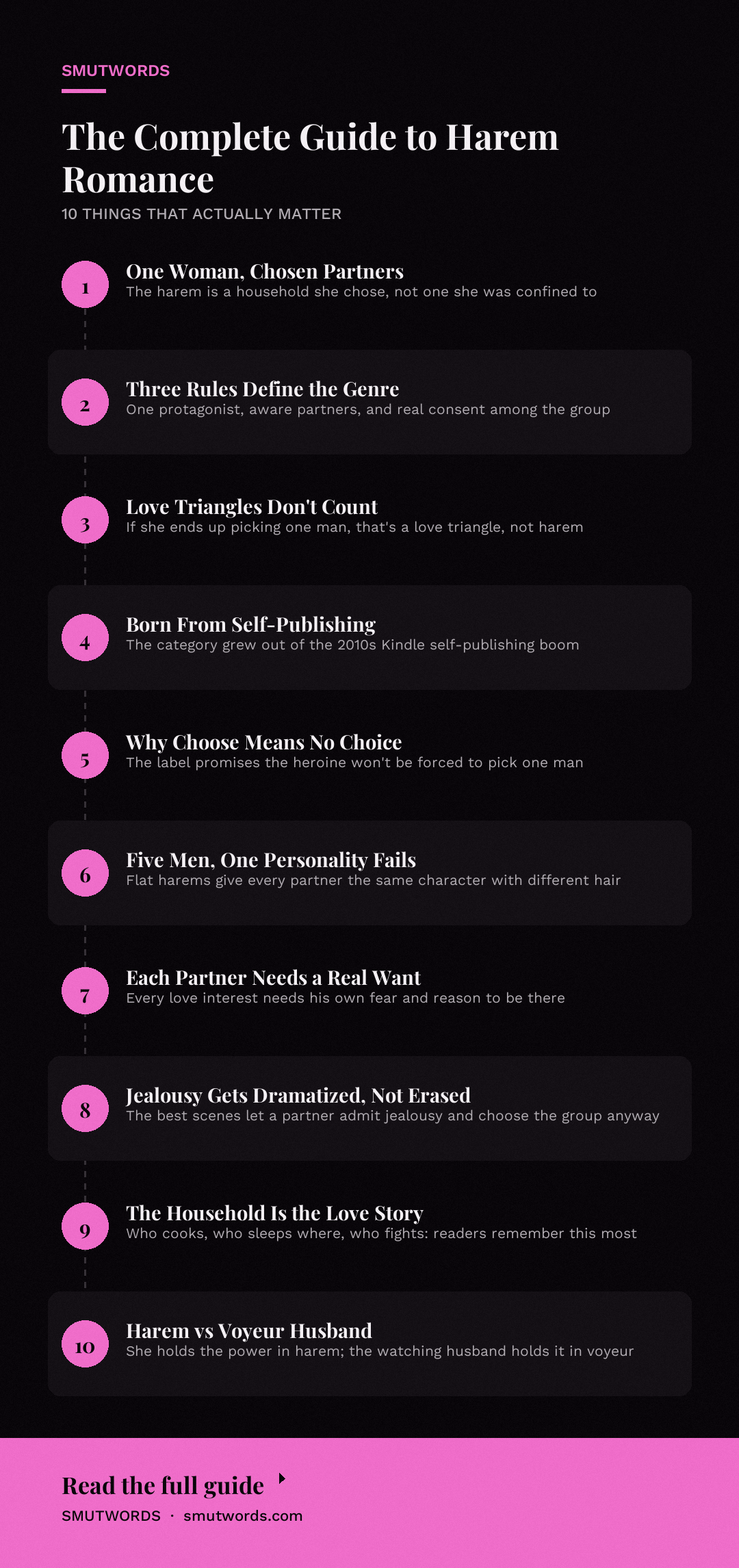
What counts as harem romance comes down to three conditions:
- A single protagonist at the center.
- Multiple romantic and sexual partners who are all aware of each other.
- Genuine consent and mutual agreement among the group, usually formalized at some point in the story.
Remove any of those and you're reading something else.
Here's what doesn't count, despite what the search results might tell you. A love triangle where the heroine eventually picks one man is not harem romance; that's a love triangle. A story where the men don't know about each other is cheating, and the genre treats it very differently. A single scene with multiple partners that doesn't develop into an ongoing arrangement is closer to an orgy scene inside a conventional romance.
Harem romance requires the group to persist, to become a unit, and to matter to the plot beyond one hot night. The most common misconception is that the term is interchangeable with every multi-partner story. It isn't. Readers are fierce about the distinction because they're reading for a specific emotional payoff: being wanted by everyone, with nobody left out and nobody betrayed.
Where Harem Romance Comes From
The publishing history here matters more than any real-world anthropology. Harem romance as a recognizable commercial category is a product of the 2010s self-publishing boom, especially on Amazon's Kindle store, where authors could publish fast, price low, and reach readers directly without a gatekeeper deciding the genre was too niche.
Japanese light novels and manga get partial credit. The "harem" genre in anime and manga, where a male protagonist accumulates female admirers, has existed since at least the 1990s and trained a generation of readers to accept the multi-partner premise. Western romance writers took that structure and reversed the genders, then added what anime harems often lacked: actual sex on the page and a real emotional conclusion.
The term "reverse harem" spread through reader communities on Goodreads and Facebook reader groups around 2016 to 2018, and the "why choose" label followed as authors and readers looked for a way to signal that the heroine wouldn't be forced to pick. That label matters because it tells the reader exactly which anxiety the book won't make them feel.
The evolution from "reverse harem" to "why choose" was partly a marketing shift and partly a revolt against the assumption that a woman with multiple partners needs to be punished for it by the ending.
What changed over time: early entries often ended with the heroine choosing one man, and readers hated it. The genre course-corrected. Now the expectation is a committed group, often with a shared home, sometimes a formal ceremony, and an ending where nobody gets discarded. The genre got more explicit, more polyamorous in its framing, and more interested in the logistics of an actual household rather than a fantasy that dissolves at the last chapter.
How It Shows Up in Erotica
Read enough of these books and you start to see the architecture. The heroine meets her men one at a time, each arrival adding a distinct flavor. One is the brooding protector, one is the sunshine one, one is the rival she can't stand until she can't stand not touching him.
The diversity of the cast is the point. Each partner delivers a different dynamic, and the reader gets the pleasure of watching the group negotiate how all those dynamics coexist. The strongest versions do what every good romance does with one person, multiplied and then complicated. Each love interest needs a real want, a real fear, and a real reason to be in this arrangement beyond the heroine being hot.
The flat versions give you five men with five hair colors and one personality between them. That's the failure mode, and it's the most common one.
Authors handle the sex in a few recognizable ways:
- Solo rotation. Each partner gets dedicated one-on-one scenes, often in a rotation, with group scenes saved for milestones. This is the most common structure and the easiest to make emotionally coherent.
- Shared scenes from the start. The group is intimate together early, which emphasizes the group as a unit rather than a series of pairings. Harder to write, because you need to track everyone's reactions and keep the focus legible.
- The slow integration. Partners join the physical relationship at different speeds, and the negotiation itself becomes the plot. This structure lives or dies on communication scenes.
The craft problems
First, the "slotting" problem: the reader needs to feel each partner matters, and any hint that one is a spare part kills the fantasy. Second, the consent paperwork problem. A harem is a group relationship, which means group negotiation, and authors who skip the negotiation end up with a scene that reads like coercion.
If you're writing this, look at how group marriage stories handle the formal commitment beat. The ceremony and the conversation before it do a lot of the consent work for you.
Third, the jealousy problem. A strong harem romance doesn't pretend jealousy is absent; it dramatizes it and resolves it. The moment a partner admits he's jealous and then chooses the arrangement anyway is often the most emotionally charged scene in the book.
Enjoyed this? Get a free book.
Join the list and we will send a complete free story straight to your inbox, plus new releases every week after that. No credit card, no catch.
Compare the way a possessiveness kink story uses jealousy as fuel rather than as a disease to be cured. Harem romance runs on that same engine, just spread across more people.
Fourth, physical variety. The genre leans hard on contrast between partners, and the anatomy of each love interest becomes part of the appeal. Some books make the range explicit, and the monster cock kink is often played for size contrast within the cast, or across the cast if it's a fantasy setting with nonhuman partners.
Fantasy harem books push this further, adding species variety and sometimes the literal duplication of a favorite partner through magic or science, which overlaps with the cloning kink in a way that readers either love or find deeply silly.
Fifth, the household. The best books in the genre eventually have to answer the boring questions: who sleeps where, who cooks, who gets the heroine tonight, what happens when two partners fight. Those scenes are where the genre earns its "chosen family" reputation. The domestic negotiation is the part readers remember, more than any single sex scene.
If you want a model for how detailed group logistics can be made emotionally rich, the ritual collaring ceremony breakdown shows how a formal commitment structure can anchor a story that would otherwise float free.
What a flat version looks like, concretely: the men exist only in relation to the heroine, they never interact with each other except competitively, the sex scenes are interchangeable, and the ending is a group hug.
What a strong version looks like: the men have relationships with each other, the reader could describe any two of them alone in a room, and the sex scenes are written by someone who understands that a group scene has a rhythm and a geometry, closer to choreography than to a single couple's push-pull.
If you want to see how a writer stages a group dynamic with real spatial and emotional logic, the gangbang guide is surprisingly useful for craft, because it forces you to think about how multiple bodies occupy a scene without turning into chaos.
Harem Romance vs the Voyeur Husband Trope
These two get confused because both involve a woman with multiple sexual partners, and both are often filed under the same taboo-adjacent shelf. The difference is structural. In harem romance, the woman is the center and the partners are chosen, equal-ish participants in a shared arrangement.
In the voyeur husband trope, there's a husband in the picture who is watching, usually orchestrating, and the erotic charge depends on his presence as the framing consciousness.
The power sits in different places. Harem romance gives power to the heroine who chose the group. The voyeur husband trope gives power to the husband who set the stage. A book can technically do both, but they pull in different directions, and readers looking for one are often disappointed when they get the other.
If the husband is directing the action, it's the voyeur trope. If the heroine is building a life with several partners, it's harem romance.
Frequently Asked Questions
What is the difference between harem romance and reverse harem?
They're the same genre. "Reverse harem" emphasizes the gender reversal from the anime and manga tradition, where one man accumulates female admirers. "Harem romance" is the broader, more widely used commercial label. Many authors use both terms on the same cover to catch different search traffic.
Does harem romance always have a happy ending with everyone together?
In the modern genre, yes, almost always. The defining promise is that the heroine doesn't have to choose and nobody gets discarded. Early entries sometimes ended with her picking one man, but reader backlash pushed the category toward the committed-group ending, which is now the expectation rather than a surprise.
Is harem romance the same as polyamory romance?
They overlap heavily but aren't identical. Polyamory romance can involve multiple partners regardless of gender and doesn't require one central figure. Harem romance specifies a single protagonist with a cast of partners orbiting her. The genre is usually polyamorous in its structure, but the label harem describes a particular shape.
What is "why choose" romance?
"Why choose" is a reader-facing label that signals the heroine won't be forced to pick between love interests. It's a marketing term that tells you the ending includes everyone. Authors use it alongside harem romance and reverse harem to reach readers searching specifically for the no-choice-required promise.
Can harem romance be dark or kinky?
Absolutely. The genre includes sweet contemporary versions, dark mafia and captive variants, and explicit kink-heavy fantasy entries. Keyholding and strap-on play show up in harem books regularly, since a group structure offers more partners to explore with. The strap-on play guide is worth reading if you want to see how a single act can be varied meaningfully across multiple partners rather than repeated.
Why are the men in harem romance often a diverse mix?
The variety is the appeal. Each partner offers a different dynamic, and the contrast between them (temperament, size, dominance, species in fantasy) creates the sense of abundance readers come for. Books where every partner reads the same fail quickly, because the whole point is the range of attention the heroine receives.
Final Thoughts
Harem romance works when the group becomes a real unit with real tensions and real domestic texture, and it fails when the cast is a checklist. If you want a book that gets the unit part right, start with one that treats the household itself as the love story.
The genre rewards authors who understand that a woman at the center of several devoted partners is only interesting if every one of those partners is interesting on his own. It rewards readers who know what they're looking for when a cover promises her everything.




Loading comments…