Keyholding is the arrangement where one person holds the keys to another person's chastity device, and with them, control over when that person is locked, unlocked, allowed release, or denied it. The locks are physical in some relationships and purely symbolic in others. Either way, keyholding in erotica is a power exchange made visible: a small piece of metal or a whispered permission standing in for who owns whose orgasms right now.
It has become one of the most reliable engines in kinky romance for one specific reason. Keyholding turns waiting into a plot. Every day locked, every release postponed, every "not yet" becomes a scene with stakes, and every unlocked moment lands harder because of it.
If you have been reading chastity dynamics in romance and wondering what the keyholder actually does, or you are writing one and want the mechanics to hold up on the page, this guide covers the whole thing: the definition, the genre history, the craft, and the practical safety that separates a hot scene from a bad one.
What Keyholding Actually Means
The name is literal. One partner wears a chastity device (a cage, a belt, a locked ring, whatever form the story uses), and the other partner keeps the key. The keyholder decides the schedule. They decide when the device comes off, whether release happens, and what has to occur first.
In broader usage, keyholding also covers arrangements with no hardware at all: a dominant partner who simply controls a submissive partner's orgasms by agreement, with the "key" as a metaphor for that authority.
What separates keyholding from adjacent kinks is the custody. Orgasm control is the umbrella term for deciding when someone comes. Tease and denial is the technique of keeping them close to the edge without letting them finish.
Keyholding is the specific structure where the denial is held by another person, often with a physical token that both parties can see and touch. The key is the point. It is a prop, a symbol, and a daily reminder in one object.
What counts as keyholding
- A chastity device locked by one partner, with the key kept somewhere the wearer cannot access.
- A verbal arrangement where one partner must ask permission before touching themselves or coming.
- A hybrid: physical device plus rule that release only happens in the keyholder's presence.
- Long-distance keyholding, where the key is mailed, hidden, or held by a third party at the keyholder's instruction.
- Symbolic keyholding, where a key on a chain or in a drawer represents authority that both partners honor without a working lock.
What does not count
Keyholding is not the same as a partner simply having a higher sex drive than you, or a lower one. It is not the incidental experience of wanting sex when your partner does not. It requires an explicit, agreed transfer of control over release, with both people aware of what they have signed up for.
It is also not inherently a humiliation kink, a cuckold arrangement, or a permanent lifestyle. Some keyholding relationships run for a weekend. Some run for years. The duration is a choice, and the best-written keyholding fiction makes that choice visible.
Common misconceptions
The biggest one is that keyholding means the keyholder is cruel or the wearer is suffering. In practice, the dynamic runs on mutual investment: the keyholder gets authority and attention, the wearer gets the sharpened anticipation of a release that has been earned.
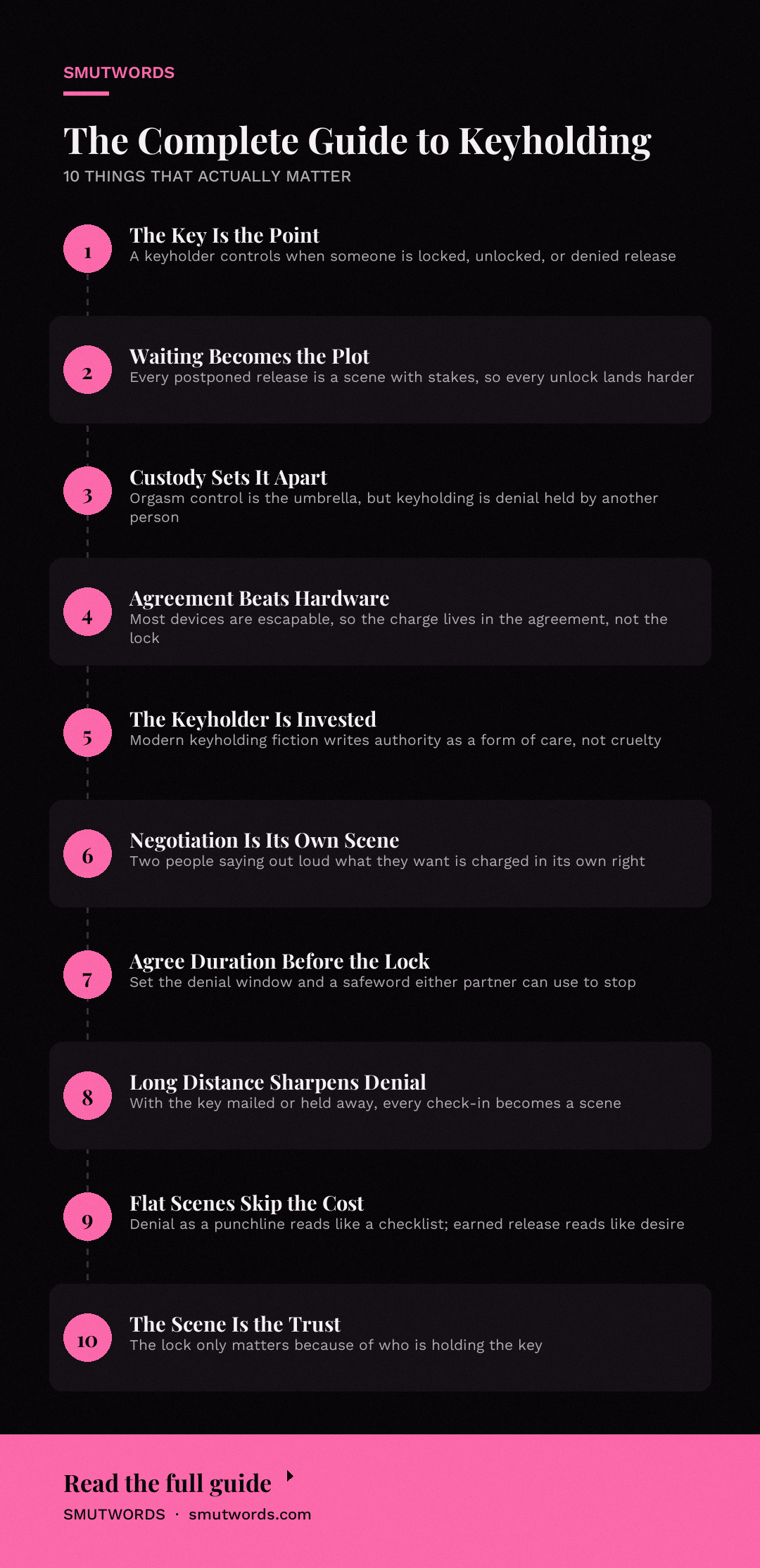
The other persistent misconception is that a chastity device is inescapable. Most are not, and the power in the dynamic lives in the agreement, not the hardware. That matters for how a scene reads on the page: a device the wearer could technically remove but doesn't is far more charged than one that traps them.
Where Keyholding Comes From
Chastity devices are old. Locking belts appear in European art and writing going back centuries, and their earliest documented uses were about guarding fidelity, usually in arrangements where a man controlled a woman's body. That history is worth knowing because it explains the iconography that erotica inherited: the belt, the lock, the absent key.
The keyholding dynamic as readers recognize it today is much younger. It took recognizable shape in the mid-twentieth century alongside the modern fetish press, and it inverted the older image. Instead of a jealous husband locking his wife away, the twentieth-century version increasingly put the key in the hands of a dominant woman controlling a man's access to his own orgasms.
Chastity moved from a symbol of ownership to a symbol of surrender, and the person holding the key became the center of the story.
In published erotica and romance, the term gained real traction in the 2000s and 2010s, tracking the general boom in explicitly negotiated power-exchange fiction. Early keyholding stories were often short, focused on the mechanics of the lock. As the trope matured, authors moved the tension off the device and onto the relationship: what it means to hand someone the key, what it means to be trusted with it, what happens when the schedule is interrupted.
How the genre's use of it has shifted
Three changes stand out. First, the keyholder used to be written almost exclusively as a cruel figure extracting obedience. Contemporary keyholding fiction, including a lot of it filed under dark romance, writes the keyholder as invested: their authority is a form of care, and the emotional weight sits in how carefully they use it.
Second, gender roles loosened. Male keyholders, female keyholders, and nonbinary keyholders all appear now, and the dynamic is written from either side.
Third, and most importantly for the trope's popularity, authors started pairing keyholding with long-form romance plots. The key becomes a slow-burn device: a first lock, a negotiated extension, a moment where holding the key starts to feel like a promise rather than a game. That shift is why the trope graduates from short kink fiction into full novels.
How Keyholding Shows Up in Erotica
Keyholding scenes run on delay, ceremony, and negotiation. The device itself is rarely the hottest part of the page. The hottest part is the moment the key turns, or the moment it doesn't. What makes the trope work is the gap between wanting release and being denied it, and how a good author fills that gap with tension instead of filler.
The negotiation scene
Strong keyholding fiction nearly always includes the setup: what rules apply, how long the lock stays on, what counts as a safeword, and how either person ends the arrangement without guilt. That negotiation is not paperwork. It's a flirtation scene in its own right, because two people saying out loud what they want is deeply charged.
Enjoyed this? Get a free book.
Join the list and we will send a complete free story straight to your inbox, plus new releases every week after that. No credit card, no catch.
The practical rule that most responsible authors put in explicitly: agree the duration of denial before the lock goes on, and keep a safeword that either partner can use at any time to end the control immediately and without a fight. A scene that skips this tends to read as unsafe rather than hot, and readers notice.
Common variations authors use
- The long-distance key. The keyholder is absent or away, and the wearer's release is controlled by text, calls, or visits. This is one of the easiest variations to write and one of the most effective at building slow-burn tension.
- The public key. The key sits on a necklace or in a pocket, visible to people who don't recognize it. The wearer knows, and that shared secret is the scene's engine.
- The ruined release. The keyholder unlocks, allows the wearer to get close, then stops. This lands best when the wearer has been denied for a stretch, because the ruin echoes the buildup.
- The shared key. A third person holds the key on the keyholder's behalf, adding a layer of control and often a jealousy subplot. This pairs naturally with the voyeur husband trope, where a partner watches rather than participates.
- The ceremonial unlock. Release is a formal event, sometimes with a small ritual. Authors who like ritual texture can borrow from the mechanics of a collaring ceremony and adapt the formality to a key.
- The permanent keyholding. The lock becomes a standing feature of the relationship, and the story moves to how the couple manages it over time.
Why it works on the page
Keyholding gives a scene a built-in clock. The reader knows release is coming eventually, so every page between the lock and the unlock carries anticipation. It also gives the couple an excuse for constant low-level contact: checking in, asking permission, sending photos of the device, discussing the schedule. That texture is what makes the relationship feel alive.
And the key is a great physical object. A key can be worn, hidden, lost, stolen, or handed back in a moment of huge emotional weight. Few props in kink fiction carry that kind of portability and symbolism at once.
Writing the key itself
If you are writing keyholding, spend time on the object itself. Where does the key live when it's not in use? Who made it? Is it on a chain the keyholder wears all day? Those small choices do more work than any description of a lock.
What a flat keyholding scene looks like
Flat versions treat denial as a punchline. The keyholder just says no a few times, then relents, and the scene ends. There's no negotiation, no physical detail, no sense of what the wearer has actually given up. Those scenes read like checklists.
Strong versions show the cost and the trust. The wearer's frustration is written as desire, not as an obstacle. The keyholder's decisions are shown to be careful. When release finally comes, it feels earned, which is exactly the appeal readers come to keyholding for: the sense that the intimacy was paid for, not simply handed over.
Pairing with other tropes
Keyholding sits comfortably beside several kinks and tropes that already appear across the genre. If you are writing a scene where marking or scars play a role, the difference between scar fetish and marking kink becomes useful vocabulary. Keyholding can also be written alongside possessive dynamics, and the guide to possessiveness kink covers how a partner's need to hold on translates into rules, including ownership of a key.
For readers who like a group dynamic rather than a two-person lock, the why choose romance structure lets several partners share or compete for keyholding responsibilities, which changes the emotional math entirely.
Keyholding vs Orgasm Control
These two terms get used interchangeably often enough that the distinction is worth spelling out, because it changes how a scene reads. Orgasm control is the broad kink: one person decides when another is allowed to come, with or without a device. Keyholding is a specific, structured version of orgasm control where the authority is held as a tangible trust, usually with a physical key or a standing arrangement that mimics one.
A scene where a dominant partner says "not tonight" is orgasm control. A scene where the submissive partner hands over the key and knows the lock stays on until Friday is keyholding.
The key adds formality, visibility, and a prop both partners can reference in dialogue. If you are writing erotica and want the lighter, more improvisational version, orgasm control is the better term. If you want the ceremonial, structured version with a clear object of custody, keyholding is doing the work.
Frequently Asked Questions
What is keyholding in a relationship?
It is an agreed dynamic where one partner controls access to the other's chastity device or sexual release. The keyholder sets the schedule, and the other partner consents to follow it. The control can be physical, symbolic, or both.
What is a keyholder in chastity?
The keyholder is the person who keeps the key and decides when the wearer is locked, unlocked, or allowed to finish. In fiction and in practice, the role is usually written as attentive rather than cruel, with authority held as a form of trust.
Is keyholding the same as orgasm control?
No. Orgasm control is the general kink of deciding when someone comes. Keyholding is a structured version of it, usually with a physical token and a standing agreement. Every keyholding dynamic is a form of orgasm control, but not every orgasm control arrangement involves keyholding.
How long does a keyholding arrangement usually last?
There is no standard duration. Arrangements range from a single evening to years-long relationships. What matters is that the duration is agreed in advance by both partners and that either person can end it at any time using a safeword, without guilt or argument.
Can keyholding be done long-distance?
Yes, and it is one of the more popular variations in erotica. The key can be kept or mailed away, and the rules communicated by text or call. Long-distance keyholding works well in fiction because absence sharpens the denial and makes every check-in a scene.
What is a safeword in keyholding, and why does it matter?
A safeword is an agreed word either partner can use to stop or pause the dynamic immediately. In keyholding it matters because the person in the device cannot easily end the arrangement themselves, so the safeword has to be reliable for both people and honored without negotiation in the moment.
Final Thoughts
Keyholding earns its place in the genre because it makes a small object carry a large promise. The best stories know the real scene is the trust, not the hardware. The lock only matters because of who is holding the key.
If you want a book to read next, find one built around a long negotiated arrangement and a long-distance key, where the denial gives the characters room to fall for each other between unlocks. That is the trope at its fullest, and it shows you why readers keep coming back.




Loading comments…