
Pirate romance is a love story set on or around the open sea, where at least one lead lives outside the law: a pirate captain, a privateer working a shaky royal commission, a smuggler, or a rogue who has traded a respectable life for a ship and a bad reputation.
The genre runs on forced proximity, since there is nowhere to storm off to on a ship, plus treasure, betrayal, sea battles, and a hero who answers to nobody until he answers to her. If you came here for the real definition and not a three-line blurb, this is the whole map.
What Pirate Romance Actually Means
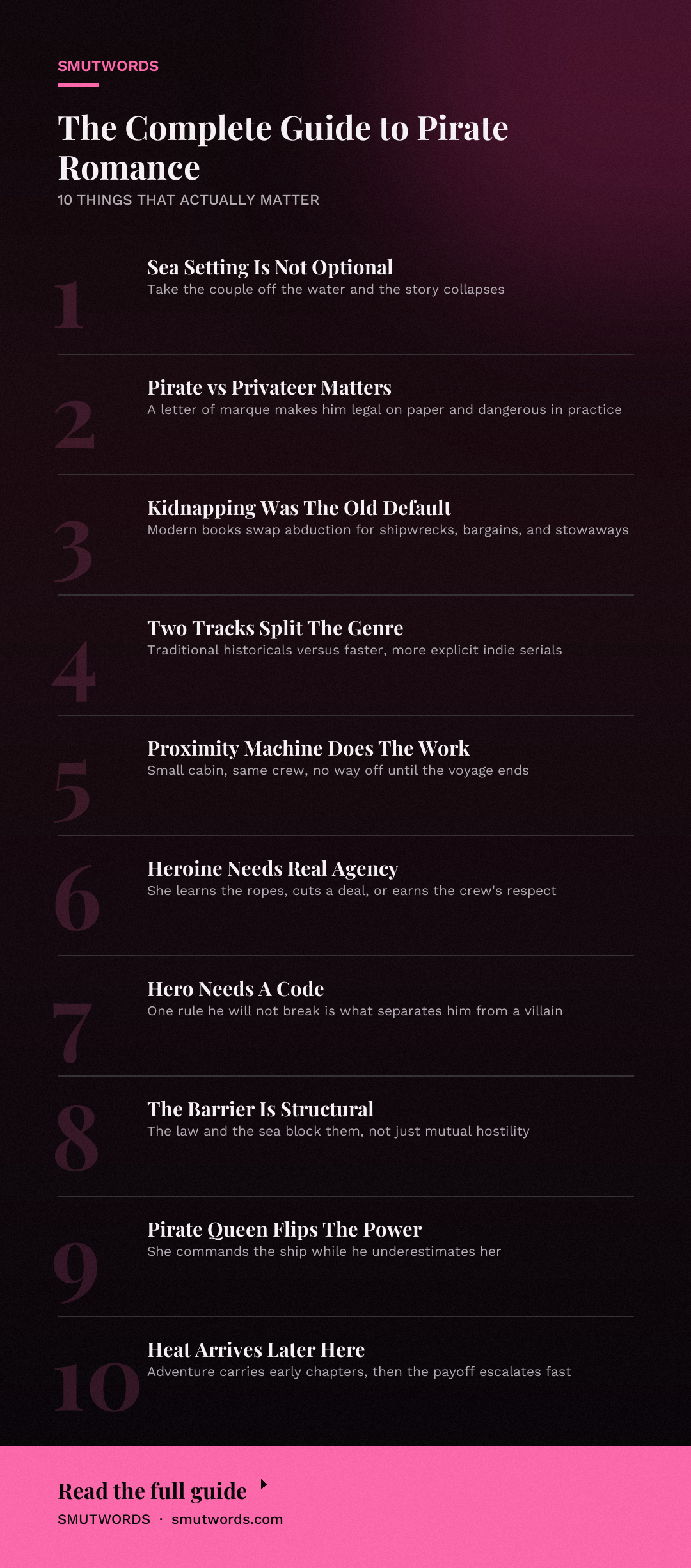
The term covers any romance novel where piracy, privateering, or nautical outlawry is central to the plot rather than set dressing. The ship matters, the lawlessness matters, the isolation matters. Take the couple out of the maritime world and the story collapses. That's the simplest test for whether a book belongs here.
It helps to know who the leads usually are. The most common pairing is a pirate captain and a woman pulled into his world by capture, shipwreck, a bargain, or a debt. She is frequently a lady, a governor's daughter, a merchant's widow, or a woman disguised as a sailor. Less common but growing fast is the pirate queen, where the woman commands the ship and the man is the one out of his depth.
Piracy here is a specific flavor of outlaw. A bandit on land can vanish into a forest or a crowd. A pirate is trapped on a wooden island with the same thirty people for months, which is why the trope leans so hard on proximity and pressure. There is no courtroom, no sheriff, and no escape hatch.
Privateers deserve their own note because they sit in a gray zone the genre loves. A privateer holds a letter of marque, meaning his government calls him a patriot while the other side calls him a thief. That single document lets an author write a hero who is technically legal and morally flexible, and it has fueled a huge share of pirate romance for two centuries.
What counts
- A pirate, privateer, or smuggler as a lead, with the sea as a real setting rather than a backdrop.
- Shipboard life shaping the plot: watches, rations, storms, cramped quarters, no privacy.
- A power imbalance that gets tested as the couple learns each other.
- Some form of plunder, pursuit, or naval conflict driving the middle act.
What does not count
A contemporary romance about a billionaire with a yacht is not pirate romance. Nor is a historical where the hero once sailed and now lives quietly on land. The outlaw life has to be active during the story.
Another common misfile: any book with a ship on the cover. Plenty of naval historicals and sea adventures have a romance subplot without ever being romance novels, and plenty of romance novels use a harbor town without ever leaving the dock.
Misconceptions worth clearing up
First, pirate romance is not one historical era. The golden age of piracy, roughly 1650 to 1730, supplies the classic version, but authors set these books in the Regency, the Victorian period, and invented fantasy worlds with the same ease. The 1980s wave leaned heavily on the Caribbean; modern books wander everywhere.
Second, the trope is not automatically dark. There is a whole spectrum from frothy comedic caper to brutal captivity story, and readers who love one end often hate the other. If you see a content note, read it.
Third, the hero is not always a hero. Some of the best-loved pirate leads do genuinely terrible things in chapter one and spend the book earning their way back, which is where the redemption arc romance structure does a lot of quiet lifting.
Where Pirate Romance Comes From
Pirate stories existed in pulp form long before romance claimed them. The trope as a romance genre staple really starts with the twentieth-century historical romance boom, when publishers figured out that a rugged sea captain on a cover sold copies by the crate. The 1970s and 1980s were the peak: thick paperbacks, clinch covers, kidnapping plots, and heroines who talked back.
Those early books leaned hard on captive and captor dynamics, sometimes in ways modern readers find rough. The heroine was frequently abducted, occasionally coerced, and almost always married by the final page. The genre had not yet separated dark romance from mainstream romance, so a lot of it reads as intense now.
The 1990s and 2000s brought a correction. Authors started writing pirate heroines who chose the sea instead of being dragged onto it, and publishers began marketing pirate books to readers who wanted adventure with their heat rather than dread. The kidnapping plot did not vanish, but it stopped being the default.
The last fifteen years split the trope into two thriving tracks. Traditional historical pirate romance kept its period detail and its measured pacing. Meanwhile indie publishing built a much smuttier, faster, more explicit version, often serialized, often with cliffhangers, and often sold through subscription reading programs. That split matters for anyone studying the genre, and it is the same divide covered in Going Wide vs Kindle Unlimited for Erotica Authors.
Fantasy romance also absorbed piracy wholesale. Books with invented archipelagos, magic tides, and sea witches now sit comfortably next to straight historicals, and readers rarely distinguish between them when browsing. Pirate is a vibe and a set of constraints more than it is a date on a calendar.
How It Shows Up in Erotica
On the page, pirate romance is a proximity machine. Authors get two people into a small cabin and then refuse to let either of them leave, which is why the trope produces such reliable slow burns. Every shared watch, every storm, every wound that needs tending is a chance to raise tension without a single sex scene.
The physical details do enormous work here, and strong authors know it. Salt, tar, wet rope, damp wool, the creak of the hull at night, the smell of gunpowder after a fight. A flat pirate book describes a ship. A good one makes you feel the roll of the deck under your feet while the hero is pinning the heroine against a mast.
Power is the other engine. The captain gives orders and expects them obeyed. The heroine either defies him, bargains with him, or outranks him in some way he did not anticipate. That friction is the entire point, and it is why pirate romance overlaps so heavily with hate to love and enemies-to-lovers plotting.
Common variants authors use
- Pirate and lady. The classic. A woman of standing ends up aboard, whether by capture, shipwreck, or a deal she made to escape a worse fate.
- Pirate queen. She commands. He is her prisoner, her navigator, her rival captain, or the naval officer who hunted her.
- Privateer and spy. A letter of marque plus a hidden agenda, usually with one lead lying about their identity the whole first act.
- Captive and captor. The darkest version. High intensity, high risk, and heavily dependent on how the author handles consent.
- Enemies on the water. Two crews, two captains, one prize. The rivalry is professional before it turns personal.
- Second chance at sea. Former lovers reunited on a voyage, with an old betrayal still unaddressed.
- Sea fantasy. Invented world, magic, sirens, or curses, with the pirate structure intact.
One recurring plot device deserves its own mention: the long separation. A pirate can be lost at sea, presumed dead, or imprisoned for years, which sets up the kind of reunion that also powers secret baby plots. It is a cheap trick and it works every time.
Revenge drives a surprising number of these books. The captain is hunting the man who sank his ship, killed his crew, or sold out his family, and the heroine is either the target's daughter or the one person who can help him get close. That structure borrows directly from revenge romance, and it gives the middle act a spine when the proximity tension alone starts to sag.
Enjoyed this? Get a free book.
Join the list and we will send a complete free story straight to your inbox, plus new releases every week after that. No credit card, no catch.
What makes a strong version work
A good pirate romance gives the heroine real agency inside an unequal situation. She may be stuck on the ship, but she is not passive about it. She learns the ropes, cuts a deal, hides a weapon, or earns the crew's respect. Readers forgive a lot of captivity plotting when the woman is clearly doing something.
The hero needs a code, even a broken one. A captain with no lines at all is just a villain with a ship. Give him one rule he will not break, whether it is never harming a child, never breaking a promise, or never abandoning his crew, and the whole character snaps into focus.
Strong versions use the maritime world as a constraint, not decoration. Storms create forced decisions. Limited fresh water creates conflict. Naval patrols create deadlines.
A weak version puts the couple in a generic room and calls it a cabin.
Finally, heat placement matters. Pirate books often delay the first sex scene longer than other subgenres because the adventure plot can carry the early chapters, then escalate fast once the couple crosses a line. Readers who want the payoff sooner should look at the faster indie end of the market.
If you write in this space, keep an eye on platform rules, because explicit piracy-era captivity content sits closer to the line than most subgenres. The practical details are in What Amazon Actually Allows for Erotica: A Practical Guide.
Pirate Romance vs Enemies to Lovers
These two get conflated constantly, and the overlap is real. Most pirate romances are also enemies-to-lovers stories, because the leads usually start on opposite sides of a conflict. The difference is what supplies the obstacle.
In a pure enemies to lovers book, the barrier is the couple's history and mutual hostility. In pirate romance, the barrier is structural: the law, the sea, the crew, the ship's destination, the fact that he is a wanted man and she has a family name to protect. Even if they liked each other on page one, the world would still be in the way.
That is why pirate romance can survive a couple who never truly hate each other. The setting supplies enough pressure on its own.
Strip the enemies-to-lovers element out of a pirate book and it would still work. Strip the maritime constraint out and there is no book. If you want to see the protective-hero version of that dynamic pushed to its limit, the protective hero trope is where a lot of pirate captains actually live.
Frequently Asked Questions
Is pirate romance always historical?
No. The golden age of piracy supplies the most popular setting, but authors write pirate romance in the Regency, in space, and in invented fantasy worlds with their own archipelagos. The trope needs ships and outlaws, not a specific century.
Are pirate romance heroes always morally gray?
Mostly, yes. The appeal is a man who breaks the law but keeps a personal code, which lands him squarely in gray territory. Some books push him all the way to dark, and those usually carry content warnings.
What is the difference between a pirate and a privateer?
A pirate operates outside any law. A privateer holds a government commission, called a letter of marque, that makes his plundering legal on paper. In romance, privateers let authors write a hero who is dangerous but not technically a criminal.
Does pirate romance require a kidnapping plot?
Not anymore. Captivity was the default in the 1970s and 1980s, but modern books use shipwrecks, bargains, stowaways, shared missions, and business arrangements just as often. The forced proximity is required, the abduction is optional.
Can the woman be the pirate?
Absolutely, and pirate queen stories have grown fast. She commands the crew, and the hero is often a naval officer, a rival captain, or a prisoner who underestimates her. The power dynamic flips and the rest of the trope holds.
How explicit does pirate romance get?
It spans the full range. Traditional published historicals usually keep sex on the page but not graphic, while indie pirate romance can be extremely explicit, sometimes serialized across several installments. Check the heat level before buying.
Why does the ship setting matter so much?
Because it removes every escape route. On a ship, the couple cannot avoid each other, cannot call for help, and cannot leave until the voyage ends. That enforced closeness is what makes the slow burn feel earned instead of contrived.
Final Thoughts
Pirate romance works because it puts two people in a wooden box on the ocean and refuses to open the lid. The law cannot reach them, the crew is always watching, and the only way off is through each other. It is a small, airtight machine, which is why it has survived two centuries of publishing trends without needing a reboot.
If you want to see the trope done with a heroine who fights for her own ship instead of waiting to be rescued, start with a pirate queen title and work backward into the classics. Watch how the first chapter traps her. That is the moment the whole book lives or dies on.








Loading comments…